Showing posts with label Father Son and Holy Spirit. Show all posts

Saturday, August 3, 2024

Lo, I am with you always, even to the end of the age

 
 Now while they were going, behold, some of the guard came into the city and reported to the chief priests all the things that had happened.  When they had assembled with the elders and consulted together, they gave a large sum of money to the soldiers, saying, "Tell them, 'His disciples came at night and stole Him away while we slept.'  And if this comes to the governor's ears, we will appease him and make you secure."  So they took the money and did as they were instructed; and this saying is commonly reported among the Jews until this day.  

Then the eleven disciples went away into Galilee, to the mountain which Jesus had appointed for them.  When they saw Him, they worshiped Him; but some doubted.  And Jesus came and spoke to them, saying, "All authority has been given to Me in heaven and on earth.  Go therefore and make disciples of all the nations, baptizing them in the name of the Father and of the Son and of the Holy Spirit, teaching them to observe all things that I have commanded you; and lo, I am with you always, even to the end of the age."  Amen.
 
- Matthew 28:11-20 
 
Yesterday we read that after the Sabbath, as the first day of the week began to dawn, Mary Magdalene and the other Mary came to see the tomb where Christ had been buried.  And behold, there was a great earthquake; for an angel of the Lord descended from heaven, and came and rolled back the stone from the door, and sat on it.  His countenance was like lightning, and his clothing as white as snow.  And the guards shook for fear of him, and became like dead men.  But the angel answered and said to the women, "Do not be afraid, for I know that you seek Jesus who was crucified.  He is not here; for He is risen, as He said.  Come, see the place where the Lord lay.  And go quickly and tell His disciples that He is risen from the dead, and indeed He is going before you into Galilee; there you will see Him.  Behold, I have told you."  So they went out quickly from the tomb with fear and great joy, and ran to bring His disciples word. And as they went to tell His disciples, behold, Jesus met them, saying, "Rejoice!"  So they came and held Him by the feet and worshiped Him.  Then Jesus said to them, "Do not be afraid.  Go and tell My brethren to go to Galilee, and there they will see Me."
 
  Now while they were going, behold, some of the guard came into the city and reported to the chief priests all the things that had happened.  When they had assembled with the elders and consulted together, they gave a large sum of money to the soldiers, saying, "Tell them, 'His disciples came at night and stole Him away while we slept.'  And if this comes to the governor's ears, we will appease him and make you secure."  So they took the money and did as they were instructed; and this saying is commonly reported among the Jews until this day.   My study Bible comments that this lie about the disciples stealing Christ away is absurd.  The disciples were afraid and had all gone into hiding.  Moreover, most of them went on to suffer terrible persecution and martyrdom.  It's simply unthinkable that they would have willingly endured such sufferings over a known fallacy.
 
Then the eleven disciples went away into Galilee, to the mountain which Jesus had appointed for them.  When they saw Him, they worshiped Him; but some doubted.  And Jesus came and spoke to them, saying, "All authority has been given to Me in heaven and on earth."  Here Christ declares that the authority that was His by nature in His divinity is now possessed by His glorified human nature.  My study Bible adds that this human nature has now trampled the final enemy -- which is death (1 Corinthians 15:20-28).  
 
"Go therefore and make disciples of all the nations, baptizing them in the name of the Father and of the Son and of the Holy Spirit, . . . "  This statement by Christ is called the Great Commission.  It is our Lord's final commandment given on earth.  My study Bible says that it is to be lived out in the Church until Christ returns again.  To make disciples cannot be done in the strength of human beings, but only in the power of God.  The power of the Resurrection is not simply for Jesus Himself, but it is given to all believers for Christian life and mission.  

" . . . baptizing them in the name of the Father and of the Son and of the Holy Spirit, teaching them to observe all things that I have commanded you; and lo, I am with you always, even to the end of the age."  Amen.  My study Bible comments that Christ Himself is present in each believer and in the Church always, both personally and in the Holy Spirit, because neither can be separated from the other.  To the end of the age, my study Bible says, does not by any means imply that we will be separated from Christ at the end of the world.  He is with us now, and forever, and unto the ages of ages.  Amen.

It is truly remarkable to consider that, from Christ's words here, so many countless generations and people have been inspired to follow His last command.  But even more important is the understanding that He is with us always.  My study Bible comments that the power of the Resurrection is not simply for Jesus Himself, but it is given to all believers for Christian life and mission.  So the power of God's creation, of life and renewal, is with us also.  In Revelation 21:5 we read that the One who sat on the throne, who is Christ in His risen authority, says, "Behold, I make all things new."  In the verbal tense of the Greek, this is literally translated, "I am always making all things new."  And this is truly the power of Resurrection present with Christ at all times in our lives.  It is the power to remit sins, to repent ("change of mind"), to be transfigured and transformed in the light of Christ and through the power of the Holy Spirit.  And we should not forget, either, that where One Person of the Trinity is, all are present.  Since Christ's death and Resurrection, the world has changed immeasurably due to the life given to us by Christ.  We cannot count the ways in which His life, death, and Resurrection has given us the foundation of life as we know it, and the things that we value and perhaps take for granted.  As we go forth in faith, we should have confidence that Christ is still at work, within us and among us, and that so long as the world exists, it will be so.  While we may witness things and events in the world that terrify or scandalize, we must keep in mind that Christ Himself has also prophesied for us that such things will continue to the end of the age.  What is important is keeping our faith, continuing to worship, and practicing our faith by living faithfully, by doing the things that He has taught.  So long as life continues, so will this mission of the Church -- and of each one who makes up the Body of Christ -- in each facet of life, from the great to the small.  We don't need to live "grand" lives for this to be so, for Christ's power works through the small and the weak (see 2 Corinthians 12:8-10).  Effectively, throughout the centuries of Christian life, it is simplicity that enables us to most clearly see our way through the grace of God we may perceive, and such has been the pursuit of those monastics who have dedicated their lives to Christ, and through constant prayer.  In applying these teachings to our present time, let us consider the proliferation of images to imitate and consume with which we are constantly bombarded, especially through the internet.  We don't always know the influences present to us and to our children, we don't always understand clearly whatever manipulative messages and techniques may be used.  But we can be assured, through our own emphasis on prayer and worship -- and on the power of simplicity and humility and truth -- that we will find our way properly for the gospel to be preached and to be lived.  Our lives are still intertwined with the power to be always making all things new, the life, death, and Resurrection of Christ -- and His glorified human nature, so that we may follow, unburdened of sin and death and to enter into and participate in His glorious life.  Let us not live by appearances, but by an understanding that it is through this power that our lives in this world are transfigured, transformed, and that grace is always present to us in our lives.  Ultimately, all authority is invested in Christ.   Let us rely upon our faith.  


Saturday, July 30, 2022

All authority has been given to Me in heaven and on earth

 
 Now while they were going, behold, some of the guard came into the city and reported to the chief priests all the things that had happened.  When they had assembled with the elders and consulted together, they gave a large sum of money to the soldiers, saying, "Tell them, 'His disciples came at night and stole Him away while we slept.'  And if this comes to the governor's ears, we will appease him and make you secure."  So they took the money and did as they were instructed; and this saying is commonly reported among the Jews until this day.  

Then the eleven disciples went away into Galilee, to the mountain which Jesus had appointed for them.  When they saw Him, they worshiped Him; but some doubted.  And Jesus came and spoke to them, saying, "All authority has been given to Me in heaven and on earth.  Go therefore and make disciples of all the nations, baptizing them in the name of the Father and of the Son and of the Holy Spirit, teaching them to observe all things that I have commanded you; and lo, I am with you always, even to the end of the age."  Amen.
 
- Matthew 28:11-20 
 
Yesterday we read that after the Sabbath, as the first day of the week began to dawn, Mary Magdalene and the other Mary came to see the tomb.  And behold, there was a great earthquake; for an angel of the Lord descended from heaven, and came and rolled back the stone from the door, and sat on it.  His countenance was like lightning, and his clothing as white as snow.  And the guards shook for fear of him, and became like dead men.  But the angel answered and said to the women, "Do not be afraid, for I know that you seek Jesus who was crucified.  He is not here; for He is risen, as He said.  Come, see the place where the Lord lay.  And go quickly and tell His disciples that He is risen from the dead, and indeed He is going before you into Galilee; there you will see Him.  Behold, I have told you."  So they went out quickly from the tomb with fear and great joy, and ran to bring His disciples word.  And as they went to tell His disciples, behold, Jesus met them, saying, "Rejoice!"  So they came and held Him by the feet and worshiped Him.  Then Jesus said to them, "Do not be afraid.  Go and tell My brethren to go to Galilee, and there they will see Me."
 
 Now while they were going, behold, some of the guard came into the city and reported to the chief priests all the things that had happened.  When they had assembled with the elders and consulted together, they gave a large sum of money to the soldiers, saying, "Tell them, 'His disciples came at night and stole Him away while we slept.'  And if this comes to the governor's ears, we will appease him and make you secure."  So they took the money and did as they were instructed; and this saying is commonly reported among the Jews until this day.  My study Bible calls this lie simply absurd, in that Christ's disciples were afraid and had gone into hiding.  Moreover, most of the disciples went on to suffer terrible persecution and martyrdom.  It is unthinkable, my study Bible says, that they would willingly endure such sufferings over a known fallacy.  

Then the eleven disciples went away into Galilee, to the mountain which Jesus had appointed for them.  When they saw Him, they worshiped Him; but some doubted.  And Jesus came and spoke to them, saying, "All authority has been given to Me in heaven and on earth."  My study Bible notes that Christ declares that the authority that was His by nature in His divinity is now possessed by His glorified human nature.  This human nature has now trampled the final enemy -- death (1 Corinthians 15:20-28).  

"Go therefore and make disciples of all the nations, baptizing them in the name of the Father and of the Son and of the Holy Spirit, teaching them to observe all things that I have commanded you . . . "  This is the Great Commission, and it is the Lord's final commandment given on earth.  It is to be lived out in the Church until He returns again.  To make disciples cannot be done in the strength of human beings, but only in the power of God.  The power of the Resurrection is not only for Jesus Himself, but we should understand it as given to all believers for Christian life and mission.  
 
 " . . . and lo, I am with you always, even to the end of the age."  Amen.  My study Bible says that Christ Himself is present in each believer, and in the Church, always -- both personally and in the Holy Spirit, as neither can be separated from the other.  To the end of the age, ti says, does not by any means imply that we will be separated from Him at the end of the world.  As the Church's prayers so often indicate and remind us, Christ is with us now, and forever, and unto the ages of ages.  Amen.  

Jesus tells the disciples, "All authority has been given to Me in heaven and on earth."  My study Bible notes something extraordinary and unexpected, but understood in the Church since ancient times:  that this authority that was always His by virtue of His divine identity as Son has now come to be shared even with the human Jesus, who has ascended in His full identity as Son of Man and Son of God, so that even His humanity is transfigured.  The implications for we human beings were never lost on the early Church, as it came to grips with the understanding of the implications of this ascent into heaven of both humanity and divinity in Christ.  My study Bible elaborates that this glorified human nature now means that Christ's power can work in us, in our lives, and in what we do:  in the name of the Father, Son, and Spirit disciples can be made in the world.  The power of God is at work in and among human beings in its transforming and powerful capacities for healing and setting aright:  we can come to faith through grace, the power of Resurrection is at work for all of us, in all of us.  In a modern frame of mind, we tend to perceive these things only individualistically.  But the implication isn't just for believers as individuals, but for the body of the Church as a corporate entity.  The many saints and stories of God's glory at work in us and among us testify to a "great cloud of witnesses," a whole body of traditions that feed us, an ongoing expression of Resurrection through the myriad saints and saintly acts of grace and experiences of God's uplifting power in so many dimensions, ongoing into the future, and at work around the world.  Sometimes it seems that this "corporate" or "community" sense of who we are is lost in debates and dissension, and a very individualistic sense of faith that results.  But we should not forget that what each one does becomes a part of the whole and touches on the whole.  We are not saved alone, but our faith works through both love of God and love of neighbor, and grace does not just touch one, but ripples out in ways that we just don't know -- perhaps only in the love that touches our hearts so that we in turn may touch others through our own changes.  There really is no such thing as one person praying alone without those prayers somehow effectively serving the world, even if unknown to the one who prays.  In our dissension and disagreements with one another, in the midst of a world engulfed by strife and seemingly ever-growing conflict, let us believers consider that our faith does not make us alone, but a part of something, and that as we practice that faith it is also up to us to be concerned with how we create community as well.  A modern world seems to lose sight of Christ's great emphasis on humility and serving one another, and that the core of what we know of God is love.  St. Paul writes what is perhaps the greatest statement on love in his Epistle to the Corinthians (found at 1 Corinthians 13:1-13).  Among other things, he writes, "Love suffers long and is kind; love does not envy; love does not parade itself, is not puffed up; does not behave rudely, does not seek its own, is not provoked, thinks no evil; does not rejoice in iniquity, but rejoices in the truth; bears all things, believes all things, hopes all things, endures all things."  He reminds us that "love never fails" but that everything else we value will pass away, and that now we know in part, but in the fullness of the Resurrection, we will know just as we are also known.  So therefore, what abides is "faith, hope, love, these three; but the greatest of these is love."  In John's Gospel, Jesus gives a new command, that we love one another as He has loved us.  He taught, "By this all will know that you are My disciples, if you have love for one another" (see John 13:34-35).  Let the transfiguring power of Resurrection be made clear in our understanding of love and community, and the great truth of Jesus Christ, God and human, who came to offer us all salvation.   Let us remember that He is with us always, and call upon Him to teach us His love.


Saturday, September 12, 2015

This is My beloved Son, in whom I am well pleased

El Greco - The Baptism of Christ, 1597-1600, Museo National Del Prado,  Madrid, Spain

Then Jesus came from Galilee to John at the Jordan to be baptized by him.  And John tried to prevent Him, saying, "I need to be baptized by You, and are You coming to me?"  But Jesus answered and said to him, "Permit it to be so now, for thus it is fitting for us to fulfill all righteousness."  Then he allowed Him.  When He had been baptized, Jesus came up immediately from the water; and and behold, the heavens were opened to Him, and He saw the Spirit of God descending like a dove and alighting upon Him.  And suddenly a voice came from heaven, saying, "This is My beloved Son, in whom I am well pleased."

- Matthew 3:13-17

Yesterday, we read that in those days John the Baptist came preaching in the wilderness of Judea, and saying, "Repent, for the kingdom of heaven is at hand!"  For this is he who was spoken of by the prophet Isaiah, saying:  "The voice of one crying in the wilderness:  'Prepare the way of the Lord; make His paths straight.'"  Now John Himself was clothed in camel's hair, with a leather belt around his waist; and his food was locusts and wild honey.  Then Jerusalem, all Judea, and all the region around the Jordan went out to him and were baptized by him in the Jordan, confessing their sins.  But when he saw many of the Pharisees and Sadducees coming to his baptism, he said to them, "Brood of vipers!  Who warned you to flee from the wrath to come?  Therefore bear fruits worthy of repentance, and do not think to say to yourselves, 'We have Abraham as our father.'  For I say to you that God is able to raise up children to Abraham even from these stones.  And even now the ax is laid to the root of the trees.  Therefore every tree which does not bear good fruit is cut down and thrown into the fire.  I indeed baptize you with water unto repentance, but He who is coming after me is mightier than I, whose sandals I am not worthy to carry.  He will baptize you with the Holy Spirit and fire.  His winnowing fan is in His hand, and He will thoroughly clean out His threshing floor, and gather His wheat into the barn; but He will burn up the chaff with unquenchable fire."

 Then Jesus came from Galilee to John at the Jordan to be baptized by him.  And John tried to prevent Him, saying, "I need to be baptized by You, and are You coming to me?"  But Jesus answered and said to him, "Permit it to be so now, for thus it is fitting for us to fulfill all righteousness."  Then he allowed Him.   In Matthew's Gospel, John knows Jesus immediately as Christ.  My study bible says that Jesus doesn't need purification.  But by making the purification of humanity His own, He would wash away humanity's sin, grant regeneration, and reveal the mystery of the Holy Trinity (in the verses further on).  Therefore, His baptism was necessary for the fulfillment of God's righteous plan of salvation.  Gregory of Nyssa writes, "Jesus enters the filthy, sinful waters of the world and when He comes out, brings up and purifies the entire world with Him."

When He had been baptized, Jesus came up immediately from the water; and and behold, the heavens were opened to Him, and He saw the Spirit of God descending like a dove and alighting upon Him.  My study bible says that the Spirit of God hovered over the water at first creation in Genesis 1:2.  Here, the Holy Spirit comes in the form of a dove to anoint the Messiah, the Son of God, at the beginning of the new creation.  Jesus has always been the Son of God, but today it's revealed to the world, via this baptism that "fulfills all righteousness."  The Holy Spirit has always rested upon Him.  In the East, the Epiphany celebrated January 6th, commemorates this day.  For the earliest Christians and some communities today like the Armenian Apostolic Church, Christmas or Nativity was celebrated together with this day, the birth of Jesus' public ministry. Epiphany (or Theophany) means "Revelation," as not only is Jesus revealed as Son of God, but more truly God is revealed in the Trinity -- the Son, the Spirit, and the Father's voice.

And suddenly a voice came from heaven, saying, "This is My beloved Son, in whom I am well pleased."   This quotation is from Psalm 2:7: "You are My Son, / Today I have begotten You."  The Trinity is revealed:  the Father speaks; the Holy Spirit descends, the Incarnate Son is baptized.

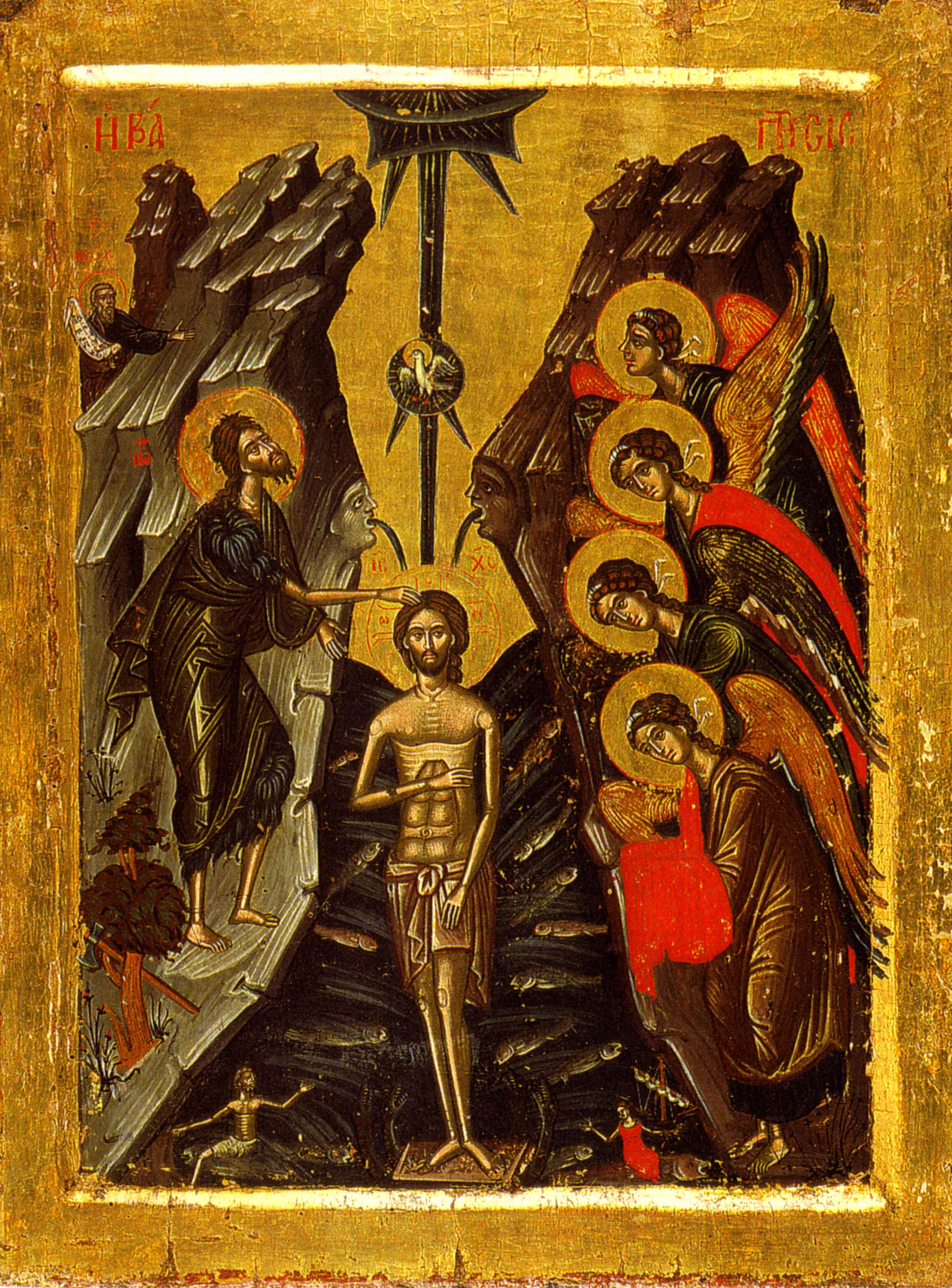
Jesus fulfills all righteousness by submitting to a baptism that He doesn't really need for sins.  In the earliest Church, tradition has it that Jesus' baptism in the Jordan blessed all the waters of the world, making them ready for Christian baptism with water and the Spirit.  If we look at some icons of the Baptism, there are fish swimming in the water, and the whole icon teems with life and the whole of creation (see this icon, in a not-very-good photo taken by me at the Byzantine Museum in Athens, Greece, in which the golden fish show with great vibrance).  There is also the presence of angels, and in some there are small figures representing the waters, the Jordan and the sea.  (See this icon, with the tiny male and female figures at the bottom right and left of Jesus, and four angels standing on the riverbank opposite John the Baptist).   They are meant to express Psalm 114:3:  "The sea saw it and fled; the Jordan turned back."  All of creation is to be made whole with this baptism, made to fulfill all righteousness, in which Christ blesses the waters of the whole world, that feed everything, and the angels rejoice and are ready to minister and serve He who is the Son.  This is the beginning of Jesus' ministry to the world, and the revelation of the Trinity.  But it is we and everything else in all of creation who are included in this gift for us.  Jesus was always Son, this is a gift of love for the world.  And all the elements of the world represented (such as the Jordan and the sea) must serve Him as Lord.   But what is the manner in which this Son is revealed, this Lord of all the elements of creation?  It is His humility in submitting to baptism by John, although John knows who He is and will in turn say, "He must increase but I must decrease."  In this sense, baptism -- a voluntary death to rebirth symbolized by the covering of the waters -- is consistent with His crucifixion, another act of humility that will "fulfill all righteousness" for the world, another gift via Incarnate Son.  Everything our gracious Lord does is for giving a gift to us, anointing the whole of creation with love.  We can't forget Jesus' final words at the Ascension:  "Go into all the world and preach the gospel to every creature."  It's more truly translated, "go everywhere" and preach the gospel "to all the creation."   All of creation is involved in this baptism, this gift, for all.   Above, I've put another image of the Baptism, by El Greco, displaying a universe of life given a greater life in abundance in Jesus' baptism.  (Click the picture to see it larger.)  Even the water at Jesus' feet stirs and glows with a hidden light and life, and golden fish, which show us the abundance of life He promises -- every creature, all of creation, is somehow involved.


Saturday, August 4, 2012

"I am with you always, even to the end of the age"

Now while they were going, behold, some of the guard came into the city and reported to the chief priests all the things that had happened. When they had assembled with the elders and consulted together, they gave a large sum of money to the soldiers, saying, "Tell them, 'His disciples came at night and stole Him away while we slept.' And if this comes to the governor's ears, we will appease him and make you secure." So they took the money and did as they were instructed; and this saying is commonly reported among the Jews until this day.

Then the eleven disciples went away into Galilee, to the mountain which Jesus had appointed for them. When they saw Him, they worshiped Him; but some doubted. And Jesus came and spoke to them, saying, "All authority has been given to Me in heaven and on earth. Go therefore and make disciples of all the nations, baptizing them in the name of the Father and of the Son and of the Holy Spirit, teaching them to observe all things that I have commanded you; and lo, I am with you always, even to the end of the age." Amen.

- Matthew 28:11-20

In yesterday's reading, we read about the events at the tomb on the first day of the week, the day after the Sabbath. Mary Magdalene and the other Mary came to see the tomb. There was a great earthquake, for an angel of the Lord descended from heaven, and came and rolled back the stone from the door, and sat on it. His countenance was like lightning, and his clothing was as white as snow. The guards were terrified. The angel said to the women, "Do not be afraid, for I know that you seek Jesus who was crucified. He is not here; for He is risen, as He said. Come, see the place where the Lord lay. And go quickly and tell His disciples that He is risen from the dead, and indeed He is going before you into Galilee; there you will see Him. Behold, I have told you." The women ran with great joy to tell the disciples, but on the way Jesus met them, saying, "Rejoice!" So they came and held Him by the feet and worshiped Him. Then Jesus said to them, "Do not be afraid. Go and tell My brethren to go to Galilee, and there they will see Me."

Now while they were going, behold, some of the guard came into the city and reported to the chief priests all the things that had happened. When they had assembled with the elders and consulted together, they gave a large sum of money to the soldiers, saying, "Tell them, 'His disciples came at night and stole Him away while we slept.' And if this comes to the governor's ears, we will appease him and make you secure." So they took the money and did as they were instructed; and this saying is commonly reported among the Jews until this day. The Gospel tells us once again about truth and manipulation, a life based around appearances versus the acceptance of truth. Whatever we may say about this story, it serves once again as an example of what Jesus condemned the most: the hypocrisy of living through manipulation of appearances, and the lawlessness that lives in anyone who "loves and makes a lie," who cannot love truth.

Then the eleven disciples went away into Galilee, to the mountain which Jesus had appointed for them. When they saw Him, they worshiped Him; but some doubted. And Jesus came and spoke to them, saying, "All authority has been given to Me in heaven and on earth." My study bible says, "This is the terminology of exaltation and glorification. It manifests the power of His resurrection, and the authority to bring human beings back to life." Jesus is now the Risen Christ, the almighty. This is the fruit of the "grain of wheat fallen into the ground." It is a universal fruit, a yield of cosmic proportion.

"Go therefore and make disciples of all the nations, baptizing them in the name of the Father and of the Son and of the Holy Spirit, teaching them to observe all things that I have commanded you." My study bible tells us here that "if we observe this context for the Lord's command to make disciples of all the nations and to baptize them in the name of the Father and of the Son and of the Holy Spirit, we see that making disciples cannot be done in the strength of man, but only in the power of God. The reality of the Resurrection refers not only to its historicity, apostolic witness, and necessity for faith, but also to its power in our Christian life and mission. The resurrected Son of God, living in us and energizing us, makes possible the salvation of all." In this message, Christ teaches His disciples what they must now do. It's the time in which we await His return, and we have a job to do if we are His disciples. There's really no limit to this teaching, this commandment that Jesus gives. There's no limitation on "make disciples of all nations." There's also no limit on "all things" -- Jesus' words and teachings can't really be taken out of context. We can't have the message of one command or another, one teaching or another, without the full context of His messages of love and comfort, and of His sacrifice nor His Resurrection. All are a part of the package we inherit, and we learn, in which we all share. Lest we doubt, the power that is behind all these things and these commands the disciples are given isn't limited to the ministry alone, but consists of Father, Son and Holy Spirit. In this baptism, which immerses us in a spiritual death and Resurrection, we are claimed for the cosmic powers that rule this Kingdom: Father, Son and Spirit.

"And lo, I am with you always, even to the end of the age." Amen. Here's the promise, the personal promise Jesus gives them and us. My study bible teaches us: "By saying He is with you always, Jesus means His Resurrection is neither of the past, nor of the future. It is always present in our lives through the Holy Spirit. We know Him directly, here and now, in the present, as our Savior and our Friend. To the end of the age does not by any means imply that we are to be separated from Him after that great consummation. He is with us now, and ever, and unto the ages of ages. Amen."

So we end the Gospel of Matthew. It began with a genealogy, giving us a picture of the history of Israel. All hope is in this Messiah. But He comes to us as a Messiah not only for Israel but for all the world, for the "people of God." Here His command teaches us what that means, that there is no limit on discipleship nor on ministry, that all the cosmic powers of heaven are within this ministry and this baptism of those who would be God's people, that all things He taught and commanded are a part of discipleship. Jesus is risen to a cosmic reality, the fullness of a Kingdom, within which we live and work and have life, within which there is ministry and discipleship -- and there is no limit to this discipleship nor this ministry. That's really simple, isn't it? There is no limit to this ministry of what we might do, where we might go, what we might learn of His commandments and teachings for ourselves and for our lives. So, if you look about today for what it is that you are called to do, remember this: that in this teaching is all the power of Father and Son and Spirit, and in the fullness of this Kingdom is all authority in heaven and on earth. When you turn to Christ, who is with us always, even unto the end of the age, remember what and to Whom you turn. You turn to that which is unlimited, to that which unblocks every path, sets all who would be free out of every spiritual prison, claims for itself all the disciples of every nation who would be part of the Kingdom of God. When you ask, "What do I do?" remember the Power you are asking, the unlimited power at work in the answer you may be given. "And lo, I am with you always, even to the end of the age." His love is always with us.


Thursday, May 17, 2012

All authority has been given to Me in heaven and on earth

Christ Pantocrator, 6th century, St. Catherine's Monastery, Mt. Sinai
Then the eleven disciples went away into Galilee, to the mountain which Jesus had appointed for them. When they saw Him, they worshiped Him, but some doubted. And Jesus came and spoke to them, saying, “All authority has been given to Me in heaven and on earth. Go therefore and make disciples of all the nations, baptizing them in the name of the Father and of the Son and of the Holy Spirit, teaching them to observe all things that I have commanded you; and lo, I am with you always, even to the end of the age.”

- Matthew 28:16-20

Today is Ascension Day, the day we commemorate Jesus’ ascension into heaven. In the Eastern church, Jesus is exemplified as Pantocrator, the Resurrected Christ. Pantocrator means Almighty; the One for whom “all authority has been given to Me in heaven and on earth.” The icon, above, is the earliest surviving icon of Pantocrator, from St. Catherine’s monastery on Mount Sinai. If you look closely (you can click to view it larger), you will see the two sides of Christ's face, and His two eyes – one full of human suffering and experience, the other by contrast illumined, fresh, “heavenly.” They are meant to give us the full picture of our risen Lord, both human and divine. We note that He holds the Gospels, His word, decorated with the Cross which speaks to us both of His life and Resurrection. His hand confers blessing, in the name of Father, Son and Holy Spirit -- the two extended fingers representing His two natures, the one divine, the second (just a little lower) human.

Now the eleven disciples went to Galilee, to the mountain to which Jesus had directed them. The eleven, minus Judas, meet at the place they’ve been told to gather. They are back in the place of Jesus’ ministry, where He began to preach and the place where most of the disciples come from, Galilee. Galilee, we remember, is a place of mixed races and cultures, not considered purely Jewish. It is an important symbol for all the world, both Jew and Gentile.

And when they saw him they worshiped him, but some doubted. We know the story of the Apostle Thomas. The Gospel gives us the understanding that the Apostles, though commissioned here in today’s reading, do not have what we might call a “perfect faith.” But Christ begins where He begins, and His Church begins with the resources it has, even eleven disciples (minus one who betrayed the Master).

And Jesus came and spoke to them, saying, “All authority has been given to Me in heaven and on earth." Jesus makes His statement about His status. He has been given “all authority in heaven and on earth.” He is the full Lord of the universe. We assume that this authority comes from the Father. Jesus has said that “He who has seen me has seen the Father.” Here, all authority is His. My study bible says, “This is the terminology of exaltation and glorification. It manifests the power of His Resurrection, and the authority to bring human beings back to life.”

Go therefore and make disciples of all nations, baptizing them in the name of the Father and of the Son and of the Holy Spirit, teaching them to observe all that I have commanded you.” In my opinion, the three statements Jesus makes here are all coupled for a reason, inseparable from one another. First, we are told that all authority in heaven and on earth has been given to Him. Now comes the next command, inseparable from that power. Contained within this second statement here are several important elements: Go therefore and make disciples of all nations . . . and the command to baptize in the name of the Trinity, Father, Son and Spirit. In Him now is all authority, and where He is there is the Trinity. The full weight of God the Father, God the Son and God the Holy Spirit is in the baptism, in what is holy, in His name. And finally, His full set of commandments: “teaching them to observe all that I have commanded you.” His teaching is inseparable from baptism in the name of Father, Son and Holy Spirit. In Him is fulfilled the Law and the Prophets. Matthew’s Gospel has fully given us, in repeated form, this emphasis. My study bible adds, “If we observe this context for the Lord’s command to make disciples of all the nations and to baptize them in the name of the Father and of the Son and of the Holy Spirit, we see that making disciples cannot be done in the strength of man, but only in the power of God. The reality of the Resurrection refers not only to its historicity, apostolic witness, and necessity for faith, but also to its power in our Christian life and mission. The resurrected Son of God, living in us and energizing us, makes possible the salvation of all.”

And lo, I am with you always, even to the end of the age.” Here is the great promise of Ascension Day. As risen Lord, as the One to whom all authority has been given, Christ is ever-present. He supersedes time to be with us, even individually – but also in all ways; i.e. “where two or three are gathered in my name.” And His rule is without end, even to the end of the age. What will happen then, none of us knows. But this is an eternal promise. The end of the age refers to earthly life, not to His rule. This is a promise that His presence will not leave us, nor will His authority of Father, Son and Holy Spirit, in heaven and on the earth. My study bible puts it this way: “By saying He is with you always, Jesus means His Resurrection is neither of the past, nor of the future. It is always present in our lives through the Holy Spirit. We know Him directly, here and now, in the present, as our Savior and our Friend. To the end of the age does not by any means imply that we are to be separated from Him after that great consummation. He is with us now, and ever, and unto the ages of ages.”

If we consider the power in the authority with which Jesus is conferred, we have to see that the promises of this kingdom, His seed among us, are really unlimited. They are even a great mystery: we can’t say, as human beings, where we are headed, where His ministry in us is headed, where His Church will go. “All nations” tells us that as far as earthly powers are concerned, there is no limit to discipleship, to the spread of this gospel message, His teachings and commands, the power of baptism in the name of Father, Son and Spirit. And baptism confers a rebirth, and an anointing. Baptism gives us an introduction, a citizenship in a holy kingdom, it initiates us into something, an order of heavenly rule that also has all authority on earth. Let us think about His promise. Perhaps the greatest promise of all is His ever-presence for us, “even to the end of the age.” What do we do with this great gift? How do we allow it into our lives? How do we give our assent to its work within us and through us? How do we live as a part of this kingdom? One thing my study bible has emphasized in its notes today: this power is with us and works with us and in us. The power of baptism and discipleship is not ours to create or make, but ours as a gift in the power and the name of Father, Son and Spirit. What do you do with the gift? How do you receive it today? Do you seek to limit its work in you? How do you practice your discipleship? Faith does not have to be “perfect.” But, let us remember, that faith is a trust. How do you put your trust in His authority?


Friday, September 9, 2011

Prepare the way of the LORD; Make His paths straight.

In those days John the Baptist came preaching in the wilderness of Judea, and saying, "Repent, for the kingdom of heaven is at hand!" For this is he who was spoken of by the prophet Isaiah, saying:

"The voice of one crying in the wilderness:

'Prepare the way of the LORD;

Make His paths straight.' "

Now John himself was clothed in camel's hair, with a leather belt around his waist; and his food was locusts and wild honey. Then Jerusalem, all Judea, and all the region around the Jordan went out to him and were baptized by him in the Jordan, confessing their sins. But when he saw many of the Pharisees and Sadducees coming to his baptism, he said to them, "Brood of vipers! Who warned you to flee from the wrath to come? Therefore bear fruits worthy of repentance, and do not think to say to yourselves, 'We have Abraham as our father.' For I say to you that God is able to raise up children to Abraham from these stones. And even now the ax is laid to the root of the trees. Therefore every tree which does not bear good fruit is cut down and thrown into the fire. I indeed baptize you with water unto repentance, but He who is coming after me is mightier than I, whose sandals I am not worthy to carry. He will baptize you with the Holy Spirit and fire. His winnowing fan is in His hand, and He will thoroughly clean out His threshing floor, and gather His wheat into the barn; but He will burn up the chaff with unquenchable fire."

- Matthew 3:1-12

In yesterday's reading, Matthew's Gospel told us of the flight of Joseph, Mary and Jesus into Egypt. An angel of the Lord appeared to Joseph in a dream, saying, "Arise, take the young Child and His mother, flee to Egypt, and stay there until I bring you word; for Herod will seek the young Child to destroy Him." King Herod, when he realized he'd been deceived by the wise men, put all the young male children of Bethlehem to death. This is known as the slaughter of the Holy Innocents. After Herod died, Joseph returned with his family from Egypt. But he decided not to go to Bethlehem, because Archelaus, known for his cruelty, ruled over Judea. Instead, he settled in Galilee, under the rule of Herod Antipas, another son of Herod the Great.

In those days John the Baptist came preaching in the wilderness of Judea, and saying, "Repent, for the kingdom of heaven is at hand!" For this is he who was spoken of by the prophet Isaiah, saying: "The voice of one crying in the wilderness: 'Prepare the way of the LORD; Make His paths straight.' " The wilderness of Judea is a barren region that descends from Jerusalem to the Dead Sea. My study bible writes, "Preparation for Jesus' ministry begins with the call of John the Baptist to repent. The reason: the kingdom . . . is at hand. Repentance, which always accompanies belief, is a total about-face. It is a radical change of one's spirit, mind and heart, a complete reorientation of the whole of one's life and being. It is the necessary first step on the way of the Lord." John quotes Isaiah, and echoes the prophecies of Daniel about the kingdom that is at hand.

Now John himself was clothed in camel's hair, with a leather belt around his waist; and his food was locusts and wild honey. John's clothing resembles that of Elijah, who also wore a leather belt. My study bible says that his ascetic life-style is in conformity with that of the Jewish sects, such as the Essenes, who made their home in the wilderness and whose purpose was to prepare for the coming Kingdom of God. It adds, "Monastics especially follow in Elijah's and the Baptist's mission of repentance and prophecy." We know that Jesus Himself will later refer to John as Elijah returned. Elijah was the prophet expected to prepare Israel for the Messiah (Mal. 4:5,6). John's radical asceticism, his freedom from attachment in a material sense, his devotion to the coming of the Kingdom, all give him focus on one thing. He was widely considered a holy man.

Then Jerusalem, all Judea, and all the region around the Jordan went out to him and were baptized by him in the Jordan, confessing their sins. As the reading says, many from all of Jerusalem and Judea, and the region around the Jordan, came to him for baptism and repentance in preparation for the Kingdom, and the Messiah. This gives us an idea of the popular expectation at the time, and the hope of deliverance from Roman rule. It also teaches us about the esteem in which John the Baptist was held.

But when he saw many of the Pharisees and Sadducees coming to his baptism, he said to them, "Brood of vipers! Who warned you to flee from the wrath to come? Therefore bear fruits worthy of repentance, and do not think to say to yourselves, 'We have Abraham as our father.' For I say to you that God is able to raise up children to Abraham from these stones. And even now the ax is laid to the root of the trees. Therefore every tree which does not bear good fruit is cut down and thrown into the fire." The Pharisees and Sadducees are among the leadership of the temple. The Sadducees did not believe in resurrection, and were an aristocratic high-priestly and landowning class. The Pharisees were a lay religious group that believed in strict observance of Mosaic Law. My study bible points out that while the Sadducees had no messianic hope due to their rejection of resurrection, the Pharisees believed that resurrection was attained on the power of one's good works according to the Law and that the Messiah "was only a glorious man." John calls them a "brood of vipers" which alludes to the enemy of Christ, the "serpent" or Satan. While there are those who "await the Kingdom" among the leadership, as a ruling group both the Sadducees and Pharisees will maliciously oppose Jesus. Jesus will condemn their hypocrisy in the practice of their faith. John's reply to them emphasizes the true spiritual fruits of repentance. If they are sincere, repentance must be genuine -- they must not comfort themselves in simply thinking that they are the children of Abraham. An almighty God, for whom nothing is impossible, could raise children to Abraham even from the stones. This warning is a play on words in Hebrew: "From these stones" ('ebanim) God can "raise up children" (banim). The coming of the Kingdom, and the anointing of the Spirit that is to come, signals the imminence of true Judgment.

"I indeed baptize you with water unto repentance, but He who is coming after me is mightier than I, whose sandals I am not worthy to carry. He will baptize you with the Holy Spirit and fire. His winnowing fan is in His hand, and He will thoroughly clean out His threshing floor, and gather His wheat into the barn; but He will burn up the chaff with unquenchable fire." We note the repeated warning about fire, that the Messiah's baptism -- in contrast to John's -- will be one of the Holy Spirit and fire. All refer to the coming of Judgment, linked with the Holy Spirit. The fire of the Spirit is also represented in the tongues of fire at Pentecost. My study bible notes, "Christ baptizes in fire, for as the grace of the Holy Spirit was poured out upon the Apostles in the form of tongues of fire, so is that grace poured out in baptism." While John baptizes for repentance, the baptism of the Spirit will bring a kind of fire to each of us. It is the fire of God's love, a great gift, with which we either comply or resist: giving up to this purifying energy what we need to give up, living in its energies of love and becoming like it. Thus the fire of Judgment and the fire of the Spirit and God's love are one and the same. My study bible also points out that a slave would carry a king's sandals: "Thus John powerfully contrasts himself with God's Son, the Messiah." John, like a slave, is a devoted servant.

So John prepares the people for what is to come. But lest we are tempted to see in this reading merely a picture of a historical time set in one place 2,000 years ago, let us think again. This warning is for all of us, and it is as real and imminent today, as present to us now, as it was then to the people who waited in expectation of deliverance and the Messiah. We may have a completely different understanding now of what it was to have their Kingdom come into their midst, and into ours, but the words still apply. They are still vibrant to us today. The Spirit is a kind of fire, a fire of love and grace. And we who wish to enter into that baptism must also be prepared to give up the things that have to go, that will burn in that fire, that are not compatible with it. We know what they are: all kinds of forms of selfishness and limitation, an unwillingness to learn and grow and expand, and especially to grow in God's love, in that likeness, in the image God will give us for ourselves. This is the purpose of prayer, of the cultivation of the relationship to God. Christ is coming into their midst to reveal what this love looks like, to teach people about it. God incarnate will walk among us. But none of these events are merely in the past: they are real and present to us even now, as we remember that God can even raise up children to Himself from the stones, and look to ourselves and our faith to bear fruits worthy of repentance -- a true "change of mind." We still seek to "prepare the way of the Lord" and "make His paths straight" within ourselves, in cooperation with the Holy Spirit which seeks to be at work in us.

Monday, January 10, 2011

The beginning of the gospel of Jesus Christ, the Son of God

The beginning of the gospel of Jesus Christ, the Son of God. As it is written in the Prophets:

"Behold, I send My messenger before Your face,

Who will prepare Your way before You."

"The voice of one crying in the wilderness:

'Prepare the way of the LORD;

Make His paths straight.'"

John came baptizing in the wilderness and preaching a baptism of repentance for the remission of sins. Then all the land of Judea, and those from Jerusalem, went out to him and were all baptized by him in the Jordan river, confessing their sins. Now John was clothed with camel's hair and with a leather belt around his waist, and he ate locusts and wild honey. And he preached, saying, "There comes One after me who is mightier than I, whose sandal strap I am not worthy to stoop down and loose. I indeed baptized you with water, but He will baptize you with the Holy Spirit."

It came to pass in those days that Jesus came from Nazareth of Galilee, and was baptized by John in the Jordan. And immediately, coming up from the water, He saw the heavens parting and the Spirit descending upon Him like a dove. Then a voice came from heaven, "You are My beloved Son, in whom I am well pleased." Immediately the Spirit drove Him into the wilderness. And He was there in the wilderness forty days, tempted by Satan, and was with the wild beasts; and the angels ministered to Him.

- Mark 1:1-13

Today we begin the readings from the Gospel of Mark. Mark is called St. Mark the Apostle, and is also known as John Mark. What we know of this evangelist is that his mother's house was a meeting place for Christians in Jerusalem (as reported in Acts 12:12). John Mark worked with Paul and Barnabas in missionary work. At some point he departed from Paul and worked with Barnabas separately, but was later reconciled with Paul. Eventually, he also aided Peter (see 1 Peter 5:13). My study bible says that, according to tradition, Mark used Peter's teaching as the primary source for his Gospel, "adding to it his personal experience and other Church traditions." Most scholars seem to agree this was the first Gospel written; because there is a connection with Rome and no deliberate reference to the destruction of Jerusalem, it is often assumed that its date is before the siege of Jerusalem which occurred in 70 A.D.

The beginning of the gospel of Jesus Christ, the Son of God. As it is written in the Prophet: My study bible notes here that "Gospel refers not to Mark per se, but to the sacred story of the life, death and Resurrection of Christ, the good News of salvation in the Kingdom of God (Matt. 4:17, 23). Beginning refers to the opening events of the ministry of Jesus, namely, the preparatory activity of John the Baptist and the baptism and temptation of Jesus, the Christ, the Son of God." In some sense, this is the "beginning of the beginning," as this earliest-written Gospel starts the story with John the Baptist. At once we grasp the emphasis of the early church in this sense, that the story of Christ begins with His public ministry and especially with the work of the Spirit, grace working through the human beings that people this story, including the words of the prophets before John, and most specifically those of Isaiah.

"Behold, I send My messenger before Your face, who will prepare Your way before You." "The voice of one crying in the wilderness: 'Prepare the way of the LORD; Make His paths straight.'" My study bible suggests, "Prepare Your way: John the Baptist, the last prophet of the Old Testament period, fulfills prophecy and prepares the people of God for the Messiah's coming. Hearts are softened to receive the Light." The references for the fulfillment of prophecy are from Malachi (3:1) and Isaiah (40:3). John, called the Forerunner, is quite consciously the fulfillment of this prophecy of the one who comes before the Christ, or the "Anointed One."

John came baptizing in the wilderness and preaching a baptism of repentance for the remission of sins. My study bible says, "Baptism . . . for the remission of sins (lit. 'to let go' of sins) is a major part of John's preparation of the people for Jesus' coming. Later, in Christian baptism, God not only forgives our sins, letting them go, but He also brings us into union with Christ (see Rom. 6:5)." It's an interesting understanding, in the Greek, to tie in the word for repentance, metanoia or "change of mind," with the word aphesin, translated as "remission." As my study bible notes, it literally means to "let go" of something, to let it fall away in a sense, release from grasp or hold. So, to "change our minds" has everything to do with forgiveness as a letting go, something to which we no longer cling and is no longer, in this sense, a part of who we are. This is to be reborn in a truly deeply spiritual sense, in our heart and soul. When we pray "forgive us our debts as we forgive our debtors" we also pray for this same sense of letting something go (and again, "forgive" in the Lord's Prayer is from the same Greek verb) - taking it off the books, releasing it from our grasp or possession. In this sense, it is releasing control to God.

Then all the land of Judea, and those from Jerusalem, went out to him and were all baptized by him in the Jordan river, confessing their sins. My study bible notes that the phrase all the land of Judea . . . went out to him "indicates the sweeping impact of the ministry of John the Baptist. He is perhaps the leading religious figure outside of official and rabbinic Judaism." John's ministry is powerful and he cuts a great figure in his time. Many of John's disciples will come to be Jesus' apostles. It tells us of the time, the expectation and the hope of Israel in its political, social, spiritual situation.

Now John was clothed with camel's hair and with a leather belt around his waist, and he ate locusts and wild honey. This is another sign, that tells us something about John the Baptist. His clothing is similar to that of Elijah as described in 2 Kin. 1:8. Jesus will declare that John fulfills the prophecy of Elijah's return before the Christ. This verse also tells us something about John's purity of dedication to God, and to his mission to proclaim the coming of the Messiah. No social position stands in the way of his complete dedication to God.

And he preached, saying, "There comes One after me who is mightier than I, whose sandal strap I am not worthy to stoop down and loose. I indeed baptized you with water, but He will baptize you with the Holy Spirit." My study bible notes here that, "Baptism with the Holy Spirit means that only Christ, the Son of God, fully possesses and gives the Spirit. So to receive the Spirit we must be baptized in Christ and adopted as children of God (see Gal. 3:27; Eph. 1:5). In adoption, Christians become anointed ones; it was of these God said, 'Do not touch My anointed ones' (Ps. 105:15)." John prepares all for something beyond what can be understood or obtained through his baptism - for the baptism of the Spirit. This tremendous event, experienced through Christ's Passion, death and Resurrection, is foreshadowed through the good news of John and his preparing ministry for all.

It came to pass in those days that Jesus came from Nazareth of Galilee, and was baptized by John in the Jordan. And immediately, coming up from the water, He saw the heavens parting and the Spirit descending upon Him like a dove. My study bible suggests that since John and Jesus were related through their mothers (see My soul magnifies the Lord), perhaps they were already acquainted in adulthood. There is a note on verse 10 which I will repeat: "By saying that He came up from the water, Mark suggests Jesus was immersed in water. Christ's rising from the water is symbolic of His Ascension, since the same Greek verb (anabaino) is also used to refer to that event (John 3:13; Acts 2:34; Eph. 4:8-10). The Church Fathers taught that in coming up, He lifts the whole world with Him. The Spirit descending upon Him foreshadows the Spirit's descent upon the first Christians at Pentecost (Acts 2:1-4). Like a dove does not mean the Holy Spirit is incarnated as a dove. Rather this is a special sign indicating the presence of the Spirit. A dove symbolizes purity, peace and wisdom." What I find particularly remarkable about what we can read into these passages are all the echoes found within them. We have testimony upon testimony, and reflections of what is come, even in the fulfillment of prophecy that has already comes centuries before. Expectation, fulfillment, awaiting, longing and testimony are all combined and reflected upon one another here in this first act of public ministry, "the beginning," and the meeting of John and Jesus.

Then a voice came from heaven, "You are My beloved Son, in whom I am well pleased." My study bible says that "the voice of God the Father from heaven makes Jesus' baptism a manifestation or epiphany of the Holy Trinity. The Father is not adopting Jesus as His Son, but proclaiming that He is and always has been His Son. This divine proclamation, combining a messianic psalm (Ps. 2:7) with the first song of the Suffering Servant of the Lord (Is. 42:1), reveals who Jesus is. Thus Jesus' baptism anticipates His Transfiguration and Resurrection, the dawning of the new creation." The truth, here, is quite simple. Jesus is the Son, in the eternal sense of heavenly time: He is and was and is to come, as quoted from Rev. 4:8. This is the testimony of God the Father.

Immediately the Spirit drove Him into the wilderness. And He was there in the wilderness forty days, tempted by Satan, and was with the wild beasts; and the angels ministered to Him. My study bible has a lengthy note here which I feel is worthwhile to repeat: "As Jesus' baptism is the first revelation of His divinity, so His temptation inaugurates His role as the 'Lamb of God' (John 1:29, 36), the suffering and obedient Son of God whose destiny is the Cross by God's will. Forty days echoes the forty years of Israel's temptations in the Old Testament and becomes the basis for the forty-day period of Great Lent in later Christian tradition. Being with the beasts and served by the angels suggests a relationship between Christ and Adam, Christ being the New Adam. Even if we are subjected to evil, (the demons, the beasts,) God will never desert us as we struggle toward Him. The Church Fathers believed meditative seclusion is (1) conducive to freer communion with God and (2) effective preparation for great tasks ahead." Jesus' life will not be simple nor filled with ease, but rather one of great challenges. As His disciples, we turn to His example to teach us about how we live our lives. As His followers, we understand ourselves to be or to become servants in this ministry. And, like Him, we understand ourselves to be ministered to by the servants of God, the angels, and the grace of the Spirit, and the word of all those who have come before us and in whose words we read this testimony - and to which we may add our own.

There is so much in today's reading that it is hard to contain it in one blog post, one commentary. I am struck by the echoes that reflect through time: the prophecy repeated by John the Baptist, the reflection of prophecy in the revelation at the Baptism of the Trinity Itself, the Three Persons of Father, Son and Spirit, and the power in this beginning of Jesus' ministry. There is much testimony here: of John the Baptist, the prophets reflected through Him (Isaiah, Malachi, Elijah), of the sign of the dove as Spirit, and of the voice of the Father. All are reflections upon reflections that teach us about the Eternal Present: it permeates and pervades our lives, it may "break through" at any moment, it is reflected in testimony through us in the present day, through the ancient words of the prophets, through those who people this Book, this Gospel, this story. And they are the words and testimony to which we may add our own. Jesus is immediately sent into the wilderness, just as John is a picture of a man from the wild with his camel skin clothing, leather belt, and food from the wild, in order to more perfectly communicate with the Father, to understand His mission, to face the realities with which His mission will be confronted and the choices He will have to make. As Jesus faces Himself and the temptations put before Him, so we are all called to do the same. I go back to the important teachings of John about sin: we repent or "change our minds" in order for our "debts" to be let go of, written off, as we do the same in our own books for others in the important process of forgiveness. In order to be closer to God, we relinquish control to God, of judgment of good and evil, and we ask God to give us our best choices as servants, as He did. Can you do the same? Can we all add our voices to testimony, to God's work in the world and the grace that permeates every moment of our life? The great gospel of the good news begins here in Mark, and continues today with us.


Wednesday, January 5, 2011

Nunc Dimittis - Simeon's Song

Now when the days of her purification according to the law of Moses were completed, they brought Him to Jerusalem to present Him to the Lord (as it is written in the law of the Lord, "Every male who opens the womb shall be called holy to the LORD"), and to offer a sacrifice according to what is said in the law of the Lord, "A pair of turtledoves or two young pigeons."

And behold there was a man in Jerusalem whose name was Simeon, and this man was just and devout, waiting for the Consolation of Israel, and the Holy Spirit was upon him. And it had been revealed to him by the Holy Spirit that he would not see death before he had seen the Lord's Christ. So he came by the Spirit into the temple. And when the parents brought in the Child Jesus, to do for Him according to the custom of the law, he took Him up in his arms and blessed God and said:

"Lord, now You are letting Your servant depart in peace,

According to Your word;

For my eyes have seen Your salvation

Which You have prepared before the face of all peoples,

A light to bring revelation to the Gentiles,

And the glory of Your people Israel."

And Joseph and His mother marveled at those things which were spoken of Him. Then Simeon blessed them, and said to Mary His mother, "Behold, this Child is destined for the fall and rising of many in Israel, and for a sign which will be spoken against (yes, a sword will pierce through your own soul also), that the thoughts of many hearts may be revealed."

- Luke 2:22-35

As we continue through Christmastide, today we come to the Dedication in the Temple, as reported by Luke. Now when the days of her purification according to the law of Moses were completed, they brought Him to Jerusalem to present Him to the Lord (as it is written in the law of the Lord, (as it is written in the law of the Lord, "Every male who opens the womb shall be called holy to the LORD"), and to offer a sacrifice according to what is said in the law of the Lord, "A pair of turtledoves or two young pigeons." A note here in my study bible indicates "Days of . . . purification: Forty days after birth (see Lev. 12:2,4), Jesus is brought to the temple to be blessed according to Jewish tradition. In the Orthodox Church women and their infants, male or female, also come for a blessing on the fortieth day." In the Eastern Church, the blessing (and in some traditions - such as the Armenian - baptism) is a way of introducing the child into the community. So we can think of a parallel with Jesus: the child is brought into the community and becomes a part of that community. In this case, we understand that Jesus is fully a part of His Jewish heritage and community life and is brought up in accordance with the Law and the Scriptures.

And behold there was a man in Jerusalem whose name was Simeon, and this man was just and devout, waiting for the Consolation of Israel, and the Holy Spirit was upon him. A note here reads, "The Consolation of Israel: the joy of the deliverance that the Messiah is expected to bring to Israel." We could think of Simeon as a metaphor for Israel - an ancient people long awaiting the Deliverer, in faith. Simeon's age is important, it seems to me, for all of us. He lives in hope, just as we are to live in expectation and hope, regardless of our age or what we have seen in life. This is a great secret to spiritual reality, to the life of those who would be devoted to spiritual understanding.

And it had been revealed to him by the Holy Spirit that he would not see death before he had seen the Lord's Christ. So he came by the Spirit into the temple. Simeon is a devout man, a man fully enmeshed in prayer in his life, living with the gifts of the Holy Spirit. Like so many others (as we mentioned in yesterday's reading and commentary) who people this story surrounding Jesus' birth into the world, Simeon experiences great grace in his life, and the action and participation of the Holy Spirit. The "Lord's Christ" is the Christ of God the Father. The Christ is the "Anointed One." In some way, we have in this passage the revelation of Trinity: God the Father, the Son as the Child and Christ, the Holy Spirit working through Simeon.

And when the parents brought in the Child Jesus, to do for Him according to the custom of the law, he took Him up in his arms and blessed God and said: "Lord, now You are letting Your servant depart in peace, according to Your word; For my eyes have seen Your salvation which You have prepared before the face of all peoples, a light to bring revelation to the Gentiles, and the glory of Your people Israel." My study bible notes that, "This 'Canticle of Simeon,' called the Nunc Dimittis (the first words of the prayer in Latin), is still sung daily at evening prayers in the Orthodox Church, as the contemporary confession and experience of all worshiping Christians. Christ is still the salvation God prepared for all peoples, the light of the Gentiles and the glory of Israel." Of course, this canticle is found in many branches of the Church during evening prayers, and its beauty still shines to us. It is the beauty of the light brought to the "old" eyes of Simeon, someone who has awaited this Day, as have his people. The prayer of awaiting is a prayer from ancient times, culminating in the aged eyes of Simeon, who realizes his hope in the Child. Yet, it is even more than this: "For my eyes have seen Your salvation which You have prepared before the face of all peoples, a light to bring revelation to the Gentiles, and the glory of Your people Israel." It is a light, Simeon understands, which is salvation before the face of all peoples, a light to bring revelation to the Gentiles, and the glory of . . . Israel." The glory of Israel, or the people of God, will be this revelation to the Gentiles. The light and hope of Simeon is not only of his people, but for the whole world - all people in all times. This is quite a hope to be realized!

And Joseph and His mother marveled at those things which were spoken of Him. Then Simeon blessed them, and said to Mary His mother, "Behold, this Child is destined for the fall and rising of many in Israel, and for a sign which will be spoken against (yes, a sword will pierce through your own soul also), that the thoughts of many hearts may be revealed." My study bible says, "At the time of the Passion of Christ, Mary will suffer the sword of pain which (according to tradition) she escaped in childbirth. Seeing her Son on the Cross, her soul will be pierced in grief." Again, Simeon speaks through the Holy Spirit, revealing spiritual reality to Joseph and Mary. The sign of Jesus' crucifixion will be "spoken against" - a curse, a scandal - but necessary so that "the thoughts of man hearts may be revealed." In Simeon's prophetic words we find the first indication of what it is to mean that Jesus' life will be a stumbling block, and bear the power of judgment in the response of all people to this event, revealing the thoughts of many hearts.

Repeated themes of age, expectation, the pain of life and its spiritual consolation are in our reading today. We think of the hope of Mary and Joseph. Both of them have been given to understand that this is a special Child - but all is revealed to them as life goes on, a light given, just as it is revealed to us through this story. No one begins this story in complete knowledge and understanding of events that are to unfold. Spiritual prophecy does not work that way: Simeon's prophetic words are the first indication of the pain that Mary will bear, the hardships that will come even to the life of the Son, the Lord's Christ. Simeon, as an old man, has awaited this moment all of his life and now it is fulfilled. His canticle blesses the Child, and praises Him, but the experience of life is also there, and the warning of the experiences to come. So let us consider then, along with our understanding of a long life in the world and the experience of pain that can bring, what it is to await in hope. What is it to live a long life in expectation, and spiritual fulfillment? Simeon sees the culmination of his hopes, the consolation he awaits as fulfillment of Scripture. But what about in our world? We who have this story, lived out 2,000 years ago, how do we await that consolation and that light of expectation? We live in hope of His return, but also in the understanding that this grace which pervades this story, and especially the life and character of Simeon, is something which is also given to us. It has been poured out upon all flesh -- the Anointed One, the Christ, has also anointed us. So to live out in long life the expectation and consolation of this moment is to live also in God's peace, in prayer and communion with the Holy Spirit and the receipt of God's grace. In this powerful understanding, the sad death of Jesus on the Cross has a potent meaning, a reason and purpose, and so can the sad or difficult events of a long life for each of us. It is not that we seek suffering or hidden meaning - but rather that we respond to suffering and the awful shadows of hardship and pain in this world by seeking that Spirit and Its response and consolation for us. I cannot speak to each individual for every pain or hardship, but there is a place for each of us to seek that for ourselves. May you all find yours, in the heart of the prayer, in union with the Holy Spirit and in the light of His life. And may we all live in hope, throughout our lives. Simeon sings an inspired song, and I hope so may we all. This is my prayer for all of us.


Tuesday, January 4, 2011

He shall be called a Nazarene

Now when Herod was dead, behold, an angel of the Lord appeared in a dream to Joseph in Egypt, saying, "Arise, take the young Child and His mother, and go to the land of Israel, for those who sought the young Child's life are dead." Then he arose, took the young Child and His mother, and came into the land of Israel. But when he heard that Archelaus was reigning over Judea instead of his father Herod, he was afraid to go there. And being warned by God in a dream, he turned aside into the region of Galilee. And he came and dwelt in a city called Nazareth, that it might be fulfilled which was spoken by the prophets, "He shall be called a Nazarene."

- Matthew 2:19-23

I have chosen a short reading for today, as we go through Christmastide. We begin with the Holy Family in Egypt, where they have fled because of Herod's murder of the children of Bethlehem, in order to destroy the Child King whom he fears threatens his reign (see The Holy Innocents).

Now when Herod was dead, behold, an angel of the Lord appeared in a dream to Joseph in Egypt, . . . A note in my study bible says here that "Herod the Great died in 4 B.C. The dating of Christ's birth on which the A.D. (Anno Domini, Latin for 'in the year of the Lord') calendar was based was off by several years." I think it's important that we understand the Bible, or any form of Holy Scripture, to be something much more than a history textbook. It's important to know the reality of Our Lord's life, the circumstances into which He was born. But if we base our understanding of life merely on a historical approach, we miss the entirety of spiritual and religious reality that permeates our worldly lives on so many levels of understanding. I once read a text that speculated on the origins of the Star followed by the wise men (see yesterday's reading, Wise men from the East). It focused on a particular day several years earlier than the traditional estimate on which there would have been a alignment of many planets in our solar system -- viewed together from earth's vantage point in that particular orbital cycle to form what would appear to be a blazing star. An interesting speculation, but the basis for our faith encompasses so much more, and impacts us at levels within ourselves that give meaning and power to our choices for faith.

. . . saying, "Arise, take the young Child and His mother, and go to the land of Israel, for those who sought the young Child's life are dead." In the earlier reading on the Holy Innocents (cited above), my study bible had an important comment: "This is one of a number of instances in Scripture where God's people must elude civil power in order to do His will." And so, we see from the very beginning of the life of Jesus an interaction with civil power that makes the birth of the holy into our world quite difficult. There is so much that pervades this story of Jesus' birth, giving them difficulties to surmount in order to bring the holy into the world: His mother's pregnancy before her marriagel her spouse, Joseph, must be a man of faith, who can accept an angel's word that comes to him in a dream; Elizabeth and Zacharias who were childless until old age, who are called to name their child a special name, not in the family. Mary and Joseph had to travel for the census when she is ready to deliver her Child, and because there is so much crowding in Bethlehem, there is no room in the guest quarters, and the child is laid in a manger. Finally, having heard the news from the wise men, Herod seeks to kill the child (and the wise men, too, are warned in a dream to avoid Herod on their return). All the parties involved in this story, who welcome the holy at work in their lives and being born into the world, have difficulties to encounter, to avoid, to endure as they play their roles in the Scriptures. We are not given a story of a perfectly charmed life, but rather the avoidance of the pitfalls of a difficult life in order to bring this fruit to bear in the world, the story of the birth of the holy among us (Emmanuel or "God with us").

Then he arose, took the young Child and His mother, and came into the land of Israel. And finally, in today's reading, the Holy Family can make the journey from Egypt to Israel, but there are still difficulties to encounter.

But when he heard that Archelaus was reigning over Judea instead of his father Herod, he was afraid to go there. And being warned by God in a dream, he turned aside into the region of Galilee. My study bible says here: "Archelaus was banished by Augustus Caesar to Gaul in A.D. 6, when the Jews, protesting the cruelty of Archelaus' rule, petitioned his removal. That very cruelty is foretold by the Lord as a warning to Joseph; hence the detour to Nazareth (v. 23), a town in Galilee governed by another son of Herod, called Herod Antipas (see Luke 3:1)." Again, Joseph is warned in a dream. We see the workings of grace repeated in this story and all through the readings that surround Jesus' birth: there are repeated warnings in dreams, including an angel that appeared previously in a dream to Joseph to tell him about the baby his wife Mary was carrying, the wise men are warned in a dream, and angelic messengers appear to Zacharias and to Mary. The Spirit also speaks through prophecy. So we encounter two important elements laced into all of these stories: the difficulties of human worldly life that are encountered, the burdens placed upon these individuals or persecution or social stigma; and the work of the Holy Spirit, of grace, which must be heeded through faith in order for this story of the birth of Jesus and the work of the Holy in the world to be completed. How do these two elements show themselves to be at work in our lives? This is the question that begs to be asked.

And he came and dwelt in a city called Nazareth, that it might be fulfilled which was spoken by the prophets, "He shall be called a Nazarene." My study bible has an interesting note on this passage: "The prophecy here cannot be conclusively identified. It has been taken variously as a reference to the Branch (Heb. neser) of Isaiah (Is. 11:1) or to the Nazirite (Heb. nazir) of Judges (Judg. 13:7; see Num. 6:1-21). Or Matthew may be alluding to passages which speak of the Messiah as despised, since Nazareth did not have a good reputation among the Jews (John 1:46). Nazarene later became a designation for followers of Jesus, especially in the Semitic world, although 'Christian' was the more common name." We will see that even from the reference cited here in John's Gospel, about Nathanael's response to Jesus ("Can anything good come out of Nazareth?"), the birth of the Holy into our world is not one of easy, streamlined, problem-free life, but of difficulties and challenges, and the faith necessary to see them through and into the life of the Spirit.

All of this, of course, goes entirely counter to our human assumptions about how the holy should work in our world. One would think that with God's hand behind all that happens in a life, all should be smooth. The way should be paved with golden paving stones. But that's not the way that this story works and that's not the way the Scriptures teach us about life in the Way of the Holy in our world. Our Scriptures, on the contrary, teach us about this Light that is born with us, into the darkness that fills or overshadows our lives and our world. And it tells us much more than just about the difficulties, but about the necessity that shapes our choice to hear the holy, through those difficulties -- to receive, accept, and understand. All of those figures that people this story endure hardship and difficulties, whether they be from the civil authorities or social shame in some sense. Worldly coercive power via political or social pressures works against them - and in the midst of that, the holy: grace at work in dreams, via angelic messenger, the work of the Holy Spirit in prophecy. Spiritual inspiration comes via spiritual means through the difficulties and in the midst of them. And there we have our test of what meets humankind in the darkness and difficulties of our lives. Without their reception and follow through, we just wouldn't have this story. And that is where the great test of what makes this story or not comes through: how do they respond? Joseph, with his acceptance of the angel's message, takes Mary as his wife and cares for this Son. Mary accepts the word of the angel and "ponders all these things in her heart." Elizabeth knows and understands what is happening through her unborn infant son and his response to Mary's just-conceived child. And there is so much more. Without them, all these people who choose, symbolically, to be "God-bearers" as was Mary, there would be no story here. There would be no Scriptural event to teach us about the work of the Holy in our world, about how God works with us and within us and through us to make such a story. So let us consider then the two elements we encounter in life in this Scripture, in this world of people who seek to hear and understand, to be the light-bearers and help to bring that light into the world: difficulties or conflicts with worldly power in one form or another, and the action of grace which must be received, accepted and acted upon. Both elements make up our story in the Scriptures, and they make up, also, our encounters in our lives. Can we understand this midst our own desires for a care-free life? Can we find God in the difficulties, love midst our encounters in life showing us the Way? Ask, He said, and ye shall receive. Let us remember the man from Nazareth who asks us for our faith, love and trust -- and that so much also depends on our answer, on us. We remember, also, that to be holy, or sacred, is to be set apart. Time and again, we encounter in the Scriptures those who are set apart via exclusion and hardship, and it is faith they are called upon to heed. Jesus will call us all to invite to the table those who are excluded, in so many ways. To be set apart is not easy - but to hear the voice of the Shepherd is the work of those who would give birth to the holy. Can we do this?