Friday, September 18, 2015

You are the salt of the earth


 "Blessed are you when they revile and persecute you, and say all kinds of evil against you falsely for My sake.  Rejoice and be exceedingly glad, for great is your reward in heaven, for so they persecuted the prophets who were before you.

"You are the salt of the earth; but if the salt loses its flavor, how shall it be seasoned?  It is then good for nothing but to be thrown out and trampled underfoot by men.

"You are the light of the world.  A city that is set on a hill cannot be hidden.  Nor do they light a lamp and put it under a basket, but on a lampstand, and it gives light to all who are in the house.  Let your light so shine before men, that they may see your good works and glorify your Father in heaven.

Matthew 5:11-16

Yesterday, we began to read the Sermon on the Mount, which we will read through in chapters 5 through 7 of Matthew's gospel.  We began with what are called the Beatitudes.  By now, Jesus' ministry is popular, and is known through all the territories where Jews live.  He is followed by "multitudes" from every region.  Seeing the multitudes, He went up on a mountain, and when He was seated His disciples came to Him.  Then He opened His mouth and taught them, saying:  "Blessed are the poor in spirit, for theirs is the kingdom of heaven.  Blessed are those who mourn, for they shall be comforted.  Blessed are the meek, for they shall inherit the earth.  Blessed are those who hunger and thirst for righteousness, for they shall be filled.  Blessed are the merciful, for they shall obtain mercy.  Blessed are the pure in heart, for they shall see God.  Blessed are the peacemakers, for they shall be called sons of God.  Blessed are those who are persecuted for righteousness' sake, for theirs is the kingdom of heaven."

  "Blessed are you when they revile and persecute you, and say all kinds of evil against you falsely for My sake.  Rejoice and be exceedingly glad, for great is your reward in heaven, for so they persecuted the prophets who were before you."  My study bible says that those who suffer persecution for Christ walk the road of the prophets, saints, and martyrs.  The Greek that is translated into be exceedingly glad means to "leap exceedingly with joy."  (See Acts 5:40-41.)  The important thing to remember here is all of the Beatitudes just listed by Christ, the real "art" of discipleship.

"You are the salt of the earth; but if the salt loses its flavor, how shall it be seasoned?  It is then good for nothing but to be thrown out and trampled underfoot by men."  Jesus uses salt and light as metaphors for the role of disciples in society.  My study bible tells us that because of its preservative powers, its necessity for life, and its ability to give flavor, salt had religious and sacrificial significance (see Leviticus 2:13; also Numbers 18:19, 2 Chronicles 13:5).  To eat salt with someone meant to be bound together in loyalty.  Salt signifies covenant.  If Christian disciples are salt of the earth, they are preservers of covenant with God and give this true flavor to the world.  Jesus is encouraging us to hang fast to our discipleship; it is the thing that gives us flavor, and worth, adding value to the world.

"You are the light of the world.  A city that is set on a hill cannot be hidden.  Nor do they light a lamp and put it under a basket, but on a lampstand, and it gives light to all who are in the house.  Let your light so shine before men, that they may see your good works and glorify your Father in heaven."   God is the true and uncreated Light.  In the Creed, we say that Jesus Christ is "true light from true light."  In the Old Testament light symbolizes God (Isaiah 60:1-3), the divine Law (Psalm 119:105), and Israel in contrast to all other nations.  In the New Testament, the Son of God is called "light" (John 1:4-9; 8:12, 1 John 1:5).  Light is necessary both for clear vision and for life itself, says my study bible.  Faith relies on this divine light, and thereby believers become "sons of light" (John 12:36; 1 Thessalonians 5:5) who shine in a perverse world (Philippians 2:15).   Discipleship therefore is both a personal and public reality; we glorify the Father for others by our personal discipleship.

 Salt and light are the metaphors that Jesus gives us for our discipleship, for what we become as disciples.  We are the salt of the earth, and the light of the world.  This teaches us about the value of discipleship, what it adds to the world, what it does for the whole of the society, of the community, which is the whole world.  He invites us in to participate in this ministry by being the salt and the light that He carries into the world.  This isn't just about ascribing or following a theory or a theology or a philosophy.  It isn't just an intellectual commitment to a good idea.  Becoming salt and light means being a living disciple, carrying the Kingdom within us, being ministry and living ministry.  In some way, it almost doesn't matter what we do formally as jobs or vocations.  Discipleship is something that infuses life, infuses us.  It becomes something that makes us on purpose no matter where we are or what we do.  It is something that is always with us, throughout all times of our lives.  The Beatitudes teach us that, a life of prayer keeps us there, always connected in to this purpose, this mission, this place where we know who we are because of what we serve.  That's the way to think about what it is to be salt and to be light.  We keep our flavor of discipleship alive and living within us at all times.  We shine a light into the world by doing so, an active light, something that comes from within us because that is where you will find the Kingdom of God.  This is Jesus' invitation, His exhortation:  Be these disciples, be salt and light.  This is worthy of your life and the great value invested in you.  You are the ones for whom the Son has been given, out of love.  This is worth everything.  Without salt and light, we cannot live.


Thursday, September 17, 2015

The Beatitudes


 And seeing the multitudes, He went up on a mountain, and when He was seated His disciples came to Him.  Then He opened His mouth and taught them, saying:
"Blessed are the poor in spirit,
For theirs is the kingdom of heaven.
Blessed are those who mourn,
For they shall be comforted.
Blessed are the meek,
For they shall inherit the earth.
Blessed are those who hunger and thirst for righteousness,
For they shall be filled.
Blessed are the merciful,
For they shall obtain mercy.
Blessed are the pure in heart,
For they shall see God.
Blessed are the peacemakers,
For they shall be called sons of God.
Blessed are those who are persecuted for righteousness' sake,
For theirs is the kingdom of heaven."

- Matthew 5:1-10

Yesterday, we read that Jesus, walking by the Sea of Galilee, saw two brothers, Simon called Peter, and Andrew his brother, casting a net into the sea; for they were fishermen.  Ten He said to them, "Follow Me, and I will make you fishers of men."  They immediately left their nets and followed Him.  Going from there, He saw two other brothers, James the son of Zebedee, and John his brother, in the boat with Zebedee their father, mending their nets.  He called them, and immediately they left the boat and their father, and followed Him.  And Jesus went about all Galilee, teaching in their synagogues, preaching the gospel of the kingdom, and healing all kinds of sickness and all kinds of disease among the people.  Then His fame went through all Syria; and they brought to Him all sick people who were afflicted with various diseases and torments, and those who were demon-possessed, epileptics, and paralytics; and He healed them.  Great multitudes followed Him -- from Galilee, and from Decapolis, Jerusalem, Judea, and beyond the Jordan.

 And seeing the multitudes, He went up on a mountain, and when He was seated His disciples came to Him.   Then He opened His mouth and taught them, saying:  . . . "  By this time, Jesus' ministry is well-known and people are coming from all over to follow Him.  My study bible tells us that in the Old Testament, only a select few were chosen to hear God directly (see Exodus 19:3-13), but here Jesus -- who is God Incarnate -- speaks to the multitudes face to face.  In Scripture, a mountain is a place where divine action enters human history, where God reveals Himself to man.  It's an 'elevated place.'  The traditional position for a rabbi to teach with authority was seated, as Jesus is here.  Some early Christian preachers followed the same tradition (like John Chrysostom, for example), while their hearers stood in the church.  My study bible also tells us that Matthew's mention that Jesus "opened his mouth" shows that this teaching is a one-way declaration, that Jesus has come to speak with authority.  This isn't a discussion or a debate; the disciples are there to listen and to receive His word.

"Blessed are the poor in spirit, for theirs is the kingdom of heaven."  My study bible says that blessed in the context of the Beatitudes indicates heavenly, spiritual exaltation as opposed to earthly happiness or prosperity.  In Hebrew, "poor" can mean both the materially poor and the faithful among God's people.   The poor in spirit, it says, are "those who have the heart of the poor, the same attitude as the poor, and are totally dependent upon God."  In the Old Testament, the words "poor" and "needy" are often used simultaneously, and this gives us an understanding of this teaching:  those with a deep need for God.

"Blessed are those who mourn, for they shall be comforted."  To mourn is to sorrow over the sufferings of this life (9:23) and also the sufferings of others (John 11:35), the state of the world (Luke 19:41), and one's own sins (Luke 7:36-38), says my study bible.  All of these are comforted by the power of God both in this world and in the age to come.  Holy sorrow is by tradition a part of repentance, conversion, and virtuous action, the firstfruit of infinite joy.  This is distinguished from an ungodly sorrow, something that leads to despair (see 2 Corinthians 7:10).

"Blessed are the meek, for they shall inherit the earth."  My study bible tells us that an attitude of meekness is one of being content with both honor and dishonor.  This is an imitation of Christ, who told us to "learn from Me, for I am gentle [meek] and lowly in heart" (11:29).   It reminds us that "all things work together for good to those who love God, to those who are the called according to His purpose" (Romans 8:28).  My study bible says that the meek are God-controlled who have mastery over their passions, especially anger.  Meekness isn't a passive weakness, rather it's a strength that's directed and under control.  The earth inherited by the meek isn't power or possession in this world, but rather the new earth which is everlasting (Revelation 21:1).  In this sense of meekness, we perhaps may read the word "acceptance."

"Blessed are those who hunger and thirst for righteousness, for they shall be filled."  My study bible says that those who hunger and thirst for righteousness see the presence of God and His Kingdom as the most important thing in life.  In this way, it's similar to those who are poor in spirit.  This is, says my study bible, "a desperate craving for what is right before God, comparable to a starving person's craving for food (see 6:33)."

"Blessed are the merciful, for they shall obtain mercy."  My study bible says that mercy is love set in motion, expressed in action.  Christ expressed God's mercy in taking our sufferings on Himself so that we may be given His Kingdom and be set free from captivity to the evil one.   In view of God's mercy to all, we are in turn to be merciful.  This teaching tells us of the importance of that practice.  The epistle of James tells us to "speak and so do as those who will be judged by the law of liberty.  For judgment is without mercy to the one who has shown no mercy. Mercy triumphs over judgment" (James 2:12-13 NKJV).

"Blessed are the pure in heart, for they shall see God."   To be pure is to be unmixed with anything else, unadulterated.  The pure in heart are devoted to the worship and service of God, says my study bible, and accept no compromises in such devotion.  With the aid of the Holy Spirit, it says, those who achieve purity "practice all virtue, have no conscious evil in themselves, and live in temperance."  This is a level of spiritual not attained by multitudes, but everybody may strive for it.  My study bible reads, "When the soul's only desire is God, and a person's will holds to this desire, then that person will indeed see God everywhere."  To be pure in heart is a heart that's unstained, without ulterior or hidden motive, truly sincere.  Jesus will teach that we can only serve one master (Matthew 6:24).

"Blessed are the peacemakers,  for they shall be called sons of God."   My study bible teaches that as Christ is the source of peace, He found no price sufficient for peace than the shedding of His own blood.  In doing so, He reveals Himself to us as the Reconciler, the Prince of Peace (Isaiah 9:6; Ephesians 2:14-16).  The Holy Spirit gives peace to those who imitate Christ.  Therefore, peacemakers share God's peace with others, imitating Christ's sacrificial love and thereby participating in His work.  A note says, "By God's grace, peacemakers become sons of God themselves."  Sons of God doesn't imply gender; rather sons implies heirs to God's kingdom.

"Blessed are those who are persecuted for righteousness' sake, for theirs is the kingdom of heaven."   My study bible tells us that children of God uphold truth, refuse to compromise with the ways of the world, and give themselves to no other (6:24, 33; see 1 Corinthians 6:19-20).  We can see how all of the Beatitudes are interrelated, as this touches also upon pureness of heart.  It says that like Jesus, these will be persecuted for righteousness' sake (see John 15:18-20).  Christ's kingdom is the crown that awaits the righteous.

Here we have what is the great crux and beginning of the longest sermon on record in Christ's words, the Sermon on the Mount, which we will be reading through in chapters 5 - 7 of Matthew's gospel.  Jesus teaches us about the kind of life we must lead if we're among those who seek the Kingdom of God.  My study bible says that this homily could properly be called, "The Righteousness of the Kingdom."  The Beatitudes, which we read today, and will continue in tomorrow's reading, describe the joys of true discipleship, the blessed way of life.  Those who form the people of God await the rewards He promises.  What we find is that in discipleship, these Beatitudes come to be revealed to us by experience.  The strange feeling of blessedness even in persecution is not something we can write off or think about only as a theory.  We come to find this is so through the practice of faith.  We come to understand what it means to be pure in heart, as choices come up in life where we really have to choose our intention, our love of God and Christ over other things.  We start to learn an attitude of being "poor in spirit," where it doesn't matter what else we may have or not have, we have a depth of need or dependence upon God for our choices, for a life worth living and full of meaning.  We may come to mourn all kinds of things we leave behind, and yet it is a blessed mourning, somehow knowing in an inner reassurance a path that is steadfast within, and full of riches we may not even know but somehow sense.  We come to identify with a hunger and thirst for righteousness we may not have understood was so deeply rooted within us.  This is the life of discipleship.  Through the time of our lives, even years or decades of faith, we can come over and over again upon these Beatitudes and understand the "embroidery" of life experience coming around and around again upon them.  Whether our experience is six months old or sixty years, we will discover these truths within our own hearts and life of faith.  This is where it begins, and this is what He teaches, if we can but receive and learn.  Let us go forward, assured in the ways He teaches and the things we come to know, like so many others before us.  Each is on a separate journey of faith.  We will discover on our own how true these simple words are, over and over again.  We will learn just how we are blessed.  And it will always surprise us.


Wednesday, September 16, 2015

Follow Me, and I will make you fishers of men


 And Jesus, walking by the Sea of Galilee, saw two brothers, Simon called Peter, and Andrew his brother, casting a net into the sea; for they were fishermen.  Ten He said to them, "Follow Me, and I will make you fishers of men."  They immediately left their nets and followed Him.  Going from there, He saw two other brothers, James the son of Zebedee, and John his brother, in the boat with Zebedee their father, mending their nets.  He called them, and immediately they left the boat and their father, and followed Him.

And Jesus went about all Galilee, teaching in their synagogues, preaching the gospel of the kingdom, and healing all kinds of sickness and all kinds of disease among the people.  Then His fame went through all Syria; and they brought to Him all sick people who were afflicted with various diseases and torments, and those who were demon-possessed, epileptics, and paralytics; and He healed them.  Great multitudes followed Him -- from Galilee, and from Decapolis, Jerusalem, Judea, and beyond the Jordan.

- Matthew 4:18-25

Yesterday, we read that when Jesus heard that John the Baptist had been put in prison, He departed to Galilee.  And leaving Nazareth, He came and dwelt in Capernaum, which is by the sea, in the regions of Zebulun and Naphtali, that it might be fulfilled which was spoken by Isaiah the prophet, saying:  "The land of Zebulun and the land of Naphtali, / By the way of the sea, beyond the Jordan, / Galilee of the Gentiles:  The people who sat in darkness have seen a great light, / And upon those who sat in the region and shadow of death / Light has dawned."  From that time Jesus began to preach and to say, "Repent, for the kingdom of heaven is at hand."

And Jesus, walking by the Sea of Galilee, saw two brothers, Simon called Peter, and Andrew his brother, casting a net into the sea; for they were fishermen.  Ten He said to them, "Follow Me, and I will make you fishers of men."  They immediately left their nets and followed Him.  Going from there, He saw two other brothers, James the son of Zebedee, and John his brother, in the boat with Zebedee their father, mending their nets.  He called them, and immediately they left the boat and their father, and followed Him.   We note the details:  James and John Zebedee are sitting in the boat with their father, mending their nets, at the family business of fishing.  Simon and Andrew are also brothers and fishermen; as Jesus walks by the Sea of Galilee, He sees them casting a net into the sea.  My study bible says that these first disciples follow Jesus immediately because they'd already heard the preaching of John the Baptist and were prepared to accept Christ in such a fashion.  We note the metaphors from daily life that Jesus uses so well and strikingly, "Follow Me, and I will make you fishers of men."  My study bible says that although illiterate and unlearned in religion, these "people of the land" whom Jesus calls will be revealed at Pentecost to be wisest of all.

 And Jesus went about all Galilee, teaching in their synagogues, preaching the gospel of the kingdom, and healing all kinds of sickness and all kinds of disease among the people.  Then His fame went through all Syria; and they brought to Him all sick people who were afflicted with various diseases and torments, and those who were demon-possessed, epileptics, and paralytics; and He healed them.  Great multitudes followed Him -- from Galilee, and from Decapolis, Jerusalem, Judea, and beyond the Jordan.   My study bible points out here that the crowds don't swarm Jesus when He commands repentance, but only after He begins to heal and to work miracles.  This shows that people do not really understand the true nature of His Kingdom.  It also shows His concession to "give credibility to what He teaches" among the fickle multitudes (according to Theopylact of Bulgaria).  Although it is a few brief verses, this is a summing up of His ministry.

We note the details:  the men are casting a net into the sea (brothers Peter and Andrew), the family of Zebedee (John, James, and their father) are mending their nets.  This is a day by the shore of the Sea of Galilee, where fishermen are working.  And Jesus passes by.  We're told what Jesus sees.  His brilliant use of metaphor immediately grabs us 2,000 years later, and in particular these fishermen.  "Follow Me, and I will make you fishers of men."  This is Jesus, with an eye for the details of the world, and a personality that knows how to use language more effectively than anyone we can recall.  He is, after all, the Word, Logos.  He knows these men, knows they've followed John the Baptist, and knows probably much more about them than we can say.  But this most effective speaker doesn't start with long-winded philosophies.  He doesn't even preach to them at all.  His language is drawn from every day life -- and even more importantly, their every day life.  They skillfully use their nets; some are casting their nets, others mending.  And they understand then what it is to be fishers of men, casting a net.  We can think of all kinds of metaphors for a net.  The Spirit is like a net, the messages of heaven working as a great net-work through the angels (whose name means messenger).  This Kingdom will be made up of a communion of saints, another great kind of net of prayer in all of Creation, the God of the living a God of those who are eternally present in this great communion or network of those who live to Him.  But Jesus knows how to reach into us, and gives us language and metaphor to use even thousands of years later, meaningful and immediate, a word used so often to describe the response to Jesus throughout the Gospels.  The slightest details are given here in the briefest of passages, and yet they are so much for us, so vivid and suggestive of so many things.  Most of all today we note the mind of Jesus; it's the beginning of ministry which will take Him and these apostles everywhere.  We read His story, we hear the message, and we let His words take us as well.  We hear He's looking for "a few good men," to quote a modern phrase.  But that's not really it; in the Greek this word for men doesn't mean "men only."  The word is "anthropos," and it means human being (like the word "men" as it is traditionally used in English to mean people, or persons, as in "mankind").  They are to be fishers of people, of those who are able to respond to His message.  Where do we fall in that crowd?  Do we have ears to hear His word?   What is our immediate response to His vivid language?


Tuesday, September 15, 2015

Repent, for the kingdom of heaven is at hand


 Now when Jesus heard that John had been put in prison, He departed to Galilee.  And leaving Nazareth, He came and dwelt in Capernaum, which is by the sea, in the regions of Zebulun and Naphtali, that it might be fulfilled which was spoken by Isaiah the prophet, saying:
"The land of Zebulun and the land of Naphtali,
By the way of the sea, beyond the Jordan,
Galilee of the Gentiles:
The people who sat in darkness have seen a great light,
And upon those who sat in the region and shadow of death
Light has dawned."
From that time Jesus began to preach and to say, "Repent, for the kingdom of heaven is at hand."

- Matthew 4:12-17

Yesterday, we read that, after His baptism by John the Baptist,  Jesus was led up by the Spirit into the wilderness to be tempted by the devil.  And when He had fasted forty days and forty nights, afterward He was hungry.  Now when the tempter came to Him, he said, "If You are the Son of God, command that these stones become bread."  But He answered and said, "It is written, 'Man shall not live by bread alone, but by every word that proceeds from the mouth of God.'"  Then the devil took Him up into the holy city, set Him on the pinnacle of the temple, and said to Him, "If You are the Son of God, throw Yourself down.  For it is written:  'He shall give His angels charge over you,'  and,  'In their hands they shall bear you up, / Lest you dash your foot against a stone.'" Jesus said to him, "It is written again, 'You shall not tempt the Lord your God.'"  Again, the devil took Him up on an exceedingly high mountain, and showed Him all the kingdoms of the world and their glory.  And he said to Him, "All these things I will give You if You will fall down and worship me."  Then Jesus said to him, "Away with you, Satan!  For it is written, 'You shall worship the LORD your God, and Him only you shall serve.'"  Then the devil left Him, and behold, angels came and ministered to Him.

 Now when Jesus heard that John had been put in prison, He departed to Galilee.  And leaving Nazareth, He came and dwelt in Capernaum, which is by the sea, in the regions of Zebulun and Naphtali, that it might be fulfilled which was spoken by Isaiah the prophet, saying:  "The land of Zebulun and the land of Naphtali, / By the way of the sea, beyond the Jordan, Galilee of the Gentiles: . . ."  Galilee of the Gentiles tells us that many non-Jews lived in this region.  Jesus is from Nazareth of Galilee, and many of the apostles are also Galileans.  Since Galilee had a mixed population, it wasn't considered a genuinely Jewish land, although many of the Gentile residents converted to Judaism during the Maccabean period.  Because many of the Jews there were influenced by Greek/Hellenistic culture and its customs, they were generally considered second-class citizens by the Jews of Judea. 

"The people who sat in darkness have seen a great light, / And upon those who sat in the region and shadow of death / Light has dawned."  In the context of the Scripture, darkness means ungodliness.  My study bible says that here it represents the Gentiles' unawareness of God and the Jews being under the shadow of the Old Covenant.  To sit in darkness is to be completely overcome by spiritual ignorance.  The great light is the gospel of Jesus Christ.  The quotation is from Isaiah 9:1-2.

 From that time Jesus began to preach and to say, "Repent, for the kingdom of heaven is at hand."  John is in prison, we read, and Jesus begins where John's preaching left off:  "Repent, for the kingdom of heaven is at hand."  The difference is that the kingdom of heaven is present wherever Christ is.

Repentance, as we've learned in discussing John the Baptist's preaching, is an about-face.  John used it as a word to indicate a need to turn toward this new "light" that is coming, the One who would baptize with the Holy Spirit and fire.  That "One" is Jesus, the Christ, the Messiah.  Here, Jesus Himself preaches repentance.   He comes from Galilee of the Gentiles, and He brings a Kingdom with Him in His divine origin.  He will bring together Jew and Gentile in His Kingdom, and all must prepare via repentance.  His ministry begins in Galilee.  If we read about the Maccabean and Hasmonean periods leading up to this time, we understand that for several centuries, what was once a Hellenistic kingdom under Alexander (who had conquered most of the known world, across an entire continent) had broken up into other kingdoms at war, and fighting over this territory was the result.  Under the Maccabees there was Jewish rule, a restoration in Judea, and forced conversion for some in Galilee and elsewhere.   But with Christ, something new and different is happening.  This Kingdom is for "both Jew and Greek," or if we want to think about it a particular way that makes complete sense in the context of warring factions, "neither Jew nor Greek."  It is something new that is at hand.   It is preached first to the Jews ("for salvation is of the Jews," says Jesus), and as fulfillment of Jewish spiritual heritage.  That is why the words of the prophets are so necessary to our understanding of Christ, and fill the Gospels.   But the great light which begins here in Galilee of the Gentiles is for the whole world.  And this Kingdom "comes not with observation" and not by the sword.  It's a Kingdom of faith, one of the heart, a spiritual presence and reality that fills the earth and all things.  It is within us, among us.  It asks for our repentance, and the depth of who we are.  It is a Kingdom of love, and love doesn't work with compulsion.  Its obedience is of love, its service is of love, and its King comes of love.  It is not just about following the rules, observing the commands.  Our King comes because the Father seeks those who can worship in spirit and in truth, as told, poignantly in light of today's reading and commentary, to the Samaritan woman.  This Kingdom is filled with those who can return God's love.  Let us think about the context, the people whose land has been fought over and dominated, who will see yet more "wars and rumors of war."  The time and place remain in memory and experience of great rulers and warriors of history, Alexander and Caesar, and all those who rule kingdoms in their name.  And let us understand this Kingdom and its King, who preaches repentance, who has been baptized by John, and continues where John, the last of the Old Testament-type prophets, leaves off.  "Repent, for the kingdom of heaven is at hand," becomes a word for all of us.  It remains always true, everywhere.


Monday, September 14, 2015

If You are the Son of God, command that these stones become bread


 Then Jesus was led up by the Spirit into the wilderness to be tempted by the devil.  And when He had fasted forty days and forty nights, afterward He was hungry.  Now when the tempter came to Him, he said, "If You are the Son of God, command that these stones become bread."  But He answered and said, "It is written, 'Man shall not live by bread alone, but by every word that proceeds from the mouth of God.'"

Then the devil took Him up into the holy city, set Him on the pinnacle of the temple, and said to Him, "If You are the Son of God, throw Yourself down.  For it is written:
'He shall give His angels charge over you,'
and,
'In their hands they shall bear you up,
Lest you dash your foot against a stone.'"
Jesus said to him, "It is written again, 'You shall not tempt the Lord your God.'"

Again, the devil took Him up on an exceedingly high mountain, and showed Him all the kingdoms of the world and their glory.  And he said to Him, "All these things I will give You if You will fall down and worship me."  Then Jesus said to him, "Away with you, Satan!  For it is written, 'You shall worship the LORD your God, and Him only you shall serve.'"  Then the devil left Him, and behold, angels came and ministered to Him.

- Matthew 4:1-11

On Saturday, we read that Jesus came from Galilee to John at the Jordan to be baptized by him.  And John tried to prevent Him, saying, "I need to be baptized by You, and are You coming to me?"  But Jesus answered and said to him, "Permit it to be so now, for thus it is fitting for us to fulfill all righteousness."  Then he allowed Him.  When He had been baptized, Jesus came up immediately from the water; and and behold, the heavens were opened to Him, and He saw the Spirit of God descending like a dove and alighting upon Him.  And suddenly a voice came from heaven, saying, "This is My beloved Son, in whom I am well pleased."

 Then Jesus was led up by the Spirit into the wilderness to be tempted by the devil.  My study bible says that to be tempted is to be testing in fundamental areas of faith.  As in Mark, the Spirit leads -- or more literally "throws" -- Jesus into the wilderness after Baptism to be tested in a struggle with the devil.  This is not an accident nor merely a volitional choice by Jesus.  It is something important and essential.  My study bible says that as we are aided by the Holy Spirit as well, we need not be defeated by temptations.  The wilderness is a kind of battleground, an image of the world -- both as dwelling place of demons and also a source of divine peace and victory.

And when He had fasted forty days and forty nights, afterward He was hungry.  Jesus' time in the wilderness is a kind of reversal of the experience of Israel's falling to temptation in the wilderness.  The Israelites were tested forty years in the wilderness, says my study bible, and proved disobedient and disloyal.  God humbled them by first letting them go hungry and then feeding them with manna, helping them learn dependence on Him (see Deuteronomy 8:2-5).  Jesus is now tested with hunger for forty days, but doesn't sin.  All of His answers to Satan in today's passage are also from Deuteronomy, and they all call for loyalty to God.  My study bible teaches that Jesus fasted to overcome temptation, giving us an example of our own power and limitations in the face of temptation.  The hunger of His flesh does not control Him; rather, He controls our flesh.  Our Lord's fast of forty days is the foundation the traditional Church forty-day fast of Lent.

Now when the tempter came to Him, he said, "If You are the Son of God, command that these stones become bread."  Here my study bible challenges Jesus' relationship to the Father.  "If You are the Son of God" calls into question the declaration of the Father at Jesus' Baptism (see yesterday's reading above, specifically 3:17).   It's an attempt to push Jesus to act independently and detach Himself from the will of the Father.  In Christ's divine nature, He shares one will with the Father and the Holy Spirit, and He can do nothing of Himself (John 5:30), apart from the Father.  However, in Jesus' humanity He possesses free will, and must choose at all times if he is to remain obedient to the divine will of the Father.  We note this is a temptation to use power as Son, attempting to prey on Jesus' hunger.

But He answered and said, "It is written, 'Man shall not live by bread alone, but by every word that proceeds from the mouth of God.'"   Jesus rejects this first temptation, and thereby rejects an earthly kingdom.  My study bible says that it shows us not to pursue earthly comfort in the "food which perishes (John 6:27).  It says that Adam disregarded the divine word in order to pursue passions of the body (Genesis 3), but the New Adam, who is Christ, conquers all temptation by the divine word, giving human nature the power to conquer Satan.  Jesus quotes Deuteronomy 8:3.  All of His quotations are teachings for the rest of us, as well.

Then the devil took Him up into the holy city, set Him on the pinnacle of the temple, and said to Him, "If You are the Son of God, throw Yourself down.  For it is written:  'He shall give His angels charge over you,' and, 'In their hands they shall bear you up, / Lest you dash your foot against a stone.'"   Here, the devil quotes from Psalm 91:11-12.  My study bible tells us that seeing that Christ had defeated him through the power of Scriptures, Satan vainly tries to use the Scriptures to put God's power of protection to the test.  (See also 2 Peter 1:19-21.)

Jesus said to him, "It is written again, 'You shall not tempt the Lord your God.'"   My study bible tells us that trials and temptations will come on their own, and we're never to intentionally expose ourselves to danger in order to test or prove God's protection.  To do that is to tempt the LORD.  Quotation is from Deuteronomy 6:16.

Again, the devil took Him up on an exceedingly high mountain, and showed Him all the kingdoms of the world and their glory.  And he said to Him, "All these things I will give You if You will fall down and worship me."  Then Jesus said to him, "Away with you, Satan!  For it is written, 'You shall worship the LORD your God, and Him only you shall serve.'"  Then the devil left Him, and behold, angels came and ministered to Him.   My study bible tells us that God's Kingdom isn't one of earthly power and possessions.  This is an important teaching for us, as it tells us about ourselves, that our own connection to God isn't dependent upon such things!  In the devil's test, says my study bible, Jesus was being asked to choose worldly power over the Kingdom of God.  The devil is the "ruler of this world" (according to John 12:31), "the god of this age" (2 Corinthians 4:4), because the whole world is in his power (1 John 5:19).   What Jesus refuses is this path of "earthly glory" -- such a choice would lead Him away from suffering and death for the redemption of the world.

What does it mean to be tempted?  I believe that it is very important that we recognize Jesus' temptation as something essential to His mission, something made possible through the Holy Spirit's action of "throwing" Him into the wilderness.  My study bible suggests that the wilderness represents the world, where we are torn between the tranquility and beauty of God's creation, and also dwelling place of demons.  Thereby, it's traditionally seen as a battleground, a place both of temptation to weakness and also of victory.  The earliest monastics went into the deserts, the wilderness such as the one into which Jesus went, in order to live lives within such a battleground, to pray without ceasing, and to depend upon God, in a life devoted to such practices and spiritual dedication.  There are many stories about them, all of which are surprising and enlightening.  But what we learn from Jesus' experience is that He goes there before us, and that none of us are exempt.  And it doesn't matter the site of the battleground, the city or the wilderness, we all face temptation to our weaknesses.  I believe the most important thing we can learn and understand is really our dependence upon God.  We have the failure of Peter, a seasoned apostle by the time of his temptation to deny Christ three times while Jesus is on trial, just outside the building as he warms himself on a fire, and in the face of a servant girl of the high priest.  It tells us that of ourselves, even the "best" of us, we can't really do this alone; everything depends on our relationship to God for this kind of strength.  Failure isn't an obstacle but rather a stepping stone, a way of learning better, understanding ourselves with greater honesty, and turning in greater faith back to the One upon whom we depend, in the love and mercy and help of both Christ and the Spirit.  We pray to Our Father, as taught by Jesus, "Lead us not into temptation, but deliver us from evil " (or the evil one, as can also be interpreted from the Greek).   If we think about it, a "worldly" perspective seems to offer us two choices:  dominate or be dominated.  Both lead us into a failure to live a good and healthy life in terms of spiritual choices, and they leave us with a false dilemma.  To be dominated is to be led away from what we might think is best, following a false god, giving away our soul.  To dominate is to be tempted to use power in service to the worst of our hidden inclinations and weaknesses.  Both can capture us in temptation.  The hidden solution is really dependence upon God, a life lived outside the box of the worldly perspective, serving the image God gives us of ourselves, and learning and growing as we go, negotiating the worldly on His terms.  And that is our goal as Christians, and the Way that Christ has taught.  We are all sons of God by faith, inheritors of the Kingdom, and we follow Him to become such as fully as possible.  To fail to do so is to lose His promise of being with Him.


Saturday, September 12, 2015

This is My beloved Son, in whom I am well pleased

El Greco - The Baptism of Christ, 1597-1600, Museo National Del Prado,  Madrid, Spain

Then Jesus came from Galilee to John at the Jordan to be baptized by him.  And John tried to prevent Him, saying, "I need to be baptized by You, and are You coming to me?"  But Jesus answered and said to him, "Permit it to be so now, for thus it is fitting for us to fulfill all righteousness."  Then he allowed Him.  When He had been baptized, Jesus came up immediately from the water; and and behold, the heavens were opened to Him, and He saw the Spirit of God descending like a dove and alighting upon Him.  And suddenly a voice came from heaven, saying, "This is My beloved Son, in whom I am well pleased."

- Matthew 3:13-17

Yesterday, we read that in those days John the Baptist came preaching in the wilderness of Judea, and saying, "Repent, for the kingdom of heaven is at hand!"  For this is he who was spoken of by the prophet Isaiah, saying:  "The voice of one crying in the wilderness:  'Prepare the way of the Lord; make His paths straight.'"  Now John Himself was clothed in camel's hair, with a leather belt around his waist; and his food was locusts and wild honey.  Then Jerusalem, all Judea, and all the region around the Jordan went out to him and were baptized by him in the Jordan, confessing their sins.  But when he saw many of the Pharisees and Sadducees coming to his baptism, he said to them, "Brood of vipers!  Who warned you to flee from the wrath to come?  Therefore bear fruits worthy of repentance, and do not think to say to yourselves, 'We have Abraham as our father.'  For I say to you that God is able to raise up children to Abraham even from these stones.  And even now the ax is laid to the root of the trees.  Therefore every tree which does not bear good fruit is cut down and thrown into the fire.  I indeed baptize you with water unto repentance, but He who is coming after me is mightier than I, whose sandals I am not worthy to carry.  He will baptize you with the Holy Spirit and fire.  His winnowing fan is in His hand, and He will thoroughly clean out His threshing floor, and gather His wheat into the barn; but He will burn up the chaff with unquenchable fire."

 Then Jesus came from Galilee to John at the Jordan to be baptized by him.  And John tried to prevent Him, saying, "I need to be baptized by You, and are You coming to me?"  But Jesus answered and said to him, "Permit it to be so now, for thus it is fitting for us to fulfill all righteousness."  Then he allowed Him.   In Matthew's Gospel, John knows Jesus immediately as Christ.  My study bible says that Jesus doesn't need purification.  But by making the purification of humanity His own, He would wash away humanity's sin, grant regeneration, and reveal the mystery of the Holy Trinity (in the verses further on).  Therefore, His baptism was necessary for the fulfillment of God's righteous plan of salvation.  Gregory of Nyssa writes, "Jesus enters the filthy, sinful waters of the world and when He comes out, brings up and purifies the entire world with Him."

When He had been baptized, Jesus came up immediately from the water; and and behold, the heavens were opened to Him, and He saw the Spirit of God descending like a dove and alighting upon Him.  My study bible says that the Spirit of God hovered over the water at first creation in Genesis 1:2.  Here, the Holy Spirit comes in the form of a dove to anoint the Messiah, the Son of God, at the beginning of the new creation.  Jesus has always been the Son of God, but today it's revealed to the world, via this baptism that "fulfills all righteousness."  The Holy Spirit has always rested upon Him.  In the East, the Epiphany celebrated January 6th, commemorates this day.  For the earliest Christians and some communities today like the Armenian Apostolic Church, Christmas or Nativity was celebrated together with this day, the birth of Jesus' public ministry. Epiphany (or Theophany) means "Revelation," as not only is Jesus revealed as Son of God, but more truly God is revealed in the Trinity -- the Son, the Spirit, and the Father's voice.

And suddenly a voice came from heaven, saying, "This is My beloved Son, in whom I am well pleased."   This quotation is from Psalm 2:7: "You are My Son, / Today I have begotten You."  The Trinity is revealed:  the Father speaks; the Holy Spirit descends, the Incarnate Son is baptized.

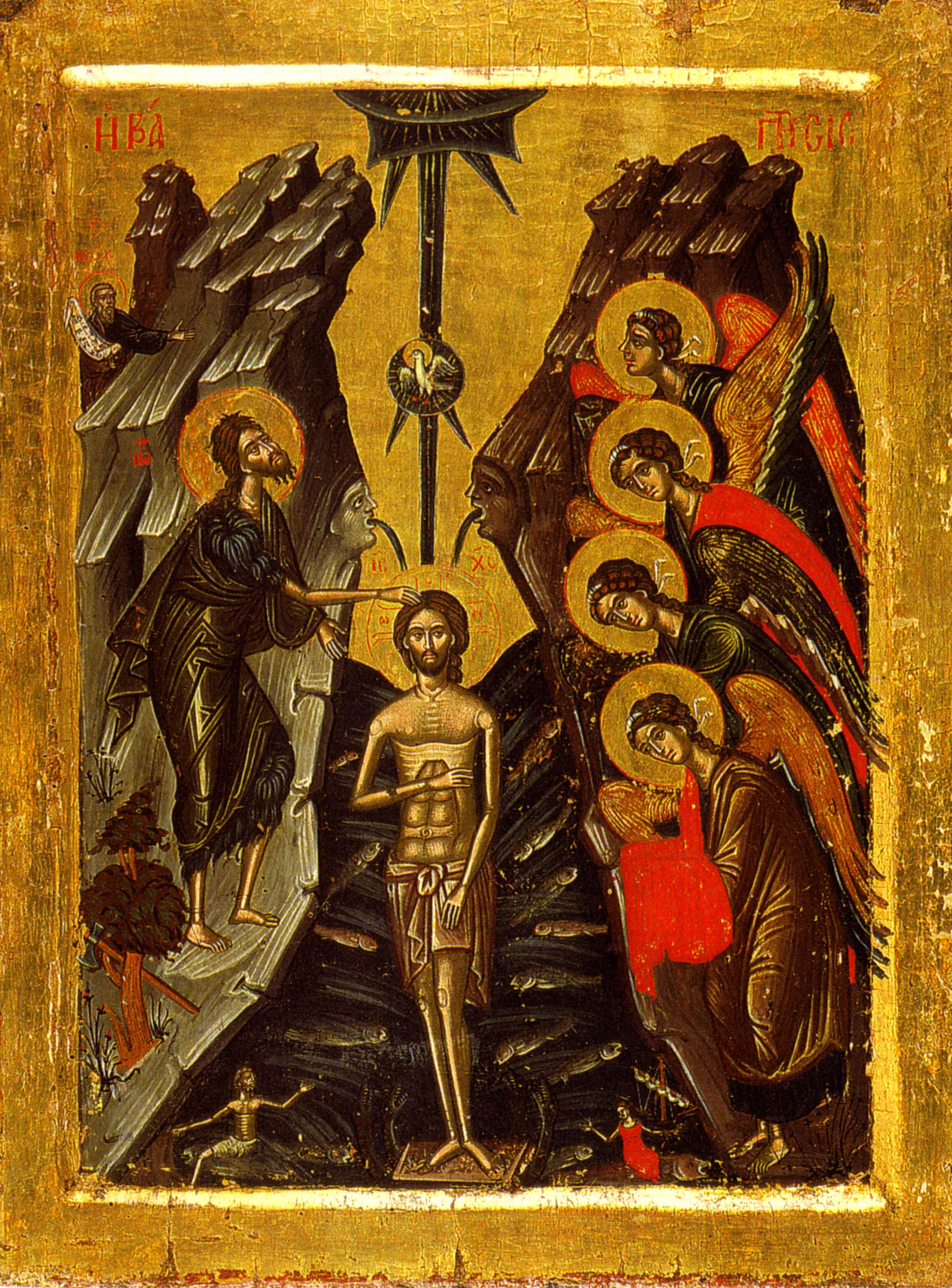
Jesus fulfills all righteousness by submitting to a baptism that He doesn't really need for sins.  In the earliest Church, tradition has it that Jesus' baptism in the Jordan blessed all the waters of the world, making them ready for Christian baptism with water and the Spirit.  If we look at some icons of the Baptism, there are fish swimming in the water, and the whole icon teems with life and the whole of creation (see this icon, in a not-very-good photo taken by me at the Byzantine Museum in Athens, Greece, in which the golden fish show with great vibrance).  There is also the presence of angels, and in some there are small figures representing the waters, the Jordan and the sea.  (See this icon, with the tiny male and female figures at the bottom right and left of Jesus, and four angels standing on the riverbank opposite John the Baptist).   They are meant to express Psalm 114:3:  "The sea saw it and fled; the Jordan turned back."  All of creation is to be made whole with this baptism, made to fulfill all righteousness, in which Christ blesses the waters of the whole world, that feed everything, and the angels rejoice and are ready to minister and serve He who is the Son.  This is the beginning of Jesus' ministry to the world, and the revelation of the Trinity.  But it is we and everything else in all of creation who are included in this gift for us.  Jesus was always Son, this is a gift of love for the world.  And all the elements of the world represented (such as the Jordan and the sea) must serve Him as Lord.   But what is the manner in which this Son is revealed, this Lord of all the elements of creation?  It is His humility in submitting to baptism by John, although John knows who He is and will in turn say, "He must increase but I must decrease."  In this sense, baptism -- a voluntary death to rebirth symbolized by the covering of the waters -- is consistent with His crucifixion, another act of humility that will "fulfill all righteousness" for the world, another gift via Incarnate Son.  Everything our gracious Lord does is for giving a gift to us, anointing the whole of creation with love.  We can't forget Jesus' final words at the Ascension:  "Go into all the world and preach the gospel to every creature."  It's more truly translated, "go everywhere" and preach the gospel "to all the creation."   All of creation is involved in this baptism, this gift, for all.   Above, I've put another image of the Baptism, by El Greco, displaying a universe of life given a greater life in abundance in Jesus' baptism.  (Click the picture to see it larger.)  Even the water at Jesus' feet stirs and glows with a hidden light and life, and golden fish, which show us the abundance of life He promises -- every creature, all of creation, is somehow involved.


Friday, September 11, 2015

He will baptize you with the Holy Spirit and fire


 In those days John the Baptist came preaching in the wilderness of Judea, and saying, "Repent, for the kingdom of heaven is at hand!"  For this is he who was spoken of by the prophet Isaiah, saying:
"The voice of one crying in the wilderness:
'Prepare the way of the Lord;
Make His paths straight.'"
Now John Himself was clothed in camel's hair, with a leather belt around his waist; and his food was locusts and wild honey.  Then Jerusalem, all Judea, and all the region around the Jordan went out to him and were baptized by him in the Jordan, confessing their sins.

But when he saw many of the Pharisees and Sadducees coming to his baptism, he said to them, "Brood of vipers!  Who warned you to flee from the wrath to come?  Therefore bear fruits worthy of repentance, and do not think to say to yourselves, 'We have Abraham as our father.'  For I say to you that God is able to raise up children to Abraham even from these stones.  And even now the ax is laid to the root of the trees.  Therefore every tree which does not bear good fruit is cut down and thrown into the fire.  I indeed baptize you with water unto repentance, but He who is coming after me is mightier than I, whose sandals I am not worthy to carry.  He will baptize you with the Holy Spirit and fire.  His winnowing fan is in His hand, and He will thoroughly clean out His threshing floor, and gather His wheat into the barn; but He will burn up the chaff with unquenchable fire."

- Matthew 3:1-12

Yesterday, we read that when the wise men had departed Bethlehem, behold, an angel of the Lord appeared to Joseph in a dream, saying, "Arise, take the young Child and His mother, flee to Egypt, and stay there until I bring you word; for Herod will seek the young Child to destroy Him."  When he arose, he took the young Child and His mother by night and departed for Egypt, and was there until the death of Herod, that it might be fulfilled which was spoken by the Lord through the prophet, saying, "Out of Egypt I called My Son."  Then Herod, when he saw that he was deceived by the wise men, was exceedingly angry; and he sent forth and put to death all the male children who were in Bethlehem and in all its districts, from two years old and under, according to the time which he had determined from the wise men.  Then was fulfilled what was spoken by Jeremiah the prophet, saying:  "A voice was heard in Ramah, lamentation, weeping, and great mourning, Rachel weeping for her children, refusing to be comforted, because they are no more."  Now when Herod was dead, behold, an angel of the Lord appeared in a dream to Joseph in Egypt, saying, "Arise, take the young Child and His mother, and go to the land of Israel, for those who sought the young Child's life are dead."  Then he arose, took the young Child and His mother, and came into the land of Israel.  But when he heard that Archelaus was reigning over Judea instead of his father Herod, he was afraid to go there.  And being warned by God in a dream, he turned aside into the region of Galilee.  And he came and dwelt in a city called Nazareth, that it might be fulfilled which was spoken by the prophets, "He shall be called a Nazarene."

 In those days John the Baptist came preaching in the wilderness of Judea, and saying, "Repent, for the kingdom of heaven is at hand!"  For this is he who was spoken of by the prophet Isaiah, saying:  "The voice of one crying in the wilderness:  'Prepare the way of the Lord; make His paths straight.'"  The Gospel skips from Jesus' early childhood to the ministry of John the Baptist.  The wilderness of Judea, my study bible says, is the barren region which descends from Jerusalem to the Dead Sea.  This is the preparation for the ministry of Christ, and it begins with the Baptist's call to repent.  Repentance is a kind of constant in a life of faith; it indicates a complete about-face.  It literally means to change one's mind in the Greek, or else to turn around in a general sense.  My study bible says that repentance is a "radical change of one's spirit, mind, thought, and heart, a complete reorientation of the whole of one's life.  It is the necessary first step in the way of the LORD.  It is accompanied by the confession of sins and the act of baptism, and is followed by a life filled with fruits worthy of this change," all of which is noted in today's reading in the acts and preaching of John the Baptist.  John quotes Isaiah (40:3), a prophet essential to the Gospels, who will often be quoted by Jesus.  Once again, we are witnessing the fulfillment of the Prophets, of the spiritual history and heritage of Israel.

Now John Himself was clothed in camel's hair, with a leather belt around his waist; and his food was locusts and wild honey.  Then Jerusalem, all Judea, and all the region around the Jordan went out to him and were baptized by him in the Jordan, confessing their sins.    The description of John the Baptist echoes the image of another great prophet, Elijah.  (See 2 Kings 1:8).  This would be understood and striking to contemporaries and those who knew the Scripture.  John's life of asceticism conformed to that of Jewish sects like the Essenes, who lived in the wilderness and were preparing for the coming Kingdom of God.  In the early Church, the monastic movement into the wilderness (Desert Fathers and Mothers) was patterned after John the Baptist's way of life.  John calls for a confession of sins to accompany baptism; my study bible says this was essential to baptism under both the Old Covenant and the New.  But John's Baptism was a sign of repentance and forgiveness of sins alone -- it did not confer the power of total regeneration nor adoption as a child of God as does baptism "with the Holy Spirit" (verse 11).

But when he saw many of the Pharisees and Sadducees coming to his baptism, he said to them, "Brood of vipers!  Who warned you to flee from the wrath to come?"  The Sadducees were members of the high-priestly and landowning class.  They controlled the temple and the internal political affairs of the Jews.  They were like an early aristocratic class based around Jerusalem and Judea.  They did not believe in the resurrection of the dead and "had no messianic hope beyond this life," as my study bible puts it.  The Pharisees were a lay religious movement centered on the study of the Law and the strict observance of its regulations, around which were shaped additional traditions.  They did believe in the resurrection of the dead (in contrast to the Sadducees) and looked to the coming of Messiah with hope.  But they taught that righteousness is attained on the strength of works according to the Law, and that the Messiah would be a glorious man, not divine.  Jesus will later use this same phrase for them, "Brood of vipers!"  (Matthew 12:34; 23:33). My study bible says that it indicates their deception and malice and their being under the influence of Satan.

"Therefore bear fruits worthy of repentance, and do not think to say to yourselves, 'We have Abraham as our father.'  For I say to you that God is able to raise up children to Abraham even from these stones.  And even now the ax is laid to the root of the trees.  Therefore every tree which does not bear good fruit is cut down and thrown into the fire."  My study bible tells us that "repentance, confession, and baptism lead to fruits worthy of repentance."  That is, a way of life consistent with the Kingdom of God (see Galatians 5:22-25).  It says that if a fruitful life doesn't follow, then sacramental acts and spiritual discipline are useless.  In many icons of Baptism, we see an ax (lower left of this icon), reflecting John's warning.   John says that from these stones (Hebrew 'ebanimn) God can raise up children (Hebrew banim) as a memorable play on words.  My study bible says, "God will not admit fruitless children into His house, but adopts other children from the Gentiles."

"I indeed baptize you with water unto repentance, but He who is coming after me is mightier than I, whose sandals I am not worthy to carry.  He will baptize you with the Holy Spirit and fire.  His winnowing fan is in His hand, and He will thoroughly clean out His threshing floor, and gather His wheat into the barn; but He will burn up the chaff with unquenchable fire."  My study bible says that "Christ baptizes in the fire of the Holy Spirit, the power and grace of God divinely poured out on all believers at baptism."  It notes that in the culture of John the Baptist, a slave would carry the sandals of a king; so John is actually depicting himself as lower than a slave of Jesus.  His inability to carry the sandals of Christ has another meaning, also, for it means another's responsibility (Ruth 4:7).  John could not have carried the responsibility that Christ does -- as, in parallel, John the Baptist, the last and greatest of the Old Testament-type prophets, gives us an image that teaches the Law could not redeem the world the world in the way that Christ has come to do.  The winnowing fan produces wind that separates wheat from chaff on the threshing floor, a metaphor for judgment.

This is the moment we are introduced to the Christ.  What is John's emphasis, before Jesus' baptism in the Jordan?   The Christ will bring the Holy Spirit, and His baptism will be a baptism of fire.  That is, the Holy Spirit given as a kind of testing of fire, that which will try us and prove us out.  John, the last and considered the greatest in the lineage of the Old Testament-type prophets, gives us the fullness of the age begun with the birth of the Messiah:  the grace of the Spirit, anointing the world and testing it out, in preparation for judgment.  He's introducing us to the time we live in now, the years labeled AD for anno domini, year of the Lord.  It is this age, for us, that is marked by the giving of the Spirit, the baptism of the Spirit -- that which is present in the world and is also an image of fire, such as at the burning bush.  We live in an age, initiated by Christ's Incarnation, in which the Spirit is present, poured out upon the world, interacting with us and with all of creation.  But as John emphasizes in today's reading, everything depends, really, upon our response.  This is the whole thing.  This is the fullness of the age and of mercy, the crux of how judgment happens.  God is always prompting, always waiting, always loving.  In the image of fire that purifies this is what we need to see.  It is linked with repentance, as salvation is a kind of ongoing process of repentance, turning over our "worldly" ways for the way of God who is love, as taught by the interaction of the Spirit.  That is the life in Christ, the life of baptism by Spirit and fire.  A prayer life should be such fruits, turning over, bit by bit, things we've learned to a way of life and perception that sees things differently, in the lens of the love that the Spirit teaches.  Christ teaches the same love, of course, as a proactive kind of reality, in which -- for example -- we are a neighbor by living as a neighbor.  That's what it means to fulfill our God-likeness.  Fire indicates a constant process of transformation, of energy at work in us and with us, creating a kind of repentance or change of mind that is ongoing, illuminating, burning away the things we don't need and mustn't hang onto.  Purification is symbolized by fire, meaning that love doesn't just coddle, it changes, it tells you what's wrong and waits for a positive response to what is better.  This is all contained in John's words today, warning those who should know better already, the experts in the Scripture and the Law, "Who warned you to flee from the wrath to come?"  and calling them, "Brood of vipers!"   This isn't a place for hypocrisy or acting, this fire reaches deep inside of us.  It's not about a kind of obedience from fear, but from love.  This is the faith we're called to, and the whole thing starts here.  John's radical poverty is a sign of our total and complete dependence on God, and that nothing is hidden in that relationship.