Showing posts with label James and John Zebedee. Show all posts

Friday, November 28, 2025

You will indeed drink My cup, and be baptized with the baptism that I am baptized with

 
 Now Jesus, going up to Jerusalem, took the twelve disciples aside on the road and said to them, "Behold, we are going up to Jerusalem, and the Son of Man will be betrayed to the chief priests and to the scribes; and they will condemn Him to death, and deliver Him to the Gentiles to mock and to scourge and to crucify.  And the third day He will rise again."
 
Then the mother of Zebedee's sons came to Him with her sons, kneeling down and asking something from Him.  And He said to her, "What do you wish?"  She said to Him, "Grant that these two  sons of mine may sit, one on Your right hand and the other on the left, in Your kingdom."  But Jesus answered and said, "You do not know what you ask.  Are you able to drink the cup that I am about to drink, and be baptized with the baptism that I am baptized with?"  They said to Him, "We are able."  So He said to them, "You will indeed drink My cup, and be baptized with the baptism that I am baptized with, but to sit on My right hand and on My left is not Mine to give, but it is for those for whom it is prepared by My Father."  
 
And when the ten heard it, they were greatly displeased with the two brothers.  But Jesus called them to Himself and said, "You know that the rulers of the Gentiles lord it over them, and those who are great exercise authority over them.  Yet it shall not be so among you; but whoever desires to become great among you, let him be your servant.  And whoever desires to be first among you, let him be your slave -- just as the Son of Man did not come to be served, but to serve, and to give His life a ransom for many."
 
- Matthew 20:17-28 
 
In yesterday's reading, Jesus gave us the parable of the Workers in the Vineyard:  "For the kingdom of heaven is like a landowner who went out early in the morning to hire laborers for his vineyard.  Now when he had agreed with the laborers for a denarius a day, he sent them into his vineyard.  And he went out about the third hour and saw others standing idle in the marketplace, and said to them, 'You also go into the vineyard, and whatever is right I will give you.'  So they went.  Again he went out about the sixth and the ninth hour, and did likewise.  And about the eleventh hour he went out and found others standing idle, and said to them, 'Why have you been standing here idle all day?'  They said to him, 'Because no one hired us.'  He said to them, 'You also go into the vineyard, and whatever is right you will receive.'  So when evening had come, the owner of the vineyard said to his steward, 'Call the laborers and give them their wages, beginning with the last to the first.'  And when those came who were hired about the eleventh hour, they each received a denarius.  But when the first came, they supposed that they would receive more; and they likewise received each a denarius.  And when they had received it, they complained against the landowner, saying, 'These last men have worked only one hour, and you made them equal to us who have borne the burden and the heat of the day.'  But he answered one of them and said, 'Friend, I am doing you no wrong.  Did you not agree with me for a denarius?  Take what is yours and go your way.  I wish to give to this last man the same as to you.  Is it not lawful for me to do what I wish with my own things?  Or is your eye evil because I am good?'  So the last will be first, and the first last.  For many are called, but few chosen." 
 
 Now Jesus, going up to Jerusalem, took the twelve disciples aside on the road and said to them, "Behold, we are going up to Jerusalem, and the Son of Man will be betrayed to the chief priests and to the scribes; and they will condemn Him to death, and deliver Him to the Gentiles to mock and to scourge and to crucify.  And the third day He will rise again."  My study Bible comments that Christ's repeated prediction of His Passion is meant to encourage and strengthen the disciples for the terrifying events they would face (note that now Jesus is going up to Jerusalem).   According to Theophylact, it's as if Jesus were saying to them, "Think on all these [words and miracle], so that when you see me hanging on the Cross, you will not imagine that I am suffering because I am powerless to do otherwise."
 
 Then the mother of Zebedee's sons came to Him with her sons, kneeling down and asking something from Him.  And He said to her, "What do you wish?"  She said to Him, "Grant that these two  sons of mine may sit, one on Your right hand and the other on the left, in Your kingdom."  But Jesus answered and said, "You do not know what you ask.  Are you able to drink the cup that I am about to drink, and be baptized with the baptism that I am baptized with?"  They said to Him, "We are able."  So He said to them, "You will indeed drink My cup, and be baptized with the baptism that I am baptized with, but to sit on My right hand and on My left is not Mine to give, but it is for those for whom it is prepared by My Father."  My study Bible comments that this question for temporal power and glory is unfitting for a disciple and it shows an earthly misunderstanding of the Kingdom of God.  Here, St. Matthew tells us that this is the mother of Zebedee's sons who is requesting this honor.  But John and James' own involvement is revealed in the Greek of the original text, as "you" is plural in Christ's response, "You do not know what you ask . . . " as well as in Mark 10:36.  Note here also that Christ calls His Crucifixion a cup and His death a baptism.  My study Bible explains that the Cross is a cup because Jesus drank it willingly (Hebrews 12:2).  His death is baptism in that He was completely immersed in it -- but it cleansed the world (Romans 6:3-6).  Christ's prophecy regarding the future participation of John and James Zebedee in the same cup and baptism portrays the life of persecution and martyrdom they would lead after Pentecost (John lived a long life of persecution and exile during the worst of the persecutions of the Church; James was the first apostle to be martyred; see Acts 12:1-2).  My study Bible further explains that Christ declaring that the places of honor in the Kingdom are not His to give does not mean that He lacks authority.  What it does mean is that they are not His to give arbitrarily.  In other words, these will be given to those for whom God has prepared them.  My study Bible asks us to note also that with regard to sitting as equals on the right and left hand of Christ in His Kingdom.  It cites St. John Chrysostom, who teaches that no one could possibly occupy such a position.  Regarding the highest places of honor that can be given to human beings, the icons of the Orthodox Churches universally depict the Virgin Mary (most blessed among women; Luke 1:28) and John the Baptist (greatest born of women; Matthew 11:11) in these places.  
 
 And when the ten heard it, they were greatly displeased with the two brothers.  But Jesus called them to Himself and said, "You know that the rulers of the Gentiles lord it over them, and those who are great exercise authority over them.  Yet it shall not be so among you; but whoever desires to become great among you, let him be your servant.  And whoever desires to be first among you, let him be your slave -- just as the Son of Man did not come to be served, but to serve, and to give His life a ransom for many."  Again, Jesus emphasizes service over claims of greatness; His power is that which does good.  For many is an Aramaic expression which means "for all."  My study Bible comments that He corrects the disciples by first comparing them to the power-hungry Gentiles, whom they themselves considered to be an abomination, and contrasting them to Himself.  Christ serves us even though He is the Lord of all.  
 
Once again, Jesus is preparing the disciples for what is going to happen in the final week of His earthly life.  This takes place at the beginning of Christ's final journey, as Jesus sets His sights for Jerusalem and takes the disciples on the road which will lead them there.   This is His third prophesy to them of what will happen when they reach Jerusalem.  As the disciples do not clearly understand what is to happen there, they likely still believe and expect that Christ's Kingdom will be manifest as an earthly kingdom.  So, once again, this expectation leads to a question about greatness and position in Christ's kingdom (as in this reading previously).  Earlier, such a demand to know position in His kingdom led to Christ's lessons on humility and the treatment of the "little ones" in the Church, leading to His prescription for mutual correction in the Church.  Here, the issue of power comes up once again, and Christ contrasts the notion of leadership in the pagan Gentile world they know (and already abhor) with His sense of power and authority.  Christ shares His power with His disciples, His gift to us all through Baptism is the Holy Spirit.  He does not compel anyone to return His love.  So we must learn of Christ's authority and power, and even today, we are in this same spiritual struggle to take on His yoke and learn from Him (Matthew 11:29-30).  Of course, we know from their histories in the tradition of the Church that James and John both served Christ in the ways that He prophesies here.  As said above, James was the first apostle to be martyred, and John would go on to a long life of persecution, protecting and caring for the Theotokos, the Mother of God, Mary, Jesus' mother.  He would give the Church substantial literature, contributing to the Bible one Gospel, three Epistles, and the Book of Revelation, and so guiding and steering the Church even today!  Perhaps there is no greater lesson to us all than this consideration of James and John Zebedee and their own transfiguration through the Holy Spirit, their lives of service, and their unimaginable and, frankly, incalculable gift of their lives and works of faith for the Church, for us all.  Let us seek to be like their example, and cherish what they have done in service to us all.


Friday, February 14, 2025

For even the Son of Man did not come to be served, but to serve, and to give His life a ransom for many

 
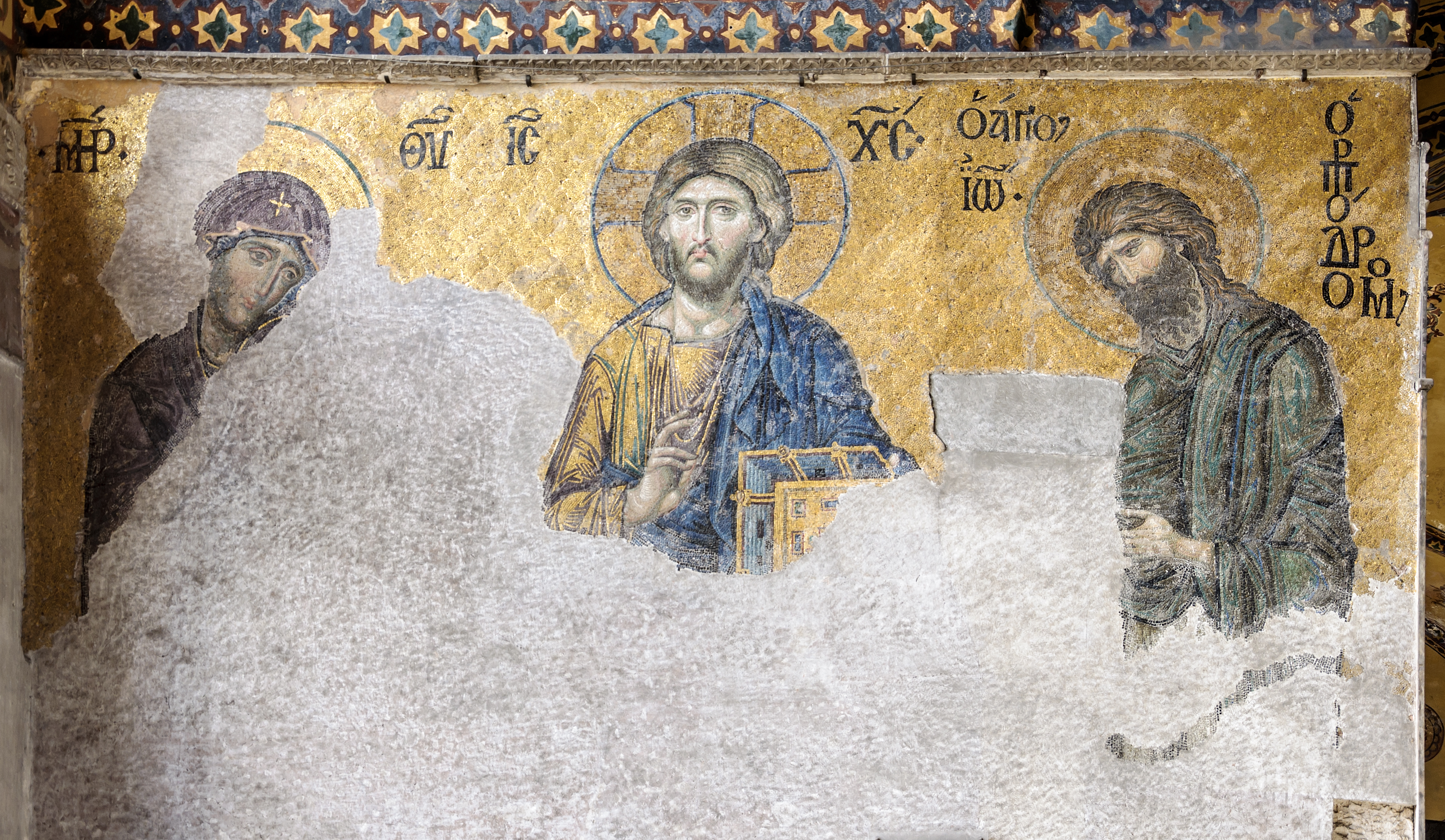
Deësis mosaic, Hagia Sophia cathedral, 13th century, Constantinople, Byzantine Empire
 
 Now they were on the road, going up to Jerusalem, and Jesus was going before them; and they were amazed.  And as they followed they were afraid.  Then He took the twelve aside again and began to tell them the things that would happen to Him:  "Behold, we are going up to Jerusalem, and the Son of Man will be betrayed to the chief priests and to the scribes; and they will condemn Him to the Gentiles; and they will mock Him, and scourge Him, and spit on Him, and kill Him.  And the third day He will rise again."
 
Then James and John, the sons of Zebedee, came to Him, saying, "Teacher, we want You to do for us whatever we ask."  And He said to them, "What do you want Me to do for you?"  They said to Him, "Grant us that we may sit, one on Your right hand and the other on Your left, in Your glory."   But Jesus said to them, "You do not know what you ask.  Are you able to drink the cup that I drink, and be baptized with the baptism that I am baptized with?"  They said to Him, "We are able."  So Jesus said to them, "You will indeed drink the cup that I drink, and with the baptism I am baptized you will be baptized; but to sit on My right hand and on My left is not Mine to give, but it is for those for whom it is prepared."  And when the ten heard it, they began to be greatly displeased with James and John.  But Jesus called them to Himself and said to them, "You know that those who are considered rulers over the Gentiles lord it over them, and their great ones exercise authority over them.  Yet it shall not be so among you; but whoever desires to become great among you shall be your servant.  And whoever of you desires to be first shall be slave of all.  For even the Son of Man did not come to be served, but to serve, and to give His life a ransom for many."
 
- Mark 10:32–45 
 
Yesterday we read that as Jesus was going out on the road, one came running, knelt before Him, and asked Him, "Good Teacher, what shall I do that I may inherit eternal life?"  So Jesus said to him, "Why do you call Me good?  No one is good but One, that is, God.  You know the commandments:  'Do not commit adultery,' 'Do not murder,' 'Do not steal,' 'Do not bear false witness,' 'Do not defraud,' 'Honor your father and your mother.'"  And he answered and said to Him, "Teacher, all these things I have kept from my youth."  Then Jesus, looking at him, loved him, and said to him, "One thing you lack:  Go your way, sell whatever you have and give to the poor, and you will have treasure in heaven; and come, take up the cross, and follow Me."  But he was sad at this word, and went away sorrowful, for he had great possessions.  Then Jesus looked around and said to His disciples, "How hard it is for those who have riches to enter the kingdom of God!"  And the disciples were astonished at His words.  But Jesus answered again and said to them, "Children, how hard it is for those who trust in riches to enter the kingdom of God!  It is easier for a camel to go through the eye of a needle than for a rich man to enter the kingdom of God."  And they were greatly astonished, saying among themselves, "Who then can be saved?"  But Jesus looked at them and said, "With men it is impossible, but not with God; for with God all things are possible."  Then Peter began to say to Him, "See, we have left all and followed You."  So Jesus answered and said, "Assuredly, I say to you, there is no one who has left house or brothers or sisters or father or mother or wife or children or lands, for My sake and the gospel's, who shall not receive a hundredfold now in this time -- houses and brothers and sisters and mothers and children and lands, with persecutions -- and in the age to come, eternal life.  But many who are first will be last, and the last first."
 
  Now they were on the road, going up to Jerusalem, and Jesus was going before them; and they were amazed.  And as they followed they were afraid.  Then He took the twelve aside again and began to tell them the things that would happen to Him:  "Behold, we are going up to Jerusalem, and the Son of Man will be betrayed to the chief priests and to the scribes; and they will condemn Him to the Gentiles; and they will mock Him, and scourge Him, and spit on Him, and kill Him.  And the third day He will rise again."  My study Bible comments that Christ's repeated predictions of His Passion were intended to encourage and strengthen the disciples for the terrifying events they would face.  Additionally, these predictions confirm that Christ was going to His death of His own will and choosing.  As He is now going up to Jerusalem, going before them, this much is certain.
 
 Then James and John, the sons of Zebedee, came to Him, saying, "Teacher, we want You to do for us whatever we ask."  And He said to them, "What do you want Me to do for you?"  They said to Him, "Grant us that we may sit, one on Your right hand and the other on Your left, in Your glory."   But Jesus said to them, "You do not know what you ask.  Are you able to drink the cup that I drink, and be baptized with the baptism that I am baptized with?"  They said to Him, "We are able."  So Jesus said to them, "You will indeed drink the cup that I drink, and with the baptism I am baptized you will be baptized; but to sit on My right hand and on My left is not Mine to give, but it is for those for whom it is prepared."  And when the ten heard it, they began to be greatly displeased with James and John.  But Jesus called them to Himself and said to them, "You know that those who are considered rulers over the Gentiles lord it over them, and their great ones exercise authority over them.  Yet it shall not be so among you; but whoever desires to become great among you shall be your servant.  And whoever of you desires to be first shall be slave of all."   Once again, questions of who among them will be the greatest in the kingdom they can only imagine come up among the disciples; this time it is James and John Zebedee who make this request.  My study Bible comments that this quest for temporal power and glory is unfitting for a disciple and shows an earthly misunderstanding of the Kingdom of God.  In St. Matthew's Gospel, it is noted that the mother of Zebedee's sons makes this request, but Jesus responds in the plural "you" there, and the brothers' own involvement is clear here in St. Mark's Gospel.  Christ calls His Crucifixion a cup and His death a baptism.  The Cross is a cup, my study Bible explains, because He drank it willingly (Hebrews 12:2).  Christ's death is a baptism, as He was completely immersed in it, yet it cleansed the whole world (Romans 6:3-6).  Christ's prophecy of John and James eventual participating in the same cup and baptism reveals the life of persecution and martyrdom which they would lead after Pentecost.  James would be the first martyr among the disciples, and John lived a long life under persecution and exile.  My study Bible also states that Christ declaring that places of honor in the Kingdom are not His to give does not mean that He lacks authority.  It means, instead, that they are not His to give arbitrarily.  They will be given to those for whom God has prepared them.  Also, with regard to sitting as equals on the right and left hand of Christ in His Kingdom, St. John Chrysostom teaches that no one could possibly occupy such a position.  Regarding the highest places of honor that can be given to human beings, the icons of the Orthodox Church universally depict the Virgin Mary ("most blessed among women" Luke 1:28) and John the Baptist ("greatest born of women" (Matthew 11:11) holding these places.  

"For even the Son of Man did not come to be served, but to serve, and to give His life a ransom for many."  For many, according to my study Bible, is an Aramaic expression, which means "for all."
 
 In its commentary on the request of John and James Zebedee, my study Bible tells us that the icons of the Orthodox Church universally depict the Virgin Mary and St. John the Baptist in the highest places of honor given to human beings, next to Christ.  It quotes from Luke 1:28 and Matthew 11:11, giving us the words from Scripture regarding these two saints.  In the case of the Virgin Mary, the words are of the Archangel Gabriel, in greeting Mary at the Annunciation to her of Christ's birth.  The words describing John the Baptist are those spoken by Jesus Christ.  The mosaic above, called Deësis, which means, in Greek, "Supplication" or "Prayer" shows the Virgin Mary and St. John the Baptist on either side of Christ enthroned, praying on behalf of humanity.  St. John the Baptist is considered to be a figure of the Old Testament, the greatest of all the prophets, while Mary the Mother of God is the "queen" among the saints, also called "All Holy" in the Orthodox tradition.  She is considered the supreme saint to call upon at all times.   In James 5:16 we read, "The effective, fervent prayer of a righteous man avails much."  As she is considered to be the greatest among the saints, her compassion is one that turns no one away.  These traditions are born out through the 2,000 year experience of the Church, the prayers and supplications of believers throughout the centuries.  In the mosaic above, we can see the expressions of compassion on the faces of the saints at prayer, and we know that their lives were those of great sacrifice for the love of Christ and of the gospel of the kingdom of God He preached.  All of this speaks to us of love and compassion, love and blessing within the gracious love of God -- even for the Son who came to live among us as one of us, to share our burdens and griefs and die out of love for us.  Ultimately the story of Jesus is a story of so many who were loved by Him and who shared in His love, for He goes to His cup and His baptism "for many," as the text says, meaning for all of us.  Let us consider the compassion and love of a loving God, seeking to free us from the slavishness of a life devoted to a different kind of power, one that knows exploitation and hardship, greedy demands of passions, and stripping us to a bare materialism without pity.  Let us, together with these greatest of saints, participate in the joy of His Kingdom, for there is the place of His love for all of us in which we, too, may share. 


Thursday, June 27, 2024

Are you able to drink the cup that I am about the drink, and to be baptized with the baptism that I am baptized with?


File:Deesis mosaic Hagia Sophia.jpg
Deësis (Gr. "Prayer" or "Supplication") mosaic, 13th century.  Hagia Sophia  (Holy Wisdom) Cathedral, Constantinople, Byzantine Empire; showing the Virgin Mary and John the Baptist on Christ's left and right (photo Wikimedia Commons)
 
 Now Jesus, going up to Jerusalem, took the twelve disciples aside on the road and said to them, "Behold, we are going up to Jerusalem, and the Son of Man will be betrayed to the chief priests and to the scribes; and they will condemn Him to death, and deliver Him to the Gentiles to mock and to scourge and to crucify.  And the third day He will rise again."

Then the mother of Zebedee's sons came to Him with her sons, kneeling down and asking something from Him.  And He said to her, "What do you wish?"  She said to Him, "Grant that these two sons of mine may sit, one of Your right hand and the other on the left, in Your kingdom."  But Jesus answered and said, "You do not know what you ask.  Are you able to drink the cup that I am about the drink, and to be baptized with the baptism that I am baptized with?"  They said to Him, "We are able."  So He said to them, "You will indeed drink My cup, and be baptized with the baptism that I am baptized with; but to sit on My right hand and on My left is not Mine to give, but it is for those for whom it is prepared by My Father."  And when the ten heard it, they were greatly displeased with the two brothers.  But Jesus called them to Himself and said, "You know  that the rulers of the Gentiles lord it over them, and those who are great exercise authority over them.  Yet it shall not be so among you; but whoever desires to become great among you, let him be your servant.  And whoever desires to be first among you, let him be your slave -- just as the Son of Man did not come to be served, but to serve, and to give His life a ransom for many."
 
- Matthew 20:17-28 
 
In yesterday's reading, Jesus gave the parable of the Workers in the Vineyard:  "For the kingdom of heaven is like a landowner who went out early in the morning to hire laborers for his vineyard.  Now when he had agreed with the laborers for a denarius a day, he sent then into his vineyard.  And he went out about the third hour and saw others standing idle in the marketplace, and said to them, 'You also go into the vineyard, and whatever is right I will give you.'  So they went.  Again he went out about the sixth and the ninth hour, and did likewise.  And about the eleventh hour he went out and found others standing idle, and said to them, 'Why have you been standing here idle all day?'  They said to him, 'Because no one hired us.'  He said to them, 'You also go into the vineyard, and whatever is right you will receive.'  So when evening had come, the owner of the vineyard said to his steward, 'Call the laborers and give them their wages, beginning with the last to the first.'  And when those came who were hired about the eleventh hour, they each received a denarius.  But when the first came, they supposed that they would receive more; and they likewise received each a denarius.  And when they had received it, they complained against the landowner, saying, 'These last men have worked only one hour, and you made them equal to us who have borne the burden and the heat of the day.'  But he answered one of them and said, 'Friend, I am doing you no wrong.  Did you not agree with me for a denarius?  Take what is yours and go your way.  I wish to give to this last man the same as to you.  Is it not lawful for me to do what I wish with my own things?  Or is your eye evil because I am good?'  So the last will be first, and the first last.  For many are called, but few chosen."
 
  Now Jesus, going up to Jerusalem, took the twelve disciples aside on the road and said to them, "Behold, we are going up to Jerusalem, and the Son of Man will be betrayed to the chief priests and to the scribes; and they will condemn Him to death, and deliver Him to the Gentiles to mock and to scourge and to crucify.  And the third day He will rise again."  My study Bible comments that Christ's repeated prediction of His Passion is meant to encourage and strengthen disciples for the terrifying events they will face.  According to Theophylact, it is as if Christ were saying, "Think on all these [words and miracles], so that when you see me hanging on the Cross, you will not imagine that I am suffering because I am powerless to do otherwise."

Then the mother of Zebedee's sons came to Him with her sons, kneeling down and asking something from Him.  And He said to her, "What do you wish?"  She said to Him, "Grant that these two sons of mine may sit, one of Your right hand and the other on the left, in Your kingdom."  But Jesus answered and said, "You do not know what you ask.  Are you able to drink the cup that I am about the drink, and to be baptized with the baptism that I am baptized with?"  They said to Him, "We are able."  So He said to them, "You will indeed drink My cup, and be baptized with the baptism that I am baptized with; but to sit on My right hand and on My left is not Mine to give, but it is for those for whom it is prepared by My Father."   We don't really know why at this juncture the mother of James and John Zebedee has come to Christ with this request.  It is a sort of repetition of the disciples previously asking, "Who then is greatest in the kingdom of heaven?"  But this time, it is the mother of Zebedee's sons who comes with this request on behalf of James and John.  When the question of "the greatest" was asked before, Jesus took pains with specific and extended teachings on humility and the need to serve, especially to take care of the "little ones" in the Church.  Perhaps Christ speaking of His coming Passion, and saying that on the third day He will rise again has prompted the disciples to assume that He will come into an eternal, earthly kingdom, as is widely expected of the Messiah.  But my study Bible comments that this quest for temporal power and glory is unfitting for a disciple and it shows an earthly misunderstanding of the Kingdom of God.  Here Matthew tells us that it was their mother who requested such an honor -- but John and James' own involved in revealed because Jesus addresses them in the plural "you" in the Greek both here and in Mark 10:36.   We must note that Christ calls His Crucifixion a cup and His death a baptism.  The Cross is a cup, my study Bible says, because He drank it willingly (Hebrews 12:2).  His death is baptism, as He was completely immersed in it, and yet it cleansed the world (Romans 6:3-6).  Christ's prophecy of John and James participating in the same cup and baptism shows the life of persecution and martyrdom these brothers would lead after Pentecost -- James would be the first apostle to be martyred (Acts 12:1-2), and John would go on to a long life of persecution and exile, producing one Gospel, three Epistles, and the Revelation.  My study Bible further notes on this passage that Christ declaring that the places of honor in the Kingdom are not His to give doesn't mean He lacks authority.  It means, instead, that they are not His to give arbitrarily.  He will give them to those for whom God has prepared them.  Note also, my study Bible says, that with regard to sitting as equals on the right and the left hand of Christ in Christ's Kingdom, St. John Chrysostom teaches that nobody could possibly occupy these positions.  Regarding the highest places of honor that can be given to human beings, the icons of the Orthodox Church universally depict the Virgin Mary (most blessed among women -- Luke 1:28) and John the Baptist (greatest born of women -- Matthew 11:11) holding these places.  See the icon above, the 13th century mosaic entitled Deësis, meaning "prayer" or "supplication" in Greek, from Hagia Sophia (Holy Wisdom) Cathedral in Constantinople, the capitol of the Byzantine Empire.
 
And when the ten heard it, they were greatly displeased with the two brothers.  But Jesus called them to Himself and said, "You know  that the rulers of the Gentiles lord it over them, and those who are great exercise authority over them.  Yet it shall not be so among you; but whoever desires to become great among you, let him be your servant.  And whoever desires to be first among you, let him be your slave -- just as the Son of Man did not come to be served, but to serve, and to give His life a ransom for many."  My study Bible notes that Jesus once again corrects the disciples, this time by first comparing them to the power-hungry Gentiles, whom they themselves considered an abomination, and contrasting them to Himself, who serves us although He is Lord of all.  My study Bible notes here that for many is an Aramaic expression which indicates "for all."

So, in the context of the Gospel, there is the common theme of sacrifice running as a thread throughout the past few readings.  There was first the story of the rich young man, whom Jesus loved, and whom He told that if he wanted to be perfect, he should sell his possessions and give to the poor, and follow Him.  This was followed by a discussion regarding the difficulties which wealth presents to those who would seek the kingdom of heaven, and the sacrifices which the disciples themselves have made.  In yesterday's reading (see above), Jesus gave the parable of the Workers in the Vineyard, expressing the principle that not all will labor equally, and yet all will receive the same reward.  Here we have the dynamic quality in the story line in which the mother of John and James Zebedee comes (seemingly on their behalf) asking Christ to make her two sons effectively greatest in His coming Kingdom, to sit at His right and left hand.  According to my study Bible, as we read above, these are positions no one could fill, and the positions there will be will go to those for whom they are prepared by God.  But again, all of this comes within the theme of sacrifice, for it all begins with Christ's second warning of His Passion and death to come, followed by Resurrection.  While the family of Zebedee has focused on what this might mean for a coming "earthly" type kingdom, Jesus' true meaning here is about His own sacrifice on behalf of all -- which will function as an image of service for everyone to remember after Pentecost and the mission of the Church has truly begun.  While Jesus has already answered the question, "Who then is the greatest in the kingdom of heaven?" with warnings about abuses of power, about humility, and service in the Church, this is yet a repetition with more emphasis, contrasting the use of power witnessed in the kingdoms of the Gentiles with the type of leadership Christ wants in His Church, to which He will entrust these apostles.  It's such an important lesson that sections of the Gospel are repeatedly devoted it, as Jesus begins His way toward Jerusalem with warnings to the disciples about what is to come.  Therefore it remains an essential lesson for the Church, and the world has seen plenty of excesses which enforce Christ's teachings all the more for all of us.  Let us endeavor to keep and live His faith, as He has taught, and follow the examples of those who have served throughout the centuries, both great and small, martyrs and saints, and the countless "little ones" who have served with their own lives and faith as well.  


Monday, February 26, 2024

And He went up on the mountain and called to Him those He Himself wanted. And they came to Him

 
 But Jesus withdrew with His disciples to the sea.  And a great multitude from Galilee followed Him, and from Judea and Jerusalem and Idumea and beyond the Jordan; and those from Tyre and Sidon, a great multitude, when they heard how many things He was doing, came to Him.  So He told His disciples that a small boat should be kept ready for Him because of the multitude, lest they should crush Him.  For He healed many, so that as many as had afflictions pressed about Him to touch Him.  And the unclean spirits, whenever they saw Him, fell down before Him and cried out, saying, "You are the Son of God."  But He sternly warned them that they should not make Him known.  

And He went up on the mountain and called to Him those He Himself wanted.  And they came to Him.  Then He appointed twelve, that they might be with Him and that He might send them out to preach, and to have power to heal sicknesses and to cast out demons:  Simon, to whom He gave the name Peter; James the son of Zebedee and John the brother of James, to whom He gave the name Boanerges, that is, "Sons of Thunder"; Andrew, Philip, Bartholomew, Matthew, Thomas, James the son of Alphaeus, Thaddaeus, Simon the Cananite; and Judas Iscariot, who also betrayed Him. 
 
- Mark 3:7–19a 
 
On Saturday we read that it happened that He went through the grainfields on the Sabbath; and as they went His disciples began to pluck the heads of the grain.  And the Pharisees said to Him, "Look, why do they do what is not lawful on the Sabbath?"  But He said to them, "Have you never read what David did when he was in need and hungry, he and those with him:  how he went into the house of God in the days of Abiathar the high priest, and ate the showbread, which is not lawful to eat except for the priests, and also gave some to those who were with him?"  And He said to them, "The Sabbath was made for man, and not man for the Sabbath.  Therefore the Son of Man is also Lord of the Sabbath."  And He entered the synagogue again, and a man was there who had a withered hand.  So they watched Him closely, whether He would heal him on the Sabbath, so that they might accuse Him.  And He said to the man who had the withered hand, "Step forward."  Then He said to them, "Is it lawful on the Sabbath to do good or to do evil, to save life or to kill?"  But they kept silent.  And when He had looked around them with anger, being grieved by the hardness of their hearts, He said to the man, "Stretch out your hand."  And he stretched it out, and his hand was restored as whole as the other.  Then the Pharisees went out and immediately plotted with the Herodians against Him, how they might destroy Him.  
 
But Jesus withdrew with His disciples to the sea.  And a great multitude from Galilee followed Him, and from Judea and Jerusalem and Idumea and beyond the Jordan; and those from Tyre and Sidon, a great multitude, when they heard how many things He was doing, came to Him.  So He told His disciples that a small boat should be kept ready for Him because of the multitude, lest they should crush Him.  For He healed many, so that as many as had afflictions pressed about Him to touch Him.  At the end of our previous reading (see above), we learned that the Pharisees began to plot with the Herodians to destroy Jesus.  So, in today's reading we understand that Jesus withdrew in response to this, and also so that He would preach in other places.  Let us note that people now come to hear Him from all over Israel:  not only do they follow Him from Galilee but also from Judea, Jerusalem, Idumea, and beyond the Jordan -- even those who come from the nominally Gentile region of Tyre and Sidon.  Christ's great popularity is another factor in the threat to their leadership the Pharisees feel because of Him. 
 
 And the unclean spirits, whenever they saw Him, fell down before Him and cried out, saying, "You are the Son of God."  But He sternly warned them that they should not make Him known.  The Gospels repeatedly let us know that there are not only the faithful who seek Him out, but also among the people are unclean spirits.   Let us note that these would seem to plague even those who seek out Jesus, just as there are other afflictions among them.  But His authority over the unclean spirits is clear, and they recognize Him.  But just as it is not yet time for His Passion, it is also not yet time to open reveal His identity as Messiah and Son of God.

And He went up on the mountain and called to Him those He Himself wanted.  And they came to Him.  Then He appointed twelve, that they might be with Him and that He might send them out to preach, and to have power to heal sicknesses and to cast out demons:  Simon, to whom He gave the name Peter; James the son of Zebedee and John the brother of James, to whom He gave the name Boanerges, that is, "Sons of Thunder"; Andrew, Philip, Bartholomew, Matthew, Thomas, James the son of Alphaeus, Thaddaeus, Simon the Cananite; and Judas Iscariot, who also betrayed Him.   As multitudes gather to Christ from all the regions of Israel, a new turning point occurs for Christ's ministry.  It is time to appoint those who will become apostles, whom He will send out to preach.  Let us note that the tax collector earlier identified as Levi the son of Alphaeus is now called Matthew.   To go up on a mountain is an indication of the spiritually-led nature of this new change, and the communion with God that prompts this new revelation of holiness.  The word for disciple means "learner," while apostle is from a Greek word that means "one sent out" as on a mission.  My study Bible notes that they not only are disciples (they might be with Him) and to be sent out to preach as apostles, but also Christ gives them power to heal sicknesses and cast out demons.   This power was given to them by Christ, while He healed and cast out demons by His own power.  My study Bible also notes that the names of the Twelve are not the same in all lists, as many people had more than one name.  Besides Matthew/Levi, Bartholomew, for example, is also known to us as Nathanael.

It's interesting to think back upon our lives and recognize the various turning points we believe we've experienced; that is, times when our lives have shifted or pivoted onto new paths and we've made new decisions for the directions we'll go.  So it is with today's reading, where, going up on the mountain, Jesus institutes something new, a profound new development in His ministry.  He chooses the Twelve for special missions, to be given power, and to be sent out to the world.  They will learn from Him as disciples by living with Him and continuing as part of His ministry, and they will be sent out to preach, and heal sicknesses, and cast out demons as He does.  This happens because He will share His own power with them to do so.  Notably, Jesus went up on the mountain, and then called those whom He wanted to Himself.   Since we know that Jesus frequently goes to a mountain to pray (for example, Mark 6:46), and we also witness other events of a profoundly divine nature that take place on a mountain (like the Transfiguration), we may make note of the importance of this new change in His ministry.  Moreover, these mountaintop events seem deeply to be connected with prayer to the Father, and thus we might assume the Father's direction coming to Him as He grows His ministry and decides future steps in its growth and evolution.  Perhaps it is even in prayer with the Father that Jesus chooses which disciples He will call to Himself for this new mission of apostolic ministry.  It seems significant that it is at this stage where His ministry has evolved to attract so many people from everywhere in Israel that it is now time to consider appointing apostles and training them for their future mission.  But it shows us how God's blessings and plans evolve and grow, and the incredible notion that indeed, God shares power with human beings.  This work of Christ's ministry will not remain solely in His hands, but He will use human beings for His work and ministry to be carried on and outward to the world, as it continues even today.  We understand angels as beings that serve God in a ministering capacity, even going out with messages (the Greek word ἄγγελος/angelos means "messenger").  But now these are human beings who are chosen and prepared for such a mission, even to share in Christ's power for healing and casting out demons.  And that is a tremendous new understanding of the evolution of God's power and the kingdom of God among us.  We might even consider that in our own lives God tries to prepare us for a deeper spiritual sense of who we are and where we are going in life.  Our journeys in life are meant to be accompanied and guided by prayer, as Christ sets the true example for us, as well as the apostles and those who would come afterward in the saints of the Church.  For we, too, join that communion in faith and in prayer.  So, therefore, we must accept that we also may be prepared and guided with challenges that teach us about being a part of God's kingdom, and how to bear it into the world.  


Thursday, August 17, 2023

For even the Son of Man did not come to be served, but to serve, and to give His life a ransom for many

 
 Now they were on the road, going up to Jerusalem, and Jesus was going before them; and they were amazed.  And as they followed they were afraid.  Then He took the twelve aside again and began to tell them the things that would happen to Him:  "Behold, we are going up to Jerusalem, and the Son of Man will be betrayed to the chief priests and to the scribes; and they will condemn Him to death and deliver Him to the Gentiles; and they will mock Him, and scourge Him, and spit on Him, and kill Him.  And the third day He will rise again."

Then James and John, the sons of Zebedee, came to Him, saying, "Teacher, we want You to do for us whatever we ask."  And He said to them, "What do you want Me to do for you?"  They said to Him, "Grant us that we may sit, one on Your right hand and the other on Your left, in Your glory."  But Jesus said to them, "You do not know what you ask.  Are you able to drink the cup that I drink, and be baptized with the baptism that I am baptized with?"  They said to Him, "We are able."  So Jesus said to them, "You will indeed drink the cup that I drink, and with the baptism I am baptized with you will be baptized; but to sit on My right hand and on My left is not Mine to give, but it is for those for whom it is prepared."  And when the ten heard it, they began to be greatly displeased with James and John.  But Jesus called them to Himself and said to them, "You know that those who are considered rulers over the Gentiles lord it over them, and their great ones exercise authority over them.  Yet it shall not be so among you; but whoever desires to become great among you shall be your servant.  And whoever of you desires to be first shall be slave of all.  For even the Son of Man did not come to be served, but to serve, and to give His life a ransom for many."
 
- Mark 10:32–45 
 
Yesterday we read that as Jesus was going out on the road, one came running, knelt before Him, and asked Him, "Good Teacher, what shall I do that I may inherit eternal life?"  So Jesus said to him, "Why do you call Me good?  No one is good but One, that is, God.  You know the commandments:  'Do not commit adultery,' 'Do not murder,' 'Do not steal,' 'Do not bear false witness,' 'Do not defraud,' 'Honor your father and your mother.'"  And he answered and said to Him, "Teacher, all these things I have kept from my youth."  Then Jesus, looking at him, loved him, and said to him, "One thing you lack:  Go your way, sell whatever you have and give to the poor, and you will have treasure in heaven; and come, take up the cross, and follow Me."  But he was sad at this word, and went away sorrowful, for he had great possessions.  Then Jesus looked around and said to His disciples, "How hard it is for those who have riches to enter the kingdom of God!"  And the disciples were astonished at His words.  But Jesus answered again and said to them, "Children, how hard it is for those who trust in riches to enter the kingdom of God!  It is easier for a camel to go through the eye of a needle than for a rich man to enter the kingdom of God."   And they were greatly astonished, saying among themselves, "Who then can be saved?"  But Jesus looked at them and said, "With men it is impossible, but not with God; for with God all things are possible."  Then Peter began to say to Him, "See, we have left all and followed You."  So Jesus answered and said, "Assuredly, I say to you, there is no one who has left house or brothers or sisters or father or mother or wife or children or lands, for My sake and the gospel's, who shall not receive a hundredfold now in this time -- houses and brothers and sisters and mothers and children and lands, with persecutions -- and in the age to come, eternal life.  But many who are first will be last, and the last first."  
 
Now they were on the road, going up to Jerusalem, and Jesus was going before them; and they were amazed.  And as they followed they were afraid.  Then He took the twelve aside again and began to tell them the things that would happen to Him:  "Behold, we are going up to Jerusalem, and the Son of Man will be betrayed to the chief priests and to the scribes; and they will condemn Him to death and deliver Him to the Gentiles; and they will mock Him, and scourge Him, and spit on Him, and kill Him.  And the third day He will rise again."  This is the third time we've read that Jesus warns the disciples about what is to come in Jerusalem.  Let us note, they are now on the road, going up to Jerusalem, and so the events of what we call Holy Week are drawing near.  Jesus gets even more specific in His warnings to the disciples, saying that He will be betrayed to the chief priests and scribes.  He includes that He will be delivered to the Gentiles, who will mock Him, scourge Him, and spit on Him and kill Him.  My study Bible notes that Christ's repeated predictions of His Passion were intended to encourage and strengthen the disciples for the terrifying events they would face.  Once again, He also confirms that He goes to His death of His own will and choosing. 
 
Then James and John, the sons of Zebedee, came to Him, saying, "Teacher, we want You to do for us whatever we ask."  And He said to them, "What do you want Me to do for you?"  They said to Him, "Grant us that we may sit, one on Your right hand and the other on Your left, in Your glory."  But Jesus said to them, "You do not know what you ask.  Are you able to drink the cup that I drink, and be baptized with the baptism that I am baptized with?"  They said to Him, "We are able."  So Jesus said to them, "You will indeed drink the cup that I drink, and with the baptism I am baptized with you will be baptized; but to sit on My right hand and on My left is not Mine to give, but it is for those for whom it is prepared."    Yet again we find the disciples concerned with issues of greatness and position (see also this reading, in which they disputed among themselves who would be greatest).  My study Bible comments that this quest for temporal power and glory is unfitting for a disciple and shows an earthly misunderstanding of the Kingdom of God.  In Matthew's Gospel, it is written that the mother of Zebedee's sons requested this honor, but James' and John's own involvement is clear as Jesus addresses them in the plural "you" and also here in this passage in Mark.  My study Bible adds that Christ calls His Crucifixion a cup and His death a baptism.  The Cross is a cup, it explains, because Christ drank it willingly (Hebrews 12:2).  His death is baptism, as He was completely immersed in it, but it cleansed the world (Romans 6:3-6).  Christ's prophecy of John and James participating in the same cup and baptism shows the life of persecution and martyrdom they would lead after Pentecost, James being the first of the Twelve to be martyred, and John living a long life of persecution.  My study Bible also notes that Christ declaring that the places of honor in the Kingdom are not His to give does not mean that He lacks authority.  Instead, it means that they are not His to give arbitrarily.  Rather, Jesus will give them to those for whom God has prepared them.  My study Bible asks us to note also that with regard to sitting as equals on the right and left hand of Christ in His Kingdom, St. John Chrysostom teaches that no one could possibly occupy such a position.  With regard to the highest places of honor that can be given to human beings, in the icons of the Orthodox Church it is universally depicted that the Virgin Mary (the most blessed among women -- Luke 1:28) and John the Baptist (the greatest born of women - Matthew 11:11) hold these places on the left and right of the opening to the altar.
 
And when the ten heard it, they began to be greatly displeased with James and John.  But Jesus called them to Himself and said to them, "You know that those who are considered rulers over the Gentiles lord it over them, and their great ones exercise authority over them.  Yet it shall not be so among you; but whoever desires to become great among you shall be your servant.  And whoever of you desires to be first shall be slave of all.  For even the Son of Man did not come to be served, but to serve, and to give His life a ransom for many.For many is an Aramaic expression which means "for all."

It seems that as Jesus and the disciples go toward Jerusalem, expectations are high among the disciples (and today, among John and James Zebedee) that Jesus will be coming into a physical kingdom.  Thus, their concern about their places within that kingdom.  No wonder Jesus repeatedly tries to tell them about what is to come in Jerusalem.  Not only does He need to prepare them for the entirely (to them) unexpected outcome.  He also must change their own expectations about what it will mean to be apostles of the Kingdom of God.  It will mean the same cup and baptism which Jesus Himself will endure.  So often, we seem to expect the establishment of a beautiful kingdom with all of its attendant splendor will be established for us because of our faith.  But our faith simply doesn't really work that way.  In yesterday's reading, Jesus taught in reply to Peter, "Assuredly, I say to you, there is no one who has left house or brothers or sisters or father or mother or wife or children or lands, for My sake and the gospel's, who shall not receive a hundredfold now in this time -- houses and brothers and sisters and mothers and children and lands, with persecutions -- and in the age to come, eternal life.  But many who are first will be last, and the last first."  Note Jesus' reassurance of some sort of recompense or replenishing of losses or sacrifice endured for the sake of Himself and the gospel.  But these things will come through our faith, and most likely through the Church in some way; worship houses, brothers and sisters in the Church.  Notice also that Jesus is careful to say that these things will come with persecutions as well.    But here in today's reading, Christ's emphasis is once again on service.  They are not to look to the kingdoms of the Gentiles to think about what the Kingdom of God is all about, and what they must be about.  Christ's servants are not to lord it over others, even to exercise authority in the same style.  If these disciples truly want to be great in His Church, then it is they who must serve others instead.  "Yet it shall not be so among you; but whoever desires to become great among you shall be your servant.  And whoever of you desires to be first shall be slave of all."  If we are to be great in our Church, among believers, and within His Kingdom, then it is we who must be prepared to serve.  How does that happen?  We pray for others.  We seek to do good to our brothers and sisters.  We comfort.  We extend a kind word.  We give what we can and when we can.  We are to show compassion (Matthew 25:31-46).  Sometimes even just sitting with someone is an act of kindness and compassion, and can make all the difference in a hard circumstance.  For if we listen to Jesus, then this is what we are made for.  We are made to help, and to find ourselves in what we can do to help.  Jesus goes so far as to say that whoever desires to be first shall be a slave of all.  Note that this has nothing to do with socially significant acts, designed to be approved of and noticed.  Christ does not establish rules defining what being a servant or slave means here.  This is not about a solution to social and political problems on abstract terms.  Above all, these are personal actions He's speaking of, personal kinds of relations, personal "right-relatedness."  For it is where there is need that we can be truly helpful.  And finally there is the great caveat, "For even the Son of Man did not come to be served, but to serve, and to give His life a ransom for many."  He sets the example.  If we want to look to the One whom we follow, we look to Him.  When we steep ourselves in prayer, and find ourselves in Christ's own love, then we find the energy to do as He asks.  Let us not leave out our own preparedness  and pacing for this journey, just as Jesus prepares and paces the disciples in so many ways.


Saturday, July 15, 2023

The time is fulfilled, and the kingdom of God is at hand. Repent, and believe in the gospel

 
 Now after John was put in prison, Jesus came to Galilee, preaching the gospel of the kingdom of God, and saying, "The time is fulfilled, and the kingdom of God is at hand.  Repent, and believe in the gospel."  

And as He walked by the Sea of Galilee, He saw Simon and Andrew his brother casting a net into the sea; for they were fishermen.  Then Jesus said to them, "Follow Me, and I will make you become fishers of men."  They immediately left their nets and followed Him.  When He had gone a little farther from there, He saw James the son of Zebedee, and John his brother, who also were in the boat mending their nets.  And immediately He called them, and they left their father Zebedee in the boat with the hired servants, and went after Him. 

Then they went into Capernaum, and immediately on the Sabbath He entered the synagogue and taught.  And they were astonished at His teaching, for He taught them as one having authority, and not as the scribes.  Now there was a man in their synagogue with an unclean spirit.  And he cried out, saying, "Let us alone!  What have we to do with You, Jesus of Nazareth?  Did You come to destroy us?  I know who You are -- the Holy One of God!"  But Jesus rebuked him, saying, "Be quiet, and come out of him!"  And when the unclean spirit had convulsed him and cried out with a loud voice, he came out of him.  Then they were all amazed, so that they questioned among themselves, saying, "What is this?  What new doctrine is this?  For with authority He commands even the unclean spirits, and they obey Him."  And immediately His fame spread throughout all the region around Galilee. 
 
- Mark 1:14–28 
 
 The beginning of the gospel of Jesus Christ, the Son of God.  As it is written in the Prophets:  "Behold, I send My messenger before Your face, who will prepare Your way before You."  "The voice of one crying in the wilderness:  'Prepare the way of the LORD; make His paths straight.' John came baptizing in the wilderness and preaching a baptism of repentance for the remission of sins.  Then all the land of Judea, and those from Jerusalem, went out to him and were all baptized by him in the Jordan River, confessing their sins.   Now John was clothed with camel's hair and with a leather belt around his waist, and he ate locusts and wild honey.  And he preached, saying, "There comes One after me who is mightier than I, whose sandal strap I am not worthy to stoop down and loose.  I indeed baptized you with water, but He will baptize you with the Holy Spirit."  It came to pass in those days that Jesus came from Nazareth of Galilee, and was baptized by John in the Jordan.  And immediately, coming up from the water, He saw the heavens parting and the Spirit descending upon Him like a dove.  Then a voice came from heaven, "You are My beloved Son, in whom I am well pleased."  Immediately the Spirit drove Him into the wilderness.  And He was there in the wilderness forty days, tempted by Satan, and was with the wild beasts; and the angels ministered to Him. 
 
  Now after John was put in prison, Jesus came to Galilee, preaching the gospel of the kingdom of God, and saying, "The time is fulfilled, and the kingdom of God is at hand.  Repent, and believe in the gospel."  My study Bible comments that Mark's written emphasis on John being put in prison before Jesus begins preaching reveals that a key purpose of the old covenant -- to prepare the people for Christ -- had been completed (Galatians 4:1-5).  Once Christ came, the time of preparation was fulfilled.  To repent is to do a total "about-face," my study Bible explains.  The word in Greek (μετανοια/metanoia) literally means to "change one's mind."  My study Bible says that repentance is a radical change of one's spirit, mind, thought, and heart -- a complete reorientation to a life centered in Christ.  
 
 And as He walked by the Sea of Galilee, He saw Simon and Andrew his brother casting a net into the sea; for they were fishermen.  Then Jesus said to them, "Follow Me, and I will make you become fishers of men."  They immediately left their nets and followed Him.  When He had gone a little farther from there, He saw James the son of Zebedee, and John his brother, who also were in the boat mending their nets.  And immediately He called them, and they left their father Zebedee in the boat with the hired servants, and went after Him.  My study Bible reminds us that these first disciples had already heard the preaching of John the Baptist, and so they are prepared to immediately leave their nets and follow Him (see John 1:35-50).  It adds that, although they were illiterate and unlearned in religion, these "people of the land" whom Jesus calls will be revealed at Pentecost to be the wisest of all (see Acts 2).

Then they went into Capernaum, and immediately on the Sabbath He entered the synagogue and taught.  My study Bible comments that the word immediately occurs nearly forty times in Mark's Gospel, almost all of them before Christ's entrance into Jerusalem.  This sense of urgency and  purpose as Christ goes toward Jerusalem to fulfill His mission of redeeming the world helps make Mark's account not only the shortest but also the most direct of the four Gospels.

And they were astonished at His teaching, for He taught them as one having authority, and not as the scribes.  Now there was a man in their synagogue with an unclean spirit.  And he cried out, saying, "Let us alone!  What have we to do with You, Jesus of Nazareth?  Did You come to destroy us?  I know who You are -- the Holy One of God!"  But Jesus rebuked him, saying, "Be quiet, and come out of him!"  And when the unclean spirit had convulsed him and cried out with a loud voice, he came out of him.  Then they were all amazed, so that they questioned among themselves, saying, "What is this?  What new doctrine is this?  For with authority He commands even the unclean spirits, and they obey Him."  And immediately His fame spread throughout all the region around Galilee.  Christ's first public preaching astonished the people, because He teaches as one having authority, and not as the scribes.  My study Bible explains that both the prophets of old and the teachers of Christ's day taught in the third person (e.g. "The Lord says").  But Christ teaches in the first person ("I say to you," as in Matthew 5).   Christ commands the unclean spirit to "Be quiet, and come out of him!"   My study Bible comments that our Lord's refusal to fully disclose His identity as Messiah is foreseen by Isaiah (Isaiah 42:1-4).  There are several reasons for this.  We will see the growing hostility of the religious leaders; the people's misunderstanding of the Messiah as an earthly, political leader will cause problems and false expectations; and Christ's desire is to evoke genuine faith which is not based only on marvelous signs.  Isaiah prophesies about the Servant; referring first to Christ, and then by extension to all who follow Him.
 
In today's reading, we can see a clear kind of evolution of Christ's ministry, a pattern of a beginning and expansion.  But, as my study Bible points out, the beginning isn't really a beginning, but one that was made possible by what came before as preparation, and that is the whole history of the people of God, of Israel and the God of Israel.  John the Baptist is the last in a long line of prophets of the Old Testament.  He tells us all directly what this pattern of both fulfillment and beginning is about:  "The time is fulfilled, and the kingdom of God is at hand.  Repent, and believe in the gospel."  So perhaps today we might pause to think about what it means to evolve, and why when we look at patterns -- such as in our reading for today -- we can see what look like stepping stones on a way somewhere.  There is a foundation of the spirituality embedded in the ministry of John the Baptist, who introduces Christ's first disciples to Jesus (see the excerpt from John's Gospel), so that later they may "immediately" leave their boats and follow Christ when He calls them to His ministry.  From there Jesus begins to teach in the Sabbaths in the synagogue at Capernaum, and almost as a natural response to that, the unclean spirits -- usually hidden from our awareness -- begin to respond to the presence of Jesus.  One thing seems to proceed to the other, and it's presented to us as a kind of road, a pattern that will be followed through to the end.  That is, to Christ's Passion, which is, of course, another beginning, and another foundation for something new, and growing, and proceeding ahead -- which is the period in which we currently live.  One may stop and wonder just how all of this evolves, and of course we ascribe it to the work of God in the world.  But even that is something that grows and expands, and takes on surprising new turns and manifestations.  In our recent readings at the end of Luke's Gospel, we read about the Promise given of the Holy Spirit.  In the theological language of the Orthodox Church, grace is spoken of as the energies of God.  That is, grace is the form that God's energies take on in the world, through which we can know God.  This is so even though we cannot know God in God's essence, as God "knows" God, so to speak.  This action of the Holy Spirit in the world is something to which the Scriptures and the Church testify, but the evolution of God's work in the world also contends with the patterns of rebellion against God, with the fact that "an enemy" has also sown seeds in this world (see the parable of the Wheat and the Tares).  So what we might expect as a clear or straight path is not really precisely our earthly idea of clear and straight.  It must also deal with the "enemy" who sowed other seeds in this world.  It must also contend with, for instance, the unclean spirit, who calls out to Jesus, "Let us alone!  What have we to do with You, Jesus of Nazareth?  Did You come to destroy us?  I know who You are -- the Holy One of God!"  This becomes a part of the path, a part of the story, as Jesus must Himself assert His authority over the spirit.  Importantly, in our own lives, we should see our paths similarly.  There might be all kinds of things that seem to tempt us to go this way or that, distract us with their drama, or with an appeal that says we "should" be doing some other thing.  In the parable of the Sower, Jesus talks about distractions as thorns that choke the word, "the cares of this world, the deceitfulness of riches, and the desires for other things" (Mark 4:19).  And yet, He has given us the Promise, His Spirit.  He has given us His word.  He has given us the saints, and He has given us the Church.  Our paths might not be straight, and the world may not beat a path to our door as a result, but He gives us the grace, and shows us the way to follow Him.  This particular time is always at hand, and John's words remain true for this always-new beginning, even today:  "The time is fulfilled, and the kingdom of God is at hand.  Repent, and believe in the gospel."


Thursday, April 27, 2023

Launch out into the deep and let down your nets for a catch

 
 So it was, as the multitude pressed about Him to hear the word of God, that He stood by the Lake of Gennesaret, and saw two boats standing by the lake; but the fishermen had gone from them and were washing their nets.  Then He got into one of the boats, which was Simon's, and asked him to put out a little from the land.  And He sat down and taught the multitudes from the boat.  When He had stopped speaking, He said to Simon, "Launch out into the deep and let down your nets for a catch."  But Simon answered and said to Him, "Master, we have toiled all night and caught nothing; nevertheless at Your word I will let down the net."  And when they had done this, they caught a great number of fish, and their net was breaking.  So they signaled to their partners in the other boat to come and help them.  And they came and filled both the boats, so that they began to sink.  When Simon Peter saw it, he fell down at Jesus' knees, saying, "Depart from me, for I am a sinful man, O Lord!"  For he and all who were with him were astonished at the catch of fish which they had taken; and so also were James and John, the sons of Zebedee, who were partners with Simon.  And Jesus said to Simon, "Do not be afraid.  From now on you will catch men."  So when they had brought their boats to land, they forsook all and followed Him.
 
- Luke 5:1–11 
 
Yesterday we read that, after preaching there, Jesus arose from the synagogue in Capernaum and entered Simon's house.  But Simon's wife's mother was sick with a high fever, and they made request of Him concerning her.  So He stood over her and rebuked the fever, and it left her.  And immediately she arose and served them.  When the sun was setting, all those who had any that were sick with various diseases brought them to Him; and He laid His hands on every one of them and healed them.  And demons also came out of many, crying out and saying, "You are the Christ, the Son of God!"  And He, rebuking them, did not allow them to speak, for they knew that He was the Christ.  Now when it was day, He departed and went to a deserted place.  And the crowd sought Him and came to Him, and tried to keep Him from leaving them; but He said to them, "I must preach the kingdom of God to the other cities also, because for this purpose I have been sent."  And He was preaching in the synagogues of Galilee.
 
 So it was, as the multitude pressed about Him to hear the word of God, that He stood by the Lake of Gennesaret, and saw two boats standing by the lake; but the fishermen had gone from them and were washing their nets.  My study Bible explains that the Lake of Gennesaret is also known as the Sea of Galilee.  It is about 13 miles long and 7 miles wide.  
 
 Then He got into one of the boats, which was Simon's, and asked him to put out a little from the land.  And He sat down and taught the multitudes from the boat.  My study Bible explains that sitting was the traditional position for a teacher.  Some early Christian preachers, such as St. John Chrysostom, sat while the people stood.  In Matthew 5:1, Jesus is described as "seated" just before He begins to preach the Sermon on the Mount to His disciples.  

When He had stopped speaking, He said to Simon, "Launch out into the deep and let down your nets for a catch."  My study Bible tells us that St. Ambrose sees a spiritual meaning in the command to launch out into the deep, as an invitation to give one's life over to the deep mystery of the knowledge of the Son of God.  
 
 But Simon answered and said to Him, "Master, we have toiled all night and caught nothing; nevertheless at Your word I will let down the net."  And when they had done this, they caught a great number of fish, and their net was breaking.  So they signaled to their partners in the other boat to come and help them.  And they came and filled both the boats, so that they began to sink.  My study Bible comments here that the Lord draws people to Himself by things which are familiar to them.  As He drew the Magi with a star (Matthew 2:2), as He would draw tax collectors by a tax collector (Luke 5:29), here Christ draws the fishermen with fish (see 1 Corinthians 9:19-23).  
 
 When Simon Peter saw it, he fell down at Jesus' knees, saying, "Depart from me, for I am a sinful man, O Lord!"  My study Bible says that Peter's cry in the face of divine power is not a rejection of Jesus (contrast this to Luke 8:37).  Rather, he suddenly sees himself in the light of Christ.  My study Bible explains that holy people such as Peter become keenly aware of their own unworthiness (compare Isaiah 6:5; Revelation 1:17). 

For he and all who were with him were astonished at the catch of fish which they had taken; and so also were James and John, the sons of Zebedee, who were partners with Simon.  And Jesus said to Simon, "Do not be afraid.  From now on you will catch men."  So when they had brought their boats to land, they forsook all and followed Him.  My study Bible explains that the great catch of fish is an image of the apostles, who bring mankind to the knowledge of Jesus Christ, and it fulfills the prophecy of Jeremiah 16:16.  In the Eastern Orthodox festal hymn of Pentecost, it is sung, "Through the fishermen, You drew the world into Your net."
 
There are a few interesting elements in today's reading which we might call poetic.  It is something of the poetry of Scripture, or perhaps we might simply say the poetry of God.  First of all, the text says that they are at the Lake of Gennesaret, where Simon Peter has his boat, and is fishing along with James and John Zebedee.  The etymology of the word Gennesaret is disputed and unclear. But many suggest that the basis for the name is a word for "garden."  Some say it means possibly, "garden of the Prince," or suggestive of Paradise (long associated with a beautiful garden).  The Lake of Gennesaret (also known as the Sea of Galilee) overlooks a very fertile plain called the plain of Gennesaret.  This area was known for its abundance:  abundant fertility and variety of crops, good soil and conditions for growth, as well as the abundance of fish the lake provided here.  So, all of this combines with the poetic imagery of the disciples whom Jesus says will become fishers of men.  They will go out to bring an abundant harvest, an abundant catch, symbolized in the great catch of fish in their nets, and they bear the kingdom of heaven with them, the "Paradise" suggested in the name and the abundant beauty and fertility of this region, evidently great conditions for the sustaining of human life.  Think of the impossibly great multiples of faithful created through this beginning of Christ's ministry and this handful of early disciples.   Finally we come to the end of our reading, in which we're told that these early disciples brought their boats to land, and then forsook all and followed Him.  We know they were already disciples before this point (in yesterday's reading, we read how Jesus came to Peter's house, and healed his mother-in-law of a fever).  But now they are called by Christ to a new life, a new métier, a new way of life and work to do, so they forsake all and follow Him.  When we think of that net full of fish to the point of breaking, the boats full to the point of sinking, we can think of this fertile plain, and the surprising variety of crops that grew together, usually requiring varying conditions, because that is what the future Church would look like.  That abundance of the fish is the abundance of the countless number of people since who have come to know Christ because of the apostles.  These men, too, will give it their "all," for they have been called, and they will respond, nearly all of them holding nothing back, including even the sacrifice of their lives.  Jesus told them to "launch out into the deep," and so they have -- deepening their faith, moving toward the deeper mysteries of God, and expanding their commitment more deeply into their hearts and lives.


Saturday, May 7, 2022

Great multitudes followed Him -- from Galilee, and from Decapolis, Jerusalem, Judea, and beyond the Jordan

 
 And Jesus, walking by the Sea of Galilee, saw two brothers, Simon called Peter, and Andrew his brother, casting a net into the sea; for they were fishermen.  Then He said to them, "Follow Me, and I will make you fishers of men."  They immediately left their nets and followed Him.  Going on from there, He saw two other brothers, James the son of Zebedee, and John his brother, in the boat with Zebedee their father, mending their nets.  He called them, and immediately they left the boat and their father, and followed Him.  

And Jesus went about all Galilee, teaching in their synagogues, preaching the gospel of the kingdom, and healing all kinds of sickness and all kinds of disease among the people.  Then His fame went throughout all Syria; and they brought to Him all sick people who were afflicted with various diseases and torments, and those who were demon-possessed, epileptics, and paralytics; and He healed them.  Great multitudes followed Him -- from Galilee, and from Decapolis, Jerusalem, Judea, and beyond the Jordan. 
 
- Matthew 4:18-25 
 
In yesterday's reading, we were told that when Jesus heard that John had been put in prison, He departed to Galilee.  And leaving Nazareth, He came and dwelt in Capernaum, which is by the sea, in the regions of Zebulun and Naphtali, that it might be fulfilled which was spoken by Isaiah the prophet, saying:  "The land of Zebulun and the land of Naphtali, / By the way of the sea, beyond the Jordan, / Galilee of the Gentiles: / The people who sat in darkness have seen a great light, / And upon those who sat in the region and shadow of death / Light has dawned."  From that time Jesus began to preach and to say, "Repent, for the kingdom of heaven is at hand." 

 And Jesus, walking by the Sea of Galilee, saw two brothers, Simon called Peter, and Andrew his brother, casting a net into the sea; for they were fishermen.  Then He said to them, "Follow Me, and I will make you fishers of men."  They immediately left their nets and followed Him.  Going on from there, He saw two other brothers, James the son of Zebedee, and John his brother, in the boat with Zebedee their father, mending their nets.  He called them, and immediately they left the boat and their father, and followed Him.  These first disciples had already heard the preaching of John the Baptist and were prepared to accept Christ immediately (see John 1:19-42).  although they were illiterate and unlearned in religion, my study Bible says, these "people of the land" whom Jesus calls will be revealed at Pentecost to be the wisest of all.  
 
 And Jesus went about all Galilee, teaching in their synagogues, preaching the gospel of the kingdom, and healing all kinds of sickness and all kinds of disease among the people.  Then His fame went throughout all Syria; and they brought to Him all sick people who were afflicted with various diseases and torments, and those who were demon-possessed, epileptics, and paralytics; and He healed them.  Great multitudes followed Him -- from Galilee, and from Decapolis, Jerusalem, Judea, and beyond the Jordan. My study Bible remarks that the crowds do not swarm Jesus when He commands repentance (see 4:17, from yesterday's reading, above), but only when He begins to heal and work miracles.  This fact, it says, shows that the people misunderstand the true nature of Christ's Kingdom.  It also shows Christ's concession, as Theophan puts it, "to give credibility to what He teaches" among the fickle multitudes.  

What is the power of the presence of God, of God being extraordinarily near -- of God manifest as one of us?  How can we put limits on it, or know precisely its nature?  Jesus is Son of God and also Son of Man, both human and divine.  These signs of healing are signs of the power of the Logos, God who brings order out of chaos and who is always making all things new (Revelation 21:5).  These are signs of the presence and the power of God, these healings which include the casting out of demons, and the healing of various difficult and serious diseases such as episepsy and paralysis.  It's almost as if Jesus can't help it, that the people who come near Him receive the influence of this holy power that is within Him and comes from Him.  We read this quite clearly in the story of the woman with the blood flow (Matthew 9:20-22), in which Jesus is seemingly startled in the midst of a jostling crowd because He feels power going out from Himself; it is the response of this holy power to the faith of the woman who touched Him, desiring healing.  In a sense, the holy power of Christ and how it works in the world provides to us a contrast to the chaos of things we might consider to be the effects of evil, the influence of demons, and ailments and illnesses that afflict humankind in our mortality, also understood in the context of the Bible to be the result of distance from God (Genesis 3, esp. verses 23, 24).  In a very imperfect world beset with ailments and grief, influences of evil and distance from God, Jesus comes among the crowds and heals.  The influence is clearly immediate, as we can see from the swift change as reported in Matthew's Gospel from which Jesus begins to call His first disciples and seemingly extremely quickly is known for His ministry to multitudes from all over Israel who come to Him:  from Galilee, and from Decapolis, Jerusalem, Judea, and beyond the Jordan.  Perhaps this seemingly swift response is also a factor that involves the mysterious power of God that not only heals but also communicates to us in ways we do not know nor understand.  Note that my study Bible comments that the people respond to healing right away, and seek Him out, but that this response does not come from His first word of preaching, to repent.  And almost as quickly, Jesus will also be making enemies of those who resent Him, who question His power and authority, and envy His place.  So when we look at our world, and we observe Jesus in His ministry in the world, we should not be confused by the fact that we live in an imperfect world, created by God but also with influences that are "against God."  The illustration of our faith is not one in which our lives will fall into place perfectly -- in which people will automatically adore us for our good devotions to our faith -- but rather one in which there will also be difficulties and upsets, stumbling and hurdles put in our way, even at times because we love God.  All of this is put before us in the Gospels, but one thing we know remains true:  it is Christ's influence that helps to put us in order, to get a grip on our lives and discipline over ourselves, God's power that can be at work in our lives through our prayers and through worship to become fruit of the Spirit in us (such as "love, joy, peace, longsuffering, kindness, goodness, faithfulness, gentleness, self-control," according to St. Paul), and which we share with others.  God's work in the world has most of all the hallmark of love, and of compassion, and in His strength and power, and through participation in His life, we may also grow in this image that we are given.  Through His power and that of the Spirit, we grow in the ways God holds for us, and we are also led to repent in the ways God holds for us, to cast off that which keeps us from becoming and manifesting the things He calls us toward, changing our lives and setting us on a deep path to His holy work and through our faith.  God's way is surprising, and not easy or simple, but it is always good and good for us, even when we must turn away from things we thought we loved.  Let us remember the power of His healing and how deeply that goes into our lives, even into who we think we are.