Showing posts with label Matthew 20. Show all posts

Saturday, November 29, 2025

And immediately their eyes received sight, and they followed Him

 
 Now as they went out of Jericho, a great multitude followed Him.  And behold, two blind men sitting by the road, when they heard that Jesus was passing by, cried out, saying, "Have mercy on us, O Lord, Son of David!"  Then the multitude warned them that they should be quiet; but they cried out all the more, saying, "Have mercy on us, O Lord, Son of David!"  So Jesus stood still and called them, and said, "What do you want Me to do for you?"  They said to Him, "Lord, that our eyes may be opened."  So Jesus had compassion and touched their eyes.  And immediately their eyes received sight, and they followed Him. 
 
- Matthew 20:29-34 
 
Yesterday we read that Jesus, going up to Jerusalem, took the twelve disciples aside on the road and said to them, "Behold, we are going up to Jerusalem, and the Son of Man will be betrayed to the chief priests and to the scribes; and they will condemn Him to death, and deliver Him to the Gentiles to mock and to scourge and to crucify.  And the third day He will rise again."  Then the mother of Zebedee's sons came to Him with her sons, kneeling down and asking something from Him.  And He said to her, "What do you wish?"  She said to Him, "Grant that these two  sons of mine may sit, one on Your right hand and the other on the left, in Your kingdom."  But Jesus answered and said, "You do not know what you ask.  Are you able to drink the cup that I am about to drink, and be baptized with the baptism that I am baptized with?"  They said to Him, "We are able."  So He said to them, "You will indeed drink My cup, and be baptized with the baptism that I am baptized with, but to sit on My right hand and on My left is not Mine to give, but it is for those for whom it is prepared by My Father."  And when the ten heard it, they were greatly displeased with the two brothers.  But Jesus called them to Himself and said, "You know that the rulers of the Gentiles lord it over them, and those who are great exercise authority over them.  Yet it shall not be so among you; but whoever desires to become great among you, let him be your servant.  And whoever desires to be first among you, let him be your slave -- just as the Son of Man did not come to be served, but to serve, and to give His life a ransom for many."
 
 Now as they went out of Jericho, a great multitude followed Him.  And behold, two blind men sitting by the road, when they heard that Jesus was passing by, cried out, saying, "Have mercy on us, O Lord, Son of David!"  Then the multitude warned them that they should be quiet; but they cried out all the more, saying, "Have mercy on us, O Lord, Son of David!"  So Jesus stood still and called them, and said, "What do you want Me to do for you?"  They said to Him, "Lord, that our eyes may be opened."  So Jesus had compassion and touched their eyes.  And immediately their eyes received sight, and they followed Him.   My study Bible points out that these two blind men greet Jesus as Lord, the common title for God, and Son of David, which is a title deeply associated with the Messiah.   It comments that although Jesus knows what we want before we ask, He calls us to ask freely so that we might learn of His mercy.  Church Fathers also give a spiritual interpretation to this miracle, in which the blind men symbolize future generations who would come to faith only by hearing, without the benefit of seeing Christ in person (see John 20:29).  Those who tried to silence the blind men are persecutors and tyrants who, in each generation, try to silence the Church.  Under persecution, nonetheless, the Church all the more confesses Jesus Christ. 
 
If we were to look at the story of this blind man symbolically in another sense, we can think in terms of the darkness and light that their limited sight allows them.  To have their eyes "opened" per their request, in this sense, is to open their eyes to light, to more light.  Analogous to this is spiritual sight, and the light of Christ.  And in this parallel analogy, we all need the sight that these blind men clamor for, because all of us are blind in some way or another.  There are all kinds of ways, perhaps, in which we might see, and we don't see.  When we pray, we are so often looking for guidance, or for help, or for mercy.  Speaking for myself, the problems that present themselves in my life are always such that I need help to see my way through them, guidance for the ways that God would like me to proceed through them.  So, as Jesus passes by on His way toward Jerusalem and to the Cross, the two blind men sitting on the road just outside of Jericho cry out to Him.  There is a way to read this story in which we understand another kind of symbolism about the place, and that is that Jericho was associated with sin.  This particular road was a very dangerous one, in which there were frequent attacks by robbers.  It's the setting for the attack by robbers in the story of the Good Samaritan (found in St. Luke's Gospel).  In this understanding, we can ask ourselves who are the truly blind people in this story?  That is, who are the spiritually blind?  These two blind men know Christ, they know His mercy, they know and have faith that He can "open their eyes."  In this place associated with sin, life and its values are upside down, in which the blind see, and those who see do not.  It is those who "see" who tell the blind men to be silent, and it is Christ, our beacon of light (and therefore  the Giver of sight) who stands still and hears their cry.  They even call Him Son of David, indicating they understand He is the Messiah.  This is sight indeed, in these blind men who know upon whom they call and from whom they cry for help, for mercy.  In this context of a seeming "upside down" reality, we recall Christ's words to the Pharisees who questioned His healing of another man, who had been blind from birth, "For judgment I have come into this world, that those who do not see may see, and that those who see may be made blind" (John 9:39).  The truth is that Christ's light is always something we need so that we may truly see our way through this world and through our lives.  It's as important to think about the place Christ would ask us to go, as it is about where we have been, and for this we need His light.  There is no way that is "perfect" in the sense that we are finished with our journey of life as long as we live in this world, for we are those who also must seek in discipleship to follow Christ on the road to the Cross.  In my experience, the times my life seemed "perfect" were the times when my own cross appeared to set me in a different place, with Christ's light to seek to find my way.  Jesus tells us, "I am the light of the world. He who follows Me shall not walk in darkness, but have the light of life" (John 8:12).  Let us recall that it is Christ who came into the world to dispel the darkness, to destroy the forces of death through the Cross, and His Resurrection.  We follow Him, and know that we need His light to illumine the darkness we find in the world, joining Him in His mission by bearing whatever cross we're given in our lives.  St. John's Gospel tells us, "In Him was life, and the life was the light of men. And the light shines in the darkness, and the darkness did not comprehend it" (John 1:4-5).  Let us find and follow His light, so that we also may see our way ahead.   Let us pay attention to these blind men and what they do immediately when they received their sight:  they follow Him on the road to Jerusalem.  So, if we see, we will do likewise.


Friday, November 28, 2025

You will indeed drink My cup, and be baptized with the baptism that I am baptized with

 
 Now Jesus, going up to Jerusalem, took the twelve disciples aside on the road and said to them, "Behold, we are going up to Jerusalem, and the Son of Man will be betrayed to the chief priests and to the scribes; and they will condemn Him to death, and deliver Him to the Gentiles to mock and to scourge and to crucify.  And the third day He will rise again."
 
Then the mother of Zebedee's sons came to Him with her sons, kneeling down and asking something from Him.  And He said to her, "What do you wish?"  She said to Him, "Grant that these two  sons of mine may sit, one on Your right hand and the other on the left, in Your kingdom."  But Jesus answered and said, "You do not know what you ask.  Are you able to drink the cup that I am about to drink, and be baptized with the baptism that I am baptized with?"  They said to Him, "We are able."  So He said to them, "You will indeed drink My cup, and be baptized with the baptism that I am baptized with, but to sit on My right hand and on My left is not Mine to give, but it is for those for whom it is prepared by My Father."  
 
And when the ten heard it, they were greatly displeased with the two brothers.  But Jesus called them to Himself and said, "You know that the rulers of the Gentiles lord it over them, and those who are great exercise authority over them.  Yet it shall not be so among you; but whoever desires to become great among you, let him be your servant.  And whoever desires to be first among you, let him be your slave -- just as the Son of Man did not come to be served, but to serve, and to give His life a ransom for many."
 
- Matthew 20:17-28 
 
In yesterday's reading, Jesus gave us the parable of the Workers in the Vineyard:  "For the kingdom of heaven is like a landowner who went out early in the morning to hire laborers for his vineyard.  Now when he had agreed with the laborers for a denarius a day, he sent them into his vineyard.  And he went out about the third hour and saw others standing idle in the marketplace, and said to them, 'You also go into the vineyard, and whatever is right I will give you.'  So they went.  Again he went out about the sixth and the ninth hour, and did likewise.  And about the eleventh hour he went out and found others standing idle, and said to them, 'Why have you been standing here idle all day?'  They said to him, 'Because no one hired us.'  He said to them, 'You also go into the vineyard, and whatever is right you will receive.'  So when evening had come, the owner of the vineyard said to his steward, 'Call the laborers and give them their wages, beginning with the last to the first.'  And when those came who were hired about the eleventh hour, they each received a denarius.  But when the first came, they supposed that they would receive more; and they likewise received each a denarius.  And when they had received it, they complained against the landowner, saying, 'These last men have worked only one hour, and you made them equal to us who have borne the burden and the heat of the day.'  But he answered one of them and said, 'Friend, I am doing you no wrong.  Did you not agree with me for a denarius?  Take what is yours and go your way.  I wish to give to this last man the same as to you.  Is it not lawful for me to do what I wish with my own things?  Or is your eye evil because I am good?'  So the last will be first, and the first last.  For many are called, but few chosen." 
 
 Now Jesus, going up to Jerusalem, took the twelve disciples aside on the road and said to them, "Behold, we are going up to Jerusalem, and the Son of Man will be betrayed to the chief priests and to the scribes; and they will condemn Him to death, and deliver Him to the Gentiles to mock and to scourge and to crucify.  And the third day He will rise again."  My study Bible comments that Christ's repeated prediction of His Passion is meant to encourage and strengthen the disciples for the terrifying events they would face (note that now Jesus is going up to Jerusalem).   According to Theophylact, it's as if Jesus were saying to them, "Think on all these [words and miracle], so that when you see me hanging on the Cross, you will not imagine that I am suffering because I am powerless to do otherwise."
 
 Then the mother of Zebedee's sons came to Him with her sons, kneeling down and asking something from Him.  And He said to her, "What do you wish?"  She said to Him, "Grant that these two  sons of mine may sit, one on Your right hand and the other on the left, in Your kingdom."  But Jesus answered and said, "You do not know what you ask.  Are you able to drink the cup that I am about to drink, and be baptized with the baptism that I am baptized with?"  They said to Him, "We are able."  So He said to them, "You will indeed drink My cup, and be baptized with the baptism that I am baptized with, but to sit on My right hand and on My left is not Mine to give, but it is for those for whom it is prepared by My Father."  My study Bible comments that this question for temporal power and glory is unfitting for a disciple and it shows an earthly misunderstanding of the Kingdom of God.  Here, St. Matthew tells us that this is the mother of Zebedee's sons who is requesting this honor.  But John and James' own involvement is revealed in the Greek of the original text, as "you" is plural in Christ's response, "You do not know what you ask . . . " as well as in Mark 10:36.  Note here also that Christ calls His Crucifixion a cup and His death a baptism.  My study Bible explains that the Cross is a cup because Jesus drank it willingly (Hebrews 12:2).  His death is baptism in that He was completely immersed in it -- but it cleansed the world (Romans 6:3-6).  Christ's prophecy regarding the future participation of John and James Zebedee in the same cup and baptism portrays the life of persecution and martyrdom they would lead after Pentecost (John lived a long life of persecution and exile during the worst of the persecutions of the Church; James was the first apostle to be martyred; see Acts 12:1-2).  My study Bible further explains that Christ declaring that the places of honor in the Kingdom are not His to give does not mean that He lacks authority.  What it does mean is that they are not His to give arbitrarily.  In other words, these will be given to those for whom God has prepared them.  My study Bible asks us to note also that with regard to sitting as equals on the right and left hand of Christ in His Kingdom.  It cites St. John Chrysostom, who teaches that no one could possibly occupy such a position.  Regarding the highest places of honor that can be given to human beings, the icons of the Orthodox Churches universally depict the Virgin Mary (most blessed among women; Luke 1:28) and John the Baptist (greatest born of women; Matthew 11:11) in these places.  
 
 And when the ten heard it, they were greatly displeased with the two brothers.  But Jesus called them to Himself and said, "You know that the rulers of the Gentiles lord it over them, and those who are great exercise authority over them.  Yet it shall not be so among you; but whoever desires to become great among you, let him be your servant.  And whoever desires to be first among you, let him be your slave -- just as the Son of Man did not come to be served, but to serve, and to give His life a ransom for many."  Again, Jesus emphasizes service over claims of greatness; His power is that which does good.  For many is an Aramaic expression which means "for all."  My study Bible comments that He corrects the disciples by first comparing them to the power-hungry Gentiles, whom they themselves considered to be an abomination, and contrasting them to Himself.  Christ serves us even though He is the Lord of all.  
 
Once again, Jesus is preparing the disciples for what is going to happen in the final week of His earthly life.  This takes place at the beginning of Christ's final journey, as Jesus sets His sights for Jerusalem and takes the disciples on the road which will lead them there.   This is His third prophesy to them of what will happen when they reach Jerusalem.  As the disciples do not clearly understand what is to happen there, they likely still believe and expect that Christ's Kingdom will be manifest as an earthly kingdom.  So, once again, this expectation leads to a question about greatness and position in Christ's kingdom (as in this reading previously).  Earlier, such a demand to know position in His kingdom led to Christ's lessons on humility and the treatment of the "little ones" in the Church, leading to His prescription for mutual correction in the Church.  Here, the issue of power comes up once again, and Christ contrasts the notion of leadership in the pagan Gentile world they know (and already abhor) with His sense of power and authority.  Christ shares His power with His disciples, His gift to us all through Baptism is the Holy Spirit.  He does not compel anyone to return His love.  So we must learn of Christ's authority and power, and even today, we are in this same spiritual struggle to take on His yoke and learn from Him (Matthew 11:29-30).  Of course, we know from their histories in the tradition of the Church that James and John both served Christ in the ways that He prophesies here.  As said above, James was the first apostle to be martyred, and John would go on to a long life of persecution, protecting and caring for the Theotokos, the Mother of God, Mary, Jesus' mother.  He would give the Church substantial literature, contributing to the Bible one Gospel, three Epistles, and the Book of Revelation, and so guiding and steering the Church even today!  Perhaps there is no greater lesson to us all than this consideration of James and John Zebedee and their own transfiguration through the Holy Spirit, their lives of service, and their unimaginable and, frankly, incalculable gift of their lives and works of faith for the Church, for us all.  Let us seek to be like their example, and cherish what they have done in service to us all.


Thursday, November 27, 2025

So the last will be first, and the first last. For many are called, but few chosen

 
 "For the kingdom of heaven is like a landowner who went out early in the morning to hire laborers for his vineyard.  Now when he had agreed with the laborers for a denarius a day, he sent them into his vineyard.  And he went out about the third hour and saw others standing idle in the marketplace, and said to them, 'You also go into the vineyard, and whatever is right I will give you.'  So they went.  Again he went out about the sixth and the ninth hour, and did likewise.  And about the eleventh hour he went out and found others standing idle, and said to them, 'Why have you been standing here idle all day?'  They said to him, 'Because no one hired us.'  He said to them, 'You also go into the vineyard, and whatever is right you will receive.'  So when evening had come, the owner of the vineyard said to his steward, 'Call the laborers and give them their wages, beginning with the last to the first.'  And when those came who were hired about the eleventh hour, they each received a denarius.  But when the first came, they supposed that they would receive more; and they likewise received each a denarius.  And when they had received it, they complained against the landowner, saying, 'These last men have worked only one hour, and you made them equal to us who have borne the burden and the heat of the day.'  But he answered one of them and said, 'Friend, I am doing you no wrong.  Did you not agree with me for a denarius?  Take what is yours and go your way.  I wish to give to this last man the same as to you.  Is it not lawful for me to do what I wish with my own things?  Or is your eye evil because I am good?'  So the last will be first, and the first last.  For many are called, but few chosen."
 
- Matthew 20:1-16 
 
Yesterday, following His encounter with the rich young ruler,  Jesus said to His disciples, "Assuredly, I say to you that it is hard for a rich man to enter the kingdom of heaven.  And again I say to you, it is easier for a camel to go through the eye of a needle than for a rich man to enter the kingdom of God."  When His disciples heard it, they were greatly astonished, saying, "Who then can be saved?"  But Jesus looked at them and said to them, "With men this is impossible, but with God all things are possible."  Then Peter answered and said to Him, "See, we have left all and followed You.  Therefore what shall we have?"  So Jesus said to them, "Assuredly I say to you, that in the regeneration, when the Son of Man sits on the throne of His glory, you who have followed Me will also sit on twelve thrones, judging the twelve tribes of Israel.  And everyone who has left houses or brothers or sisters or father or mother or wife or children or lands, for My name's sake, shall receive a hundredfold, and inherit eternal life.  But many who are first will be last, and the last first."
 
  "For the kingdom of heaven is like a landowner who went out early in the morning to hire laborers for his vineyard.  Now when he had agreed with the laborers for a denarius a day, he sent them into his vineyard.  And he went out about the third hour and saw others standing idle in the marketplace, and said to them, 'You also go into the vineyard, and whatever is right I will give you.'  So they went.  Again he went out about the sixth and the ninth hour, and did likewise.  And about the eleventh hour he went out and found others standing idle, and said to them, 'Why have you been standing here idle all day?'  They said to him, 'Because no one hired us.'  He said to them, 'You also go into the vineyard, and whatever is right you will receive.'  So when evening had come, the owner of the vineyard said to his steward, 'Call the laborers and give them their wages, beginning with the last to the first.'  And when those came who were hired about the eleventh hour, they each received a denarius.  But when the first came, they supposed that they would receive more; and they likewise received each a denarius.  And when they had received it, they complained against the landowner, saying, 'These last men have worked only one hour, and you made them equal to us who have borne the burden and the heat of the day.'  But he answered one of them and said, 'Friend, I am doing you no wrong.  Did you not agree with me for a denarius?  Take what is yours and go your way.  I wish to give to this last man the same as to you.  Is it not lawful for me to do what I wish with my own things?  Or is your eye evil because I am good?'  So the last will be first, and the first last.  For many are called, but few chosen."  My study Bible explains that in this parable, the vineyard is life in this world.  The day refers both to the span of a single person's life, and also to the whole of human history.  The laborers are all the people in every nation.  Each hour can refer to times in a person's life, whether infancy, youth, adulthood, maturity, or old age.  There is also a second meaning in the span of history, referring to those called during the covenants with Adam, Noah, Abraham, Moses, and finally Christ.  Take note that God's generosity provides equal reward for both early and late comers.  Jesus teaches here that the former should not be proud of their long service, nor should they resent those called at the eleventh hour.  My study Bible adds that to the latecomers, Jesus teaches that it is possible even in a short time, or at the end of one's life, to recover and inherit everything.  In the early Church, we're told, this message applied specifically to the Jews (the first-called) and the Gentiles (those called later).  In our time, it can apply to those who were raised in the Church and to those who find the Church later in life, both of whom receive an equal reward.  The renowned paschal sermon of St. John Chrysostom is based on this parable, applying it to the preparations of each person in approaching the paschal Eucharist. 
 
My husband is an economist, and when I asked him his opinion about this parable, he said that in an economics perspective, the same payment for different work (or work hours) means that each worker makes a unique contribution, and each contribution is necessary to the project.  The equal payment also teaches us about the equality in the Kingdom, that each soul is equally precious, and giving meaning to Jesus' words, "the last will be first, and the first last."  So, as in the paschal homily of St. Chrysostom, we are each reassured that God welcomes our contributions, and each is precious to the completion of the project of the kingdom of heaven, of Christ's mission for salvation in our world.  Indeed, we may assume that in the fullness of salvation, no souls are meant to be lost -- just as Jesus taught in the parable of the ninety-nine sheep and one stray (found in this reading).  Each is precious and necessary to God.  The parable of the Prodigal Son illustrates this point eloquently (Luke 15:11-32).  As in our recent readings regarding the rich young ruler, we remind ourselves once again that Christ's life for us is the way of the Cross, and our "work" in faith -- our own cross to take up -- will be unique for each of us.  As we know from the lives of the saints, and countless others, including perhaps one's own life experience, there are differing amounts of time one may suffer with a particular cross.  Sometimes injustices last a lifetime; sometimes they do indeed take away our lifetime (as in the case of martyrs).  Some suffer seemingly lesser burdens than others.  But in all cases, the unique cross we each bear becomes, in some way paradoxically, the means of our salvation.  We find that exchanging our way of seeing and thinking about and even responding to that particular cross of ours for the meanings and efforts and work that Christ will give us is, in the end, the whole point.  So, for today, which is the day of Thanksgiving in my country, the United States of America, I invite my readers to consider giving thanks for just that, that cross that you bear in life.  For perhaps, through the grace of God, it is the very thing that blesses your life most profoundly, the very work in the vineyard that God has given you to do to contribute to God's kingdom, and for the life of the world. 


Friday, June 28, 2024

Have mercy on us, O Lord, Son of David!

 
 Now as they went out of Jericho, a great multitude followed Him.  And behold, two blind men sitting by the road, when they heard that Jesus was passing by, cried out, saying, "Have mercy on us, O Lord, Son of David!"  Then the multitude warned them that they should be quiet; but they cried out all the more, saying, "Have mercy on us, O Lord, Son of David!"  So Jesus stood still and called them, and said, "What do you want Me to do for you?"  They said to Him, "Lord, that our eyes may be opened."  So Jesus had compassion and touched their eyes.  And immediately their eyes received sight, and they followed Him.
 
- Matthew 20:29-34 
 
Yesterday we read that Jesus, going up to Jerusalem, took the twelve disciples aside on the road and said to them, "Behold, we are going up to Jerusalem, and the Son of Man will be betrayed to the chief priests and to the scribes; and they will condemn Him to death, and deliver Him to the Gentiles to mock and to scourge and to crucify.  And the third day He will rise again."  (This was the second prophesy of His Passion that Jesus has given to the disciples.)  Then the mother of Zebedee's sons came to Him with her sons, kneeling down and asking something from Him.  And He said to her, "What do you wish?"  She said to Him, "Grant that these two sons of mine may sit, one of Your right hand and the other on the left, in Your kingdom."  But Jesus answered and said, "You do not know what you ask.  Are you able to drink the cup that I am about the drink, and to be baptized with the baptism that I am baptized with?"  They said to Him, "We are able."  So He said to them, "You will indeed drink My cup, and be baptized with the baptism that I am baptized with; but to sit on My right hand and on My left is not Mine to give, but it is for those for whom it is prepared by My Father."  And when the ten heard it, they were greatly displeased with the two brothers.  But Jesus called them to Himself and said, "You know  that the rulers of the Gentiles lord it over them, and those who are great exercise authority over them.  Yet it shall not be so among you; but whoever desires to become great among you, let him be your servant.  And whoever desires to be first among you, let him be your slave -- just as the Son of Man did not come to be served, but to serve, and to give His life a ransom for many."
 
 Now as they went out of Jericho, a great multitude followed Him.  And behold, two blind men sitting by the road, when they heard that Jesus was passing by, cried out, saying, "Have mercy on us, O Lord, Son of David!"  Then the multitude warned them that they should be quiet; but they cried out all the more, saying, "Have mercy on us, O Lord, Son of David!"  So Jesus stood still and called them, and said, "What do you want Me to do for you?"  They said to Him, "Lord, that our eyes may be opened."  So Jesus had compassion and touched their eyes.  And immediately their eyes received sight, and they followed Him.  My study Bible comments that these two blind men greet Jesus as Lord, the common title for God, and Son of David, which is a title which was deeply associated with the Messiah.  Although Christ knows what we want before we ask, it notes, He calls us to ask freely so that we might learn of His mercy.  There is also a spiritual interpretation of this miracle in patristic commentary, in which the two blind men symbolize future generations who would come to faith only through hearing, without the benefit of seeing Christ in person (see John 20:29).  In this interpretation, my study Bible notes, those who tried to silence the blind men are persecutors and tyrants who, in each generation, try to silence the Church.  But nonetheless, under persecution, the Church all the more confesses Jesus Christ.
 
 Today's reading asks us to consider for ourselves where our own blindness may be, and how it might be remedied and healed.  These two men understand their circumstances, and they pray to Christ -- as Messiah and Lord -- for their healing, which is His mercy.   They are asked by Christ, "What do you want Me to do for you?"  This invites us to consider not just what we want or would like God to do for us, but whether or not we understand our own blindness, and therefore what help we need to see.  The people who call for them to be quiet can be compared to our own voices, or to the voices of those around us, who don't want us to recognize our blindness nor what we need.  The blindness in today's reading can be compared to the blindness of denial to the truths that are around us and even within us, and especially denial of our need for Christ and the ways in which He can heal us.  In the Bible, Jericho is often considered a city symbolic of sin; in the parable of the Good Samaritan, the attack on the man needing help occurred on this road between Jerusalem and Jericho which Jesus now travels.  If we take today's reading symbolically, we might get great insight by considering how often circumstances would ask us to remain blind when we seek to be healed of the falsehoods we tell ourselves in order to "keep the peace," when in fact we need to face the reality of our circumstances.  Christ, as the way, the truth, and the life, is the One who brings the healing light to us that exposes the falsehoods we tell ourselves, or the lies that keep a bad circumstance from being opened up and cleansed for the good of all parties involved.  In this allegorical sense, it is these two blind men on the side of the road who are the ones who truly see, while the rest demand silence.  It is these two blind men who, in fact, recognize their Healer and Savior, and call to Him, who are the ones doing as He would desire.  And it is these two with whom Jesus will engage with a heart-to-heart question, "What do you want Me to do for you?"  As an allegorical story, we might ask ourselves why they are the only ones who seem to honestly want what Christ has to offer -- and in His truth and insight into the heart of human beings, He engages with them.  We human beings have a remarkable capacity for denial, for keeping ourselves blind so that we don't "rock the boat," as the expression goes, so that we can live with things we really should be doing something about to heal rather than leaving them as they are in neglect.  We might turn a blind eye to unpleasant facts we'd rather not face, or to problems -- for whatever reason -- we don't really want to solve.  But let us note:  this is not to suggest that radical solutions are necessary for everybody, or that we need to tear our world down in order to heal it.  Such theoretical abstractions are misguided.  What we need to do is what these two blind men do:  we need to appeal to Christ the true light for our healing, to help to show us what's in our hearts, and what is the truth we need to embrace and accept.  For this is the way of mercy and true justice, not destruction or hate, but love.  Let us remember that when we seek Christ's mercy, we seek His light and compassion, and we should be prepared to follow Him out of our own Jerichos, as these blind men do -- not heeding the voices that tell us to keep quiet or stop seeking our Lord.  Let us always remember that when we pray, "Lord have mercy," we ask for healing and light, the truth that saves.


Thursday, June 27, 2024

Are you able to drink the cup that I am about the drink, and to be baptized with the baptism that I am baptized with?


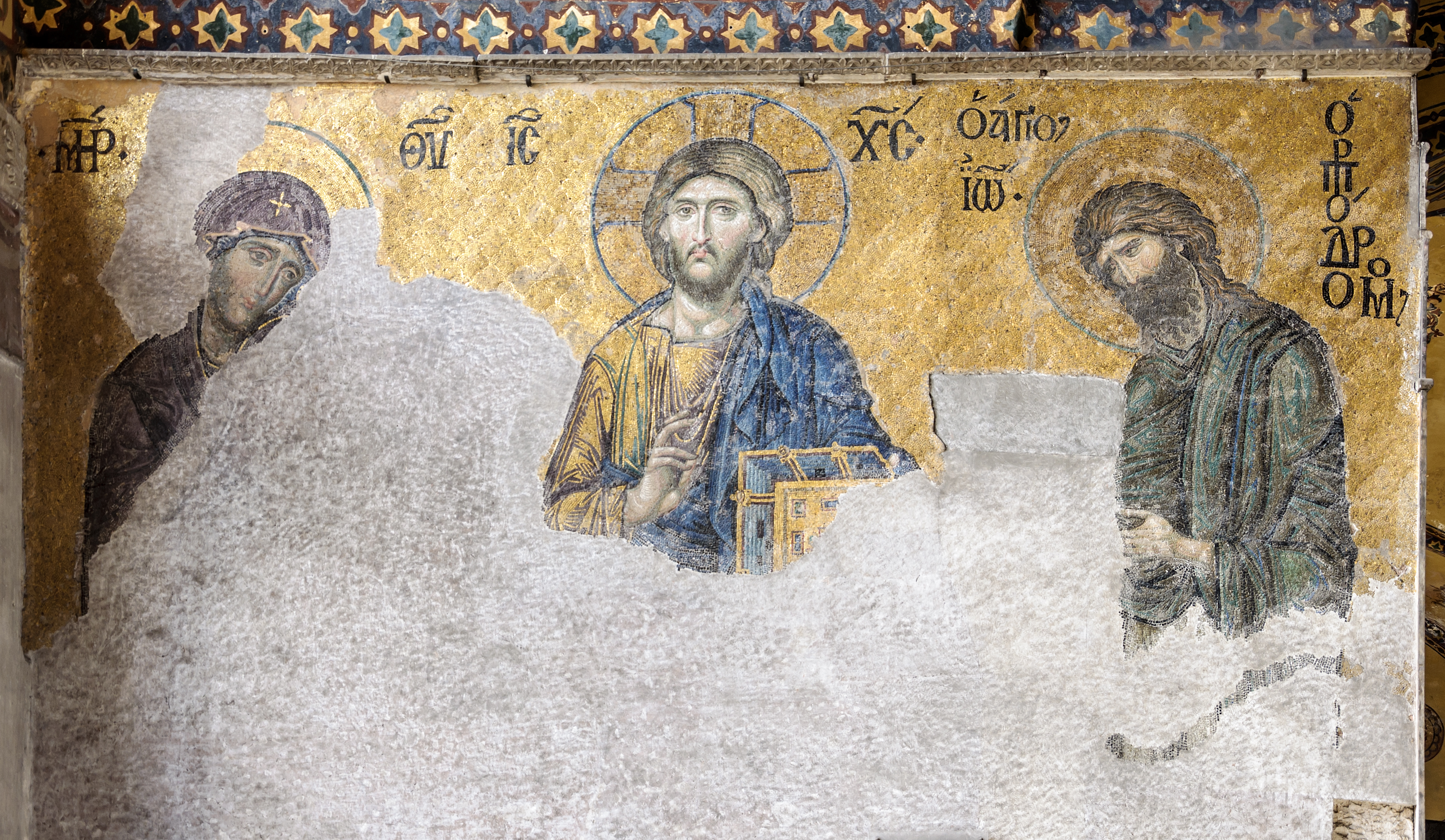
File:Deesis mosaic Hagia Sophia.jpg
Deësis (Gr. "Prayer" or "Supplication") mosaic, 13th century.  Hagia Sophia  (Holy Wisdom) Cathedral, Constantinople, Byzantine Empire; showing the Virgin Mary and John the Baptist on Christ's left and right (photo Wikimedia Commons)
 
 Now Jesus, going up to Jerusalem, took the twelve disciples aside on the road and said to them, "Behold, we are going up to Jerusalem, and the Son of Man will be betrayed to the chief priests and to the scribes; and they will condemn Him to death, and deliver Him to the Gentiles to mock and to scourge and to crucify.  And the third day He will rise again."

Then the mother of Zebedee's sons came to Him with her sons, kneeling down and asking something from Him.  And He said to her, "What do you wish?"  She said to Him, "Grant that these two sons of mine may sit, one of Your right hand and the other on the left, in Your kingdom."  But Jesus answered and said, "You do not know what you ask.  Are you able to drink the cup that I am about the drink, and to be baptized with the baptism that I am baptized with?"  They said to Him, "We are able."  So He said to them, "You will indeed drink My cup, and be baptized with the baptism that I am baptized with; but to sit on My right hand and on My left is not Mine to give, but it is for those for whom it is prepared by My Father."  And when the ten heard it, they were greatly displeased with the two brothers.  But Jesus called them to Himself and said, "You know  that the rulers of the Gentiles lord it over them, and those who are great exercise authority over them.  Yet it shall not be so among you; but whoever desires to become great among you, let him be your servant.  And whoever desires to be first among you, let him be your slave -- just as the Son of Man did not come to be served, but to serve, and to give His life a ransom for many."
 
- Matthew 20:17-28 
 
In yesterday's reading, Jesus gave the parable of the Workers in the Vineyard:  "For the kingdom of heaven is like a landowner who went out early in the morning to hire laborers for his vineyard.  Now when he had agreed with the laborers for a denarius a day, he sent then into his vineyard.  And he went out about the third hour and saw others standing idle in the marketplace, and said to them, 'You also go into the vineyard, and whatever is right I will give you.'  So they went.  Again he went out about the sixth and the ninth hour, and did likewise.  And about the eleventh hour he went out and found others standing idle, and said to them, 'Why have you been standing here idle all day?'  They said to him, 'Because no one hired us.'  He said to them, 'You also go into the vineyard, and whatever is right you will receive.'  So when evening had come, the owner of the vineyard said to his steward, 'Call the laborers and give them their wages, beginning with the last to the first.'  And when those came who were hired about the eleventh hour, they each received a denarius.  But when the first came, they supposed that they would receive more; and they likewise received each a denarius.  And when they had received it, they complained against the landowner, saying, 'These last men have worked only one hour, and you made them equal to us who have borne the burden and the heat of the day.'  But he answered one of them and said, 'Friend, I am doing you no wrong.  Did you not agree with me for a denarius?  Take what is yours and go your way.  I wish to give to this last man the same as to you.  Is it not lawful for me to do what I wish with my own things?  Or is your eye evil because I am good?'  So the last will be first, and the first last.  For many are called, but few chosen."
 
  Now Jesus, going up to Jerusalem, took the twelve disciples aside on the road and said to them, "Behold, we are going up to Jerusalem, and the Son of Man will be betrayed to the chief priests and to the scribes; and they will condemn Him to death, and deliver Him to the Gentiles to mock and to scourge and to crucify.  And the third day He will rise again."  My study Bible comments that Christ's repeated prediction of His Passion is meant to encourage and strengthen disciples for the terrifying events they will face.  According to Theophylact, it is as if Christ were saying, "Think on all these [words and miracles], so that when you see me hanging on the Cross, you will not imagine that I am suffering because I am powerless to do otherwise."

Then the mother of Zebedee's sons came to Him with her sons, kneeling down and asking something from Him.  And He said to her, "What do you wish?"  She said to Him, "Grant that these two sons of mine may sit, one of Your right hand and the other on the left, in Your kingdom."  But Jesus answered and said, "You do not know what you ask.  Are you able to drink the cup that I am about the drink, and to be baptized with the baptism that I am baptized with?"  They said to Him, "We are able."  So He said to them, "You will indeed drink My cup, and be baptized with the baptism that I am baptized with; but to sit on My right hand and on My left is not Mine to give, but it is for those for whom it is prepared by My Father."   We don't really know why at this juncture the mother of James and John Zebedee has come to Christ with this request.  It is a sort of repetition of the disciples previously asking, "Who then is greatest in the kingdom of heaven?"  But this time, it is the mother of Zebedee's sons who comes with this request on behalf of James and John.  When the question of "the greatest" was asked before, Jesus took pains with specific and extended teachings on humility and the need to serve, especially to take care of the "little ones" in the Church.  Perhaps Christ speaking of His coming Passion, and saying that on the third day He will rise again has prompted the disciples to assume that He will come into an eternal, earthly kingdom, as is widely expected of the Messiah.  But my study Bible comments that this quest for temporal power and glory is unfitting for a disciple and it shows an earthly misunderstanding of the Kingdom of God.  Here Matthew tells us that it was their mother who requested such an honor -- but John and James' own involved in revealed because Jesus addresses them in the plural "you" in the Greek both here and in Mark 10:36.   We must note that Christ calls His Crucifixion a cup and His death a baptism.  The Cross is a cup, my study Bible says, because He drank it willingly (Hebrews 12:2).  His death is baptism, as He was completely immersed in it, and yet it cleansed the world (Romans 6:3-6).  Christ's prophecy of John and James participating in the same cup and baptism shows the life of persecution and martyrdom these brothers would lead after Pentecost -- James would be the first apostle to be martyred (Acts 12:1-2), and John would go on to a long life of persecution and exile, producing one Gospel, three Epistles, and the Revelation.  My study Bible further notes on this passage that Christ declaring that the places of honor in the Kingdom are not His to give doesn't mean He lacks authority.  It means, instead, that they are not His to give arbitrarily.  He will give them to those for whom God has prepared them.  Note also, my study Bible says, that with regard to sitting as equals on the right and the left hand of Christ in Christ's Kingdom, St. John Chrysostom teaches that nobody could possibly occupy these positions.  Regarding the highest places of honor that can be given to human beings, the icons of the Orthodox Church universally depict the Virgin Mary (most blessed among women -- Luke 1:28) and John the Baptist (greatest born of women -- Matthew 11:11) holding these places.  See the icon above, the 13th century mosaic entitled Deësis, meaning "prayer" or "supplication" in Greek, from Hagia Sophia (Holy Wisdom) Cathedral in Constantinople, the capitol of the Byzantine Empire.
 
And when the ten heard it, they were greatly displeased with the two brothers.  But Jesus called them to Himself and said, "You know  that the rulers of the Gentiles lord it over them, and those who are great exercise authority over them.  Yet it shall not be so among you; but whoever desires to become great among you, let him be your servant.  And whoever desires to be first among you, let him be your slave -- just as the Son of Man did not come to be served, but to serve, and to give His life a ransom for many."  My study Bible notes that Jesus once again corrects the disciples, this time by first comparing them to the power-hungry Gentiles, whom they themselves considered an abomination, and contrasting them to Himself, who serves us although He is Lord of all.  My study Bible notes here that for many is an Aramaic expression which indicates "for all."

So, in the context of the Gospel, there is the common theme of sacrifice running as a thread throughout the past few readings.  There was first the story of the rich young man, whom Jesus loved, and whom He told that if he wanted to be perfect, he should sell his possessions and give to the poor, and follow Him.  This was followed by a discussion regarding the difficulties which wealth presents to those who would seek the kingdom of heaven, and the sacrifices which the disciples themselves have made.  In yesterday's reading (see above), Jesus gave the parable of the Workers in the Vineyard, expressing the principle that not all will labor equally, and yet all will receive the same reward.  Here we have the dynamic quality in the story line in which the mother of John and James Zebedee comes (seemingly on their behalf) asking Christ to make her two sons effectively greatest in His coming Kingdom, to sit at His right and left hand.  According to my study Bible, as we read above, these are positions no one could fill, and the positions there will be will go to those for whom they are prepared by God.  But again, all of this comes within the theme of sacrifice, for it all begins with Christ's second warning of His Passion and death to come, followed by Resurrection.  While the family of Zebedee has focused on what this might mean for a coming "earthly" type kingdom, Jesus' true meaning here is about His own sacrifice on behalf of all -- which will function as an image of service for everyone to remember after Pentecost and the mission of the Church has truly begun.  While Jesus has already answered the question, "Who then is the greatest in the kingdom of heaven?" with warnings about abuses of power, about humility, and service in the Church, this is yet a repetition with more emphasis, contrasting the use of power witnessed in the kingdoms of the Gentiles with the type of leadership Christ wants in His Church, to which He will entrust these apostles.  It's such an important lesson that sections of the Gospel are repeatedly devoted it, as Jesus begins His way toward Jerusalem with warnings to the disciples about what is to come.  Therefore it remains an essential lesson for the Church, and the world has seen plenty of excesses which enforce Christ's teachings all the more for all of us.  Let us endeavor to keep and live His faith, as He has taught, and follow the examples of those who have served throughout the centuries, both great and small, martyrs and saints, and the countless "little ones" who have served with their own lives and faith as well.  


Wednesday, June 26, 2024

So the last will be first, and the first last. For many are called, but few chosen

 
 "For the kingdom of heaven is like a landowner who went out early in the morning to hire laborers for his vineyard.  Now when he had agreed with the laborers for a denarius a day, he sent then into his vineyard.  And he went out about the third hour and saw others standing idle in the marketplace, and said to them, 'You also go into the vineyard, and whatever is right I will give you.'  So they went.  Again he went out about the sixth and the ninth hour, and did likewise.  And about the eleventh hour he went out and found others standing idle, and said to them, 'Why have you been standing here idle all day?'  They said to him, 'Because no one hired us.'  He said to them, 'You also go into the vineyard, and whatever is right you will receive.'  So when evening had come, the owner of the vineyard said to his steward, 'Call the laborers and give them their wages, beginning with the last to the first.'  And when those came who were hired about the eleventh hour, they each received a denarius.  But when the first came, they supposed that they would receive more; and they likewise received each a denarius.  And when they had received it, they complained against the landowner, saying, 'These last men have worked only one hour, and you made them equal to us who have borne the burden and the heat of the day.'  But he answered one of them and said, 'Friend, I am doing you no wrong.  Did you not agree with me for a denarius?  Take what is yours and go your way.  I wish to give to this last man the same as to you.  Is it not lawful for me to do what I wish with my own things?  Or is your eye evil because I am good?'  So the last will be first, and the first last.  For many are called, but few chosen."
 
- Matthew 20:1-16 
 
In yesterday's reading, Jesus was following up with His disciples regarding the rich young man who had come to Him seeking eternal life.  Jesus said to His disciples, "Assuredly, I say to you that it is hard for a rich man to enter the kingdom of heaven.  And again I say to you, it is easier for a camel to go through the eye of a needle than for a rich man to enter the kingdom of God."  When His disciples heard it, they were greatly astonished, saying, "Who then can be saved?"  But Jesus looked at them and said to them, "With men this is impossible, but with God all things are possible."  Then Peter answered and said to Him, "See, we have left all and followed You.  Therefore what shall we have?"  So Jesus said to them, "Assuredly I say to you, that in the regeneration, when the Son of Man sits on the throne of His glory, you who have followed Me will also sit on twelve thrones, judging the twelve tribes of Israel.  And everyone who has left houses or brothers or sisters or father or mother or wife or children or lands, for My name's sake, shall receive a hundredfold, and inherit eternal life.  But many who are first will be last, and the last first."
 
"For the kingdom of heaven is like a landowner who went out early in the morning to hire laborers for his vineyard.  Now when he had agreed with the laborers for a denarius a day, he sent then into his vineyard.  And he went out about the third hour and saw others standing idle in the marketplace, and said to them, 'You also go into the vineyard, and whatever is right I will give you.'  So they went.  Again he went out about the sixth and the ninth hour, and did likewise.  And about the eleventh hour he went out and found others standing idle, and said to them, 'Why have you been standing here idle all day?'  They said to him, 'Because no one hired us.'  He said to them, 'You also go into the vineyard, and whatever is right you will receive.'  So when evening had come, the owner of the vineyard said to his steward, 'Call the laborers and give them their wages, beginning with the last to the first.'  And when those came who were hired about the eleventh hour, they each received a denarius.  But when the first came, they supposed that they would receive more; and they likewise received each a denarius.  And when they had received it, they complained against the landowner, saying, 'These last men have worked only one hour, and you made them equal to us who have borne the burden and the heat of the day.'  But he answered one of them and said, 'Friend, I am doing you no wrong.  Did you not agree with me for a denarius?  Take what is yours and go your way.  I wish to give to this last man the same as to you.  Is it not lawful for me to do what I wish with my own things?  Or is your eye evil because I am good?'  So the last will be first, and the first last.  For many are called, but few chosen."  My study Bible explains that in this parable, the vineyard is life in this world.  The day refers both to the span of a single person's life, and also to the whole of human history.  The laborers, it says, are the people in every nation.  Each hour in this sense can refer to times in a person's life -- whether infancy, youth, adulthood, maturity, or old age.  There is a second meaning considering the span of history perspective, and in that idea this parable may refer to those called during the various covenants we know from Scripture:  with Adam, Noah, Abraham, Moses, and finally Christ.  My study Bible adds that God's generosity provides equal reward for both early and late comers.  It notes that Jesus teaches that the former should not be proud of their long service nor resent those who are called at the eleventh hour.  To the latecomers, then, Christ teaches that it is possible even in a short time or at the end of one's life to recover and inherit everything.  In the early Church, therefore, this message applied specifically to the Jews (who were the first-called) and the Gentiles (those who were called later).  In our time, this can be applied to those raised in the Church and also to those who find the Church later in life, both of whom receive an equal reward.  The renowned paschal sermon by St. John Chrysostom is based on this parable, as he applies it to the preparations of each person in approaching the paschal Eucharist.  
 
Today's parable comes to us in context of readings with the theme of sacrifice; that is, what do we sacrifice for the sake of the kingdom of God?  The rich young man who came to Christ asking what he must do for eternal life was asked to sell his possessions, give to the poor, and follow Christ -- then he would be "perfect."   Following this encounter, the disciples -- through Peter, who so frequently speaks for all -- said, "See, we have left all and followed You.  Therefore what shall we have?" (see yesterday's reading, above).  Jesus replied, "Assuredly I say to you, that in the regeneration, when the Son of Man sits on the throne of His glory, you who have followed Me will also sit on twelve thrones, judging the twelve tribes of Israel.  And everyone who has left houses or brothers or sisters or father or mother or wife or children or lands, for My name's sake, shall receive a hundredfold, and inherit eternal life.  But many who are first will be last, and the last first."  And Christ has followed this statement with the teaching of the parable in today's reading, about the laborers in the vineyard.  One thing He seems to make clear is that we should not expect a sort of worldly sense of work and reward  (or risk-reward, in modern investment terms) in equal measure.  In this economy of the Kingdom, all who labor, regardless of differing degrees of sacrifice and time, earn the same reward.  Jesus gives us a sense of this seemingly upside-down (by worldly standards) economy when He states flatly, "So the last will be first, and the first last.  For many are called, but few chosen."  He also makes it plain that this reward system is purely up to the wisdom and discretion of the owner, the Lord, and not up to the laborers.  The landowner says, "Friend, I am doing you no wrong.  Did you not agree with me for a denarius?  Take what is yours and go your way.  I wish to give to this last man the same as to you.  Is it not lawful for me to do what I wish with my own things?  Or is your eye evil because I am good?"  The ultimate good is God, the Lord, the landowner.  Out of some sort of envy (is your eye evil?) comes the thinking that we know better, have a better idea how things should be run than God does.  But we, like the disciples, are to trust that all things are in the hands of God, and thus the ultimate good is in the judgment and discernment of God.  There may be things that are quire mysterious to us, like whether or not it is fair or just that those who sacrifice more receive the same ultimate reward or benefit of eternal life.  But the ultimate good is in the discernment of God -- and we who are called, in whatever way, need to understand that how we are called, and the "work" we are called to, is just that:  appropriate to us.  This is true even if we do not understand the why and the wherefore.  This parable reminds us that, after Job had his long-desired confrontation with the Lord, the Lord began to reply with these words:  "Where were you when I laid the foundations of the earth? Tell Me, if you have understanding. Who determined its measurements?  Surely you know! Or who stretched the line upon it? To what were its foundations fastened? Or who laid its cornerstone, when the morning stars sang together, and all the sons of God shouted for joy?"  (Job 38:4-7).  The vineyard owner is the One who told Isaiah, "For My thoughts are not your thoughts, nor are your ways My ways" (Isaiah 55:8).  This is an important theme throughout the whole of the Bible, and is expressed even in the ending to John's Gospel, in which Peter was given personal and explicit instruction three times. "Feed my lambs," said the Lord.  But then Peter asked, referring to John, "But Lord, what about this man?"  Christ replied to Peter, "If I will that he remain till I come, what is that to you?  You follow Me" (see John 21:15-25).  Therefore let us understand that, as we take up our own crosses (just as in that same passage from St. John's Gospel, St. Peter was warned by Christ that he would follow Him to his own cross), each one's own "labor" may be entirely different from the others.  Truly we may recall that St. John Chrysostom's commentary on the command Christ gives to the rich young man, to sell all that he has and give to the poor, is actually easier than following Christ in all things.  Life often does not seem fair -- and indeed, it is not.  But if we pay attention to the ways God will ask us to go forward, the things we will be asked to work at and perhaps to sacrifice, we just might find that all that we do in faith is in fact the remedy to the injustice we perceive.  All will receive the equal reward in God's sight, but not all will perform the same labors in life, and not every life or person will be exactly the same -- nor should we wish it to be.  "So the last will be first, and the first last.  For many are called, but few chosen." 


Saturday, December 2, 2023

Have mercy on us, O Lord, Son of David!

 
 Now as they went out of Jericho, a great multitude followed Him.  And behold, two blind men sitting by the road, when they heard that Jesus was passing by, cried out, saying, "Have mercy on us, O Lord, Son of David!"  Then the multitude warned them that they should be quiet; but they cried out all the more, saying, "Have mercy on us, O Lord, Son of David!"  So Jesus stood still and called them, and said, "What do you want Me to do for you?"  They said to Him, "Lord, that our eyes may be opened."  So Jesus had compassion and touched their eyes.  And immediately their eyes received sight, and they followed Him.
 
- Matthew 20:29-34 
 
Yesterday we read that Jesus, now going up to Jerusalem, took the twelve disciples aside on the road and said to them, "Behold, we are going up to Jerusalem, and the Son of Man will be betrayed to the chief priests and to the scribes; and they will condemn Him to death, and deliver Him to the Gentiles to mock and to scourge and to crucify.  And the third day He will rise again."  Then the mother of Zebedee's sons came to Him with her sons, kneeling down and asking something from Him.  And He said to her, "What do you wish?"  She said to Him, "Grant that these two sons of mine may sit, one of Your right hand and the other on the left, in Your kingdom."  But Jesus answered and said, "You do not know what you ask.  Are you able to drink the cup that I am about to drink, and be baptized with the baptism that I am baptized with?"  They said to Him, "We are able."  So He said to them, "You will indeed drink My cup, and be baptized with the baptism that I am baptized with; but to sit on My right hand and on My left is not Mine to give, but it is for those for whom it is prepared by My Father."  And when the ten heard it, they were greatly displeased with the two brothers.  But Jesus called them to Himself and said, "You know that the rulers of the Gentiles lord it over them, and those who are great exercise authority over them, and those who are great exercise authority over them.  Yet it shall not be so among you; but whoever desires to become great among you, let him be your servant.  And whoever desires to be first among you, let him be your slave -- just as the Son of Man did not come to be served but to serve, and to give His life a ransom for many."
 
  Now as they went out of Jericho, a great multitude followed Him.  And behold, two blind men sitting by the road, when they heard that Jesus was passing by, cried out, saying, "Have mercy on us, O Lord, Son of David!"  Then the multitude warned them that they should be quiet; but they cried out all the more, saying, "Have mercy on us, O Lord, Son of David!"  So Jesus stood still and called them, and said, "What do you want Me to do for you?"  They said to Him, "Lord, that our eyes may be opened."  So Jesus had compassion and touched their eyes.  And immediately their eyes received sight, and they followed Him. My study Bible comments that the two blind men greet Jesus as Lord, which is the common title for God, and they also call Him Son of David, a title deeply associated with the Messiah.  It notes that although Jesus knows what we want before we ask, He calls us to ask freely so that we might learn of His mercy.  There is another, spiritual interpretation to this miracle in patristic literature, with the blind men symbolizing future generations who would come to faith only by hearing, without the benefit of seeing Christ in person (see John 20:29).  In this spiritual interpretation, the ones who tried to silence the blind men are seen as persecutors and tyrants, who in each generation try to silence the Church.  Nonetheless, under persecution, the Church all the more confesses Jesus Christ.  

We might ask ourselves how, in light of the spiritual interpretation of this story noted by my study Bible, we respond when others wish us to keep silent in expressions of our faith.  Such an expression can be as simple as wearing a cross pendant, or perhaps at times giving indication of prayer, such as giving thanks before a meal in a public place.  In the West, we can't really say we face mass movement of persecution for some things, although depending upon where we are, there are times when culturally or socially speaking, such expressions rub others, who are hostile, the wrong way, and are found to be objectionable.  This is the state of things in the Western world for some of us.  But what do we do when our expressions of compassion, inspired by faith, are seen to be objectionable?  Without any overt reference to our faith, there are times when people will seemingly find offensive things that our faith inspires us to do, which we believe are doing good for others.  Some very political matters currently come to mind, like the debate over giving gender-changing hormones to very young people who have not yet physically matured sufficiently, so that the effects on their bodies will be drastic and lifelong (see, for example, this article).  That's in addition to historical understanding of psychological maturity to make such life-altering changes which will follow for the rest of their lives, regardless of later choices.  Other issues that surround us simply have to do with the objections of those who may be hostile to faith for any reason, and don't want to be reminded of it.  But what is important is our own prayerful response to what we find in our lives, our social interactions, and our own struggles with the questions that come up for choices in the ways we live our lives.  There is a level at which we struggle to balance compassion for others with respect for different opinions.  Tolerance itself would seem to be a virtue born out of Christianity, for it is Christ Himself who faced hostility for actions such as healing these men, or preaching His gospel, a hostility born out of envy or resentment by those with official religious authority (Matthew 27:18).  What we find is that the very issue of God's kingdom breaking into the world will present spiritual challenges that don't necessarily have the explanations that justify them on logical or even legal terms, and this is because, in St. Paul's words, "we do not wrestle against flesh and blood, but against principalities, against powers, against the rulers of the darkness of this age, against spiritual hosts of wickedness in the heavenly places" (Ephesians 6:12).  There are times when things that are nominally good will present as a threat to those who reject the Author of the good.  These things manifest in psychological terms, and without obvious explanation.  But we will find that secondary reasons can be created to defend even irrational hatreds.  The blind men are in some ways perfect examples of this phenomenon, because of the symbolic values inherent in the setting.  Jericho was a very ancient city, even predating the development of agriculture, to 10,000 BC.  As such, during Christ's time, its reputation was one of sinfulness and iniquity, connected perhaps to the practices of the various gods worshiped throughout its history.  The parable of the Good Samaritan is set on the road going down to Jericho from Jerusalem (the opposite direction that Christ now travels in today's reading), about a man beset and beaten by robbers and left abandoned and neglected by the side of the road.  So the blindness of these men who call out to Christ in today's reading is easily seen as symbolic of the blindness of a place like Jericho, notorious for its bad practices and abuses.  Clearly in Biblical language blindness is often associated with the darkness of ignorance and therefore sin.  The lack of illumination of sight is another metaphor for spiritual blindness, light that does not "enter" into the eye.  As such we can see them as those who, unlike the ones mired in and blind to the sinfulness of their surroundings, are different in that they are aware of their affliction.  They call out to Christ the Savior, the Messiah and Deliverer (Son of David) to take them out of their state and to help them.  Even in Christ's request asking them to state what they wish from Him we see the spiritual need to name our ailments, to identify them, so that we may be healed and come to Christ in that state of awareness for His intervention in our lives and for our problems.  But what makes these blind men stand out so that people seek to make them be quiet is precisely their awareness of both their sad condition, and Christ's capacity to heal them for which they shout.  Those who are complacent with going along with blindness and spiritual darkness will resent such awareness and its overt expression of need -- and there we have a deeper metaphor for the spiritual obstacles for those whose hearts have turned to that light and desire it greatly for themselves.  Simply by loving Christ, we may find ourselves a target for offense without cause.  What we must find for ourselves is not necessarily a sense in which we must openly challenge or materially change such responses, but rather remind ourselves that our mission is to endure in faith, because this is what Christ has taught.  In His teachings and warnings of times of difficulty to come, His words declare to us that "he who endures to the end will be saved."  This message is repeated twice in Matthew's gospel, at Matthew 10:22 and 24:13, emphasizing its significance in Christ's teachings to His disciples.  We must consider what it means to endure, to simply persist in being faithful regardless of our experiences.  For a prayerful life, and endurance in faith, is powerful -- and that is what is asked of us.  Let us consider what it means to be like the blind men, aware of what we lack, and yet persisting in seeking what we know we need -- even when others who do not seek the same may be disturbed by that very seeking.  The spiritual life is powerful, and there are those who sense and feel it, even when its very existence is denied.  In this context, it's important to remember the history of monasticism within Christianity, and the faith in the power of prayer to save the world -- even on a mountain or in the desert.  "Have mercy on us, O Lord" (Ἐλέησον ἡμᾶς κύριε)  would become the prayer of the Church for the whole of its existence, and remains so today


Friday, December 1, 2023

Are you able to drink the cup that I am about to drink, and be baptized with the baptism that I am baptized with?

 
 Now Jesus, going up to Jerusalem, took the twelve disciples aside on the road and said to them, "Behold, we are going up to Jerusalem, and the Son of Man will be betrayed to the chief priests and to the scribes; and they will condemn Him to death, and deliver Him to the Gentiles to mock and to scourge and to crucify.  And the third day He will rise again."

Then the mother of Zebedee's sons came to Him with her sons, kneeling down and asking something from Him.  And He said to her, "What do you wish?"  She said to Him, "Grant that these two sons of mine may sit, one of Your right hand and the other on the left, in Your kingdom."  But Jesus answered and said, "You do not know what you ask.  Are you able to drink the cup that I am about to drink, and be baptized with the baptism that I am baptized with?"  They said to Him, "We are able."  So He said to them, "You will indeed drink My cup, and be baptized with the baptism that I am baptized with; but to sit on My right hand and on My left is not Mine to give, but it is for those for whom it is prepared by My Father."  And when the ten heard it, they were greatly displeased with the two brothers.  But Jesus called them to Himself and said, "You know that the rulers of the Gentiles lord it over them, and those who are great exercise authority over them, and those who are great exercise authority over them.  Yet it shall not be so among you; but whoever desires to become great among you, let him be your servant.  And whoever desires to be first among you, let him be your slave -- just as the Son of Man did not come to be served but to serve, and to give His life a ransom for many."
 
- Matthew 20:17-28 
 
In yesterday's reading, Jesus told a parable of the kingdom of heaven:  "For the kingdom of heaven is like a landowner who went out early in the morning to hire laborers for his vineyard.  Now when he had agreed with the laborers for a denarius a day, he sent them into his vineyard.  And he went out about the third hour and saw others standing idle in the marketplace, and said to them, 'You also go into the vineyard, and whatever is right I will give you.'  So they went.  Again he went out about the sixth and the ninth hour, and did likewise.  And about the eleventh hour he went out and found others standing idle, and said to them, 'Why have you been standing here idle all day?'  They said to him, 'Because no one hired us.'  He said to them, 'You also go into the vineyard, and whatever is right you will receive.'  So when evening had come, the owner of the vineyard said to his steward, 'Call the laborers and give them their wages, beginning with the last to the first.'  And when those came who were hired about the eleventh hour, they each received a denarius.  But when the first came, they supposed that they would receive more; and they likewise received each a denarius.  And when they had received it, they complained against the landowner, saying, 'These last men have worked only one hour, and you made them equal to us who have borne the burden and the heat of the day.'  But he answered one of them and said, 'Friend, I am doing you no wrong.  Did you not agree with me for a denarius?  Take what is yours and go your way.  I wish to give to this last man the same as to you.  Is it not lawful for me to do what I wish with my own things?  Or is your eye evil because I am good?'  So the last will be first, and the first last.  For many are called, but few chosen." 
 
  Now Jesus, going up to Jerusalem, took the twelve disciples aside on the road and said to them, "Behold, we are going up to Jerusalem, and the Son of Man will be betrayed to the chief priests and to the scribes; and they will condemn Him to death, and deliver Him to the Gentiles to mock and to scourge and to crucify.  And the third day He will rise again."  Now, the text notes for us, Jesus is going up to Jerusalem.  As He begins this final journey, He warns the disciples for the third time of His Passion to come.  My study Bible comments that Christ's repeated prediction of His Passion is meant to encourage and strengthen them for the terrifying events they will be facing.  Theophylact is cited here, who comments that it is as if Christ were saying to them, "Think on all these [words and miracles], so that when you see me hanging on the Cross, you will not imagine that I am suffering because I am powerless to do otherwise."
 
 Then the mother of Zebedee's sons came to Him with her sons, kneeling down and asking something from Him.  And He said to her, "What do you wish?"  She said to Him, "Grant that these two sons of mine may sit, one of Your right hand and the other on the left, in Your kingdom."  But Jesus answered and said, "You do not know what you ask.  Are you able to drink the cup that I am about to drink, and be baptized with the baptism that I am baptized with?"  They said to Him, "We are able."  So He said to them, "You will indeed drink My cup, and be baptized with the baptism that I am baptized with; but to sit on My right hand and on My left is not Mine to give, but it is for those for whom it is prepared by My Father."   We've already been given to understand that there is concern among the disciples for the places they might expect in Christ's kingdom (see this reading).  At this stage it's likely they expect an earthly kingdom to be established by the Messiah, and so Christ gives them repeated warnings about what is to come at Jerusalem.  My study Bible comments that this quest for temporal power and glory is unfitting for a disciple, and it shows an earthly misunderstanding of the kingdom of God.  Here, we're told that it is the mother of Zebedee's sons who requests this honor (perhaps also letting us know that she is among the women from Galilee who travel with and support Christ's ministry).  But John's and James' own involvement in this desire is shown by a plural "you" in Christ's response in the Greek (verse 22), and in Mark 10:35.  We must note also that Christ calls His Crucifixion a cup and His death a baptism.  My study Bible comments that the Cross is a cup because He drank it willingly (Hebrews 12:2).  His death is baptism as He was completely immersed in it, yet it cleansed the world (Romans 6:3-6).  Christ's prophecy of John and James participating in the same cup and baptism shows the life of persecution and martyrdom they will lead after Pentecost.  Moreover, Christ declaring that the places of honor in the Kingdom are not His to give doesn't mean He lacks authority.  Instead, it indicates they aren't His to give arbitrarily.  They will be given to those for whom God has prepared them.  (See Wednesday's reading, in which Jesus tells them that "you who have followed Me will also sit on twelve thrones, judging the twelve tribes of Israel.")  With regard to sitting as equals on the right and left hand of Christ in His Kingdom, my study Bible cites St. John Chrysostom, who teaches that no one could possibly occupy such a position.  Regarding the highest places of honor given to human beings, the icons of the Orthodox Church universally depict the Virgin Mary (most blessed among women - Luke 1:28) and John the Baptist (greatest born of women - Matthew 11:11) holding these places. 

And when the ten heard it, they were greatly displeased with the two brothers.  But Jesus called them to Himself and said, "You know that the rulers of the Gentiles lord it over them, and those who are great exercise authority over them, and those who are great exercise authority over them.  Yet it shall not be so among you; but whoever desires to become great among you, let him be your servant.  And whoever desires to be first among you, let him be your slave -- just as the Son of Man did not come to be served but to serve, and to give His life a ransom for many."   Let us keep in mind that Christ has just revealed to the disciples (for the third time) that He "will be betrayed to the chief priests and to the scribes; and they will condemn Him to death, and deliver Him to the Gentiles to mock and to scourge and to crucify.  And the third day He will rise again.So let us consider in that light how out of place this request is in light of such revelation.  My study Bible comments that Jesus corrects the disciples by first comparing them to the power-hungry Gentiles, whom they themselves considered an abomination, and contrasts them to Himself.  He serves us, although He is Lord of all.   For many is an Aramaic expression which means "for all." 
 
 As noted above, the popular expectations of the people were that a Messiah would be an earthly deliverer, one who would throw off Roman rule and re-establish the kingdom of David and the fortunes of Israel.  With that understanding, we might assume that it is quite likely that the request by the mother of Zebedee's sons (the disciples John and James) comes in expectation of such a worldly kingdom, and hope that these important places will be given to them.  As my study Bible notes, Jesus' response using the plural "you" indicates that it's not just their mother who's making this request!  So we contrast this request with the very somber note in Jesus' warning, informing the disciples -- for the third time -- that He will suffer and be killed.  We can be fairly certain that this information is nearly impossible for the disciples to fathom, and likely they are unable to take it in and truly understand.  What they make of His words that "the third day He will rise again" we also don't know, and likely they have no idea.  Mark's Gospel tells us not only that they did not understand, but they were also afraid to ask Him (Mark 9:30-32).  Jesus more or less tells them so when He says in response to the Zebedees' request, "You do not know what you ask."  In this light, Jesus' preparation of the disciples for the eventuality of the Church must include teachings on humility, on the capacity for service.  There is so much that they will have to learn to separate from themselves in order to truly become the Church of the gospel message.   He teaches that James and John not only must understand His own mission, but be prepared to follow Him.  He asks them, "Are you able to drink the cup that I am about to drink, and be baptized with the baptism that I am baptized with?" and promises them that indeed they will.  He contrasts the Gentiles, who worship the pagan gods of power and acquisition, with Himself, who, although He is the Son, has come to serve all.   Even those places at His right and left hand are not His to give, but will go to the ones for whom the Father has prepared them.  Power and authority, for Jesus the Son of God, are vested in grace and service and self-emptying, and this is the great secret to the Kingdom and the Church which seeks to bear that Kingdom into the world.  It's a lesson that is too frequently forgotten, but is indispensable and invaluable -- the one precious thing we truly need.  James and John will go on to fulfill Christ's prediction about their future lives.  James will be the first martyr among the disciples, and John will go on to a long life lived in persecution and exile, leaving the Church His Gospel and three Epistles characterized by love, and the Revelation which gives the ultimate promise of the Bridegroom and the New Jerusalem for all.  But let us understand once more for ourselves, and think about the great seeming paradox (to us) of God's power and authority, which is qualified by grace, mercy, self-emptying, and service.  For we also are to go and do likewise, and follow Him.  This Advent, we would do well to consider how our own lives might benefit and follow this pattern.   For often, strange as it may seem to worldly eyes, it is in the giving up and serving Christ that we find who we really are, and what truly belongs to us.


Thursday, November 30, 2023

So the last will be first, and the first last. For many are called, but few chosen

 
 "For the kingdom of heaven is like a landowner who went out early in the morning to hire laborers for his vineyard.  Now when he had agreed with the laborers for a denarius a day, he sent them into his vineyard.  And he went out about the third hour and saw others standing idle in the marketplace, and said to them, 'You also go into the vineyard, and whatever is right I will give you.'  So they went.  Again he went out about the sixth and the ninth hour, and did likewise.  And about the eleventh hour he went out and found others standing idle, and said to them, 'Why have you been standing here idle all day?'  They said to him, 'Because no one hired us.'  He said to them, 'You also go into the vineyard, and whatever is right you will receive.'  So when evening had come, the owner of the vineyard said to his steward, 'Call the laborers and give them their wages, beginning with the last to the first.'  And when those came who were hired about the eleventh hour, they each received a denarius.  But when the first came, they supposed that they would receive more; and they likewise received each a denarius.  And when they had received it, they complained against the landowner, saying, 'These last men have worked only one hour, and you made them equal to us who have borne the burden and the heat of the day.'  But he answered one of them and said, 'Friend, I am doing you no wrong.  Did you not agree with me for a denarius?  Take what is yours and go your way.  I wish to give to this last man the same as to you.  Is it not lawful for me to do what I wish with my own things?  Or is your eye evil because I am good?'  So the last will be first, and the first last.  For many are called, but few chosen."
 
- Matthew 20:1-16 
 
In Tuesday's reading, Jesus advised a rich young ruler who sought eternal life to sell all his possessions, give to the poor, and to follow Him.  But that young man went away dejected, as he had many possessions.  In yesterday's reading, we were told that Jesus said to His disciples, "Assuredly, I say to you that it is hard for a rich man to enter the kingdom of heaven.  And again I say to you, it is easier for a camel to go through the eye of a needle than for a rich man to enter the kingdom of God."  When His disciples heard it, they were greatly astonished, saying, "Who then can be saved?"  But Jesus looked at them and said to them, "With men this is impossible, but with God all things are possible."  Then Peter answered and said to Him, "See, we have left all and followed You.  Therefore what shall we have?"  So Jesus said to them, "Assuredly I say to you, that in the regeneration, when the Son of Man sits on the throne of His glory, you who have followed Me will also sit on twelve thrones, judging the twelve tribes of Israel.  And everyone who has left houses or brothers or sisters or father or mother or wife or children or lands, for My name's sake, shall receive a hundredfold, and inherit eternal life.  But many who are first will be last, and the last first."
 
  "For the kingdom of heaven is like a landowner who went out early in the morning to hire laborers for his vineyard.  Now when he had agreed with the laborers for a denarius a day, he sent them into his vineyard.  And he went out about the third hour and saw others standing idle in the marketplace, and said to them, 'You also go into the vineyard, and whatever is right I will give you.'  So they went.  Again he went out about the sixth and the ninth hour, and did likewise.  And about the eleventh hour he went out and found others standing idle, and said to them, 'Why have you been standing here idle all day?'  They said to him, 'Because no one hired us.'  He said to them, 'You also go into the vineyard, and whatever is right you will receive.'  So when evening had come, the owner of the vineyard said to his steward, 'Call the laborers and give them their wages, beginning with the last to the first.'  And when those came who were hired about the eleventh hour, they each received a denarius.  But when the first came, they supposed that they would receive more; and they likewise received each a denarius.  And when they had received it, they complained against the landowner, saying, 'These last men have worked only one hour, and you made them equal to us who have borne the burden and the heat of the day.'  But he answered one of them and said, 'Friend, I am doing you no wrong.  Did you not agree with me for a denarius?  Take what is yours and go your way.  I wish to give to this last man the same as to you.  Is it not lawful for me to do what I wish with my own things?  Or is your eye evil because I am good?'  So the last will be first, and the first last.  For many are called, but few chosen."  My study Bible explains this parable as follows.  It says that the vineyard is life in this world.  The day is a reference both to the span of an individual person's life, and also to the whole of human history.  The laborers are all the people in each nation.  Every hour can refer to times in a person's life -- such as infancy, youth, adulthood, maturity, or old age.  There is a second meaning as well concerning the span of history.  This may refer to those called during the covenants with Adam, Noah, Abraham, Moses, and finally Christ.  Interestingly, the hours at which people are called (third hour or 9:00 a.m.; sixth hour or noon; ninth hour or 3:00 p.m.) are all formal hours for prayer in the structure of traditional church services.  My study Bible adds that God's generosity provides an equal reward for both early and late comers.  Jesus is teaching that the former should not be proud of their long service nor resent those called at the eleventh hour.  To the latecomers, Jesus is teaching that it is possible within even a short time, or at the end of one's life, to recover and to inherit everything.  There is another framework in which we may read this parable as well.  In the early Church, my study Bible explains, this message applied specifically to the Jews (the first-called) and the Gentiles (those called later).  In our time, we can apply it to those raised in the Church and to those who find the Church later in life, both of whom receive an equal reward.  This parable is also the basis for St. John Chrysostom's renowned paschal sermon (read at the midnight Resurrection service in the Orthodox Church each year).  In that sermon, St. Chrysostom applied the parable to the preparations of each person in approaching the paschal Eucharist. 
 
In today's parable, the vineyard owner asks, "'Is it not lawful for me to do what I wish with my own things?  Or is your eye evil because I am good?'  So the last will be first, and the first last.  For many are called, but few chosen."   These words are striking as they indicate the Lord's absolute sovereignty over the cosmos, and even over our lives.  The "rules" belong to God, the way salvation works and is decided also belongs to God, and so therefore, "The last will be first, and the first last.  For many are called but few chosen."  And clearly the Lord does the choosing.  Perhaps in the context of the parable, it's important to remember that Jesus is speaking to those who were the first called, the disciples, upon whose shoulders the rest of the Church and all those who would follow in faith would stand.  In that sense, their work began the earliest and was in some way possibly the heaviest or the hardest.  Their "heavy lifting" has stood us in good stead.  We and all who followed and will follow learn from them and have benefited from all that they established.  How could we read the Scriptures -- or even have Scriptures, for example, without the foundation laid by their work to begin with.  They did not have the resources we have available to us to begin their works of faith.  But of course, they had Christ, the vineyard owner, who directly called them.  But what of us, we who come later, even at the eleventh hour?  If we also become chosen for life in God's kingdom, we receive the same reward as do those first disciples.  And what of those who came before, such as Moses and Abraham?  It would seem that they were also called, and that somehow in the Lord's kingdom there is equal opportunity for the same reward.  We might not understand how the Lord's reckoning and judgment works, but we do understand that we are each -- no matter where we are, or who we are -- called to a purpose.  And this is not a purpose of our own choosing, but of God's choosing.  And therefore we each may receive the same reward.  For there is a job, an expectation, a potential for each of us, and it is the Lord who sets that bar, and who knows what that is.  It doesn't matter when we come into this activity, this work in the vineyard, but it does matter how we respond to what we're called, and when we're called.  In the end what matters is how the Lord calls us, and to what purpose, for God will do what God wishes with God's own things.  The landowner asks, "Or is your eye evil because I am good?"  An evil eye, we should understand, is one of malice born of envy.  This would seem to speak to the fallen angels, who could not accept the place God had for them, the humility to serve humankind, creatures made "a little lower than the angels" (Psalm 8:3-8).  It's a reminder to the disciples, and to us, of the humility we need to accept that perhaps we will do a different work than others, and yet receive the same reward for our own assignment; if necessary accepting that the last will be first, and the first last -- for many are called by the Lord, but few chosen.  For as Jesus says elsewhere, we are each called to take up our own cross (Luke 9:23).  An economist has commented on this parable that the equal payment to each one makes perfect economic sense for a project that requires different unique and complementary skills from each laborer, with each one's work essential for the ultimate product.  So let us accept and do our part, contributing to the whole of God's economy of salvation.  Let us find how we are called, and the humility to accept the way we might also be chosen.