
Showing posts with label right hand and left. Show all posts

Thursday, June 27, 2024

Are you able to drink the cup that I am about the drink, and to be baptized with the baptism that I am baptized with?


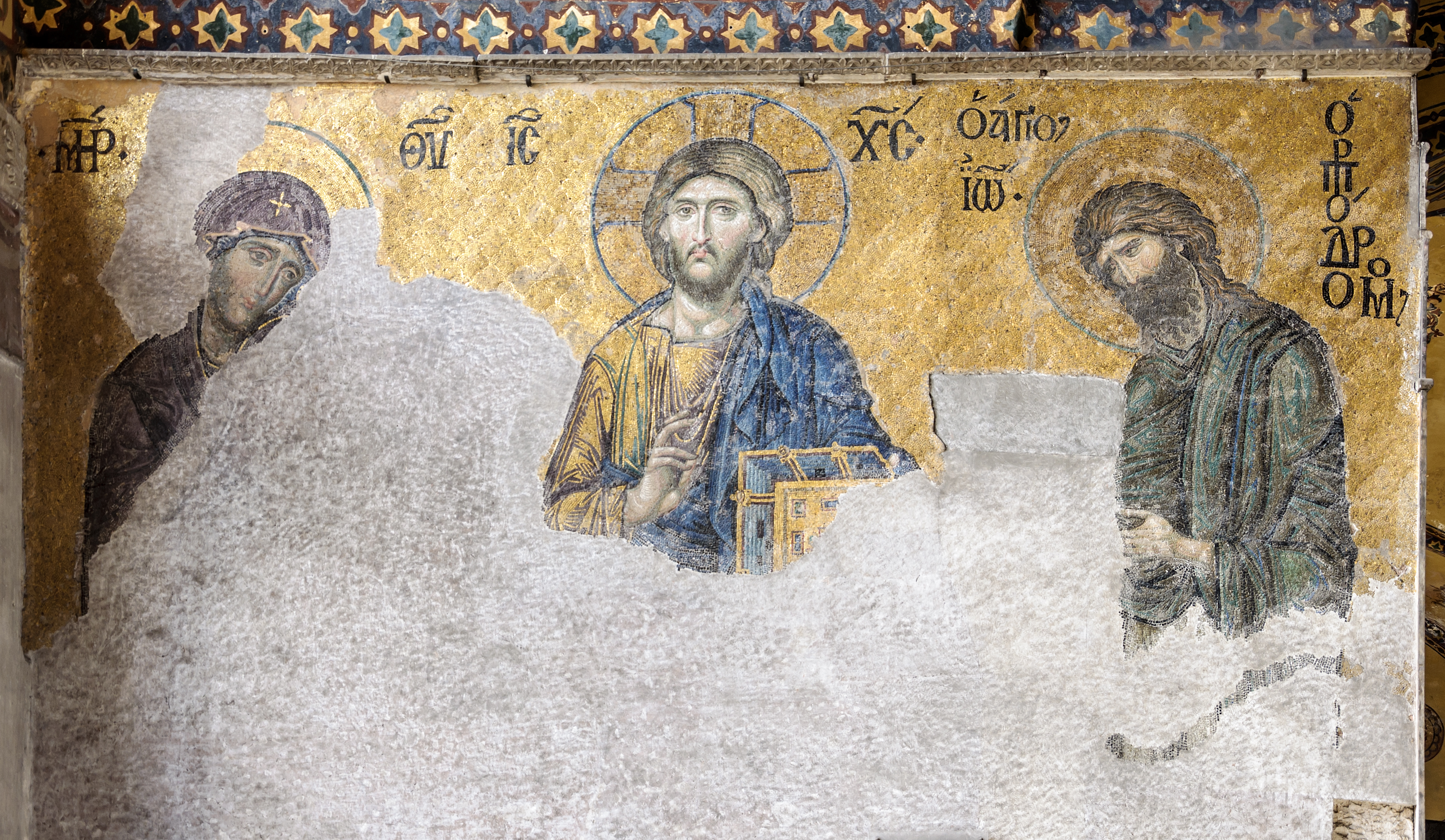
File:Deesis mosaic Hagia Sophia.jpg
Deësis (Gr. "Prayer" or "Supplication") mosaic, 13th century.  Hagia Sophia  (Holy Wisdom) Cathedral, Constantinople, Byzantine Empire; showing the Virgin Mary and John the Baptist on Christ's left and right (photo Wikimedia Commons)
 
 Now Jesus, going up to Jerusalem, took the twelve disciples aside on the road and said to them, "Behold, we are going up to Jerusalem, and the Son of Man will be betrayed to the chief priests and to the scribes; and they will condemn Him to death, and deliver Him to the Gentiles to mock and to scourge and to crucify.  And the third day He will rise again."

Then the mother of Zebedee's sons came to Him with her sons, kneeling down and asking something from Him.  And He said to her, "What do you wish?"  She said to Him, "Grant that these two sons of mine may sit, one of Your right hand and the other on the left, in Your kingdom."  But Jesus answered and said, "You do not know what you ask.  Are you able to drink the cup that I am about the drink, and to be baptized with the baptism that I am baptized with?"  They said to Him, "We are able."  So He said to them, "You will indeed drink My cup, and be baptized with the baptism that I am baptized with; but to sit on My right hand and on My left is not Mine to give, but it is for those for whom it is prepared by My Father."  And when the ten heard it, they were greatly displeased with the two brothers.  But Jesus called them to Himself and said, "You know  that the rulers of the Gentiles lord it over them, and those who are great exercise authority over them.  Yet it shall not be so among you; but whoever desires to become great among you, let him be your servant.  And whoever desires to be first among you, let him be your slave -- just as the Son of Man did not come to be served, but to serve, and to give His life a ransom for many."
 
- Matthew 20:17-28 
 
In yesterday's reading, Jesus gave the parable of the Workers in the Vineyard:  "For the kingdom of heaven is like a landowner who went out early in the morning to hire laborers for his vineyard.  Now when he had agreed with the laborers for a denarius a day, he sent then into his vineyard.  And he went out about the third hour and saw others standing idle in the marketplace, and said to them, 'You also go into the vineyard, and whatever is right I will give you.'  So they went.  Again he went out about the sixth and the ninth hour, and did likewise.  And about the eleventh hour he went out and found others standing idle, and said to them, 'Why have you been standing here idle all day?'  They said to him, 'Because no one hired us.'  He said to them, 'You also go into the vineyard, and whatever is right you will receive.'  So when evening had come, the owner of the vineyard said to his steward, 'Call the laborers and give them their wages, beginning with the last to the first.'  And when those came who were hired about the eleventh hour, they each received a denarius.  But when the first came, they supposed that they would receive more; and they likewise received each a denarius.  And when they had received it, they complained against the landowner, saying, 'These last men have worked only one hour, and you made them equal to us who have borne the burden and the heat of the day.'  But he answered one of them and said, 'Friend, I am doing you no wrong.  Did you not agree with me for a denarius?  Take what is yours and go your way.  I wish to give to this last man the same as to you.  Is it not lawful for me to do what I wish with my own things?  Or is your eye evil because I am good?'  So the last will be first, and the first last.  For many are called, but few chosen."
 
  Now Jesus, going up to Jerusalem, took the twelve disciples aside on the road and said to them, "Behold, we are going up to Jerusalem, and the Son of Man will be betrayed to the chief priests and to the scribes; and they will condemn Him to death, and deliver Him to the Gentiles to mock and to scourge and to crucify.  And the third day He will rise again."  My study Bible comments that Christ's repeated prediction of His Passion is meant to encourage and strengthen disciples for the terrifying events they will face.  According to Theophylact, it is as if Christ were saying, "Think on all these [words and miracles], so that when you see me hanging on the Cross, you will not imagine that I am suffering because I am powerless to do otherwise."

Then the mother of Zebedee's sons came to Him with her sons, kneeling down and asking something from Him.  And He said to her, "What do you wish?"  She said to Him, "Grant that these two sons of mine may sit, one of Your right hand and the other on the left, in Your kingdom."  But Jesus answered and said, "You do not know what you ask.  Are you able to drink the cup that I am about the drink, and to be baptized with the baptism that I am baptized with?"  They said to Him, "We are able."  So He said to them, "You will indeed drink My cup, and be baptized with the baptism that I am baptized with; but to sit on My right hand and on My left is not Mine to give, but it is for those for whom it is prepared by My Father."   We don't really know why at this juncture the mother of James and John Zebedee has come to Christ with this request.  It is a sort of repetition of the disciples previously asking, "Who then is greatest in the kingdom of heaven?"  But this time, it is the mother of Zebedee's sons who comes with this request on behalf of James and John.  When the question of "the greatest" was asked before, Jesus took pains with specific and extended teachings on humility and the need to serve, especially to take care of the "little ones" in the Church.  Perhaps Christ speaking of His coming Passion, and saying that on the third day He will rise again has prompted the disciples to assume that He will come into an eternal, earthly kingdom, as is widely expected of the Messiah.  But my study Bible comments that this quest for temporal power and glory is unfitting for a disciple and it shows an earthly misunderstanding of the Kingdom of God.  Here Matthew tells us that it was their mother who requested such an honor -- but John and James' own involved in revealed because Jesus addresses them in the plural "you" in the Greek both here and in Mark 10:36.   We must note that Christ calls His Crucifixion a cup and His death a baptism.  The Cross is a cup, my study Bible says, because He drank it willingly (Hebrews 12:2).  His death is baptism, as He was completely immersed in it, and yet it cleansed the world (Romans 6:3-6).  Christ's prophecy of John and James participating in the same cup and baptism shows the life of persecution and martyrdom these brothers would lead after Pentecost -- James would be the first apostle to be martyred (Acts 12:1-2), and John would go on to a long life of persecution and exile, producing one Gospel, three Epistles, and the Revelation.  My study Bible further notes on this passage that Christ declaring that the places of honor in the Kingdom are not His to give doesn't mean He lacks authority.  It means, instead, that they are not His to give arbitrarily.  He will give them to those for whom God has prepared them.  Note also, my study Bible says, that with regard to sitting as equals on the right and the left hand of Christ in Christ's Kingdom, St. John Chrysostom teaches that nobody could possibly occupy these positions.  Regarding the highest places of honor that can be given to human beings, the icons of the Orthodox Church universally depict the Virgin Mary (most blessed among women -- Luke 1:28) and John the Baptist (greatest born of women -- Matthew 11:11) holding these places.  See the icon above, the 13th century mosaic entitled Deësis, meaning "prayer" or "supplication" in Greek, from Hagia Sophia (Holy Wisdom) Cathedral in Constantinople, the capitol of the Byzantine Empire.
 
And when the ten heard it, they were greatly displeased with the two brothers.  But Jesus called them to Himself and said, "You know  that the rulers of the Gentiles lord it over them, and those who are great exercise authority over them.  Yet it shall not be so among you; but whoever desires to become great among you, let him be your servant.  And whoever desires to be first among you, let him be your slave -- just as the Son of Man did not come to be served, but to serve, and to give His life a ransom for many."  My study Bible notes that Jesus once again corrects the disciples, this time by first comparing them to the power-hungry Gentiles, whom they themselves considered an abomination, and contrasting them to Himself, who serves us although He is Lord of all.  My study Bible notes here that for many is an Aramaic expression which indicates "for all."

So, in the context of the Gospel, there is the common theme of sacrifice running as a thread throughout the past few readings.  There was first the story of the rich young man, whom Jesus loved, and whom He told that if he wanted to be perfect, he should sell his possessions and give to the poor, and follow Him.  This was followed by a discussion regarding the difficulties which wealth presents to those who would seek the kingdom of heaven, and the sacrifices which the disciples themselves have made.  In yesterday's reading (see above), Jesus gave the parable of the Workers in the Vineyard, expressing the principle that not all will labor equally, and yet all will receive the same reward.  Here we have the dynamic quality in the story line in which the mother of John and James Zebedee comes (seemingly on their behalf) asking Christ to make her two sons effectively greatest in His coming Kingdom, to sit at His right and left hand.  According to my study Bible, as we read above, these are positions no one could fill, and the positions there will be will go to those for whom they are prepared by God.  But again, all of this comes within the theme of sacrifice, for it all begins with Christ's second warning of His Passion and death to come, followed by Resurrection.  While the family of Zebedee has focused on what this might mean for a coming "earthly" type kingdom, Jesus' true meaning here is about His own sacrifice on behalf of all -- which will function as an image of service for everyone to remember after Pentecost and the mission of the Church has truly begun.  While Jesus has already answered the question, "Who then is the greatest in the kingdom of heaven?" with warnings about abuses of power, about humility, and service in the Church, this is yet a repetition with more emphasis, contrasting the use of power witnessed in the kingdoms of the Gentiles with the type of leadership Christ wants in His Church, to which He will entrust these apostles.  It's such an important lesson that sections of the Gospel are repeatedly devoted it, as Jesus begins His way toward Jerusalem with warnings to the disciples about what is to come.  Therefore it remains an essential lesson for the Church, and the world has seen plenty of excesses which enforce Christ's teachings all the more for all of us.  Let us endeavor to keep and live His faith, as He has taught, and follow the examples of those who have served throughout the centuries, both great and small, martyrs and saints, and the countless "little ones" who have served with their own lives and faith as well.  


Thursday, June 23, 2022

Whoever desires to be first among you, let him be your slave -- just as the Son of Man did not come to be served, but to serve, and to give His life a ransom for many

 
 Now Jesus, going up to Jerusalem, took the twelve disciples aside on the road and said to them, "Behold, we are going up to Jerusalem, and the Son of Man will be betrayed to the chief priests and to the scribes; and they will condemn Him to death, and deliver Him to the Gentiles to mock and to scourge and to crucify.  And the third day He will rise again."

Then the mother of Zebedee's sons came to Him with her sons, kneeling down and asking something from Him.  And He said to her, "What do you wish?"  She said to Him, "Grant that these two sons of mine may sit, one on Your right hand and the other on the left, in Your kingdom."  But Jesus answered and said, "You do not know what you ask.  Are you able to drink the cup that I am about to drink, and be baptized with the baptism that I am baptized with?"  They said to Him, "We are able."  So He said to them, "You will indeed drink My cup, and be baptized with the baptism that I am baptized with, but to sit on My right hand and on My left is not Mine to give, but it is for those for whom it is prepared by My Father."  And when the ten heard it, they were greatly displeased with the two brothers.  But Jesus called them to Himself and said, "You know that the rulers of the Gentiles lord it over them, and those who are great exercise authority over them.  Yet it shall not be so among you; but whoever desires to become great among you, let him be your servant.  And whoever desires to be first among you, let him be your slave -- just as the Son of Man did not come to be served, but to serve, and to give His life a ransom for many."
 
- Matthew 20:17-28 
 
In yesterday's reading, Jesus taught the parable of the Workers in the Vineyard:  "For the kingdom of heaven is like a landowner who went out early in the morning to hire laborers for his vineyard.  Now when he had agreed with the laborers for a denarius a day, he sent them into his vineyard.  And he went out about the third hour and saw others standing idle in the marketplace, and said to them, 'You also go into the vineyard, and whatever is right I will give you.'  So they went.  Again he went out about the sixth and the ninth  hour, and did likewise.  And about the eleventh hour he went out and found others standing idle, and said to them, 'Why have you been standing here idle all day?'  They said to him, 'Because no one hired us.'  He said to them, 'You also go into the vineyard, and whatever is right you will receive.'  So when evening had come, the owner of the vineyard said to his steward, 'Call the laborers and give them their wages, beginning with the last to the first.'  And when those came who were hired about the eleventh hour, they each received a denarius.  But when the first came, they supposed that they would receive more; and they likewise received each a denarius.  And when they had received it, they complained against the landowner, saying, 'These last men have worked only one hour, and you made them equal to us who have borne the burden and the heat of the day.'  But he answered one of them and said, 'Friend, I am doing you no wrong.  Did you not agree with me for a denarius?  Take what is yours and go your way.  I wish to give to this last man the same as to you.  Is it not lawful for me to do what I wish with my own things?  Or is your eye evil because I am good?'  So the last will be first, and the first last.  For many are called, but few chosen."
 
  Now Jesus, going up to Jerusalem, took the twelve disciples aside on the road and said to them, "Behold, we are going up to Jerusalem, and the Son of Man will be betrayed to the chief priests and to the scribes; and they will condemn Him to death, and deliver Him to the Gentiles to mock and to scourge and to crucify.  And the third day He will rise again."  This is the third time Christ has taught the disciples about what is to come in Jerusalem.  My study Bible comments that His repeated prediction of His Passion was meant to encourage and strengthen them to face the terrifying events that would come.   Theophan suggests that it is as if Christ were saying, "Think on all these [words and miracles], so that when you see me hanging on the Cross, you will not imagine that I am suffering because I am powerless to do otherwise."
 
 Then the mother of Zebedee's sons came to Him with her sons, kneeling down and asking something from Him.  And He said to her, "What do you wish?"  She said to Him, "Grant that these two sons of mine may sit, one on Your right hand and the other on the left, in Your kingdom."  But Jesus answered and said, "You do not know what you ask.  Are you able to drink the cup that I am about to drink, and be baptized with the baptism that I am baptized with?"  They said to Him, "We are able."  So He said to them, "You will indeed drink My cup, and be baptized with the baptism that I am baptized with, but to sit on My right hand and on My left is not Mine to give, but it is for those for whom it is prepared by My Father."  Once again we see the disciples concerned for personal greatness in Christ's kingdom.  Only this time, it is specific to Zebedee's sons (the disciples James and John).  We know that previously they asked, "Who is the greatest in the kingdom of heaven?" (see this reading), after which Jesus has spent considerable time teaching about humility and gracious behavior to even the littlest ones in His Church.  Jesus has counseled a rich young ruler to sells his possessions and give to the poor and become a disciple (in this reading), after which Peter asked, concerned, "See, we have left all and followed You.  Therefore what shall we have?" (in Tuesday's reading).  After this, Jesus taught them the parable of the Workers in the Vineyard (in yesterday's reading, see above).  So this request comes with a history of concern and teachings by Jesus over the subject of both positions of authority in the Kingdom and how that authority is to be used.  My study Bible comments, in that context, that this quest for temporal power and glory is unfitting for a disciple and also shows an earthly misunderstanding of the Kingdom of God.  Matthew tells us that it is the mother of Zebedee's sons who makes the request for this honor, but the brothers' involvement is revealed as Jesus address them in the plural "you" (evident in the Greek text); see also Mark 10:35.  Jesus calls His Crucifixion a cup and His death a baptism.  My study Bible explains that the Cross is a cup because He drank it willingly (Hebrews 12:2), and His death is baptism because He was completely immersed in it -- yet it cleansed the world (Romans 6:3-6).  It further notes that Christ's prophecy of John and James participating in the same cup and baptism is a revelation of the life of persecution and martyrdom they would lead after Pentecost.  When He declares that the places of honor in the Kingdom are not His to give, He doesn't mean that He lacks authority.  Rather, it means that they aren't His to give arbitrarily; instead, they will be given to those for whom God has prepared them.  In terms of sitting as equals on the right and left of Christ in His Kingdom, St. John Chrysostom teaches that there is no one who could possibly occupy such a position.  Regarding the highest places of honor that can e given to human beings, in the icons of the Church it is universally depicted that the Virgin Mary (the most blessed among women - Luke 1:28) and John the Baptist (the greatest born of women - Matthew 11:11) hold these places.
 
And when the ten heard it, they were greatly displeased with the two brothers.  But Jesus called them to Himself and said, "You know that the rulers of the Gentiles lord it over them, and those who are great exercise authority over them.  Yet it shall not be so among you; but whoever desires to become great among you, let him be your servant.  And whoever desires to be first among you, let him be your slave -- just as the Son of Man did not come to be served, but to serve, and to give His life a ransom for many."  Once more, Jesus teaches the disciples about leadership and authority in His Church.  This time He directly contrasts the kind of power wielded in the empires and kingdoms of the Gentiles (such as the court of Herod Antipas, tetrarch of Galilee, for example) with what power and positions of greatness should mean in His Church among them.  My study Bible says that He first corrects the disciples by comparing them to the power-hungry Gentiles, whom they themselves considered an abomination, and then He contrasts them to Himself, who serves us although He is Lord of all.

In modern times, there is a famous political quotation often repeated as one that inspires true patriotism.  It was made by President John Kennedy at his inaugural address in January 1961.  President Kennedy said, "Ask not what your country can do for you – ask what you can do for your country."  While political programs and aims to garner votes might seem today far away from this high ideal, this statement by President Kennedy continues to be invoked as one that is truly inspired and inspiring.  It seems to me a statement predicated on the ideas of Jesus regarding service as the epitome of greatness, applied in a common political setting of patriotism to one's country.  If we can still, in our modern culture, pay tribute to this sentiment as good and inspiring, then let us take seriously Christ's absolute insistence on this foundation of power for His Church, and among those who would follow Him.  We need to take it very seriously and apply it to ourselves and to our Church today.  We can look around ourselves and see all kinds of ways in which notions of power and its use remain a stumbling block to those in authority and even to the rest of us.  Our churches stumble with stories of abuse of "little ones," or stories of abuse of position for personal gain, expenditures and wealth, and position in the society.  We don't have to name them all to be familiar with them!  But we should still take the time to appreciate how extraordinarily important Christ's teachings are on this subject.  Not only are they the great focus in the many recent readings in Matthew's Gospel preparing the disciples for the journey to Jerusalem and the events that will happen there, but they remain the bedrock and foundation of teaching for what His Church should be like.  This doesn't apply only to our leadership, but to all of us.  We are to be models to all the rest, a paradigm of what it is to be in God's kingdom, and we are to shine the light of God's glory through our love and care of one another (Matthew 5:16).  It is this notion of service that Christ so clearly takes great pains to distinguish from the notions of greatness of the rulers of the Gentiles, who "lord it over" one another and exercise great authority over others as signs of greatness.  Well, we followers of Christ are, for the most part, descendants of those Gentiles and those systems, and it is up to us to be vigilant regarding our own understanding of power -- and more importantly, what makes a person truly "great."  In a modern time it is easy to mistake prescriptions for virtuous behavior for the kind of graciousness Christ is teaching, but if we think this is merely about following the rules then I fear we have missed the point.  There will always be those in every nominal group who have no currency, who are considered to be outsiders, unpopular, looked down upon simply for reasons of identity and not for anything they have done.  This is an unfortunate fact of human societies, and it hasn't changed despite our efforts to teach these gracious teachings of Christ about how power should be used if we are His followers.  Let us consider what it means to be loyal enough to Christ to ask ourselves what our social life should look like when we approach it with the idea of service in mind.  What is God's ideal of service?  How do we practice a kind of love that is compassionate, and at the same time not kowtowing to whims of fashion or current prejudice being offered as enlightened social decree (often for someone's personal gain)?  How do we truly build up community in this sense of service that gives true glory to God, spreads the light of Christ, and at the same time lends dignity to the notion that we are all made to dwell in God's image, to behold God's face in others, and to keep in mind that the angels of the most humble always behold God's face in heaven?  Let us consider what it means to serve Christ and Christ's community in this sense, to love God and neighbor -- and to expect the same of those in leadership.  For we ourselves must take on this mantle we're given, and set the example as best we can, with whatever place we have in life. 


Friday, November 26, 2021

And whoever desires to be first among you, let him be your slave -- just as the Son of Man did not come to be served, but to serve, and to give His life a ransom for many

 
 Now Jesus, going up to Jerusalem, took the twelve disciples aside on the road and said to them, "Behold, we are going up to Jerusalem, and the Son of Man will be betrayed to the chief priests and to the scribes; and they will condemn Him to death, and deliver Him to the Gentiles to mock and to scourge and to crucify.  And the third day He will rise again."  

Then the mother of Zebedee's sons came to Him with her sons, kneeling down and asking something from Him.  And He said to her, "What do you wish?"  She said to Him, "Grant that these two sons of mine may sit, one on Your right hand and the other on the left, in Your kingdom."  But Jesus answered and said, "You do not know what you ask.  Are you able to drink the cup that I am about to drink, and be baptized with the baptism that I am baptized with?"  They said to Him, "We are able."  So He said to them, "You will indeed drink My cup, and be baptized with the baptism that I am baptized with; but to sit on My right hand and on My left is not Mine to give, but it is for those for whom it is prepared by My Father."  And when the ten heard it, they were greatly displeased with the two brothers.  But Jesus called them to Himself and said, "You know that the rulers of the Gentiles lord it over them, and those who are great exercise authority over them.  Yet it shall not be so among you; but whoever desires to become great among you, let him be your servant.  And whoever desires to be first among you, let him be your slave -- just as the Son of Man did not come to be served, but to serve, and to give His life a ransom for many."
 
- Matthew 20:17-28 
 
 In yesterday's reading, Jesus taught a parable, in response to a question from Peter regarding the reward for discipleship:  "For the kingdom of heaven is like a landowner who went out early in the morning to hire laborers for his vineyard.  Now when he had agreed with the laborers for a denarius a day, he sent them into his vineyard.  And he went out about the third hour and saw others standing idle in the marketplace, and said to them, 'You also go into the vineyard, and whatever is right I will give you.'  So they went.  Again he went out about the sixth and the ninth hour, and did likewise.  And about the eleventh hour he went out and found others standing idle, and said to them, 'Why have you been standing here idle all day?'  They said to him, 'Because no one hired us.'  He said to them, 'You also to into the vineyard, and whatever is right you will receive.'  So when evening had come, the owner of the vineyard said to his steward, 'Call the laborers and give them their wages, beginning with the last to the first.'  And when those came who were hired about the eleventh hour, they each received a denarius.  But when the first came, they supposed that they would receive more; and they likewise received a denarius.  And when they had received it, they complained against the landowner, saying, 'These last men have worked only one hour, and you made them equal to us who have borne the burden and the heat of the day.'  But he answered one of them and said, 'Friend, I am doing you no wrong.  Did you not agree with me for a denarius?  Take what is yours and go your way.  I wish to give to this last man the same as to you.  Is it not lawful for me to do what I wish with my own things?  Or is your eye evil because I am good?'  So the last will be first, and the first last.  For many are called, but few chosen."
 
  Now Jesus, going up to Jerusalem, took the twelve disciples aside on the road and said to them, "Behold, we are going up to Jerusalem, and the Son of Man will be betrayed to the chief priests and to the scribes; and they will condemn Him to death, and deliver Him to the Gentiles to mock and to scourge and to crucify.  And the third day He will rise again."   My study Bible comments that Christ's repeated prediction of His Passion was meant to encourage and strengthen the disciples for the terrifying events that they would face.  Theophan comments that it is as if Christ were saying, "Think on all these [words and miracles], so that when you see me hanging on the Cross, you will not imagine that I am suffering because I am powerless to do otherwise."  This is the third time He has taught the disciples that He will suffer, die, and rise again on the third day.  This is also the first time He has declared openly that "we are going up to Jerusalem."

Then the mother of Zebedee's sons came to Him with her sons, kneeling down and asking something from Him.  And He said to her, "What do you wish?"  She said to Him, "Grant that these two sons of mine may sit, one on Your right hand and the other on the left, in Your kingdom."  But Jesus answered and said, "You do not know what you ask.  Are you able to drink the cup that I am about to drink, and be baptized with the baptism that I am baptized with?"  They said to Him, "We are able."  So He said to them, "You will indeed drink My cup, and be baptized with the baptism that I am baptized with; but to sit on My right hand and on My left is not Mine to give, but it is for those for whom it is prepared by My Father." This is yet again another request from among the disciples regarding being one of the great ones in Christ's Kingdom.  In last Thursday's reading, the disciples asked Him, "Who then is the greatest in the kingdom of heaven?"  In Wednesday's reading this week, Peter asked, "See, we have left all and followed You.  Therefore what shall we have?"   Directly following Christ's third prophecy that He will suffer, die, and rise again, there is this request from James and John Zebedee.  Matthew reports that it is their mother who makes the request, but Christ answers with a plural you in the Greek text (in "You do not know what you ask.  Are you able to drink the cup that I am about to drink, and be baptized with the baptism that I am baptized with?"), which reveals the brothers' involvement, as in Mark 10:35.   It is as if in hearing Christ's repeated warnings about what is to come, all the disciples seem to grasp is that He will come into His kingdom, and they want to know their places in that kingdom.  My study Bible says that this quest for temporal power and glory is unfitting for a disciple, and that it shows an earthly misunderstanding of the Kingdom of God.  It also notes that Christ calls His Crucifixion a cup and His death a baptism.  The Cross is a cup because He drank it willingly (Hebrews 12:2).  His death is baptism, for He was completely immersed in it, yet it cleansed the world (Romans 6:3-6).  Christ's prophecy of James and John participating in this same cup and baptism is a prediction of the life of persecution and martyrdom they both would lead after Pentecost.  James would be the first apostle to be martyred (Acts 12:2), and John endured a long life of persecution, giving the Church one Gospel, three Epistles, and the Revelation.  My study Bible also says that Christ declaring that the places of honor in the Kingdom are not His to give doesn't mean that He lacks authority.  Instead, it means that these are not His to give arbitrarily.  They will be given by Him to those for whom God has prepared them.  In regard to those sitting as equals on the right and left hand of Christ in the Kingdom, St. John Chrysostom teaches that no one could possibly occupy such a position.  As to the highest places of honor that can be given to human beings, the icons of the Church universally depict the Virgin Mary (most blessed among women -- Luke 1:28) and John the Baptist (greatest born of women -- Matthew 11:11) holding those places.  As Jesus has just declared His intent to go to Jerusalem, it is easy to imagine the expectation of the disciples that there He will claim what they think will be a worldly kingdom.  The text in this way makes clear to us that at this stage, they simply cannot fathom the reality of what is to come.

And when the ten heard it, they were greatly displeased with the two brothers.  But Jesus called them to Himself and said, "You know that the rulers of the Gentiles lord it over them, and those who are great exercise authority over them.  Yet it shall not be so among you; but whoever desires to become great among you, let him be your servant.  And whoever desires to be first among you, let him be your slave -- just as the Son of Man did not come to be served, but to serve, and to give His life a ransom for many."    Jesus makes it clear that His Kingdom will not be like the kingdoms of the world; and that to think only of places of greatness is out of place for His disciples -- especially in the context of the mysteries of His Passion, Crucifixion, and Resurrection that He's just revealed.  My study Bible points out that He corrects their thinking by comparing them to the power-hungry Gentiles, whom they themselves considered an abomination, and then contrasting them to Himself, who serves us even though He is Lord of all.  For many is an Aramaic expression which means "for all."

Jesus teaches us here about what it means to be great, what greatness is and does.  He makes Himself the example, that the Son of Man did not come to be served, but to serve, and to give His life as a ransom for many.  It is an important lesson which builds on the things He has already taught them regarding how to use power within His Kingdom, and in His Church.   They must be humble and serve the littlest ones; acts of abuse of power, habits which lead to offenses against those in their charge must be decisively dealt with and cut away from their lives (see this reading).   The pursuit of and love of wealth for its own sake can be prohibitive to anyone desiring to be a part of His Kingdom (see this reading).  And the ultimate lesson is here, regarding service to all.  Everything leads back to the ultimate good, the ultimate truth, and the ultimate beauty and value -- and that is a life lived in service to God and God's kingdom lived through our own lives in this world.  Jesus will go to the Cross for our salvation, but it is ultimately up to us to accept and value the gift of His Kingdom, and to choose also to participate in His life as He has offered it to us.  This is not a question of sacrifice or even service for its own sake or as some sort of pious virtue we can hold up in front of others.  Jesus will have His own choice words for the hypocrites who supposedly served God and were the custodians for the people and their spiritual heritage of His time -- which serves as another warning to we who call ourselves His followers about how we live our faith and how nominal custodians and guardians of that faith conduct themselves and use that power to do so.  Jesus' service is not sentimentality nor pity; but it is a gift to the world that conquers death and evil through its sacrifice, that plants the seeds of love, and ultimately seeks to secure God's will "on earth as it is in heaven."  That is, to bring the real values of goodness, truth, and beauty into this world and to secure them as posterity for all by living them in our lives, and to teach others to do so.  This is the only real way to serve the "little ones," and it requires humility to do so, for no matter how much we know, regardless of what wisdom we might possess or authority we might merit in our lives, there will always be the One to whom we humble ourselves, more to learn, and more to examine in our own hearts in Christ's light.  There is always more to real love than what we think we know and understand, for God is always beyond us and Christ always calls us forward.  This requires self-emptying, the willingness to learn more, to change, to be corrected, and in so doing to serve all.  Christ's teaching here is for us to escape the confines of the prison of a type of self-centeredness that has us focus on our image in the eyes of others and instead to focus on the image that God gives us of ourselves.  Ultimately, to love God with all our heart and soul and mind and strength, and neighbor as ourselves, becomes a focus on living the fullness of such a relationship, securing God's kingdom in this world through that living relationship that teaches us what love is, where our real boundaries must be, and not to look away from what is evil but to seek God's will for how to deal with it.  This is how we serve all, and Christ will give the fullest example we have, His once-and-for-all sacrifice for all, in which we may participate in our own lives.  Let us consider the truth of Christ's teaching, the power of removing the mask the world might seek for our image of "greatness," and serving by instead asking God to bring us to the fullness of what our "greatness "might really look like.  For this is what He did, even to the point of His death on the Cross, so that He might point the way to what is truly worth serving.


Thursday, June 25, 2020

Are you able to drink the cup that I am about to drink, and be baptized with the baptism that I am baptized with?


Deesis mosaic, 13th century.  Haghia Sophia cathedral, Constantinple

Now Jesus, going up to Jerusalem, took the twelve disciples aside on the road and said to them, "Behold, we are going up to Jerusalem, and the Son of Man will be betrayed to the chief priests and to the scribes; and they will condemn Him to death, and deliver Him to the Gentiles to mock and to scourge and to crucify.  And the third day He will rise again."

Then the mother of Zebedee's sons came to Him with her sons, kneeling down and asking something from Him.  And He said to her, "What do you wish?"  She said to Him, "Grant that these two sons of mine may sit, one on Your right hand and the other on the left, in Your kingdom."  But Jesus answered and said, "You do not know what you ask.  Are you able to drink the cup that I am about to drink, and be baptized with the baptism that I am baptized with?"  They said to Him, "We are able."  So He said to them, "You will indeed drink My cup, and be baptized with the baptism that I am baptized with; but to sit on My right hand and on My left is not Mine to give, but it is for those for whom it is prepared by My Father."  And when the ten heard it, they were greatly displeased with the two brothers.  But Jesus called them to Himself and said, "You know that the rulers of the Gentiles lord it over them, and those who are great exercise authority over them.  Yet it shall not be so among you; but whoever desires to become great among you, let him be your servant.  And whoever desires to be first among you, let him be your slave -- just as the Son of Man did not come to be served, but to serve, and to give His life a ransom for many."

- Matthew 20:17-28

Yesterday we read that Jesus taught:  "For the kingdom of heaven is like a landowner who went out early in the morning to hire laborers for his vineyard.  Now when he had agreed with the laborers for a denarius a day, he sent them into his vineyard.  And he went out about the third hour and saw others standing idle in the marketplace, and said to them, 'You also go into the vineyard, and whatever is right I will give you.'  So they went.  Again he went out about the sixth and the ninth hour, and did likewise.  And about the eleventh hour he went out and found others standing idle, and said to them, 'Why have you been standing idle here all day?'  They said to him, 'Because no one hired us.'  He said to them, 'You also go into the vineyard, and whatever is right you will receive.'  So when evening had come, the owner of the vineyard said to his steward, 'Call the laborers and give them their wages, beginning with the last to the first.'  And when those came who were hired about the eleventh hour, they each received a denarius. But when the first came, they supposed that they would receive more; and they likewise received each a denarius.  And when they had received it, they complained against the landowner, saying, 'These last men have worked only one hour, and you made them equal to us who have borne the burden and the heat of the day.'  But he answered one of them and said, 'Friend, I am doing you no wrong.  Did you not agree with me for a denarius?  Take what is yours and go your way.  I wish to give to this last man the same as to you.  Is it not lawful for me to do what I wish with my own things?  Or is your eye evil because I am good?'  So the last will be first, and the first last.  For many are called, but few chosen."

Now Jesus, going up to Jerusalem, took the twelve disciples aside on the road and said to them, "Behold, we are going up to Jerusalem, and the Son of Man will be betrayed to the chief priests and to the scribes; and they will condemn Him to death, and deliver Him to the Gentiles to mock and to scourge and to crucify.  And the third day He will rise again."  My study bible comments here that Christ's repeated prediction of His Passion is meant to encourage and strengthen the disciples:  after Jesus is in Jerusalem they will face the terrifying events to come.  According to Theophan, it is as if Jesus is saying:  "Think on all these [words and miracles], so that when you see me hanging on the Cross, you will not imagine that I am suffering because I am powerless to do otherwise."

Then the mother of Zebedee's sons came to Him with her sons, kneeling down and asking something from Him.  And He said to her, "What do you wish?"  She said to Him, "Grant that these two sons of mine may sit, one on Your right hand and the other on the left, in Your kingdom."  But Jesus answered and said, "You do not know what you ask."   My study bible calls this question for temporal power and glory unfitting for a disciple, and says that it shows an earthly misunderstanding of the Kingdom of God.  Here, Matthew tells us that it was the mother of Zebedee's sons who made this request.  But Jesus' responses is in the plural you (in the Greek text), when He says, "You do not know what you ask . . ..Mark 10:35 clearly indicates the involvement of John and James as well.

"Are you able to drink the cup that I am about to drink, and be baptized with the baptism that I am baptized with?"  They said to Him, "We are able."  So He said to them, "You will indeed drink My cup, and be baptized with the baptism that I am baptized with; but to sit on My right hand and on My left is not Mine to give, but it is for those for whom it is prepared by My Father."   Jesus refers to His Crucifixion as a cup and His death as a baptism.  My study bible says that the Cross is a cup because Jesus drank it willingly (Hebrews 12:2).  His death is baptism, as He was completely immersed in it, yet it cleansed the world (Romans 6:3-6).  Jesus' prophecy of John and James participating in the same cup and baptism shows the life of persecution and martyrdom they would lead after Pentecost.   That these places of honor requested by the mother of Zebedee's sons (and John and James themselves) is not Christ's to give doesn't mean that He is lacking in authority.  Rather, my study bible points out, it means that they are not Christ's to give arbitrarily.  Instead, these places will be given by Christ to those for whom God has prepared them.  St. John Chrysostom, additionally, teaches that to sit as equals on the right and left hand of Christ in His Kingdom belongs to no one -- for there is none who could occupy such a position.  Regarding the highest places of honor given to human beings, in the icons of the Orthodox Church it is universally depicted that the Virgin Mary (most blessed among women, Luke 1:28) and John the Baptist (greatest born of women, 11:11) hold these places.

And when the ten heard it, they were greatly displeased with the two brothers.  But Jesus called them to Himself and said, "You know that the rulers of the Gentiles lord it over them, and those who are great exercise authority over them.  Yet it shall not be so among you; but whoever desires to become great among you, let him be your servant.  And whoever desires to be first among you, let him be your slave -- just as the Son of Man did not come to be served, but to serve, and to give His life a ransom for many."  For many, my study bible says, is an Aramaic expression which means "for all."

What does it mean to accept a place of honor?  We have to think about this in terms of Christ's answer to Zebedee's wife Salome, the mother of the apostles James and John.  Jesus makes it clear that the places of honor in His Kingdom are not about favoritism.  They are not about doing political favors.  Neither are they even about how close Jesus might be to one disciple or another in a worldly sense (for these men are surely His friends, and one of them -- John -- will be the one to whom He entrusts the care of His mother at the Cross; see John 19:26).  Jesus makes it very clear that the positions of honor which may come in is Kingdom are those for whom God has prepared such places.  This authority does not rest only in Jesus, but rather in the will of the Father and -- perhaps even more importantly -- within the grand scheme of salvation for an entire cosmos.  This "event" therefore, of honor in the Kingdom, involves much more than a temporal sense of Jesus' ministry.  It involves all who are to come, and all that is to become in the salvation plan of God.  Moreover, it involves spiritual judgment, even the ultimate judgment in the hands of Christ.  Therefore, when you or I speak about honor, about whom we should honor in our hearts and in our lives, about how we ourselves might find honor in our lives, let us consider first of all to Whom it is that Jesus turns when He's asked about places of honor.  He makes it clear that all things rest in the hands of God, and it is to God that all must turn in honor in order to realize honor.  That is, there is an entirety to the plan of salvation not only for this world and all of the people in the world, but in terms of the entirety of a cosmos,  a created order of things, the full range of time and space and all that is within it.  Honor, in short, comes only from the One who has such a perspective, and we don't know what roles we may play in such a purview.  Consider, for instance, the long-range effects of one person's choice and another's.  We don't really know where such things will lead.  We don't know the depth of commitment in their hearts to God, nor their actual level of participation in the life of God.  Who can know these things?  Only God can know such things.  But there is one thing of which we can be certain:  that is that Jesus turns the attention from the places of honor to what it takes to fulfill that honor and to live that honor.  That is, He focuses their attention upon the cup of His Crucifixion, and the baptism of His death.  These are the things that are asked of Jesus in the fullness of the story of salvation and in His role in it.  Can they be prepared to drink that cup and accept that baptism for themselves?  Will they participate in the same honor in which He will play that role?  The answer is surely yes, as James Zebedee will be the first of the apostles to be martyred (Acts 12:1-2), and his brother John will go on to a life of exile and persecution, to care for Christ's mother, and to have attributed to him one Gospel, three Epistles, and the Revelation.  Each one will fulfill the cup and baptism asked of them as well.  But the answer of Christ, and this question posed to these disciples, "Are you able to drink the cup that I am about to drink, and be baptized with the baptism that I am baptized with?" is really a question that applies to each of us.  It is, moreover, a question to be asked throughout time of all who would follow Jesus.  This is because, to one extent and another, we must all be prepared to follow in Christ's footsteps -- but even more importantly, to participate in His life.  We do this through the sacraments, through the Eucharist and the commemoration of His life and Incarnation, through our understanding of His Ascension, and even as we await His return.  We participate in the same sense in which the rich man was asked to give up His possessions to receive eternal life (in this reading).  It is not that we each must follow some pre-ordered prescription of what we must do.  It is, rather, that as we move forward in faith in Christ, and grow in that discipleship, there will be cups and baptisms that are asked of us, and that this is the way of the Cross, to which each of us is called.  We are called to become what we must be in Christ's image of who we are, and that image is shaped, formed, and transfigured in the life He offers.  What that means for each one of us is specific to each, as St. Chrysostom has commented on the story of the rich young man.  But it is indeed the way of the Cross.  It is, indeed, the call for humility and especially for us to honor the very place -- or rather, the Person -- from whom all honor comes.  Jesus goes on to set the record straight with the rest of the disciples when He contrasts the "Lordship" of the Gentiles (and worldly power) with the kind of Lordship He exercises.  His power is in the reality of the love that is the substance of God, and all power and authority extends from God who is love (1 John 4:7-8).  In that understanding, it is the One who will lay down His life for His friends in an expression of the greatest love to whom we turn to define "honor" (John 15:13).  In the icon above, a mosaic made in the 13th century on the wall of the Hagia Sophia Church in Constantinople, we see a scene which is called in Greek "Deesis" (which means prayer or supplication).  It shows the risen Christ, the Almighty.  Closes to Him are Mary ("blessed among women") and John the Baptist ("among those born of women no one greater").  Both bow to Christ in the position of prayer.  Let us consider those whom we join when we do the same, and enter into the honor of those who honor God with their lives.


Friday, April 3, 2020

For even the Son of Man did not come to be served, but to serve, and to give His life a ransom for many


 Now they were on the road, going up to Jerusalem, and Jesus was going before them; and they were amazed.  And as they followed they were afraid.  Then He took the twelve aside again and began to tell them the things that would happen to Him:  "Behold, we are going up to Jerusalem, and the Son of Man will be betrayed to the chief priests and to the scribes; and they will condemn Him to death and deliver Him to the Gentiles; and they will mock Him, and scourge Him, and spit on Him, and kill Him.  And the third day He will rise again."

Then James and John, the sons of Zebedee, came to Him, saying, "Teacher, we want You to do for us whatever we ask."  And He said to them, "What do you want Me to do for you?"  They said to Him, "Grant that we may sit, one on Your right hand and the other on Your left, in your glory."  But Jesus said to them, "You do not know what you ask.  Are you able to drink the cup that I drink, and be baptized with the baptism that I am baptized with?"  They said to Him, "We are able."  So Jesus said to them, "You will indeed drink the cup that I drink, and with the baptism I am baptized with you will be baptized; but to sit on My right hand and on My left is not Mine to give, but it is for those for whom it is prepared."  And when the ten heard it, they began to be greatly displeased with James and John.  But Jesus called them to Himself and said to them, "You know that those who are considered rulers over the Gentiles lord it over them, and their great ones exercise authority over them.  Yet it shall not be so among you; but whoever desires to become great among you shall be your servant.  And whoever of you desires to be first of all shall be slave of all.  For even the Son of Man did not come to be served, but to serve, and to give His life a ransom for many."

- Mark 10:32-45

 Yesterday we read that as Jesus was going out on the road, one came running, knelt before Him, and asked Him, "Good Teacher, what shall I do that I may inherit eternal life?"  So Jesus said to him, "Why do you call Me good?  No one is good but One, that is, God.  You know the commandments:  'Do not commit adultery,' 'Do not murder,' 'Do not steal,' 'Do not bear false witness,' 'Do not defraud,' 'Honor your father and your mother.'"  And he answered and said to Him, "Teacher, all these things I have kept from my youth."  Then Jesus, looking at him, loved him, and said to him, "One thing you lack:  Go your way, sell whatever you have and give to the poor, and you will have treasure in heaven; and come, take up the cross, and follow Me."  But he was sad at this word, and went away sorrowful, for he had great possessions.  Then Jesus looked around and said to His disciples, "How hard it is for those who have riches to enter the kingdom of God!"  And the disciples were astonished at His words.  But Jesus answered again and said to them, "Children, how hard it is for those who trust in riches to enter the kingdom of God!  It is easier for a camel to go through the eye of a needle than for a rich man to enter the kingdom of God."  And they were greatly astonished, saying among themselves, "Who then can be saved?"  But Jesus looked at them and said, "With men it is impossible, but not with God; for with God all things are possible."  Then Peter began to say to Him, "See, we have left all and followed You."  So Jesus answered and said, "Assuredly, I say to you, there is no one who has left house or brothers or sisters or father or mother or wife or children or lands, for My sake and the gospel's, who shall not receive a hundredfold now in this time -- houses and brothers and sisters and mothers and children and lands, with persecutions -- and in the age to come, eternal life.  But many who are first will be last, and the last first."

 Now they were on the road, going up to Jerusalem, and Jesus was going before them; and they were amazed.  And as they followed they were afraid.  Then He took the twelve aside again and began to tell them the things that would happen to Him:  "Behold, we are going up to Jerusalem, and the Son of Man will be betrayed to the chief priests and to the scribes; and they will condemn Him to death and deliver Him to the Gentiles; and they will mock Him, and scourge Him, and spit on Him, and kill Him.  And the third day He will rise again."  My study bible points out here that Christ's repeated predictions of His Passion were intended to encourage and strengthen the disciples for the terrifying events they would face.  It suggests that this also confirms that Christ was going to His death of His own will and choosing.

Then James and John, the sons of Zebedee, came to Him, saying, "Teacher, we want You to do for us whatever we ask."  And He said to them, "What do you want Me to do for you?"  They said to Him, "Grant that we may sit, one on Your right hand and the other on Your left, in your glory."  But Jesus said to them, "You do not know what you ask.  Are you able to drink the cup that I drink, and be baptized with the baptism that I am baptized with?"  They said to Him, "We are able."  My study bible suggests that this question on the part of James and John Zebedee for temporal power and glory is unfitting for a disciple.  It says that this shows an earthly misunderstanding of the Kingdom of God.  In Matthew's Gospel, we are told that it was the mother of Zebedee's sons who requested this honor (Matthew 20:20-21).  But clearly from their answer in the plural (and the text here in Mark), John and James themselves are involved in this request!  That's important, because it is consistent in the Gospels that we are given the mistaken understandings of the disciples, and their correction by Christ.  It tells us that we are all on a journey, and our faith and discipleship is not about immediate perfection.  Jesus makes this clear by telling them, "You do not know what you ask."   My study bible also comments that Christ calls His Crucifixion a cup and His death a baptism.  The Cross is a cup, it says, because He drank it willingly (Hebrews 12:2).  His death is baptism, as He was completely immersed in it, and yet it cleansed the world (Romans 6:3-6). 

So Jesus said to them, "You will indeed drink the cup that I drink, and with the baptism I am baptized with you will be baptized; but to sit on My right hand and on My left is not Mine to give, but it is for those for whom it is prepared."  And when the ten heard it, they began to be greatly displeased with James and John.  But Jesus called them to Himself and said to them, "You know that those who are considered rulers over the Gentiles lord it over them, and their great ones exercise authority over them.  Yet it shall not be so among you; but whoever desires to become great among you shall be your servant.  And whoever of you desires to be first of all shall be slave of all."   Christ's prophecy of John and James participating in the same cup and baptism shows the life of persecution and martyrdom that each will indeed lead after Pentecost.  James would be the first among the apostles to be martyred (Acts 12:1-2).  John would face persecutions throughout his life, including exile on the island of Patmos, where the Revelation occurred (Revelation 1:9).  My study bible adds that Christ declaring that the places of honor in the Kingdom are not His to give does not mean that He lacks authority.  Instead, it means that they are not His to give arbitrarily.  Those places will be given instead to those for whom God has prepared them.   St. John Chrysostom comments with regard to those sitting as equals on the right and left hand of Christ in His Kingdom, that no one could possibly occupy this position.  Regarding the highest places of honor given to human beings, the icons of the Orthodox Church universally depict the Virgin Mary (most blessed among women, Luke 1:28), and John the Baptist (greatest born of women, Matthew 11:11) holding these places.

"For even the Son of Man did not come to be served, but to serve, and to give His life a ransom for many."   For many is an Aramaic expression which means "for all."

Over the past several readings, Jesus has been emphasizing humility and service, as well as sacrifice.  He has emphasized the apostles' care of the littlest ones, and made it clear the highest penalty would be paid for abuse.  He has taught about divorce, and the hardness of heart involved in easy divorce.  He has also spoken about the precious value of children in His sight.  In today's reading, there is once again a dispute about places of greatness (see also Monday's reading, which began this "cycle" of recent readings).  In today's case, it is James and John Zebedee who, in a sense, separate themselves from the rest of the disciples, and ask for the particular places of honor they desire.  But Jesus teaches them about honor by speaking about sacrifice.  He speaks of Himself first as one who will sacrifice, as He begins addressing this question by speaking about His own cup and baptism.  That is, His cup of the Crucifixion, and His baptism of death.  In a sense, He is telling them that they must be prepared to follow Him even into these places of the greatest sacrifice -- if they wish these places on His right and His left.  But even so, He cannot give these places in an arbitrary sense.  When we think of this Kingdom, we must accept that it is a communion far greater, wider, and deeper than we can understand.  Moreover, even He will defer to this wider authority than we understand.  But this leads Christ to a profound conclusion for all of us who live in this world and seek to serve that Kingdom, for Christ compares the values that govern His understanding of greatness to those which govern worldly kingdoms, when He says, "You know that those who are considered rulers over the Gentiles lord it over them, and their great ones exercise authority over them."  He uses this as stark contrast to the living Kingdom which the apostles will bear into the world, and which we as faithful seek also to bear into the world, when He says, "Yet it shall not be so among you; but whoever desires to become great among you shall be your servant.  And whoever of you desires to be first of all shall be slave of all."  So, in the first place, Jesus seeks to give us an understanding of greatness for ourselves that is at odds with the "greatness" of the worldly.  Moreover, this teaching about sacrifice also applies to us, who form the Church today, as much as it did to the apostles.  We are once more given the understanding that to participate in Christ's kingdom, we will seek to follow Him wherever He leads.  But let's think for a moment about a pragmatic way of turning to this thinking about greatness.  We have modern notions of greatness that also have to do with aspirational achievement of a certain status within the society.  Due to the huge machinery of public relations, which also includes every medium of communication open to us today, we might think of rap stars, movie stars, or pop stars of any kind as "great."  We have ratings agencies that monitor the attention the public pays to various public spectacles (for want of a better word) such as popular television programs, or sports spectacles.  We follow our favorite teams, or city teams in all kinds of sports.  Individual athletes, as in the ancient world, may also be considered great.  We root for politicians and parties, we hate their opposition.  But Jesus addresses directly the notion of power as tied with greatness, and that worldly notion of power as one who may "lord it over" another.  In this sense, we can still see Jesus' understanding in the ways in which the person who occupies a "great" place may exploit, use, and command power over others.  There is a great deal of popular attention to the abuse of positions of "greatness," especially private abuses of individuals (such as sexual abuse of any kind) that would not be so readily tolerated by others.  In this difference we can see to some degree the conflict of Jesus' perspective with a worldly perspective.  But far from being merely moralistic, Jesus' understanding of greatness extends right down to our identity and existence, for we are to see ourselves within a continuum in which the One who sacrificed for all is at the top.  And it is this "greatness" with which we are to ally ourselves and our sense of ourselves.  Those for whom aspiration includes a place of greatness in which we may simply "lord it over" others are therefore still opposed to the kingdom of God.  For there is a fundamental disconnect between these concepts of greatness.  As we still, to a certain extent, live in a world in which some who lord it over others are seen as great, let us consider where our own understanding of greatness comes into our lives in order to monitor or regular our responses to life.  What do we admire?  Whom do we admire?  To what sort of greatness do we aspire?  Moreover, we could ask ourselves what sort of greatness we model for others.  Do we show the maturity of sacrifice for the sake of the good?  Or are our own notions of greatness for ourselves nevertheless tinged with the selfishness of this worldly model Christ presents of the Gentile kingdoms?  What kind of love do we carry?  What friendships are important to us?  Where is our honor?  We live in a world rich in material goods and prosperity, particularly for those "first world" countries at the top of a list of developed or industrial nations.  But at the moment, as I write my blog, due to the pandemic of the coronavirus, each country is to some extent shutting down its usual economic activity in order to combat the virus, so that health care systems do not become more overwhelmed than necessary.  This is an admitted prioritization of particular need over other need, and it is also a prioritization of health care for all who may have access to that system.  So we see ourselves as sacrificing for the greater good.  We call our doctors heroes, as well as so many others who work for us all.  At this time, let us stop to consider our models of greatness.  How do they fit with this particular time, or our actions right now?  What can we do to get more closely in touch with Christ's vision for what makes us truly great?  It is a good time, an important and essential time to focus in prayer.  For it is in a crisis like this that time for ourselves in prayer is so important.  Through prayer we will find strength and hone our top priorities.    We will find guidance for how to conduct ourselves through uncertainty.  And we will focus on better ideas of what is essential and important, and what is not.  It is at times like these, in fact, that God lifts up the lowly and scatters the proud in their conceit (Luke 1:46-55).  If we are wise, and willing to see beyond the usual appearances the world presents, this is a time of opportunity to focus on who we are and where we are, to get ourselves "right with God," to refocus on life with the right priorities to stand us in good stead through the future.  We may adjust ourselves and our identities better, and repent (or change) the things that don't put us on a good road.  Let us not be like those who scatter.  Let us endure in His word, in His strength, and in His love, by finding what is real and true in God's sight.  This is our opportunity!


Friday, February 10, 2017

Whoever desires to become great among you shall be your servant. And whoever of you desires to be first shall be slave of all


 Now they were going on the road, going up to Jerusalem, and Jesus was going before them; and they were amazed.  And as they followed they were afraid.  Then He took the twelve aside again and began to tell them the things that would happen to Him:  "Behold, we are going up to Jerusalem, and the Son of Man will be betrayed to the chief priests and to the scribes; and they will condemn Him to death and deliver Him to the Gentiles; and they will mock Him, and scourge Him, and spit on Him, and kill Him.  And the third day He will rise again."

Then James and John, the sons of Zebedee, came to Him, saying, "Teacher, we want You to do for us whatever we ask."  And He said to them, "What do you want Me to do for you?"  They said to Him, "Grant us that we may sit, one on Your right hand and the other on Your left, in Your glory."  But Jesus said to them, "You do not know what you ask.  Are you able to drink the cup that I drink, and be baptized with the baptism that I am baptized with?"  They said to Him, "We are able."  So Jesus sad to them, "You will indeed drink the cup that I drink, and with the baptism I am baptized with you will be baptized; but to sit on My right hand and on My left is not Mine to give, but it is for those for whom it is prepared."  And when the ten heard it, they began to be greatly displeased with James and John.  But Jesus called them to Himself and said to them, "You know that those who are considered rulers over the Gentiles lord it over them, and their great ones exercise authority over them.  Yet it shall not be so among you; but whoever desires to become great among you shall be your servant.  And whoever of you desires to be first shall be slave of all.  For even the Son of man did not come to be served, but to serve, and to give His life a ransom for many."

- Mark 10:32-45

Yesterday we read that as Jesus was going out on the road, one came running, knelt before Him, and asked Him, "Good Teacher, what shall I do that I may inherit eternal life?"  So Jesus said to him, "Why do you call Me good?  No one is good but One, that is, God.  You know the commandments:  'Do not commit adultery,' 'Do not murder,' 'Do not steal,' 'Do not bear false witness,' 'Do not defraud,' 'Honor your father and your mother.'"  And he answered and said to Him, "Teacher, all these things I have kept from my youth."  Then Jesus, looking at him, loved him, and said to him, "One thing you lack:  Go your way, sell whatever you have and give to the poor, and you will have treasure in heaven; and come, take up the cross, and follow Me."  But he was sad at this word, and went away sorrowful, for he had great possessions.  Then Jesus looked around and said to His disciples, "How hard it is for those who have riches to enter the kingdom of God!"  And the disciples were astonished at His words.  But Jesus answered again and said to them, "Children, how hard it is for those who trust in riches to enter the kingdom of God!  It is easier for a camel to go through the eye of a needle than for a rich man to enter the kingdom of God."  And they were greatly astonished, saying among themselves, "Who then can be saved?"  But Jesus looked at them and said, "With men it is impossible, but not with God; for with God all things are possible."  Then Peter began to say to Him, "See, we have left all and followed You."  So Jesus answered and said, "Assuredly, I say to you, there is no one who has left house or brothers or sisters or father or mother or wife or children or lands, for My sake and the gospel's, who shall not receive a hundredfold now in this time -- houses and brothers and sisters and mothers and children and lands, with persecutions -- and in the age to come, eternal life.  But many who are first will be last, and the last first."

 Now they were going on the road, going up to Jerusalem, and Jesus was going before them; and they were amazed.  And as they followed they were afraid.  Then He took the twelve aside again and began to tell them the things that would happen to Him:  "Behold, we are going up to Jerusalem, and the Son of Man will be betrayed to the chief priests and to the scribes; and they will condemn Him to death and deliver Him to the Gentiles; and they will mock Him, and scourge Him, and spit on Him, and kill Him.  And the third day He will rise again."  In the face of open hostility from the religious authorities, Jesus leads the way to Jerusalem, the center of their power.  We recall that Jesus and the disciples are currently in Judea "on the other side of the Jordan."  This is the third time Jesus predicts to the disciples what is going to happen to Him.  My study bible says that His repeated predictions of His Passion were intended to encourage and strengthen the disciples for the terrifying events they are going to face.  And these repeated prophecies of His Passion confirm that Christ was going to His death of His own will and choosing.

Then James and John, the sons of Zebedee, came to Him, saying, "Teacher, we want You to do for us whatever we ask."  And He said to them, "What do you want Me to do for you?"  They said to Him, "Grant us that we may sit, one on Your right hand and the other on Your left, in Your glory."  But Jesus said to them, "You do not know what you ask.  Are you able to drink the cup that I drink, and be baptized with the baptism that I am baptized with?"  They said to Him, "We are able."  So Jesus sad to them, "You will indeed drink the cup that I drink, and with the baptism I am baptized with you will be baptized; but to sit on My right hand and on My left is not Mine to give, but it is for those for whom it is prepared."   James and John Zebedee are two of the closest disciples to Jesus.  With Peter, they form the inner three who've accompanied Jesus in critical points of the Gospel journey, such as the healing of the daughter of Jairus, and the Transfiguration.   It seems the disciples have been interpreting Jesus' predictions of His Passion and death and rising on the third day to mean He will then come into a physical and eternal kingdom on earth.  In an earlier reading -- and just after an earlier prediction of His death and Resurrection -- the disciples were disputing "who would be greatest."  Here as they are on their way to Jerusalem, the presumed place from which the Messiah would rule, the brothers Zebedee decide they will ask Jesus directly about their places in this kingdom they imagine.  Jesus' question, "What do you want Me to do for you?" is one He asks of others who wish Him to heal them.  But this time the request is one He must correct, because they fail to understand not simply the nature of the Kingdom, but the nature of its leadership and authority.  My study bible says that this quest for temporal power and glory is unfitting for a disciple and shows an earthly misunderstanding of the kingdom of God.  Christ calls His Crucifixion a cup and His death a baptism.  His death is thereby a gateway to something.  He calls it a cup because He drank it willingly (Hebrews 12:2).  Like baptism, He is completely immersed in death, but it cleansed the world (Romans 6:3-6).  In His response to them, Christ makes another prophecy here:  that James and John will also participate in the same cup and baptism.  He correctly shows the life of persecution and martyrdom they would lead after Pentecost.  Christ cannot give these places of authority arbitrarily; they will be given to those for whom God has prepared them.  St. John Chrysostom teaches that no one could possibly occupy such a position of equal authority to Christ on His right hand and His left.  But by tradition, the highest places of honor in the Church have gone to the Virgin Mary (most blessed among women, Luke 1:28) and John the Baptist (greatest born of women, Matthew 11:11). 

 And when the ten heard it, they began to be greatly displeased with James and John.  But Jesus called them to Himself and said to them, "You know that those who are considered rulers over the Gentiles lord it over them, and their great ones exercise authority over them.  Yet it shall not be so among you; but whoever desires to become great among you shall be your servant.  And whoever of you desires to be first shall be slave of all.  For even the Son of man did not come to be served, but to serve, and to give His life a ransom for many."   Jesus explains what leadership means in His Kingdom and His Church.  He is the prime example of that leadership, and His sacrifice of His life is for all; the Aramaic expression for many means "for all."

The Gospels go to great lengths to let us know that the disciples are very slow to grasp the nature of what is coming, of Jesus' life and His Passion, His suffering and death on the Cross.  Earlier Mark's Gospel taught us that they didn't understand even about two miraculous feedings in the wilderness, when Jesus asks the question, "How is it you do not understand?"  It illustrates for us how strongly our own expectations play a role in defining our faith and understanding of life itself and the things we experience.  In today's reading, the disciples clearly expect a Messianic kingdom such as was widely prophesied among the Jews at the time of Christ.  It's not only the disciples who have such anticipations, but rather the whole of Israel seemed to be awaiting delivery from their predicament.  We can see this, for example, in Simeon, whom Luke's Gospel tells us was "waiting for the Consolation of Israel," and to whom it had been revealed "by the Holy Spirit that he would not see death before he had seen the Lord’s Christ" (see Luke 2:25-35).  The disciples, therefore, being sons of Israel and steeped in such expectation, were awaiting a worldly kingdom.  As such, their notions about leadership and service also fit the model of a worldly kingdom.  It's important that Jesus notes how those who are considered rulers over the Gentiles lord it over them, and their great ones exercise authority over them.  By this time in Israel's history, it had been over 400 years since Israel had seen a prophet (until John the Baptist).  Kingdom had fought against kingdom for approximately three centuries, with warfare only getting more intense as the time of Christ approached, including a civil war, until Israel was a part of the Roman Empire.  At the time of Christ, of course, there were those planning military insurrection against the Romans.  Into this pageant of warfare and worldly kingdoms and power comes Christ, an entirely different figure indeed.  No wonder the disciples are ill-prepared to understand the way that He is preparing for them.  The unfathomable thought that a king -- and not only king, but Messiah -- would sacrifice His life and be crucified in the most brutal form of Roman punishment reserved for the worst criminals, is completely outside of any understanding of what a kingdom was.  This is self-sacrifice, the opposite of grasping for worldly power.  Jesus, in making this once-and-for-all-time sacrifice of Himself, shows us the fullness of the exchange of worldly power for the holy.  His Resurrection will bring the kingdom of God, open to all who choose to enter.  But its rules differ from worldly rules, its notions of service and authority must be understood on their own terms.  This is how we must treat each other.  As Messiah, His own "baptism" will give birth to a Kingdom that is "not of this world," as He will say to Pilate, representative of the Roman Empire.   Jesus' lengthy prayer to the Father (immediately before His betrayal) which is given us in John 17, is filled with multiple references to "the world" and His Kingdom not of the world.  He says of His disciples, "They are not of the world, just as I am not of the world.   Sanctify them by Your truth. Your word is truth.  As You sent Me into the world, I also have sent them into the world." (John 17:16-18).  Here we are given a picture of the time in which we, too, live.  We as faithful dwell also within a kingdom that is not of this world.  We seek, as Jesus prays, to be sanctified by God's truth, God's word; that is, a part of what is holy.  As such, we take up His cross, and follow Him.  Our lives are to be a part of this same exchange and understanding, that we are guided in the ways of the Kingdom just as the disciples are.  We may often find ourselves in this complex sort of "battle," where we are called one way but our understanding has taught us another.  Let us not conflate the two.  Let us be guided in our faith to discern His Way.  He has prepared the same for each of us.