Showing posts with label ransom for many. Show all posts

Friday, November 28, 2025

You will indeed drink My cup, and be baptized with the baptism that I am baptized with

 
 Now Jesus, going up to Jerusalem, took the twelve disciples aside on the road and said to them, "Behold, we are going up to Jerusalem, and the Son of Man will be betrayed to the chief priests and to the scribes; and they will condemn Him to death, and deliver Him to the Gentiles to mock and to scourge and to crucify.  And the third day He will rise again."
 
Then the mother of Zebedee's sons came to Him with her sons, kneeling down and asking something from Him.  And He said to her, "What do you wish?"  She said to Him, "Grant that these two  sons of mine may sit, one on Your right hand and the other on the left, in Your kingdom."  But Jesus answered and said, "You do not know what you ask.  Are you able to drink the cup that I am about to drink, and be baptized with the baptism that I am baptized with?"  They said to Him, "We are able."  So He said to them, "You will indeed drink My cup, and be baptized with the baptism that I am baptized with, but to sit on My right hand and on My left is not Mine to give, but it is for those for whom it is prepared by My Father."  
 
And when the ten heard it, they were greatly displeased with the two brothers.  But Jesus called them to Himself and said, "You know that the rulers of the Gentiles lord it over them, and those who are great exercise authority over them.  Yet it shall not be so among you; but whoever desires to become great among you, let him be your servant.  And whoever desires to be first among you, let him be your slave -- just as the Son of Man did not come to be served, but to serve, and to give His life a ransom for many."
 
- Matthew 20:17-28 
 
In yesterday's reading, Jesus gave us the parable of the Workers in the Vineyard:  "For the kingdom of heaven is like a landowner who went out early in the morning to hire laborers for his vineyard.  Now when he had agreed with the laborers for a denarius a day, he sent them into his vineyard.  And he went out about the third hour and saw others standing idle in the marketplace, and said to them, 'You also go into the vineyard, and whatever is right I will give you.'  So they went.  Again he went out about the sixth and the ninth hour, and did likewise.  And about the eleventh hour he went out and found others standing idle, and said to them, 'Why have you been standing here idle all day?'  They said to him, 'Because no one hired us.'  He said to them, 'You also go into the vineyard, and whatever is right you will receive.'  So when evening had come, the owner of the vineyard said to his steward, 'Call the laborers and give them their wages, beginning with the last to the first.'  And when those came who were hired about the eleventh hour, they each received a denarius.  But when the first came, they supposed that they would receive more; and they likewise received each a denarius.  And when they had received it, they complained against the landowner, saying, 'These last men have worked only one hour, and you made them equal to us who have borne the burden and the heat of the day.'  But he answered one of them and said, 'Friend, I am doing you no wrong.  Did you not agree with me for a denarius?  Take what is yours and go your way.  I wish to give to this last man the same as to you.  Is it not lawful for me to do what I wish with my own things?  Or is your eye evil because I am good?'  So the last will be first, and the first last.  For many are called, but few chosen." 
 
 Now Jesus, going up to Jerusalem, took the twelve disciples aside on the road and said to them, "Behold, we are going up to Jerusalem, and the Son of Man will be betrayed to the chief priests and to the scribes; and they will condemn Him to death, and deliver Him to the Gentiles to mock and to scourge and to crucify.  And the third day He will rise again."  My study Bible comments that Christ's repeated prediction of His Passion is meant to encourage and strengthen the disciples for the terrifying events they would face (note that now Jesus is going up to Jerusalem).   According to Theophylact, it's as if Jesus were saying to them, "Think on all these [words and miracle], so that when you see me hanging on the Cross, you will not imagine that I am suffering because I am powerless to do otherwise."
 
 Then the mother of Zebedee's sons came to Him with her sons, kneeling down and asking something from Him.  And He said to her, "What do you wish?"  She said to Him, "Grant that these two  sons of mine may sit, one on Your right hand and the other on the left, in Your kingdom."  But Jesus answered and said, "You do not know what you ask.  Are you able to drink the cup that I am about to drink, and be baptized with the baptism that I am baptized with?"  They said to Him, "We are able."  So He said to them, "You will indeed drink My cup, and be baptized with the baptism that I am baptized with, but to sit on My right hand and on My left is not Mine to give, but it is for those for whom it is prepared by My Father."  My study Bible comments that this question for temporal power and glory is unfitting for a disciple and it shows an earthly misunderstanding of the Kingdom of God.  Here, St. Matthew tells us that this is the mother of Zebedee's sons who is requesting this honor.  But John and James' own involvement is revealed in the Greek of the original text, as "you" is plural in Christ's response, "You do not know what you ask . . . " as well as in Mark 10:36.  Note here also that Christ calls His Crucifixion a cup and His death a baptism.  My study Bible explains that the Cross is a cup because Jesus drank it willingly (Hebrews 12:2).  His death is baptism in that He was completely immersed in it -- but it cleansed the world (Romans 6:3-6).  Christ's prophecy regarding the future participation of John and James Zebedee in the same cup and baptism portrays the life of persecution and martyrdom they would lead after Pentecost (John lived a long life of persecution and exile during the worst of the persecutions of the Church; James was the first apostle to be martyred; see Acts 12:1-2).  My study Bible further explains that Christ declaring that the places of honor in the Kingdom are not His to give does not mean that He lacks authority.  What it does mean is that they are not His to give arbitrarily.  In other words, these will be given to those for whom God has prepared them.  My study Bible asks us to note also that with regard to sitting as equals on the right and left hand of Christ in His Kingdom.  It cites St. John Chrysostom, who teaches that no one could possibly occupy such a position.  Regarding the highest places of honor that can be given to human beings, the icons of the Orthodox Churches universally depict the Virgin Mary (most blessed among women; Luke 1:28) and John the Baptist (greatest born of women; Matthew 11:11) in these places.  
 
 And when the ten heard it, they were greatly displeased with the two brothers.  But Jesus called them to Himself and said, "You know that the rulers of the Gentiles lord it over them, and those who are great exercise authority over them.  Yet it shall not be so among you; but whoever desires to become great among you, let him be your servant.  And whoever desires to be first among you, let him be your slave -- just as the Son of Man did not come to be served, but to serve, and to give His life a ransom for many."  Again, Jesus emphasizes service over claims of greatness; His power is that which does good.  For many is an Aramaic expression which means "for all."  My study Bible comments that He corrects the disciples by first comparing them to the power-hungry Gentiles, whom they themselves considered to be an abomination, and contrasting them to Himself.  Christ serves us even though He is the Lord of all.  
 
Once again, Jesus is preparing the disciples for what is going to happen in the final week of His earthly life.  This takes place at the beginning of Christ's final journey, as Jesus sets His sights for Jerusalem and takes the disciples on the road which will lead them there.   This is His third prophesy to them of what will happen when they reach Jerusalem.  As the disciples do not clearly understand what is to happen there, they likely still believe and expect that Christ's Kingdom will be manifest as an earthly kingdom.  So, once again, this expectation leads to a question about greatness and position in Christ's kingdom (as in this reading previously).  Earlier, such a demand to know position in His kingdom led to Christ's lessons on humility and the treatment of the "little ones" in the Church, leading to His prescription for mutual correction in the Church.  Here, the issue of power comes up once again, and Christ contrasts the notion of leadership in the pagan Gentile world they know (and already abhor) with His sense of power and authority.  Christ shares His power with His disciples, His gift to us all through Baptism is the Holy Spirit.  He does not compel anyone to return His love.  So we must learn of Christ's authority and power, and even today, we are in this same spiritual struggle to take on His yoke and learn from Him (Matthew 11:29-30).  Of course, we know from their histories in the tradition of the Church that James and John both served Christ in the ways that He prophesies here.  As said above, James was the first apostle to be martyred, and John would go on to a long life of persecution, protecting and caring for the Theotokos, the Mother of God, Mary, Jesus' mother.  He would give the Church substantial literature, contributing to the Bible one Gospel, three Epistles, and the Book of Revelation, and so guiding and steering the Church even today!  Perhaps there is no greater lesson to us all than this consideration of James and John Zebedee and their own transfiguration through the Holy Spirit, their lives of service, and their unimaginable and, frankly, incalculable gift of their lives and works of faith for the Church, for us all.  Let us seek to be like their example, and cherish what they have done in service to us all.


Friday, February 14, 2025

For even the Son of Man did not come to be served, but to serve, and to give His life a ransom for many

 
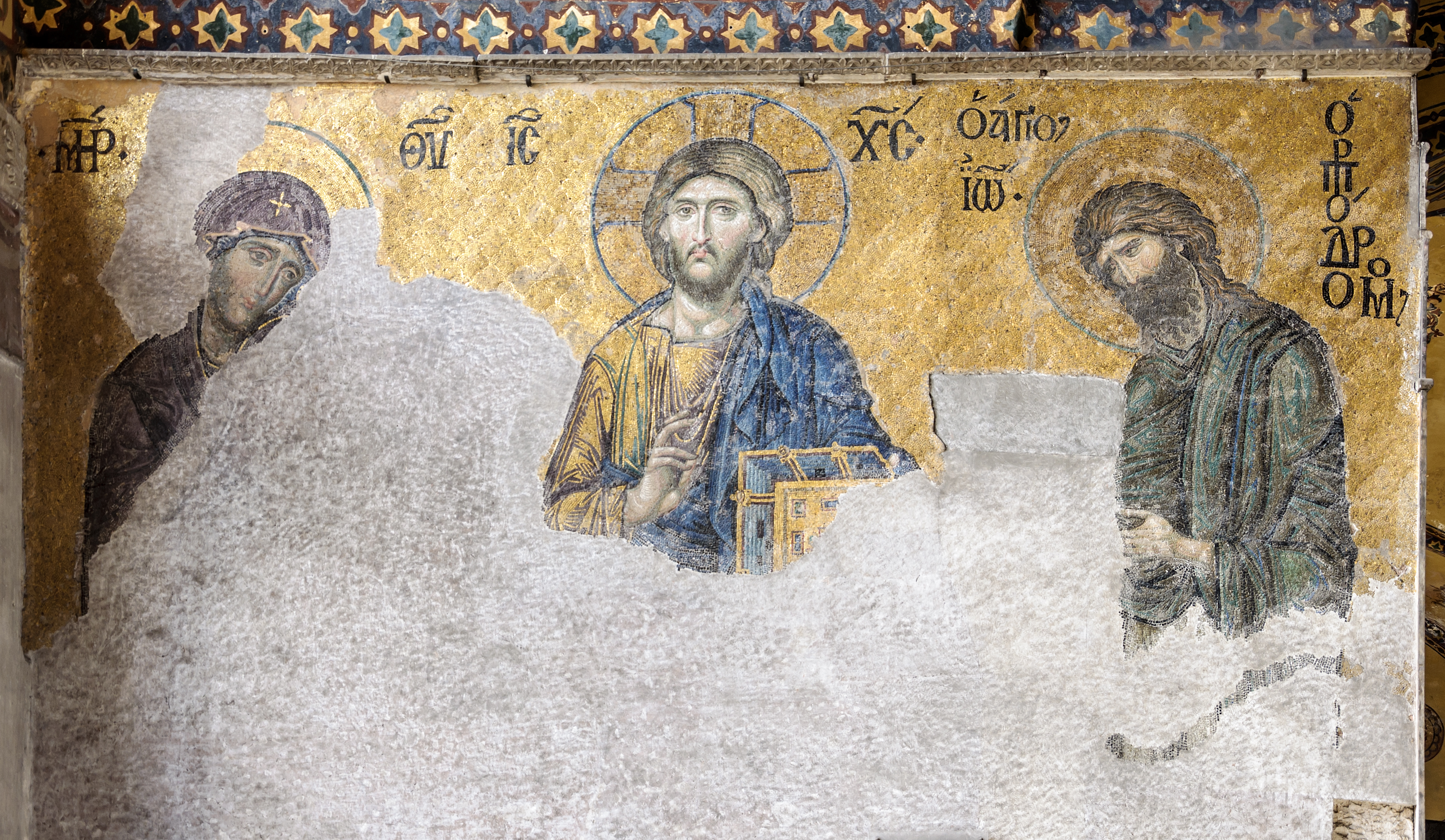
Deësis mosaic, Hagia Sophia cathedral, 13th century, Constantinople, Byzantine Empire
 
 Now they were on the road, going up to Jerusalem, and Jesus was going before them; and they were amazed.  And as they followed they were afraid.  Then He took the twelve aside again and began to tell them the things that would happen to Him:  "Behold, we are going up to Jerusalem, and the Son of Man will be betrayed to the chief priests and to the scribes; and they will condemn Him to the Gentiles; and they will mock Him, and scourge Him, and spit on Him, and kill Him.  And the third day He will rise again."
 
Then James and John, the sons of Zebedee, came to Him, saying, "Teacher, we want You to do for us whatever we ask."  And He said to them, "What do you want Me to do for you?"  They said to Him, "Grant us that we may sit, one on Your right hand and the other on Your left, in Your glory."   But Jesus said to them, "You do not know what you ask.  Are you able to drink the cup that I drink, and be baptized with the baptism that I am baptized with?"  They said to Him, "We are able."  So Jesus said to them, "You will indeed drink the cup that I drink, and with the baptism I am baptized you will be baptized; but to sit on My right hand and on My left is not Mine to give, but it is for those for whom it is prepared."  And when the ten heard it, they began to be greatly displeased with James and John.  But Jesus called them to Himself and said to them, "You know that those who are considered rulers over the Gentiles lord it over them, and their great ones exercise authority over them.  Yet it shall not be so among you; but whoever desires to become great among you shall be your servant.  And whoever of you desires to be first shall be slave of all.  For even the Son of Man did not come to be served, but to serve, and to give His life a ransom for many."
 
- Mark 10:32–45 
 
Yesterday we read that as Jesus was going out on the road, one came running, knelt before Him, and asked Him, "Good Teacher, what shall I do that I may inherit eternal life?"  So Jesus said to him, "Why do you call Me good?  No one is good but One, that is, God.  You know the commandments:  'Do not commit adultery,' 'Do not murder,' 'Do not steal,' 'Do not bear false witness,' 'Do not defraud,' 'Honor your father and your mother.'"  And he answered and said to Him, "Teacher, all these things I have kept from my youth."  Then Jesus, looking at him, loved him, and said to him, "One thing you lack:  Go your way, sell whatever you have and give to the poor, and you will have treasure in heaven; and come, take up the cross, and follow Me."  But he was sad at this word, and went away sorrowful, for he had great possessions.  Then Jesus looked around and said to His disciples, "How hard it is for those who have riches to enter the kingdom of God!"  And the disciples were astonished at His words.  But Jesus answered again and said to them, "Children, how hard it is for those who trust in riches to enter the kingdom of God!  It is easier for a camel to go through the eye of a needle than for a rich man to enter the kingdom of God."  And they were greatly astonished, saying among themselves, "Who then can be saved?"  But Jesus looked at them and said, "With men it is impossible, but not with God; for with God all things are possible."  Then Peter began to say to Him, "See, we have left all and followed You."  So Jesus answered and said, "Assuredly, I say to you, there is no one who has left house or brothers or sisters or father or mother or wife or children or lands, for My sake and the gospel's, who shall not receive a hundredfold now in this time -- houses and brothers and sisters and mothers and children and lands, with persecutions -- and in the age to come, eternal life.  But many who are first will be last, and the last first."
 
  Now they were on the road, going up to Jerusalem, and Jesus was going before them; and they were amazed.  And as they followed they were afraid.  Then He took the twelve aside again and began to tell them the things that would happen to Him:  "Behold, we are going up to Jerusalem, and the Son of Man will be betrayed to the chief priests and to the scribes; and they will condemn Him to the Gentiles; and they will mock Him, and scourge Him, and spit on Him, and kill Him.  And the third day He will rise again."  My study Bible comments that Christ's repeated predictions of His Passion were intended to encourage and strengthen the disciples for the terrifying events they would face.  Additionally, these predictions confirm that Christ was going to His death of His own will and choosing.  As He is now going up to Jerusalem, going before them, this much is certain.
 
 Then James and John, the sons of Zebedee, came to Him, saying, "Teacher, we want You to do for us whatever we ask."  And He said to them, "What do you want Me to do for you?"  They said to Him, "Grant us that we may sit, one on Your right hand and the other on Your left, in Your glory."   But Jesus said to them, "You do not know what you ask.  Are you able to drink the cup that I drink, and be baptized with the baptism that I am baptized with?"  They said to Him, "We are able."  So Jesus said to them, "You will indeed drink the cup that I drink, and with the baptism I am baptized you will be baptized; but to sit on My right hand and on My left is not Mine to give, but it is for those for whom it is prepared."  And when the ten heard it, they began to be greatly displeased with James and John.  But Jesus called them to Himself and said to them, "You know that those who are considered rulers over the Gentiles lord it over them, and their great ones exercise authority over them.  Yet it shall not be so among you; but whoever desires to become great among you shall be your servant.  And whoever of you desires to be first shall be slave of all."   Once again, questions of who among them will be the greatest in the kingdom they can only imagine come up among the disciples; this time it is James and John Zebedee who make this request.  My study Bible comments that this quest for temporal power and glory is unfitting for a disciple and shows an earthly misunderstanding of the Kingdom of God.  In St. Matthew's Gospel, it is noted that the mother of Zebedee's sons makes this request, but Jesus responds in the plural "you" there, and the brothers' own involvement is clear here in St. Mark's Gospel.  Christ calls His Crucifixion a cup and His death a baptism.  The Cross is a cup, my study Bible explains, because He drank it willingly (Hebrews 12:2).  Christ's death is a baptism, as He was completely immersed in it, yet it cleansed the whole world (Romans 6:3-6).  Christ's prophecy of John and James eventual participating in the same cup and baptism reveals the life of persecution and martyrdom which they would lead after Pentecost.  James would be the first martyr among the disciples, and John lived a long life under persecution and exile.  My study Bible also states that Christ declaring that places of honor in the Kingdom are not His to give does not mean that He lacks authority.  It means, instead, that they are not His to give arbitrarily.  They will be given to those for whom God has prepared them.  Also, with regard to sitting as equals on the right and left hand of Christ in His Kingdom, St. John Chrysostom teaches that no one could possibly occupy such a position.  Regarding the highest places of honor that can be given to human beings, the icons of the Orthodox Church universally depict the Virgin Mary ("most blessed among women" Luke 1:28) and John the Baptist ("greatest born of women" (Matthew 11:11) holding these places.  

"For even the Son of Man did not come to be served, but to serve, and to give His life a ransom for many."  For many, according to my study Bible, is an Aramaic expression, which means "for all."
 
 In its commentary on the request of John and James Zebedee, my study Bible tells us that the icons of the Orthodox Church universally depict the Virgin Mary and St. John the Baptist in the highest places of honor given to human beings, next to Christ.  It quotes from Luke 1:28 and Matthew 11:11, giving us the words from Scripture regarding these two saints.  In the case of the Virgin Mary, the words are of the Archangel Gabriel, in greeting Mary at the Annunciation to her of Christ's birth.  The words describing John the Baptist are those spoken by Jesus Christ.  The mosaic above, called Deësis, which means, in Greek, "Supplication" or "Prayer" shows the Virgin Mary and St. John the Baptist on either side of Christ enthroned, praying on behalf of humanity.  St. John the Baptist is considered to be a figure of the Old Testament, the greatest of all the prophets, while Mary the Mother of God is the "queen" among the saints, also called "All Holy" in the Orthodox tradition.  She is considered the supreme saint to call upon at all times.   In James 5:16 we read, "The effective, fervent prayer of a righteous man avails much."  As she is considered to be the greatest among the saints, her compassion is one that turns no one away.  These traditions are born out through the 2,000 year experience of the Church, the prayers and supplications of believers throughout the centuries.  In the mosaic above, we can see the expressions of compassion on the faces of the saints at prayer, and we know that their lives were those of great sacrifice for the love of Christ and of the gospel of the kingdom of God He preached.  All of this speaks to us of love and compassion, love and blessing within the gracious love of God -- even for the Son who came to live among us as one of us, to share our burdens and griefs and die out of love for us.  Ultimately the story of Jesus is a story of so many who were loved by Him and who shared in His love, for He goes to His cup and His baptism "for many," as the text says, meaning for all of us.  Let us consider the compassion and love of a loving God, seeking to free us from the slavishness of a life devoted to a different kind of power, one that knows exploitation and hardship, greedy demands of passions, and stripping us to a bare materialism without pity.  Let us, together with these greatest of saints, participate in the joy of His Kingdom, for there is the place of His love for all of us in which we, too, may share. 


Thursday, June 27, 2024

Are you able to drink the cup that I am about the drink, and to be baptized with the baptism that I am baptized with?


File:Deesis mosaic Hagia Sophia.jpg
Deësis (Gr. "Prayer" or "Supplication") mosaic, 13th century.  Hagia Sophia  (Holy Wisdom) Cathedral, Constantinople, Byzantine Empire; showing the Virgin Mary and John the Baptist on Christ's left and right (photo Wikimedia Commons)
 
 Now Jesus, going up to Jerusalem, took the twelve disciples aside on the road and said to them, "Behold, we are going up to Jerusalem, and the Son of Man will be betrayed to the chief priests and to the scribes; and they will condemn Him to death, and deliver Him to the Gentiles to mock and to scourge and to crucify.  And the third day He will rise again."

Then the mother of Zebedee's sons came to Him with her sons, kneeling down and asking something from Him.  And He said to her, "What do you wish?"  She said to Him, "Grant that these two sons of mine may sit, one of Your right hand and the other on the left, in Your kingdom."  But Jesus answered and said, "You do not know what you ask.  Are you able to drink the cup that I am about the drink, and to be baptized with the baptism that I am baptized with?"  They said to Him, "We are able."  So He said to them, "You will indeed drink My cup, and be baptized with the baptism that I am baptized with; but to sit on My right hand and on My left is not Mine to give, but it is for those for whom it is prepared by My Father."  And when the ten heard it, they were greatly displeased with the two brothers.  But Jesus called them to Himself and said, "You know  that the rulers of the Gentiles lord it over them, and those who are great exercise authority over them.  Yet it shall not be so among you; but whoever desires to become great among you, let him be your servant.  And whoever desires to be first among you, let him be your slave -- just as the Son of Man did not come to be served, but to serve, and to give His life a ransom for many."
 
- Matthew 20:17-28 
 
In yesterday's reading, Jesus gave the parable of the Workers in the Vineyard:  "For the kingdom of heaven is like a landowner who went out early in the morning to hire laborers for his vineyard.  Now when he had agreed with the laborers for a denarius a day, he sent then into his vineyard.  And he went out about the third hour and saw others standing idle in the marketplace, and said to them, 'You also go into the vineyard, and whatever is right I will give you.'  So they went.  Again he went out about the sixth and the ninth hour, and did likewise.  And about the eleventh hour he went out and found others standing idle, and said to them, 'Why have you been standing here idle all day?'  They said to him, 'Because no one hired us.'  He said to them, 'You also go into the vineyard, and whatever is right you will receive.'  So when evening had come, the owner of the vineyard said to his steward, 'Call the laborers and give them their wages, beginning with the last to the first.'  And when those came who were hired about the eleventh hour, they each received a denarius.  But when the first came, they supposed that they would receive more; and they likewise received each a denarius.  And when they had received it, they complained against the landowner, saying, 'These last men have worked only one hour, and you made them equal to us who have borne the burden and the heat of the day.'  But he answered one of them and said, 'Friend, I am doing you no wrong.  Did you not agree with me for a denarius?  Take what is yours and go your way.  I wish to give to this last man the same as to you.  Is it not lawful for me to do what I wish with my own things?  Or is your eye evil because I am good?'  So the last will be first, and the first last.  For many are called, but few chosen."
 
  Now Jesus, going up to Jerusalem, took the twelve disciples aside on the road and said to them, "Behold, we are going up to Jerusalem, and the Son of Man will be betrayed to the chief priests and to the scribes; and they will condemn Him to death, and deliver Him to the Gentiles to mock and to scourge and to crucify.  And the third day He will rise again."  My study Bible comments that Christ's repeated prediction of His Passion is meant to encourage and strengthen disciples for the terrifying events they will face.  According to Theophylact, it is as if Christ were saying, "Think on all these [words and miracles], so that when you see me hanging on the Cross, you will not imagine that I am suffering because I am powerless to do otherwise."

Then the mother of Zebedee's sons came to Him with her sons, kneeling down and asking something from Him.  And He said to her, "What do you wish?"  She said to Him, "Grant that these two sons of mine may sit, one of Your right hand and the other on the left, in Your kingdom."  But Jesus answered and said, "You do not know what you ask.  Are you able to drink the cup that I am about the drink, and to be baptized with the baptism that I am baptized with?"  They said to Him, "We are able."  So He said to them, "You will indeed drink My cup, and be baptized with the baptism that I am baptized with; but to sit on My right hand and on My left is not Mine to give, but it is for those for whom it is prepared by My Father."   We don't really know why at this juncture the mother of James and John Zebedee has come to Christ with this request.  It is a sort of repetition of the disciples previously asking, "Who then is greatest in the kingdom of heaven?"  But this time, it is the mother of Zebedee's sons who comes with this request on behalf of James and John.  When the question of "the greatest" was asked before, Jesus took pains with specific and extended teachings on humility and the need to serve, especially to take care of the "little ones" in the Church.  Perhaps Christ speaking of His coming Passion, and saying that on the third day He will rise again has prompted the disciples to assume that He will come into an eternal, earthly kingdom, as is widely expected of the Messiah.  But my study Bible comments that this quest for temporal power and glory is unfitting for a disciple and it shows an earthly misunderstanding of the Kingdom of God.  Here Matthew tells us that it was their mother who requested such an honor -- but John and James' own involved in revealed because Jesus addresses them in the plural "you" in the Greek both here and in Mark 10:36.   We must note that Christ calls His Crucifixion a cup and His death a baptism.  The Cross is a cup, my study Bible says, because He drank it willingly (Hebrews 12:2).  His death is baptism, as He was completely immersed in it, and yet it cleansed the world (Romans 6:3-6).  Christ's prophecy of John and James participating in the same cup and baptism shows the life of persecution and martyrdom these brothers would lead after Pentecost -- James would be the first apostle to be martyred (Acts 12:1-2), and John would go on to a long life of persecution and exile, producing one Gospel, three Epistles, and the Revelation.  My study Bible further notes on this passage that Christ declaring that the places of honor in the Kingdom are not His to give doesn't mean He lacks authority.  It means, instead, that they are not His to give arbitrarily.  He will give them to those for whom God has prepared them.  Note also, my study Bible says, that with regard to sitting as equals on the right and the left hand of Christ in Christ's Kingdom, St. John Chrysostom teaches that nobody could possibly occupy these positions.  Regarding the highest places of honor that can be given to human beings, the icons of the Orthodox Church universally depict the Virgin Mary (most blessed among women -- Luke 1:28) and John the Baptist (greatest born of women -- Matthew 11:11) holding these places.  See the icon above, the 13th century mosaic entitled Deësis, meaning "prayer" or "supplication" in Greek, from Hagia Sophia (Holy Wisdom) Cathedral in Constantinople, the capitol of the Byzantine Empire.
 
And when the ten heard it, they were greatly displeased with the two brothers.  But Jesus called them to Himself and said, "You know  that the rulers of the Gentiles lord it over them, and those who are great exercise authority over them.  Yet it shall not be so among you; but whoever desires to become great among you, let him be your servant.  And whoever desires to be first among you, let him be your slave -- just as the Son of Man did not come to be served, but to serve, and to give His life a ransom for many."  My study Bible notes that Jesus once again corrects the disciples, this time by first comparing them to the power-hungry Gentiles, whom they themselves considered an abomination, and contrasting them to Himself, who serves us although He is Lord of all.  My study Bible notes here that for many is an Aramaic expression which indicates "for all."

So, in the context of the Gospel, there is the common theme of sacrifice running as a thread throughout the past few readings.  There was first the story of the rich young man, whom Jesus loved, and whom He told that if he wanted to be perfect, he should sell his possessions and give to the poor, and follow Him.  This was followed by a discussion regarding the difficulties which wealth presents to those who would seek the kingdom of heaven, and the sacrifices which the disciples themselves have made.  In yesterday's reading (see above), Jesus gave the parable of the Workers in the Vineyard, expressing the principle that not all will labor equally, and yet all will receive the same reward.  Here we have the dynamic quality in the story line in which the mother of John and James Zebedee comes (seemingly on their behalf) asking Christ to make her two sons effectively greatest in His coming Kingdom, to sit at His right and left hand.  According to my study Bible, as we read above, these are positions no one could fill, and the positions there will be will go to those for whom they are prepared by God.  But again, all of this comes within the theme of sacrifice, for it all begins with Christ's second warning of His Passion and death to come, followed by Resurrection.  While the family of Zebedee has focused on what this might mean for a coming "earthly" type kingdom, Jesus' true meaning here is about His own sacrifice on behalf of all -- which will function as an image of service for everyone to remember after Pentecost and the mission of the Church has truly begun.  While Jesus has already answered the question, "Who then is the greatest in the kingdom of heaven?" with warnings about abuses of power, about humility, and service in the Church, this is yet a repetition with more emphasis, contrasting the use of power witnessed in the kingdoms of the Gentiles with the type of leadership Christ wants in His Church, to which He will entrust these apostles.  It's such an important lesson that sections of the Gospel are repeatedly devoted it, as Jesus begins His way toward Jerusalem with warnings to the disciples about what is to come.  Therefore it remains an essential lesson for the Church, and the world has seen plenty of excesses which enforce Christ's teachings all the more for all of us.  Let us endeavor to keep and live His faith, as He has taught, and follow the examples of those who have served throughout the centuries, both great and small, martyrs and saints, and the countless "little ones" who have served with their own lives and faith as well.  


Friday, November 26, 2021

And whoever desires to be first among you, let him be your slave -- just as the Son of Man did not come to be served, but to serve, and to give His life a ransom for many

 
 Now Jesus, going up to Jerusalem, took the twelve disciples aside on the road and said to them, "Behold, we are going up to Jerusalem, and the Son of Man will be betrayed to the chief priests and to the scribes; and they will condemn Him to death, and deliver Him to the Gentiles to mock and to scourge and to crucify.  And the third day He will rise again."  

Then the mother of Zebedee's sons came to Him with her sons, kneeling down and asking something from Him.  And He said to her, "What do you wish?"  She said to Him, "Grant that these two sons of mine may sit, one on Your right hand and the other on the left, in Your kingdom."  But Jesus answered and said, "You do not know what you ask.  Are you able to drink the cup that I am about to drink, and be baptized with the baptism that I am baptized with?"  They said to Him, "We are able."  So He said to them, "You will indeed drink My cup, and be baptized with the baptism that I am baptized with; but to sit on My right hand and on My left is not Mine to give, but it is for those for whom it is prepared by My Father."  And when the ten heard it, they were greatly displeased with the two brothers.  But Jesus called them to Himself and said, "You know that the rulers of the Gentiles lord it over them, and those who are great exercise authority over them.  Yet it shall not be so among you; but whoever desires to become great among you, let him be your servant.  And whoever desires to be first among you, let him be your slave -- just as the Son of Man did not come to be served, but to serve, and to give His life a ransom for many."
 
- Matthew 20:17-28 
 
 In yesterday's reading, Jesus taught a parable, in response to a question from Peter regarding the reward for discipleship:  "For the kingdom of heaven is like a landowner who went out early in the morning to hire laborers for his vineyard.  Now when he had agreed with the laborers for a denarius a day, he sent them into his vineyard.  And he went out about the third hour and saw others standing idle in the marketplace, and said to them, 'You also go into the vineyard, and whatever is right I will give you.'  So they went.  Again he went out about the sixth and the ninth hour, and did likewise.  And about the eleventh hour he went out and found others standing idle, and said to them, 'Why have you been standing here idle all day?'  They said to him, 'Because no one hired us.'  He said to them, 'You also to into the vineyard, and whatever is right you will receive.'  So when evening had come, the owner of the vineyard said to his steward, 'Call the laborers and give them their wages, beginning with the last to the first.'  And when those came who were hired about the eleventh hour, they each received a denarius.  But when the first came, they supposed that they would receive more; and they likewise received a denarius.  And when they had received it, they complained against the landowner, saying, 'These last men have worked only one hour, and you made them equal to us who have borne the burden and the heat of the day.'  But he answered one of them and said, 'Friend, I am doing you no wrong.  Did you not agree with me for a denarius?  Take what is yours and go your way.  I wish to give to this last man the same as to you.  Is it not lawful for me to do what I wish with my own things?  Or is your eye evil because I am good?'  So the last will be first, and the first last.  For many are called, but few chosen."
 
  Now Jesus, going up to Jerusalem, took the twelve disciples aside on the road and said to them, "Behold, we are going up to Jerusalem, and the Son of Man will be betrayed to the chief priests and to the scribes; and they will condemn Him to death, and deliver Him to the Gentiles to mock and to scourge and to crucify.  And the third day He will rise again."   My study Bible comments that Christ's repeated prediction of His Passion was meant to encourage and strengthen the disciples for the terrifying events that they would face.  Theophan comments that it is as if Christ were saying, "Think on all these [words and miracles], so that when you see me hanging on the Cross, you will not imagine that I am suffering because I am powerless to do otherwise."  This is the third time He has taught the disciples that He will suffer, die, and rise again on the third day.  This is also the first time He has declared openly that "we are going up to Jerusalem."

Then the mother of Zebedee's sons came to Him with her sons, kneeling down and asking something from Him.  And He said to her, "What do you wish?"  She said to Him, "Grant that these two sons of mine may sit, one on Your right hand and the other on the left, in Your kingdom."  But Jesus answered and said, "You do not know what you ask.  Are you able to drink the cup that I am about to drink, and be baptized with the baptism that I am baptized with?"  They said to Him, "We are able."  So He said to them, "You will indeed drink My cup, and be baptized with the baptism that I am baptized with; but to sit on My right hand and on My left is not Mine to give, but it is for those for whom it is prepared by My Father." This is yet again another request from among the disciples regarding being one of the great ones in Christ's Kingdom.  In last Thursday's reading, the disciples asked Him, "Who then is the greatest in the kingdom of heaven?"  In Wednesday's reading this week, Peter asked, "See, we have left all and followed You.  Therefore what shall we have?"   Directly following Christ's third prophecy that He will suffer, die, and rise again, there is this request from James and John Zebedee.  Matthew reports that it is their mother who makes the request, but Christ answers with a plural you in the Greek text (in "You do not know what you ask.  Are you able to drink the cup that I am about to drink, and be baptized with the baptism that I am baptized with?"), which reveals the brothers' involvement, as in Mark 10:35.   It is as if in hearing Christ's repeated warnings about what is to come, all the disciples seem to grasp is that He will come into His kingdom, and they want to know their places in that kingdom.  My study Bible says that this quest for temporal power and glory is unfitting for a disciple, and that it shows an earthly misunderstanding of the Kingdom of God.  It also notes that Christ calls His Crucifixion a cup and His death a baptism.  The Cross is a cup because He drank it willingly (Hebrews 12:2).  His death is baptism, for He was completely immersed in it, yet it cleansed the world (Romans 6:3-6).  Christ's prophecy of James and John participating in this same cup and baptism is a prediction of the life of persecution and martyrdom they both would lead after Pentecost.  James would be the first apostle to be martyred (Acts 12:2), and John endured a long life of persecution, giving the Church one Gospel, three Epistles, and the Revelation.  My study Bible also says that Christ declaring that the places of honor in the Kingdom are not His to give doesn't mean that He lacks authority.  Instead, it means that these are not His to give arbitrarily.  They will be given by Him to those for whom God has prepared them.  In regard to those sitting as equals on the right and left hand of Christ in the Kingdom, St. John Chrysostom teaches that no one could possibly occupy such a position.  As to the highest places of honor that can be given to human beings, the icons of the Church universally depict the Virgin Mary (most blessed among women -- Luke 1:28) and John the Baptist (greatest born of women -- Matthew 11:11) holding those places.  As Jesus has just declared His intent to go to Jerusalem, it is easy to imagine the expectation of the disciples that there He will claim what they think will be a worldly kingdom.  The text in this way makes clear to us that at this stage, they simply cannot fathom the reality of what is to come.

And when the ten heard it, they were greatly displeased with the two brothers.  But Jesus called them to Himself and said, "You know that the rulers of the Gentiles lord it over them, and those who are great exercise authority over them.  Yet it shall not be so among you; but whoever desires to become great among you, let him be your servant.  And whoever desires to be first among you, let him be your slave -- just as the Son of Man did not come to be served, but to serve, and to give His life a ransom for many."    Jesus makes it clear that His Kingdom will not be like the kingdoms of the world; and that to think only of places of greatness is out of place for His disciples -- especially in the context of the mysteries of His Passion, Crucifixion, and Resurrection that He's just revealed.  My study Bible points out that He corrects their thinking by comparing them to the power-hungry Gentiles, whom they themselves considered an abomination, and then contrasting them to Himself, who serves us even though He is Lord of all.  For many is an Aramaic expression which means "for all."

Jesus teaches us here about what it means to be great, what greatness is and does.  He makes Himself the example, that the Son of Man did not come to be served, but to serve, and to give His life as a ransom for many.  It is an important lesson which builds on the things He has already taught them regarding how to use power within His Kingdom, and in His Church.   They must be humble and serve the littlest ones; acts of abuse of power, habits which lead to offenses against those in their charge must be decisively dealt with and cut away from their lives (see this reading).   The pursuit of and love of wealth for its own sake can be prohibitive to anyone desiring to be a part of His Kingdom (see this reading).  And the ultimate lesson is here, regarding service to all.  Everything leads back to the ultimate good, the ultimate truth, and the ultimate beauty and value -- and that is a life lived in service to God and God's kingdom lived through our own lives in this world.  Jesus will go to the Cross for our salvation, but it is ultimately up to us to accept and value the gift of His Kingdom, and to choose also to participate in His life as He has offered it to us.  This is not a question of sacrifice or even service for its own sake or as some sort of pious virtue we can hold up in front of others.  Jesus will have His own choice words for the hypocrites who supposedly served God and were the custodians for the people and their spiritual heritage of His time -- which serves as another warning to we who call ourselves His followers about how we live our faith and how nominal custodians and guardians of that faith conduct themselves and use that power to do so.  Jesus' service is not sentimentality nor pity; but it is a gift to the world that conquers death and evil through its sacrifice, that plants the seeds of love, and ultimately seeks to secure God's will "on earth as it is in heaven."  That is, to bring the real values of goodness, truth, and beauty into this world and to secure them as posterity for all by living them in our lives, and to teach others to do so.  This is the only real way to serve the "little ones," and it requires humility to do so, for no matter how much we know, regardless of what wisdom we might possess or authority we might merit in our lives, there will always be the One to whom we humble ourselves, more to learn, and more to examine in our own hearts in Christ's light.  There is always more to real love than what we think we know and understand, for God is always beyond us and Christ always calls us forward.  This requires self-emptying, the willingness to learn more, to change, to be corrected, and in so doing to serve all.  Christ's teaching here is for us to escape the confines of the prison of a type of self-centeredness that has us focus on our image in the eyes of others and instead to focus on the image that God gives us of ourselves.  Ultimately, to love God with all our heart and soul and mind and strength, and neighbor as ourselves, becomes a focus on living the fullness of such a relationship, securing God's kingdom in this world through that living relationship that teaches us what love is, where our real boundaries must be, and not to look away from what is evil but to seek God's will for how to deal with it.  This is how we serve all, and Christ will give the fullest example we have, His once-and-for-all sacrifice for all, in which we may participate in our own lives.  Let us consider the truth of Christ's teaching, the power of removing the mask the world might seek for our image of "greatness," and serving by instead asking God to bring us to the fullness of what our "greatness "might really look like.  For this is what He did, even to the point of His death on the Cross, so that He might point the way to what is truly worth serving.


Friday, February 12, 2021

You will indeed drink the cup that I drink, and with the baptism I am baptized with you will be baptized

 
 Now they were on the road, going up to Jerusalem, and Jesus was going before them; and they were amazed.  And as they followed they were afraid.  Then He took the twelve aside again and began to tell them the things that would happen to Him:  "Behold, we are going up to Jerusalem, and the Son of Man will be betrayed to the chief priests and to the scribes; and they will condemn Him to death and deliver Him to the Gentiles; and they will mock Him, and scourge Him, and spit on Him, and kill Him.  And the third day He will rise again."

Then James and John, the sons of Zebedee, came to Him, saying, "Teacher, we want You to do for us whatever we ask."  And He said to them, "What do you want Me to do for you?"  They said to Him, "Grant us that we may sit, one on Your right hand and the other on Your left, in Your glory."  But Jesus said to them, "You do not know what you ask.  Are you able to drink the cup that I drink, and be baptized with the baptism that I am baptized with?"  They said to Him, "We are able."  So Jesus said to them, "You will indeed drink the cup that I drink, and with the baptism I am baptized with you will be baptized; but to sit on My right hand and on My left is not Mine to give, but it is for those for whom it is prepared."  
 
And when the ten heard it, they began to be greatly displeased with James and John.  But Jesus called them to Himself and said to them, "You know that those who are considered rulers over the Gentiles lord it over them, and their great ones exercise authority over them.  Yet it shall not be so among you; but whoever desires to become great among you shall be your servant.  And whoever of you desires to be first shall be slave of all.  For even the Son of Man did not come to be served, but to serve, and to give His life a ransom for many."
 
- Mark 10:32-45 
 
Yesterday we read that, as Jesus was going out on the road, one came running, knelt before Him, and asked Him, "Good Teacher, what shall I do that I may inherit eternal life?"  So Jesus said to Him, "Why do You call Me good?  No one is good but One, that is, God.  You know the commandments:  'Do not commit adultery,' 'Do not murder,' 'Do not steal,' 'Do not bear false witness,' 'Do not defraud,' 'Honor your father and your mother.' "  And he answered and said to Him, "Teacher, all these things I have kept from my youth."  Then Jesus, looking at him, loved him, and said to him, "One thing you lack:  Go your way, sell whatever you have and give to the poor, and you will have treasure in heaven; and come, take up the cross, and follow Me."  But he was sad at this word, and went away sorrowful, for he had great possessions.  Then Jesus looked around and said to His disciples, "How hard it is for those who have riches to enter the kingdom of God!"  And the disciples were astonished at His words.  But Jesus answered again and said to them, "Children, how hard it is for those who trust in riches to enter the kingdom of God!  It is easier for a camel to go through the eye of a needle than for a rich man to enter the kingdom of God."   And they were greatly astonished, saying among themselves, "Who then can be saved?"  But Jesus looked at them and said, "With men it is impossible, but not with God; for with God all things are possible."  Then Peter began to say to Him, "See, we have left all and followed You."  So Jesus answered and said, "Assuredly, I say to you, there is no one who has left house or brothers or sisters or father or mother or wife or children or lands, for My sake and the gospel's, who shall not receive a hundredfold now in this time -- houses and brothers and sisters and mothers and children and lands, with persecutions -- and in the age to come, eternal life.  But many who are first will be last, and the last first."
 
Now they were on the road, going up to Jerusalem, and Jesus was going before them; and they were amazed.  And as they followed they were afraid.  Then He took the twelve aside again and began to tell them the things that would happen to Him:  "Behold, we are going up to Jerusalem, and the Son of Man will be betrayed to the chief priests and to the scribes; and they will condemn Him to death and deliver Him to the Gentiles; and they will mock Him, and scourge Him, and spit on Him, and kill Him.  And the third day He will rise again."   This is the third time Jesus gives the disciples a warning about what is to come in Jerusalem, even as the text explicitly makes clear that Jesus is leading the disciples toward the holy city.  Note that because He is leading them to Jerusalem, the disciples are both amazed and afraid.  My study bible suggests that Christ's repeated predictions of His Passion were intended to encourage and strengthen the disciples for the terrifying events they will face.  It also confirms that Christ is going to His death by His own will and choosing.  With each warning the details Jesus gives of what is to come get more specific, so that nothing will surprise His disciples.

Then James and John, the sons of Zebedee, came to Him, saying, "Teacher, we want You to do for us whatever we ask."  And He said to them, "What do you want Me to do for you?"  They said to Him, "Grant us that we may sit, one on Your right hand and the other on Your left, in Your glory."   My study bible says that this quest for temporal power and glory is unfitting for a disciple, and that it shows an earthly misunderstanding of the Kingdom of God.  They are not doubt expecting a worldly Kingdom such as was popularly anticipated of the Messiah, especially since they are now headed toward Jerusalem.  In Matthew's Gospel, we're told that it was the "mother of Zebedee's sons" who made this request (Matthew 20:20).  But here, John's and James' own participation in this request is made clear in the Greek, as Jesus uses a plural you to address them.  

But Jesus said to them, "You do not know what you ask.  Are you able to drink the cup that I drink, and be baptized with the baptism that I am baptized with?"  They said to Him, "We are able."  So Jesus said to them, "You will indeed drink the cup that I drink, and with the baptism I am baptized with you will be baptized; but to sit on My right hand and on My left is not Mine to give, but it is for those for whom it is prepared."   Jesus calls His Crucifixion a cup and His death a baptism.  My study bible explains that the Cross is a cup because Christ drank it willingly (Hebrews 12:2).  His death is a baptism, because He was completely immersed in it, but it cleaned the world (Romans 6:3-6).  It adds that Christ's prophecy of John and James participating in the same cup and baptism shows the life of persecution and martyrdom which they would lead after Pentecost.  Indeed, James was the first of the Twelve to be martyred, and John went on to a life of exile, during the harshest of persecutions.  Also, Jesus' declaration that the places of honor in the Kingdom are not His to give doesn't indicate that He lacks authority to do so.  Rather, my study bible tells us, it means that they are not His to give arbitrarily.  Instead, they will be given to those for whom God has prepared them.  In addition, with regard to sitting at the right and left hand of Christ in His Kingdom, St. John Chrysostom teaches that no one could possibly occupy such a position.  Regarding the highest places of honor that can be given to human beings, the icons of the Orthodox Church universally depict the Virgin Mary (the most blessed among women -- Luke 1:28) and John the Baptist (the greatest born of women -- Matthew 11:11) as holding these places. 

And when the ten heard it, they began to be greatly displeased with James and John.  But Jesus called them to Himself and said to them, "You know that those who are considered rulers over the Gentiles lord it over them, and their great ones exercise authority over them.  Yet it shall not be so among you; but whoever desires to become great among you shall be your servant.  And whoever of you desires to be first shall be slave of all.  For even the Son of Man did not come to be served, but to serve, and to give His life a ransom for many."   My study bible says that in Aramaic (the commonly spoken language for Christ and the disciples) the phrase for many is an expression that means "for all."
 
 The fact that the disciples repeatedly struggle with issues of power and status -- as reported in the Gospels -- should really make us aware of something.  That is, it should make us very much aware of how deep a problem this is, and how much we might struggle with it in the world.  Already once before, Jesus taught the disciples about the real sense of leadership that He wants in His Church, after they had disputed among themselves on the road about who would be the greatest in His Kingdom (see Monday's reading, and the subsequent warnings afterward, here).  But John and James (and possibly their mother) might feel they occupy a special position of closeness to Christ, and so they come separately, asking about a special place in the Kingdom, to sit on Christ's right and left hand.  After all, together with Peter, they form His innermost circle.  It was they who went upon the Mount of Transfiguration, and whom Jesus took with Him in raising the daughter of Jairus (in this reading).  Let's note also how the other disciples are upset with James and John when they find out about this request, for Jesus has already spoken to them all regarding their previous dispute among themselves regarding positions of power.  But Jesus once again turns the subject to sacrifice.  The disciples have got worldly notions of power and position in mind when they express their desires for important places in Christ's Kingdom.  It is very significant that at this point Christ begins to assert the reality of what is coming in Jerusalem as part of His place as head of His Church.  He has a cup and a baptism to drink that are appropriate to His position, and He asks John and James if they can follow in His footsteps.  Yet, even though He avows they will follow in His cup and baptism, still, He tells them, the places they desire are not His to give.  Once again, the message is an enforcement of humility and service.  Greatness, He reminds them, is going to be all about sacrifice, and serving something so much greater than themselves.  They will be nothing like the rulers they see in the great Gentile kingdoms of the Romans and others; they will not be those who "lord it over" others.  Yet again, He tells them, "Yet it shall not be so among you; but whoever desires to become great among you shall be your servant.  And whoever of you desires to be first shall be slave of all."   If these things were strange within the context of Christ's world of powerful rulers and empires, let us consider what they mean to us today.  We might have "leaders" who speak of themselves as public servants, and even those considered "great" who will make certain that we know all of their virtues, civic-mindedness, even signs of compassion.  But sacrifice?  How many of us hear around us reflected by the popular culture that those who would be great should be your servant?  Is the one who is first a slave of all?  These remain strong images to be pondered and wrestled with in the heart, for they still call us to repentance and humility, a far cry from serving an image in the eyes of others.  Finally we come to Jesus' declaration:  "For even the Son of Man did not come to be served, but to serve, and to give His life a ransom for many."   We have our chief example, the One who died for us, who laid it all on the line.  He not only set an example, but became what we could call a hero in His own image of sacrifice for us.  Sacrifice, in the Christian sense, needs to be understood in a somewhat nuanced way.  Whatever sacrifice we are called to make in a journey of faith becomes a stepping stone to an expanded and more beautiful sense of self, given to us in seeking a closer relationship to God.  It is the opposite of what "sacrifice" means to a selfish person; it is instead a way to grow and to expand, to fill bigger shoes.  He goes there first, so He shows us the way, with His cup and baptism which still inspire those who follow, as the greatest expression of love.


Thursday, August 15, 2019

Then James and John, the sons of Zebedee, came to Him, saying, "Teacher, we want You to do for us whatever we ask"


 Now they were on the road, going up to Jerusalem, and Jesus was going before them; and they were amazed.  And as they followed they were afraid.  Then He took the twelve aside again and began to tell them the things that would happen to Him:  "Behold, we are going up to Jerusalem, and the Son of Man will be betrayed to the chief priests and to the scribes; and they will condemn Him to death and deliver Him to the Gentiles; and they will mock Him, and scourge Him, and spit on Him, and kill Him.  And the third day He will rise again."

Then James and John, the sons of Zebedee, came to Him, saying, "Teacher, we want You to do for us whatever we ask."  And He said to them, "What do you want Me to do for you?"  They said to Him, "Grant us that we may sit, one on Your right hand and the other on Your left, in Your glory."  But Jesus said to them, "You do not know what you ask.  Are you able to drink the cup that I drink, and be baptized with the baptism that I am baptized with?"  They said to Him, "We are able."  So Jesus said to them, "You will indeed drink the cup that I drink, and with the baptism I am baptized with you will be baptized; but to sit on My right hand and on My left is not Mine to give, but it is for those for whom it is prepared."  And when the ten heard it, they began to be greatly displeased with James and John.  But Jesus called them to Himself and said to them, "You know that those who are considered rulers over the Gentiles lord it over them, and their great ones exercise authority over them.  Yet it shall not be so among you; but whoever desires to become great among you shall be your servant.  And whoever of you desires to be first shall be slave of all.  For even the Son of Man did not come to be served, but to serve, and to give His life a ransom for many."

- Mark 10:32-45

Yesterday we read that as Jesus was going out on the road, one came running, knelt before Him, and asked Him, "Good Teacher, what shall I do that I may inherit eternal life?"  So Jesus said to him, "Why do you call Me good?  No one is good but One, that is, God. You know the commandments:  'Do not commit adultery,' 'Do not murder,' 'Do not steal,' 'Do not bear false witness,' 'Do not defraud,' 'Honor your father and your mother.'"  And he answered and said to Him, "Teacher, all these things I have kept from my youth."  Then Jesus, looking at him, loved him, and said to him, "One thing you lack:  Go your way, sell whatever you have and give to the poor, and you will have treasure in heaven; and come, take up the cross, and follow Me."  But he was sad at this word, and went away sorrowful, for he had great possessions.  Then Jesus looked around and said to His disciples, "How hard it is for those who have riches to enter the kingdom of God!"  And the disciples were astonished at His words.  But Jesus answered again and said to them, "Children, how hard it is for those who trust in riches to enter the kingdom of God!  It is easier for a camel to go through the eye of a needle than for a rich man to enter the kingdom of God."  And they were greatly astonished, saying among themselves, "Who then can be saved?"  But Jesus looked at them and said, "With men it is impossible, but not with God; for with God all things are possible."  Then Peter began to say to Him, "See, we have left all and followed You."  So Jesus answered and said, "Assuredly, I say to you, there is no one who has left house or brothers or sisters or father or mother or wife or children or lands, for My sake and the gospel's, who shall not receive a hundredfold now in this time -- houses and brothers and sisters and mothers and children and lands, with persecutions -- and in the age to come, eternal life.  But man who are first will be last, and the last first."

 Now they were on the road, going up to Jerusalem, and Jesus was going before them; and they were amazed.  And as they followed they were afraid.  Then He took the twelve aside again and began to tell them the things that would happen to Him:  "Behold, we are going up to Jerusalem, and the Son of Man will be betrayed to the chief priests and to the scribes; and they will condemn Him to death and deliver Him to the Gentiles; and they will mock Him, and scourge Him, and spit on Him, and kill Him.  And the third day He will rise again."   The time has come, and Christ and the disciples are now really and truly on the road, going up to Jerusalem.  And Jesus is leading the way.  This is the third time Christ deliberately informs the disciples of His coming Passion.  My study bible tells us that His repeated predictions of His Passion were meant to encourage and strengthen them for the terrifying events they will be facing in the future.  They also confirm that Christ goes to His death of His own will and choosing.

Then James and John, the sons of Zebedee, came to Him, saying, "Teacher, we want You to do for us whatever we ask."  And He said to them, "What do you want Me to do for you?"  They said to Him, "Grant us that we may sit, one on Your right hand and the other on Your left, in Your glory."  But Jesus said to them, "You do not know what you ask.  Are you able to drink the cup that I drink, and be baptized with the baptism that I am baptized with?"  They said to Him, "We are able."  So Jesus said to them, "You will indeed drink the cup that I drink, and with the baptism I am baptized with you will be baptized; but to sit on My right hand and on My left is not Mine to give, but it is for those for whom it is prepared."  My study bible comments that this quest for temporal power and glory is unfitting for a disciple.  It also shows an earthly misunderstanding of the kingdom of God.  Jesus calls His Crucifixion a cup and His death a baptism.  My study bible explains that the Cross is a cup because Christ drank it willingly (Hebrews 12:2), and that His death is baptism, as He was completely immersed in it, while it cleansed the world (Romans 6:3-6).   It is also noted that Christ's prophecy of John and James participating in the same cup and baptism reveals the life of persecution and martyrdom they will lead after Pentecost.  Jesus also declares that the places of honor in the Kingdom are not His to give, but that does not mean that He lacks authority.  It means that they are not Christ's to give arbitrarily.  Instead, my study bible says, He will give them to those for whom God has prepared them.  St. John Chrysostom comments that no one could possibly occupy a position of equal on the right and left hand of Christ in His Kingdom.  As to the highest places of honor given to human beings, the icons of the Church depict the Virgin Mary (most blessed among women -- Luke 1:28), and St. John the Baptist (greatest born of women -- Matthew 11:11) in these two places.

And when the ten heard it, they began to be greatly displeased with James and John.  But Jesus called them to Himself and said to them, "You know that those who are considered rulers over the Gentiles lord it over them, and their great ones exercise authority over them.  Yet it shall not be so among you; but whoever desires to become great among you shall be your servant.  And whoever of you desires to be first shall be slave of all.  For even the Son of Man did not come to be served, but to serve, and to give His life a ransom for many."   Throughout the past several readings (and particularly beginning with Saturday's) we have read of Jesus' repeated emphasis to the disciples regarding issues of greatness and their connection to a capacity to serve -- and in particular, to serve the others.  Here on the way to Jerusalem, Jesus contrasts the power and authority of the "great ones" of the Gentiles -- that is, the kings and emperors of the world and those who serve under them -- with the greatness He wants in His Church and those who serve Him, and to whom He will grant authority.   These are very stark images He gives to emphasize the need for service and humility among them, and that this confers greatness.   He addresses all of the apostles when He says that whoever desires to become great among them has to be their servant -- and the one who desires to be first shall be slave of all.  When He speaks of Himself, He speaks of service, and even giving His life as a ransom for many.  In Aramaic, my study bible explains, the expression for many means "for all."

It is quite remarkable when we consider that the Gospels give us not very flattering pictures of the fallibility of the disciples.  This is particularly so when we consider which disciples we read about whose flaws are so evidently and explicitly depicted.   Perhaps no one comes in for more criticism than St. Peter.  We know of his denial of Christ in the courtyard of the high priest -- even after Christ predicted to him that he would do so, after Peter swore he would even face death first with Jesus.   This is made so explicit in Scripture that it appears in all four Gospels (Matthew 26:33-35, Mark 14:29-31, Luke 22:33-34, John 13:36-38), as does His three-time denial (Matthew 26:69-74,Mark 14:66-72,Luke 22:54-62, John 18:13-27).  There are other occasions when St. Peter comes in for extreme criticism, such as when He rebukes Christ for teaching that He will be killed.  Christ's response to Peter is sharp, indeed: "Get behind Me, Satan!" (see Matthew 16:21-23, Mark 8:31-33).   In today's reading, it is James and John Zebedee who come in for the criticism and displeasure of the rest of the disciples.  But it was only recently that we read that all of the apostles were disputing among themselves who would be greatest (Saturday's reading).  Perhaps after Jesus announces that it is time to go toward Jerusalem, they have assumed He will be coming into a worldly kingdom, as was expected of the Messiah.  And there was an earlier time when James and John were rebuked by Christ, for not knowing "what manner of spirit you are of" (Luke 9:51-56).  These two, also named "Sons of Thunder" by Jesus, asked if they should command fire to come down from heaven upon a village of Samaritans who would not receive Him.  It's John who asks Jesus about others, not of their group, whom they saw casting out demons in Christ's name, and were forbidden to do so by the disciples -- only to be corrected by Jesus (see Mark 9:38-39, Luke 9:49-50).  What is really remarkable about the reporting of these incidents in the Gospels is that they concern those individuals who form Jesus' closest inner circle at special times, such as the healing of Jairus' daughter, and also the Transfiguration.  These men who are distinguished in the Gospels through the explicit recounting of their faults, are also those of the greatest faith among the apostles.  That seems like a strange paradox.  Moreover, Peter, to whom Christ exclaims, "Get behind Me, Satan!" and whom we know as the one who would deny Christ three times, is the leader among them.  Why would the Gospels reveal to us weaknesses and flaws of these men who would be greatest in His Church, greatest among the apostles?  Indeed, if we simply began to consider their roles in the context of the Church, we might find it even more remarkable.  The Bible is not simply a book that appeared out of nowhere as a revelation from God, intact and whole.  It is the "Book of the Church."  That is, the texts we call Holy Scripture were selected and chosen by the Church as canonical and inspired.  Therefore, what we read in the Gospels does not contain anything that sort of "slipped in" or is contrary to what is understood to be necessary for our total understanding of our faith, given by God as the word which we need.  Moreover, St. Peter would go on to be leader among the apostles in the early Church, St. James would be the first martyr among the Twelve, and St. John contributing (at least in attribution) one Gospel, three Epistles, and the Revelation.  So what are we to make of the revelation of the flaws of these greatest among the apostles?  It tells us an important story about ourselves and about discipleship.  Jesus emphasizes to each of them the need to understand humility and service as hallmarks of greatness among them and in His Church.  One important understanding of humility is our familiarity with our own flaws in the context of discipleship over the course of a lifetime.  That is, flaws and failings are to be revealed in the course of discipleship, and correction is the key.   Discipleship is most clearly a process, as we witness the evolution of these men into the greatness that Christ asks of them.   Their flaws in the Gospels are neither celebrated nor are they condemned as that which denies them the capacity to move forward in discipleship.  They are, instead, times for correction from the One who loves them and has chosen them for this role of disciple and apostle, and even those who will be greatest among them all.  Note the difference between correction and condemnation; this is something we all need to learn, especially in the context of modern misunderstandings of the benefits of true and good discipline and loving correction.  As Christ replies to John when questioned about others who cast out demons in His name:  "You do not know what manner of spirit you are of. For the Son of Man did not come to destroy men’s lives but to save them" (Luke 9:56).  If only more of us would understand this gift of loving discipline and how, exactly, we may best exemplify it among ourselves.  It is given to save, and not to destroy or to condemn.  And this is what the Gospels teach us:  that discipleship is a process, meant for us, as we are meant for better things than we know.  Proverbs 3:12 tells us, "For whom the Lord loves He corrects, just as a father the son in whom he delights."  James and John come to Christ and say, "Teacher, we want You to do for us whatever we ask."  So often, we do the same, and assume that love means simple indulgence of all that we desire.  But God has other, grander, better things in mind for us than we are capable of knowing.  Through a loving God, Christ becomes human and gathers disciples to Himself.  Through them, we are meant to follow and learn this kind of love as well.  Let us consider all that we are shown through the Scripture, and how love comes into play as that which refines, edifies, teaches, corrects, and above all seeks to save -- and not to destroy.