Showing posts with label cup. Show all posts

Friday, March 27, 2026

You will indeed drink the cup that I drink, and with the baptism I am baptized with you will be baptized

 
 Now they were on the road, going up to Jerusalem, and Jesus was going before them; and they were amazed.  And as they followed they were afraid.  Then He took the twelve aside again and began to tell them the things that would happen to Him:  "Behold, we are going up to Jerusalem, and the Son of Man will be betrayed to the chief priests and to the scribes; and they will condemn Him to death and deliver Him to the Gentiles; and they will mock Him, and scourge Him, and spit on Him, and kill Him.  And the third day He will rise again."
 
Then James and John, the sons of Zebedee, came to Him, saying, "Teacher, we want You to do for us whatever we ask."  And He said to them, "What do you want Me to do for you?"  They said to Him, "Grant us that we may it, one on Your right hand and the other on Your left, in Your glory."  But Jesus said to them, "You do not know what you ask.  Are you able to drink the cup that I drink, and be baptized with the baptism that I am baptized with?"  They said to Him, "We are able."  Jesus said to them, "You will indeed drink the cup that I drink, and with the baptism I am baptized with you will be baptized; but to sit on My right hand and on My left is not Mine to give, but it is for those for whom it is prepared."  And when the ten heard it, they began to be greatly displeased with James and John.  But Jesus called them to Himself and said to them, "You know that those who are considered rulers over the Gentiles lord it over them, and their great ones exercise authority over them.  Yet it shall not be so among you; but whoever desires to become great among you; but whoever desires to become great among you shall be your servant.  And whoever of you desires to be first shall be slave of all.  For even the Son of Man did not come to be served, but to serve, and to give His life a ransom for many."
 
- Mark 10:32–45 
 
Yesterday we read that, as Jesus was going out on the road, one came running, knelt before Him, and asked Him, "Good Teacher, what shall I do that I may inherit eternal life?"  So Jesus said to him, "Why do you call Me good?  No one is good but One, that is, God.  You know the commandments:  'Do not commit adultery,' 'Do not murder,' 'Do not steal,' 'Do not bear false witness,' 'Do not defraud,' 'Honor your father and your mother.'"  And he answered and said to Him, "Teacher, all these things I have kept from my youth."  Then Jesus, looking at him, loved him, and said to him, "One thing you lack:  Go your way, sell whatever you have and give to the poor, and you will have treasure in heaven; and come, take up the cross, and follow Me."  But he was sad at this word, and went away sorrowful, for he had great possessions.  Then Jesus looked around and said to His disciples, "How hard it is for those who have riches to enter the kingdom of God!"  And the disciples were astonished at His words.  But Jesus answered again and said to them, "Children, how hard it is for those who trust in riches to enter the kingdom of God!  It is easier for a camel to go through the eye of a needle than for a rich man to enter the kingdom of God."  And they were greatly astonished, saying among themselves, "Who then can be saved?"  But Jesus looked at them and said, "With men it is impossible, but not with God; for with God all things are possible."  Then Peter began to say to Him, "See, we have left all and followed You."  So Jesus answered and said, "Assuredly, I say to you, there is no one who has left house or brothers or sisters or father or mother or wife or children or lands, for My sake and the gospel's, who shall not receive a hundredfold now in this time -- houses and brothers and sisters and mothers and children and lands, with persecutions -- and in the age to come, eternal life.  But many who are first will be last, and the last first."
 
  Now they were on the road, going up to Jerusalem, and Jesus was going before them; and they were amazed.  And as they followed they were afraid.  Then He took the twelve aside again and began to tell them the things that would happen to Him:  "Behold, we are going up to Jerusalem, and the Son of Man will be betrayed to the chief priests and to the scribes; and they will condemn Him to death and deliver Him to the Gentiles; and they will mock Him, and scourge Him, and spit on Him, and kill Him.  And the third day He will rise again."  This is the third time Christ predicts His Passion to the disciples.  Now they are clearly going to Jerusalem, already in Judea and on the road going up to the Holy City.  The disciples are amazed because they know the hostility of the religious leaders in Jerusalem which Jesus has so far avoided, and they are afraid.  These repeated predictions of Christ's Passion were intended to encourage and strengthen the disciples for the terrifying events they will face there, my study Bible says.  It adds that it also confirms that Christ was going to His death of His own will and choosing.  We must remark upon the detail that Jesus gives them; they are prepared for all the humiliation and rejection He will face. 
 
 Then James and John, the sons of Zebedee, came to Him, saying, "Teacher, we want You to do for us whatever we ask."  And He said to them, "What do you want Me to do for you?"  They said to Him, "Grant us that we may it, one on Your right hand and the other on Your left, in Your glory."  But Jesus said to them, "You do not know what you ask.  Are you able to drink the cup that I drink, and be baptized with the baptism that I am baptized with?"  They said to Him, "We are able."  Jesus said to them, "You will indeed drink the cup that I drink, and with the baptism I am baptized with you will be baptized; but to sit on My right hand and on My left is not Mine to give, but it is for those for whom it is prepared."  And when the ten heard it, they began to be greatly displeased with James and John.  My study Bible calls this quest for temporal power and glory unfitting for a disciple, and it shows an earthly misunderstanding of the Kingdom of God.  It seems quite likely that James and John (and their mother, as reported in St. Matthew's Gospel) expect that this travel to Jerusalem will culminate in Jesus the Messiah establishing a worldly kingdom for Himself.  Thus they ask for the highest places in that kingdom they imagine, on His right and on His left, and speak of a worldly glory.  My study Bible notes that Christ calls His Crucifixion a cup and His death a baptism.  It explains that the Cross is a cup because He drank it willingly (Hebrews 12:2).  His death is a baptism, for He was completely immersed in it, yet it cleansed the world (Romans 6:3-6).  Christ's prophecy of John and James participating in this same cup and baptism is a prediction of the life of persecution of martyrdom they would lead after Pentecost.  St. James will become the first to be martyred among the apostles (Acts 12:1-2), and St. John will go on to a long life of persecution and exile in the early Church, giving us one Gospel, three Epistles, and the Revelation.  My study Bible also explains that Christ declaring that the places of honor in the Kingdom are not His to give does not mean that He lacks authority.  It means, instead, that they are not His to give arbitrarily.  Instead, He will give them to those for whom God has prepared them.  Moreover, according to St. John Chrysostom, my study Bible says, no one could possibly occupy such a position.  Regarding the highest places of honor that can be given to human beings, the icons of the Church universally show the Virgin Mary (the most blessed among women; Luke 1:28) and St. John the Baptist (the greatest born of women; Matthew 11:11) holding these places.  
 
  But Jesus called them to Himself and said to them, "You know that those who are considered rulers over the Gentiles lord it over them, and their great ones exercise authority over them.  Yet it shall not be so among you; but whoever desires to become great among you; but whoever desires to become great among you shall be your servant.  And whoever of you desires to be first shall be slave of all.  For even the Son of Man did not come to be served, but to serve, and to give His life a ransom for many."  This is another repeated emphasis by Christ on what constitutes greatness in His Church and the Kingdom, and in particular the use of worldly power for those who will become responsible for His flock.  See also the readings from Monday and Tuesday.  For many is an Aramaic expression which means "for all."
 
The transformation (or perhaps we should say transfiguration/metamorphosis) of Sts. James and John Zebedee is a remarkable illustration of the power of the Holy Spirit and the effects of Pentecost that will manifest in the Church after Christ's Ascension.  They will go from the two who request Christ's highest places in what they imagine will be a popularly-expected worldly kingdom presided over by the Messiah, to the two great apostles who will suffer and sacrifice so much for the Church.  St. Mark tells us that Christ gave them the name "Sons of Thunder"  (Mark 3:17), and the truth of this name is borne out in their subsequent histories in the early Church.  Thunder would be the apt description of the effects of their own voices for Christ and evangelization.  St. James was a powerful (and perhaps even "fiery") orator for the Church, hence the first target of the wrath of Herod Agrippa against the early Christian movement.  St. John, of course, became a prolific spokesman in that he produced so much of the word we are given in the New Testament.  His Gospel, Epistles, and the Revelation remain for us among the most powerful inspired Scripture in existence, to this day studied, read, debated, and treasured in the Church among the faithful.  So much of St. John's writing determines what we understands about Jesus, and in particular his Gospel is the Gospel of love, and it is his words that teach us that God is love (1 John 4:8).  These men would truly go on to the cup and baptism of Christ, and lives of great sacrifice as well as great service.  We can understand the fulfillment of the name given to them by Christ in their subsequent histories in the Church, the "thunder" of their advocacy of the gospel reaching far and wide and even into today's world through the widespread dissemination of the New Testament through the internet and the world.  So we are given two great examples in today's reading, both of the power of the Spirit and Christ's ministry, and the transformational power we find in the Church, and which continues to create saints -- great and small -- today.  It is this power evident in these men that works to help all of us today to manifest the fruits of the Spirit, and to rely upon the power of God even to work through our weaknesses (2 Corinthians 12:9).


Friday, November 28, 2025

You will indeed drink My cup, and be baptized with the baptism that I am baptized with

 
 Now Jesus, going up to Jerusalem, took the twelve disciples aside on the road and said to them, "Behold, we are going up to Jerusalem, and the Son of Man will be betrayed to the chief priests and to the scribes; and they will condemn Him to death, and deliver Him to the Gentiles to mock and to scourge and to crucify.  And the third day He will rise again."
 
Then the mother of Zebedee's sons came to Him with her sons, kneeling down and asking something from Him.  And He said to her, "What do you wish?"  She said to Him, "Grant that these two  sons of mine may sit, one on Your right hand and the other on the left, in Your kingdom."  But Jesus answered and said, "You do not know what you ask.  Are you able to drink the cup that I am about to drink, and be baptized with the baptism that I am baptized with?"  They said to Him, "We are able."  So He said to them, "You will indeed drink My cup, and be baptized with the baptism that I am baptized with, but to sit on My right hand and on My left is not Mine to give, but it is for those for whom it is prepared by My Father."  
 
And when the ten heard it, they were greatly displeased with the two brothers.  But Jesus called them to Himself and said, "You know that the rulers of the Gentiles lord it over them, and those who are great exercise authority over them.  Yet it shall not be so among you; but whoever desires to become great among you, let him be your servant.  And whoever desires to be first among you, let him be your slave -- just as the Son of Man did not come to be served, but to serve, and to give His life a ransom for many."
 
- Matthew 20:17-28 
 
In yesterday's reading, Jesus gave us the parable of the Workers in the Vineyard:  "For the kingdom of heaven is like a landowner who went out early in the morning to hire laborers for his vineyard.  Now when he had agreed with the laborers for a denarius a day, he sent them into his vineyard.  And he went out about the third hour and saw others standing idle in the marketplace, and said to them, 'You also go into the vineyard, and whatever is right I will give you.'  So they went.  Again he went out about the sixth and the ninth hour, and did likewise.  And about the eleventh hour he went out and found others standing idle, and said to them, 'Why have you been standing here idle all day?'  They said to him, 'Because no one hired us.'  He said to them, 'You also go into the vineyard, and whatever is right you will receive.'  So when evening had come, the owner of the vineyard said to his steward, 'Call the laborers and give them their wages, beginning with the last to the first.'  And when those came who were hired about the eleventh hour, they each received a denarius.  But when the first came, they supposed that they would receive more; and they likewise received each a denarius.  And when they had received it, they complained against the landowner, saying, 'These last men have worked only one hour, and you made them equal to us who have borne the burden and the heat of the day.'  But he answered one of them and said, 'Friend, I am doing you no wrong.  Did you not agree with me for a denarius?  Take what is yours and go your way.  I wish to give to this last man the same as to you.  Is it not lawful for me to do what I wish with my own things?  Or is your eye evil because I am good?'  So the last will be first, and the first last.  For many are called, but few chosen." 
 
 Now Jesus, going up to Jerusalem, took the twelve disciples aside on the road and said to them, "Behold, we are going up to Jerusalem, and the Son of Man will be betrayed to the chief priests and to the scribes; and they will condemn Him to death, and deliver Him to the Gentiles to mock and to scourge and to crucify.  And the third day He will rise again."  My study Bible comments that Christ's repeated prediction of His Passion is meant to encourage and strengthen the disciples for the terrifying events they would face (note that now Jesus is going up to Jerusalem).   According to Theophylact, it's as if Jesus were saying to them, "Think on all these [words and miracle], so that when you see me hanging on the Cross, you will not imagine that I am suffering because I am powerless to do otherwise."
 
 Then the mother of Zebedee's sons came to Him with her sons, kneeling down and asking something from Him.  And He said to her, "What do you wish?"  She said to Him, "Grant that these two  sons of mine may sit, one on Your right hand and the other on the left, in Your kingdom."  But Jesus answered and said, "You do not know what you ask.  Are you able to drink the cup that I am about to drink, and be baptized with the baptism that I am baptized with?"  They said to Him, "We are able."  So He said to them, "You will indeed drink My cup, and be baptized with the baptism that I am baptized with, but to sit on My right hand and on My left is not Mine to give, but it is for those for whom it is prepared by My Father."  My study Bible comments that this question for temporal power and glory is unfitting for a disciple and it shows an earthly misunderstanding of the Kingdom of God.  Here, St. Matthew tells us that this is the mother of Zebedee's sons who is requesting this honor.  But John and James' own involvement is revealed in the Greek of the original text, as "you" is plural in Christ's response, "You do not know what you ask . . . " as well as in Mark 10:36.  Note here also that Christ calls His Crucifixion a cup and His death a baptism.  My study Bible explains that the Cross is a cup because Jesus drank it willingly (Hebrews 12:2).  His death is baptism in that He was completely immersed in it -- but it cleansed the world (Romans 6:3-6).  Christ's prophecy regarding the future participation of John and James Zebedee in the same cup and baptism portrays the life of persecution and martyrdom they would lead after Pentecost (John lived a long life of persecution and exile during the worst of the persecutions of the Church; James was the first apostle to be martyred; see Acts 12:1-2).  My study Bible further explains that Christ declaring that the places of honor in the Kingdom are not His to give does not mean that He lacks authority.  What it does mean is that they are not His to give arbitrarily.  In other words, these will be given to those for whom God has prepared them.  My study Bible asks us to note also that with regard to sitting as equals on the right and left hand of Christ in His Kingdom.  It cites St. John Chrysostom, who teaches that no one could possibly occupy such a position.  Regarding the highest places of honor that can be given to human beings, the icons of the Orthodox Churches universally depict the Virgin Mary (most blessed among women; Luke 1:28) and John the Baptist (greatest born of women; Matthew 11:11) in these places.  
 
 And when the ten heard it, they were greatly displeased with the two brothers.  But Jesus called them to Himself and said, "You know that the rulers of the Gentiles lord it over them, and those who are great exercise authority over them.  Yet it shall not be so among you; but whoever desires to become great among you, let him be your servant.  And whoever desires to be first among you, let him be your slave -- just as the Son of Man did not come to be served, but to serve, and to give His life a ransom for many."  Again, Jesus emphasizes service over claims of greatness; His power is that which does good.  For many is an Aramaic expression which means "for all."  My study Bible comments that He corrects the disciples by first comparing them to the power-hungry Gentiles, whom they themselves considered to be an abomination, and contrasting them to Himself.  Christ serves us even though He is the Lord of all.  
 
Once again, Jesus is preparing the disciples for what is going to happen in the final week of His earthly life.  This takes place at the beginning of Christ's final journey, as Jesus sets His sights for Jerusalem and takes the disciples on the road which will lead them there.   This is His third prophesy to them of what will happen when they reach Jerusalem.  As the disciples do not clearly understand what is to happen there, they likely still believe and expect that Christ's Kingdom will be manifest as an earthly kingdom.  So, once again, this expectation leads to a question about greatness and position in Christ's kingdom (as in this reading previously).  Earlier, such a demand to know position in His kingdom led to Christ's lessons on humility and the treatment of the "little ones" in the Church, leading to His prescription for mutual correction in the Church.  Here, the issue of power comes up once again, and Christ contrasts the notion of leadership in the pagan Gentile world they know (and already abhor) with His sense of power and authority.  Christ shares His power with His disciples, His gift to us all through Baptism is the Holy Spirit.  He does not compel anyone to return His love.  So we must learn of Christ's authority and power, and even today, we are in this same spiritual struggle to take on His yoke and learn from Him (Matthew 11:29-30).  Of course, we know from their histories in the tradition of the Church that James and John both served Christ in the ways that He prophesies here.  As said above, James was the first apostle to be martyred, and John would go on to a long life of persecution, protecting and caring for the Theotokos, the Mother of God, Mary, Jesus' mother.  He would give the Church substantial literature, contributing to the Bible one Gospel, three Epistles, and the Book of Revelation, and so guiding and steering the Church even today!  Perhaps there is no greater lesson to us all than this consideration of James and John Zebedee and their own transfiguration through the Holy Spirit, their lives of service, and their unimaginable and, frankly, incalculable gift of their lives and works of faith for the Church, for us all.  Let us seek to be like their example, and cherish what they have done in service to us all.


Thursday, August 14, 2025

Are you able to drink the cup that I drink, and be baptized with the baptism that I am baptized with?

 
 Now they were on the road, going up to Jerusalem, and Jesus was going before them; and they were amazed.  And as they followed they were afraid.  Then He took the twelve aside again and began to tell them the things that would happen to Him:  "Behold, we are going up to Jerusalem, and the Son of Man will be betrayed to the chief priests and to the scribes; and they will condemn Him to death and deliver Him to the Gentiles; and they will mock Him, and scourge Him, and spit on Him, and kill Him.  And the third day He will rise again."
 
Then James and John, the sons of Zebedee, came to Him, saying, "Teacher, we want You to do for us whatever we ask."   And He said to them, "What do you want Me to do for you?"  They said to Him, "Grant us that we may sit, one on Your right hand and the other on Your left, in Your glory."  But Jesus said to them, "You do not know what you ask.  Are you able to drink the cup that I drink, and be baptized with the baptism that I am baptized with?"  They said to Him, "We are able."  So Jesus said to them, "You will indeed drink the cup that I drink, and with the baptism I am baptized with you will be baptized; but to sit on My right hand and on My left is not Mine to give, but it is for those for whom it is prepared."  And when the ten heard it, they began to be greatly displeased with James and John.  But Jesus called them to Himself and said to them, "You know that those who are considered rulers over the Gentiles lord it over them, and their great ones exercise authority over them.  Yet it shall not be so among you; but whoever desires to become great among you shall be your servant.  And whoever of you desires to be first shall be slave of all.  For even the Son of Man did not come to be served, but to serve, and to give His life a ransom for many."
 
- Mark 10:32–45
 
Yesterday we read that, as Jesus was going out on the road toward Jerusalem, one came running, knelt before Him, and asked Him, "Good Teacher, what shall I do that I may inherit eternal life?"  So Jesus said to him, "Why do you call Me good?  No one is good but One, that is, God.  You know the commandments:  'Do not commit adultery,' 'Do not murder,' 'Do not steal,' 'Do not bear false witness,' 'Do not defraud,' 'Honor your father and mother.'"  And he answered and said to Him, "Teacher, all these things I have kept from my youth."  Then Jesus, looking at him, loved him, and said to him, "One thing you lack:  Go your way, sell whatever you have and give to the poor, and you will have treasure in heaven; and come, take up the cross, and follow Me."  But he was sad at this word, and went away sorrowful, for he had great possessions. Then Jesus looked around and said to His disciples, "How hard it is for those who have riches to enter the kingdom of God!"  And the disciples were astonished at His words.  But Jesus answered again and said to them, "Children, how hard it is for those who trust in riches to enter the kingdom of God!  It is easier for a camel to go through the eye of a needle than for a rich man to enter the kingdom of God."  And they were greatly astonished, saying among themselves, "Who then can be saved?"  But Jesus looked at them and said, "With men it is impossible, but not with God; for with God all things are possible."  Then Peter began to say to Him, "See, we have left all and followed You."  So Jesus answered and said, "Assuredly, I say to you, there is no one who has left house or brothers or sisters or father or mother or wife or children or lands, for My sake and the gospel's, who shall not receive a hundredfold now in this time -- houses and brothers and sisters and mothers and children and lands, with persecutions -- and in the age to come, eternal life.  But many who are first will be last, and the last first."
 
 Now they were on the road, going up to Jerusalem, and Jesus was going before them; and they were amazed.  And as they followed they were afraid.  Then He took the twelve aside again and began to tell them the things that would happen to Him:  "Behold, we are going up to Jerusalem, and the Son of Man will be betrayed to the chief priests and to the scribes; and they will condemn Him to death and deliver Him to the Gentiles; and they will mock Him, and scourge Him, and spit on Him, and kill Him.  And the third day He will rise again."  My study Bible comments that Christ's repeated predictions of His Passion were intended to encourage and strengthen the disciples for the terrifying events they would face.  They also confirm that Christ was going to His death of His own will and choosing.  This is the third time Jesus has warned the disciples of what will happen at Jerusalem.   
 
 Then James and John, the sons of Zebedee, came to Him, saying, "Teacher, we want You to do for us whatever we ask."   And He said to them, "What do you want Me to do for you?"  They said to Him, "Grant us that we may sit, one on Your right hand and the other on Your left, in Your glory."  But Jesus said to them, "You do not know what you ask.  Are you able to drink the cup that I drink, and be baptized with the baptism that I am baptized with?"  They said to Him, "We are able."  So Jesus said to them, "You will indeed drink the cup that I drink, and with the baptism I am baptized with you will be baptized; but to sit on My right hand and on My left is not Mine to give, but it is for those for whom it is prepared."  And when the ten heard it, they began to be greatly displeased with James and John.  But Jesus called them to Himself and said to them, "You know that those who are considered rulers over the Gentiles lord it over them, and their great ones exercise authority over them.  Yet it shall not be so among you; but whoever desires to become great among you shall be your servant.  And whoever of you desires to be first shall be slave of all."   Once again there is discussion among the disciples as to who would be appointed to positions of greatness (see also this reading).  My study Bible notes that this quest for temporal power and glory is unfitting for a disciple, and it shows an earthly misunderstanding of the Kingdom of God.  (Perhaps -- as with the previous dispute over who would be great -- now that they are headed toward Jerusalem, the disciples expect an earthly Kingdom to be established by Jesus.)  Christ calls is Crucifixion a cup and His death a baptism.  The Cross is a cup, my study Bible explains, because He drank it willingly (Hebrews 12:2).  His death is baptism, for He was completely immersed in it, but it cleansed the world (Romans 6:3-6).  Jesus' prophecy of John and James participating in this same cup and baptism shows the life of persecution and martyrdom they will lead after Pentecost.  My study Bible further explains that Christ declaring that the places of honor in the Kingdom are not His to give doesn't mean that He lacks authority.  It means, instead, that they are not His to give arbitrarily.  They will be given to those for whom God has prepared them.  Additionally, my study Bible asks us to note that with regard to sitting as equals on the right and left hand of Christ in His Kingdom, St. John Chrysostom teaches that no one could possibly occupy such a position.  Regarding the highest places of honor that human beings can be given, the icons of the Orthodox Church universally show the Virgin Mary (the most blessed among women; Luke 1:28) and John the Baptist (the greatest born of women; Matthew 11:11) holding these places.  Jesus repeats His teaching on greatness as linked with humility and service, and that the first shall be last.  
 
"For even the Son of Man did not come to be served, but to serve, and to give His life a ransom for many." My study Bible explains that for many is an Aramaic expression which means "for all."
 
As Jesus begins to go toward Jerusalem, He begins to prepare the disciples also for their road ahead.  At this stage, it is the disciples who bring problems to Him that He addresses in terms of their perspective on authority and "greatness."  Christ has already addressed this question of leadership in a previous reading (here), teaching them about graciousness in dealing with the "little ones" in the Church, as well as about service and humility.  This previous reading was followed by a staggering warning about abuses within His Church, and what the consequence to abuse of authority -- particularly with regard to those who are "least" in the Church.  Here in today's reading, Jesus once again emphasizes the responsibility of authority, that a "great" position is not given in order to "lord it over" others, but to serve.  It's most important that we understand that Christ Himself here indicates that He Himself will set the tone for those who follow in His footsteps.  He will sacrifice His life for the rest.  As my study Bible affirms, both John and James will follow with His cup and His baptism.  James will be the first disciple to die a martyr (Acts 12:1-2).  John will go on to a long life of service to the Church under persecution and himself in exile, giving us one Gospel, three Epistles, and the Revelation.  He will also be the one assigned by Christ to take His place as Mary's son (John 19:26), living with her and caring for her after Christ's death.  He is known also as the beloved disciple.  While in today's reading, their expectations are focused on their possible positions in a worldly kingdom, they would go on to become exemplary disciples and saints of the Church, truly serving "many" as did Christ.  Without them we would not have the Church that we have, nor the tremendous insights and understanding we know from John's works, as well as the beauty of the Light that is Christ, and possibly the most important foundation of Christian theology and our knowledge of God.  Let us keep in mind that these disciples would leave their own communities, so their expectations about the kingdom of the Messiah would be completely upended.  In persecution, in exile, in martyrdom, all the things they thought they wanted would be things they would sacrifice for Christ's Kingdom, and the new way it brought to the world.  


Wednesday, June 25, 2025

This cup is the new covenant in My blood, which is shed for you. But behold, the hand of My betrayer is with Me on the table

 
 When the hour had come, He sat down, and the twelve apostles with Him.  Then He said to them, "With fervent desire I have desired to eat this Passover with you before I suffer; for I say to you, I will no longer eat of it until it is fulfilled in the kingdom of God."  Then He took the cup, and gave thanks, and said, "Take this and divide it among yourselves; for I say to you, I will not drink of the fruit of the vine until the kingdom of God comes."  And He took bread, gave thanks and broke it, and gave it to them, saying, "This is My body which is given for you; do this in remembrance of Me."  Likewise He also took the cup after supper, saying, "This cup is the new covenant in My blood, which is shed for you.  But behold, the hand of My betrayer is with Me on the table.  And truly the Son of Man goes as it has been determined, but woe to that man by whom He is betrayed!"  Then they began to question among themselves, which of them it was who would do this thing.
 
- Luke 22:14–23 
 
Our present readings are taking place during the final week of Christ's earthly life.  It is Passover week in Jerusalem.  Yesterday we read that in the daytime Jesus was teaching in the temple, but at night He went out and stayed on the mountain called Olivet.  Then early in the morning all the people came to Him in the temple to hear Him.  Now the Feast of Unleavened Bread drew near, which is called Passover.  And the chief priests and the scribes sought how they might kill Him, for they feared the people.  Then Satan entered Judas, surnamed Iscariot, who was numbered among the twelve.  So he went his way and conferred with the chief priests and captains, how he might betray Him to them.  And they were glad, and agreed to give him money.  So he promised and sought opportunity to betray Him to them in the absence of the multitude.  Then came the Day of Unleavened Bread, when the Passover must be killed.  And He sent Peter and John, saying, "Go and prepare the Passover for us, that we may eat."  So they said to Him, "Where do You want us to prepare?"  And He said to them, "Behold, when you have entered the city, a man will meet you  carrying a pitcher of water; follow him into the house which he enters.  Then you shall say to the master of the house, 'The Teacher says to you, "Where is the guest room where I may eat the Passover with My disciples?"'  Then he will show you a large, furnished upper room; there make ready."  So they went and found it just as He had said to them, and they prepared the Passover.
 
  When the hour had come, He sat down, and the twelve apostles with Him.  Then He said to them, "With fervent desire I have desired to eat this Passover with you before I suffer; for I say to you, I will no longer eat of it until it is fulfilled in the kingdom of God."  My study Bible comments that Christ has a fervent desire for this Passover because this meal will impart the mysteries of the new covenant to Christ's followers; moreover this event will inaugurate the great deliverance of humanity from sin through the power of the Cross.  
 
 Then He took the cup, and gave thanks, and said, "Take this and divide it among yourselves; for I say to you, I will not drink of the fruit of the vine until the kingdom of God comes."  My study Bible comments that this first cup is actually the conclusion of the Old Testament Passover meal which Christ eats with His disciples in order to fulfill the Law.  Until the kingdom of God comes indicates the period that begins with Christ's Resurrection.  It is at that time He will again eat and drink with His disciples (Luke 24:43; Acts 10:41).  
 
 And He took bread, gave thanks and broke it, and gave it to them, saying, "This is My body which is given for you; do this in remembrance of Me."  Likewise He also took the cup after supper, saying, "This cup is the new covenant in My blood, which is shed for you."  Gave thanks has at its root the Greek word ευχαριστω/eucharist, which immediately came to refer to both the Liturgy and the sacrament of Holy Communion, my study Bible reminds us.   A first-century manuscript called the Didache ("The Teaching") considered to be the teaching of the apostles, refers to the celebration of the Liturgy as "the Eucharist," and in the year AD 150, St. Justin Martyr says of Holy Communion, "This food we call 'Eucharist,' of which no one is allowed to partake except one who believes that the things we teach are true, and has received the washing [holy baptism] for forgiveness of sins and for rebirth, and who lives as Christ commanded us."  Jesus says, "This is My body."   My study Bible quotes St. Justin in commenting that the Orthodox Church has always accepted Christ's words as true, "that the food consecrated by the word of prayer which comes from Him is the flesh and blood of that incarnate Jesus."  See also John 6:51-66.
 
"But behold, the hand of My betrayer is with Me on the table.  And truly the Son of Man goes as it has been determined, but woe to that man by whom He is betrayed!"  Then they began to question among themselves, which of them it was who would do this thing.   My study Bible points out that Judas, also, is invited to the table for the mystical supper, as Jesus is seeking by all means to save him.  His unworthy participation, it notes, leads Judas to his utter destruction (see 1 Corinthians 11:27-30; compare Esther 7).  
 
 There is an interesting emphasis in today's reading, which is slightly hidden but clearly implied in these events and the commentary included with them.  That is, concerning the Eucharist, there is an important hidden understanding about our preparation to receive the body and blood of Christ.  In Orthodoxy, the belief is that these realities are mystically present.  As indicated by Christ's words, we partake of the Eucharist in remembrance of Him, but not as merely symbolic representation.  The elements of bread and wine are consecrated through prayer and the Holy Spirit so that Christ is mystically present.  For the Orthodox this remains a mystery of faith.  However, to receive Christ in His mystical presence offers challenges in terms of our own preparation for "meeting" Christ in this deeply personal way, integral to who we are as human beings, wherein we participate in Him and He in us.  We confess before taking the Eucharist so that we meet Christ within His capacity to forgive sins; but we partake in hopes that we become more "like Christ" through the mystical work of the Eucharist and the indwelling of the Holy Spirit.  As Jesus indicates, His desire is that all believers may be "one" with God the Father, Son, and Spirit, and "be made perfect in one" (John 17:20-23).  My study Bible comments above that Judas' unworthy participation in the Eucharist leads him to his utter destruction (1 Corinthians 11:27-32).   When we partake of this body and blood, we do so as partaking in the energies and reality of Christ, both human and divine, so that we may become more like Him.  But we also meet the One who is the judge, the measuring stick of all things, the One whom we aspire to imitate.  Should we do so despising Him in some sense, without faith, we also meet that judge and the reality of His presence.  There is a reality to holiness, a power at work, which we can't see, but nonetheless will be at work in our lives, one way and another.  If we come into contact in such a way as to receive what we are offered, the Eucharist offers to us what other holy or sacred things do, a capacity for purification and illumination, deepening the journey of salvation.  If not there is a possibility of stumbling, perhaps to lead to repentance.  Let us approach the Eucharist with all the solemnity of understanding that when we do so, we not only meet the King and Lord, but do so in the most profound way possible -- for He unites Himself to us so that we may unite ourselves to Him.  In this context, let us consider the depth of the betrayal of Christ on this night, and what that means as well for Judas.  Let us take that meaning also, as solemnly as we can, for ourselves. 


Monday, December 16, 2024

Rise and pray, lest you enter into temptation

 
 Coming out, He went to the Mount of Olives, as He was accustomed, and His disciples also followed Him.  When He came to the place, He said to them, He said to them, "Pray that you may not enter into temptation."  And He was withdrawn from them about a stone's throw, and He knelt down and prayed, saying, "Father, if it is Your will, take this cup away from Me; nevertheless, not My will, but Yours, be done."  Then an angel appeared to Him from heaven, strengthening Him.  And being in agony, He prayed more earnestly.  Then His sweat became like great drops of blood falling down to the ground.  When He rose up from prayer, and had come to His disciples, He found them sleeping from sorrow.  Then He said to them, "Why do you sleep?  Rise and pray, lest you enter into temptation."

And while He was still speaking, behold, a multitude; and he who was called Judas, one of the twelve, went before them and drew near to Jesus to kiss Him.  But Jesus said to him, "Judas, are you betraying the Son of Man with a kiss?"  When those around Him saw what was going to happen, they said to Him, "Lord, shall we strike with the sword?"  And one of them struck the servant of the high priest and cut off his right ear.  But Jesus answered and said, "Permit even this."  And He touched his ear and healed him. 
 
Then Jesus said to the chief priests, captains of the temple, and the elders who had come to Him, "Have you come out, as against a robber, with swords and clubs?  When I was with you daily in the temple, you did not try to seize Me.  But this is your hour, and the power of darkness." 
 
- Luke 22:39–53 
 
On Saturday we read that the Lord said, "Simon, Simon!  Indeed, Satan has asked for you, that he may sift you as wheat.  But I have prayed for you, that your faith should not fail; and when you have returned to Me, strengthen your brethren."  But he said to Him, "Lord, I am ready to go with You, both to prison and to death."  Then He said, "I tell you, Peter, the rooster shall not crow this day before you will deny three times that you know Me."  And He said to them, "When I sent you without money bag, knapsack, and sandals, did you lack anything?"  So they said, "Nothing."  Then He said to them, "But now, he who has a money bag, let him take it, and likewise a knapsack; and he who has no sword, let him sell his garment and buy one.  For I say to you that this which is written must still be accomplished in Me:  'And He was numbered with the transgressors.'  For the things concerning Me have an end."  So they said, "Lord, look, here are two swords."  And He said to them, "It is enough."
 
  Coming out, He went to the Mount of Olives, as He was accustomed, and His disciples also followed Him.  When He came to the place, He said to them, He said to them, "Pray that you may not enter into temptation."  And He was withdrawn from them about a stone's throw, and He knelt down and prayed, saying, "Father, if it is Your will, take this cup away from Me; nevertheless, not My will, but Yours, be done."  Then an angel appeared to Him from heaven, strengthening Him.  And being in agony, He prayed more earnestly.  Then His sweat became like great drops of blood falling down to the ground.  When He rose up from prayer, and had come to His disciples, He found them sleeping from sorrow.  Then He said to them, "Why do you sleep?  Rise and pray, lest you enter into temptation."  My study Bible comments that Christ's agony was the product of His human nature.  In asking that the cup be taken away, Christ reveals His human will.  By submitting His human will to that of God the Father, my study Bible explains, He reveals His divine will is one with the Father's.  Moreover, it teaches us that this is the goal of each person in our own crossroads and choices (Luke 11:2).  Christ willingly takes in Himself the voice of weak humanity, and thereby conquers weakness.  My study Bible quotes from Pope St. Gregory the Great:  "The words of weakness are sometimes adopted by the strong in order that the hearts of the weak may be strengthened."

And while He was still speaking, behold, a multitude; and he who was called Judas, one of the twelve, went before them and drew near to Jesus to kiss Him.  But Jesus said to him, "Judas, are you betraying the Son of Man with a kiss?"  When those around Him saw what was going to happen, they said to Him, "Lord, shall we strike with the sword?"  And one of them struck the servant of the high priest and cut off his right ear.  But Jesus answered and said, "Permit even this."  And He touched his ear and healed him.  My study Bible tells us that this healing is recorded only by St. Luke the physician.  It's an indication of the way in which we're to treat our enemies.  In patristic commentary, it's understood to have a spiritual meaning, in that it is Christ who gives all of us the capacity to hear the truth, and thereby come to salvation (see Luke 8:8, 14:35). 

Then Jesus said to the chief priests, captains of the temple, and the elders who had come to Him, "Have you come out, as against a robber, with swords and clubs?  When I was with you daily in the temple, you did not try to seize Me.  But this is your hour, and the power of darkness."  Regarding darkness, see John 3:19-21, 13:30.

Hidden in today's text, there are hints of meaning in the loss of human capacity for perceiving the things of God.  First, there is the healing of the ear of the servant of the high priest.  As my study Bible notes, in patristic sources this is given a spiritual significance, in that it is Christ who enables our true spiritual hearing, our capacity to hear the truth as given by God.  It is not coincidence that, opening today's reading, we receive the passage that teaches us about Christ's agony in the garden of Gethsemane, in which He prayed His very human desire that this cup be passed from Him.  That is, the cup of the Crucifixion to come, as He knows He will be betrayed and arrested this night by those who will hand Him to the Gentiles to be killed.  Let's observe this great conflict between Christ's naturally human will to avoid death, and His desire to follow the divine will of God the Father.  He has prophesied several times what will happen to Him, and so He knows that "the Son of Man goes as it has been determined" (Luke 22:22), but we can see clearly His human response to what is before Him.  With this, Jesus puts everything before God the Father, "Father, if it is Your will, take this cup away from Me; nevertheless, not My will, but Yours, be done."  Perhaps this is a good model for all of us, for the times when we are tried with a sorely difficult choice, and we, too, have struggles that are difficult in seeing our way through them.  Christ's impulse is to "hear" God the Father, but He also knows that He is heard, and puts everything before God in so doing.  This is a powerful scene about truth as it is heard and known, for He speaks the truth of His human desire, and hears the truth of the Father's will and lives it.  Then something significant for all of us happens:  an angel appeared to Him from heaven, strengthening Him.  Again, it is an assurance of a process that happens also for us, for the angels are present to us to help to strengthen our own capacities for hearing, knowing, doing, for faith.  Jesus' response is to do what is most helpful at such a time:  And being in agony, He prayed more earnestly.  Then His sweat became like great drops of blood falling down to the ground.  His physical human response described here teaches us about the depth of His agony and the fervor of His prayer.  Next we're given the response of the disciples to their great sorrow:  they sleep.  Sleep is a time when we neither hear nor see what is happening around us, symbolic of cutting ourselves off from spiritual sight and hearing of the truth.  Jesus tells them, "Why do you sleep?  Rise and pray, lest you enter into temptation," giving us to understand prayer as the way to rekindle our capacity for hearing and seeing, being awake and alert to the things God has in mind for us, wants us to apprehend.  Finally, Jesus puts His finger on the inability to see and hear spiritually, perhaps our unwillingness to do so, either in the face of challenges such as facing terrible difficulties, or deep sorrow, or other temptations.  He also describes the betrayal of Judas and the hypocrisy of these religious leaders who now arrest Him and plot to have Him killed.  All of this He sums up in His description of their hourthe power of darkness.  Darkness, of course, obscures the light, and in particular, our sight.  So spiritual seeing and hearing -- and the lack of them both -- becomes a powerful component hidden in the scenes of today's reading, and something we have to consider at all times.  For Christ's time of agony is not an isolated event, but one that might come to each one of us, especially as we struggle with our faith.  The world can present us with alternatives we'd rather not face, hostility from those whom we love, even betrayal.  It can impose a kind of response of sorrow from friends who seem to abandon us and sleep when we need them.  Fortunately, Jesus gives us the true sword with which to meet such times of evil and the power of darkness, and that is the power of prayer and its fullness.  We see His fervent and deep prayers, letting God know all, and accepting God's word to Him in His great struggle.  He tells the disciples, "Why do you sleep?  Rise and pray, lest you enter into temptation."  Sleeping is something we try to do in darkness, and it is the power of darkness at work in the arrest of Jesus by those who have shut out spiritual light and sound so as to follow their own desires only, under cover of night, even violating their own laws in the night trial of Jesus that will follow.  When life seems dark, take up the sword of Christ's truth, and the power of the prayers He so deeply prays.  Don't sleep, but follow His teaching to rise and pray, lest you enter into temptation


Monday, July 22, 2024

Watch and pray, lest you enter into temptation

 
 Then Jesus came with them to a place called Gethsemane, and said to the disciples, "Sit here while I go and pray over there."  And He took with Him Peter and the two sons of Zebedee, and He began to be sorrowful and deeply distressed.  Then He said to them, "My soul is exceedingly sorrowful, even to death.  Stay here and watch with Me."  He went a little farther and fell on His face, and prayed, saying, "O My Father, if it is possible, let this cup pass from Me; nevertheless, not as I will, but as You will."  Then He came to the disciples and found them sleeping, and said to Peter, "What?  Could you not watch with Me one hour?  Watch and pray, lest you enter into temptation.  The spirit indeed is willing, but the flesh is weak."  Again, a second time, He went away and prayed, saying, "O My Father, if this cup cannot pass away from Me unless I drink it, Your will be done."  And He came and found them asleep again, for their eyes were heavy.  So He left them, went away again, and prayed the third time, saying the same words.  Then He came to His disciples and said to them, "Are you still sleeping and resting?  Behold, the hour is at hand, and the Son of Man is being betrayed into the hands of sinners.  Rise, let us be going.  See, My betrayer is at hand."
 
- Matthew 26:36-46 
 
On Saturday, we read about Christ's institution of the Eucharist at His final Passover Supper:   And as they were eating, Jesus took bread, blessed and broke it, and gave it to the disciples and said, "Take, eat; this is My body."  Then He took the cup, and gave thanks, and gave it to them, saying, "Drink from it, all of you.  For this is My blood of the new covenant, which is shed for many for the remission of sins.  But I say to you, I will not drink of this fruit of the vine from now on until that day when I drink it new with you in My Father's kingdom."  And when they had sung a hymn, they went out to the Mount of Olives.  Then Jesus said to them, "All of you will be made to stumble because of Me this night, for it is written: 'I will strike the Shepherd, and the sheep of the flock will be scattered.'But after I have been raised, I will go before you to Galilee."  Peter answered and said to Him, "Even if all are made to stumble because of You, I will never be made to stumble."  Jesus said to him, "Assuredly, I say to you that this night, before the rooster crows, you will deny Me three times.  Peter said to Him, "Even if I have to die with You, I will not deny You!"  And so said all the disciples.
 
  Then Jesus came with them to a place called Gethsemane, and said to the disciples, "Sit here while I go and pray over there."  And He took with Him Peter and the two sons of Zebedee, and He began to be sorrowful and deeply distressed.  Then He said to them, "My soul is exceedingly sorrowful, even to death.  Stay here and watch with Me."  He went a little farther and fell on His face, and prayed, saying, "O My Father, if it is possible, let this cup pass from Me; nevertheless, not as I will, but as You will." My study Bible explains that when Christ speaks of this cup He's referring to His impending death.  It notes that according to His divine nature, He willingly goes to His death.  But as a human being, He wishes He could avoid it -- it is the mark of humanity to abhor death.  Christ prays if it is possible that it be taken from Him, and gives thereby abundant proof of His human nature.  But Jesus is also without sin, and completely subjects and unites His human will to the Father's divine will.  

Then He came to the disciples and found them sleeping, and said to Peter, "What?  Could you not watch with Me one hour?  Watch and pray, lest you enter into temptation.  The spirit indeed is willing, but the flesh is weak."  Again, a second time, He went away and prayed, saying, "O My Father, if this cup cannot pass away from Me unless I drink it, Your will be done."  And He came and found them asleep again, for their eyes were heavy.  So He left them, went away again, and prayed the third time, saying the same words.  Then He came to His disciples and said to them, "Are you still sleeping and resting?  Behold, the hour is at hand, and the Son of Man is being betrayed into the hands of sinners.  Rise, let us be going.  See, My betrayer is at hand."  Jesus teaches the disciples (and us) to watch and pray.  My study Bible comments this command the key to Christian spirituality and our struggle against temptation.  By this, it says, Christ's human soul is strengthened, and He faces death with divine courage.  By contrast to Jesus' vigilance, the disciples sleep.  As body and soul are united, my study Bible says, the spirit is paralyzed by a lethargic body.  A willing spirit, which recognizes the weakness of the flesh, struggles against its weakness, relying on God's presence and power.  

My study Bible offers this final thought on today's reading, that a willing spirit, recognizing the weakness of the flesh, struggles against its weakness, relying on God's presence and power.  This statement is powerfully true, and in Christ's agony in the garden of Gethsemane, we also are taught how to approach our own hours of agony and sorrow.  Sometimes it is a struggle just to think what to do next in a difficult situation, particularly if we struggle at times of seeming abandonment.  In their sleeping, the disciples figuratively abandon Christ, and we hear His cries of protest, "What?  Could you not watch with Me one hour?"    To struggle against the weakness of the flesh can mean all kinds of things, and in particular, as we relate to the struggle of the humanity of Jesus, that can mean that we struggle against despair, against hopelessness, or even that we give in to the world's certain pronouncement that we're on the wrong course when we follow where our faith leads us.  Jesus' words to the disciples are "watch and pray" against such temptations.  If we think about it we may all have been there at one time or another, and Christ's struggle in the garden becomes our struggle also.  Because the divine Jesus has experienced even this part of our human lives, His life touches us and leads us in so many of our own difficulties.  He has plumbed the depths of such experiences.  When I struggled against hopelessness, not knowing what to do when a parent was under severe duress in the hospital, and left on my own by siblings to make such dire choices, my refuge became prayer.  Any inspiring prayer I could find became a help, memorably and remarkably restoring my energy to face another round of difficult choices.  Christ was right, as should not have surprised me, but prayer did indeed become an inspiration, a kind of miraculous medicine restoring my spirits, so that I could carry on with courage I didn't have a little while before.  What is important is that we take these struggles seriously, understanding or own vulnerabilities.  We "watch and pray" because the world will not always give us good news nor help us in our challenges.  We may also find ourselves sorrowful and deeply distressed.  But just as Christ knows what is coming, and that His struggle -- and even death -- will initiate a New Covenant for all (see yesterday's reading, above), God's ways are not our ways nor God's thoughts our thoughts (Isaiah 55:8).  And so, even in the extreme circumstances of Christ's approaching Passion, He prays and teaches the disciples what they must do in the face of the dire things they will soon face.  If this is Christ's teaching for this most difficult of circumstances, then it must be our lesson too, for life offers us challenges that worldly experience alone does not suffice to help.  We need encouragement and strength in the face of bad news; we need God's way for us through difficult times.  Let us remember that the temptation to despair, to give up, may so easily present itself to us.  We watch and pray because it is what we need through all things.  We don't give up or give in to such temptations of the flesh.  We need the strong medicine of our prayers, and the watchful spirit that knows what is necessary.


Thursday, June 27, 2024

Are you able to drink the cup that I am about the drink, and to be baptized with the baptism that I am baptized with?


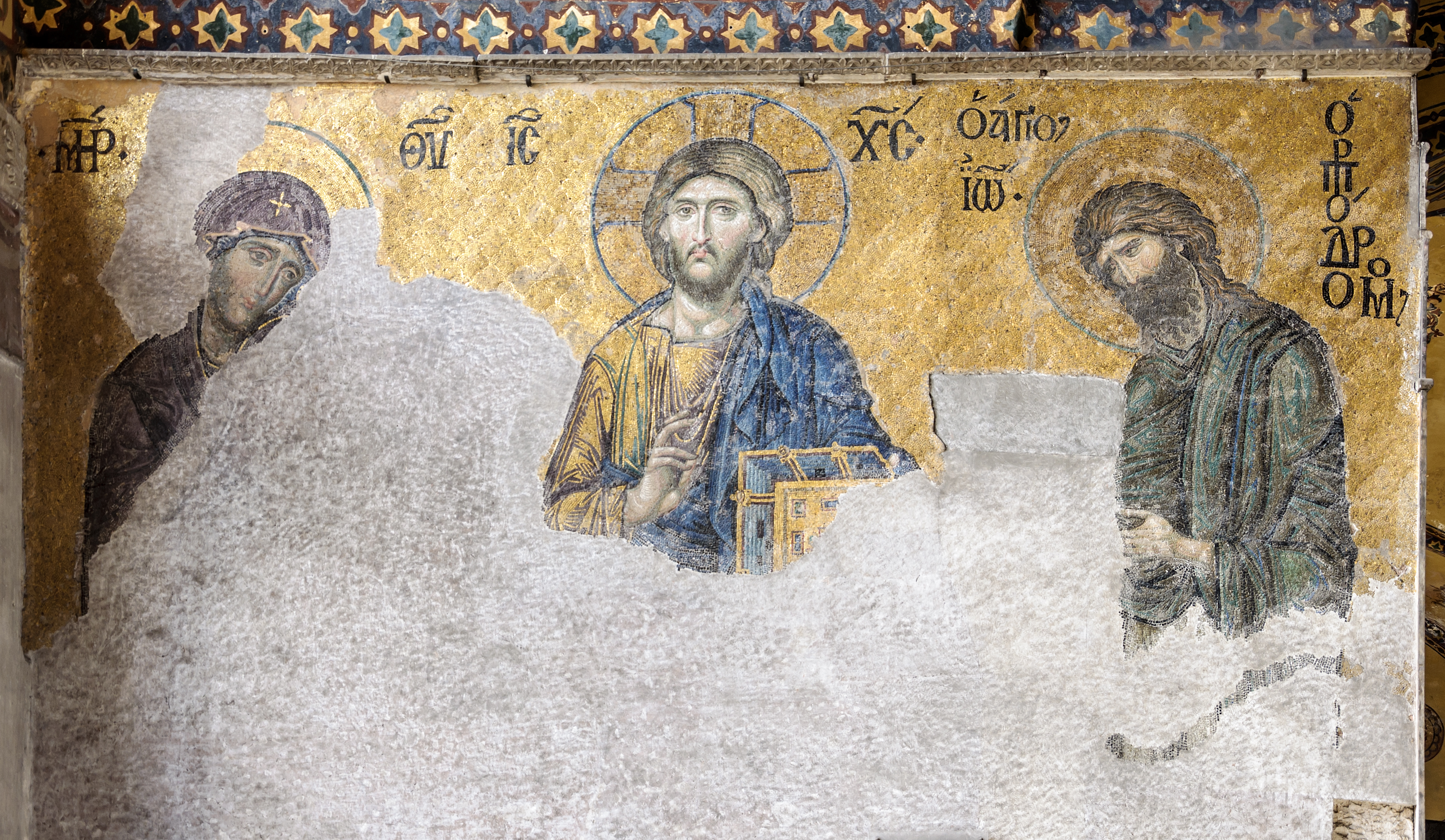
File:Deesis mosaic Hagia Sophia.jpg
Deësis (Gr. "Prayer" or "Supplication") mosaic, 13th century.  Hagia Sophia  (Holy Wisdom) Cathedral, Constantinople, Byzantine Empire; showing the Virgin Mary and John the Baptist on Christ's left and right (photo Wikimedia Commons)
 
 Now Jesus, going up to Jerusalem, took the twelve disciples aside on the road and said to them, "Behold, we are going up to Jerusalem, and the Son of Man will be betrayed to the chief priests and to the scribes; and they will condemn Him to death, and deliver Him to the Gentiles to mock and to scourge and to crucify.  And the third day He will rise again."

Then the mother of Zebedee's sons came to Him with her sons, kneeling down and asking something from Him.  And He said to her, "What do you wish?"  She said to Him, "Grant that these two sons of mine may sit, one of Your right hand and the other on the left, in Your kingdom."  But Jesus answered and said, "You do not know what you ask.  Are you able to drink the cup that I am about the drink, and to be baptized with the baptism that I am baptized with?"  They said to Him, "We are able."  So He said to them, "You will indeed drink My cup, and be baptized with the baptism that I am baptized with; but to sit on My right hand and on My left is not Mine to give, but it is for those for whom it is prepared by My Father."  And when the ten heard it, they were greatly displeased with the two brothers.  But Jesus called them to Himself and said, "You know  that the rulers of the Gentiles lord it over them, and those who are great exercise authority over them.  Yet it shall not be so among you; but whoever desires to become great among you, let him be your servant.  And whoever desires to be first among you, let him be your slave -- just as the Son of Man did not come to be served, but to serve, and to give His life a ransom for many."
 
- Matthew 20:17-28 
 
In yesterday's reading, Jesus gave the parable of the Workers in the Vineyard:  "For the kingdom of heaven is like a landowner who went out early in the morning to hire laborers for his vineyard.  Now when he had agreed with the laborers for a denarius a day, he sent then into his vineyard.  And he went out about the third hour and saw others standing idle in the marketplace, and said to them, 'You also go into the vineyard, and whatever is right I will give you.'  So they went.  Again he went out about the sixth and the ninth hour, and did likewise.  And about the eleventh hour he went out and found others standing idle, and said to them, 'Why have you been standing here idle all day?'  They said to him, 'Because no one hired us.'  He said to them, 'You also go into the vineyard, and whatever is right you will receive.'  So when evening had come, the owner of the vineyard said to his steward, 'Call the laborers and give them their wages, beginning with the last to the first.'  And when those came who were hired about the eleventh hour, they each received a denarius.  But when the first came, they supposed that they would receive more; and they likewise received each a denarius.  And when they had received it, they complained against the landowner, saying, 'These last men have worked only one hour, and you made them equal to us who have borne the burden and the heat of the day.'  But he answered one of them and said, 'Friend, I am doing you no wrong.  Did you not agree with me for a denarius?  Take what is yours and go your way.  I wish to give to this last man the same as to you.  Is it not lawful for me to do what I wish with my own things?  Or is your eye evil because I am good?'  So the last will be first, and the first last.  For many are called, but few chosen."
 
  Now Jesus, going up to Jerusalem, took the twelve disciples aside on the road and said to them, "Behold, we are going up to Jerusalem, and the Son of Man will be betrayed to the chief priests and to the scribes; and they will condemn Him to death, and deliver Him to the Gentiles to mock and to scourge and to crucify.  And the third day He will rise again."  My study Bible comments that Christ's repeated prediction of His Passion is meant to encourage and strengthen disciples for the terrifying events they will face.  According to Theophylact, it is as if Christ were saying, "Think on all these [words and miracles], so that when you see me hanging on the Cross, you will not imagine that I am suffering because I am powerless to do otherwise."

Then the mother of Zebedee's sons came to Him with her sons, kneeling down and asking something from Him.  And He said to her, "What do you wish?"  She said to Him, "Grant that these two sons of mine may sit, one of Your right hand and the other on the left, in Your kingdom."  But Jesus answered and said, "You do not know what you ask.  Are you able to drink the cup that I am about the drink, and to be baptized with the baptism that I am baptized with?"  They said to Him, "We are able."  So He said to them, "You will indeed drink My cup, and be baptized with the baptism that I am baptized with; but to sit on My right hand and on My left is not Mine to give, but it is for those for whom it is prepared by My Father."   We don't really know why at this juncture the mother of James and John Zebedee has come to Christ with this request.  It is a sort of repetition of the disciples previously asking, "Who then is greatest in the kingdom of heaven?"  But this time, it is the mother of Zebedee's sons who comes with this request on behalf of James and John.  When the question of "the greatest" was asked before, Jesus took pains with specific and extended teachings on humility and the need to serve, especially to take care of the "little ones" in the Church.  Perhaps Christ speaking of His coming Passion, and saying that on the third day He will rise again has prompted the disciples to assume that He will come into an eternal, earthly kingdom, as is widely expected of the Messiah.  But my study Bible comments that this quest for temporal power and glory is unfitting for a disciple and it shows an earthly misunderstanding of the Kingdom of God.  Here Matthew tells us that it was their mother who requested such an honor -- but John and James' own involved in revealed because Jesus addresses them in the plural "you" in the Greek both here and in Mark 10:36.   We must note that Christ calls His Crucifixion a cup and His death a baptism.  The Cross is a cup, my study Bible says, because He drank it willingly (Hebrews 12:2).  His death is baptism, as He was completely immersed in it, and yet it cleansed the world (Romans 6:3-6).  Christ's prophecy of John and James participating in the same cup and baptism shows the life of persecution and martyrdom these brothers would lead after Pentecost -- James would be the first apostle to be martyred (Acts 12:1-2), and John would go on to a long life of persecution and exile, producing one Gospel, three Epistles, and the Revelation.  My study Bible further notes on this passage that Christ declaring that the places of honor in the Kingdom are not His to give doesn't mean He lacks authority.  It means, instead, that they are not His to give arbitrarily.  He will give them to those for whom God has prepared them.  Note also, my study Bible says, that with regard to sitting as equals on the right and the left hand of Christ in Christ's Kingdom, St. John Chrysostom teaches that nobody could possibly occupy these positions.  Regarding the highest places of honor that can be given to human beings, the icons of the Orthodox Church universally depict the Virgin Mary (most blessed among women -- Luke 1:28) and John the Baptist (greatest born of women -- Matthew 11:11) holding these places.  See the icon above, the 13th century mosaic entitled Deësis, meaning "prayer" or "supplication" in Greek, from Hagia Sophia (Holy Wisdom) Cathedral in Constantinople, the capitol of the Byzantine Empire.
 
And when the ten heard it, they were greatly displeased with the two brothers.  But Jesus called them to Himself and said, "You know  that the rulers of the Gentiles lord it over them, and those who are great exercise authority over them.  Yet it shall not be so among you; but whoever desires to become great among you, let him be your servant.  And whoever desires to be first among you, let him be your slave -- just as the Son of Man did not come to be served, but to serve, and to give His life a ransom for many."  My study Bible notes that Jesus once again corrects the disciples, this time by first comparing them to the power-hungry Gentiles, whom they themselves considered an abomination, and contrasting them to Himself, who serves us although He is Lord of all.  My study Bible notes here that for many is an Aramaic expression which indicates "for all."

So, in the context of the Gospel, there is the common theme of sacrifice running as a thread throughout the past few readings.  There was first the story of the rich young man, whom Jesus loved, and whom He told that if he wanted to be perfect, he should sell his possessions and give to the poor, and follow Him.  This was followed by a discussion regarding the difficulties which wealth presents to those who would seek the kingdom of heaven, and the sacrifices which the disciples themselves have made.  In yesterday's reading (see above), Jesus gave the parable of the Workers in the Vineyard, expressing the principle that not all will labor equally, and yet all will receive the same reward.  Here we have the dynamic quality in the story line in which the mother of John and James Zebedee comes (seemingly on their behalf) asking Christ to make her two sons effectively greatest in His coming Kingdom, to sit at His right and left hand.  According to my study Bible, as we read above, these are positions no one could fill, and the positions there will be will go to those for whom they are prepared by God.  But again, all of this comes within the theme of sacrifice, for it all begins with Christ's second warning of His Passion and death to come, followed by Resurrection.  While the family of Zebedee has focused on what this might mean for a coming "earthly" type kingdom, Jesus' true meaning here is about His own sacrifice on behalf of all -- which will function as an image of service for everyone to remember after Pentecost and the mission of the Church has truly begun.  While Jesus has already answered the question, "Who then is the greatest in the kingdom of heaven?" with warnings about abuses of power, about humility, and service in the Church, this is yet a repetition with more emphasis, contrasting the use of power witnessed in the kingdoms of the Gentiles with the type of leadership Christ wants in His Church, to which He will entrust these apostles.  It's such an important lesson that sections of the Gospel are repeatedly devoted it, as Jesus begins His way toward Jerusalem with warnings to the disciples about what is to come.  Therefore it remains an essential lesson for the Church, and the world has seen plenty of excesses which enforce Christ's teachings all the more for all of us.  Let us endeavor to keep and live His faith, as He has taught, and follow the examples of those who have served throughout the centuries, both great and small, martyrs and saints, and the countless "little ones" who have served with their own lives and faith as well.  


Friday, March 22, 2024

You do not know what you ask

 
 Now they were on the road, going up to Jerusalem, and Jesus was going before them; and they were amazed.  And as they followed they were afraid.  Then He took the twelve aside again and began to tell them the things that would happen to Him:  "Behold, we are going up to Jerusalem, and the Son of Man will be betrayed to the chief priests and to the scribes; and they will condemn Him to death and deliver Him to the Gentiles; and they will mock Him, and scourge Him, and spit on Him, and kill Him.  And the third day He will rise again."

Then James and John, the sons of Zebedee, came to Him, saying, "Teacher, we want You to do for us whatever we ask."  And He said to them, "What do you want Me to do for you?"  They said to Him, "Grant us that we may sit, one on Your right hand and the other on Your left, in Your glory."  But Jesus said to them, "You do not know what you ask.  Are you able to drink the cup that I drink, and be baptized with the baptism that I am baptized with?"  They said to Him, "We are able."  So Jesus said to them, "You will indeed drink the cup that I drink, and with the baptism I am baptized with you will be baptized; but to sit on My right hand and on My left is not Mine to give, but it is for those for whom it is prepared."  And when the ten heard it, they began to be greatly displeased with James and John.  But Jesus called them to Himself and said to them, "You know that those who are considered rulers over the Gentiles lord it over them, and their great ones exercise authority over them.  Yet it shall not be so among you; but whoever desires to become great among you shall be your servant.  And whoever of you desires to be first shall be slave of all.  For even the Son of Man did not come to be served, but to serve, and to give His life a ransom for many."
 
- Mark 10:32–45 
 
Yesterday we read that as Jesus was going out on the road, one came running, knelt before Him, and asked Him, "Good Teacher, what shall I do that I may inherit eternal life?"  So Jesus said to him, "Why do you call Me good?  No one is good but One, that is, God.  You know the commandments:  'Do not commit adultery,' 'Do not murder,' 'Do not steal,' 'Do not bear false witness,' 'Do not defraud,' 'Honor your father and your mother.' "   And he answered and said to Him, "Teacher, all these things I have kept from my youth."  Then Jesus, looking at him, loved him, and said to him, "One thing you lack:  Go your way, sell whatever you have and give to the poor, and you will have treasure in heaven; and come, take up the cross, and follow Me."  But he was sad at this word, and went away sorrowful, for he had great possessions.  Then Jesus looked around and said to His disciples, "How hard it is for those who have riches to enter the kingdom of God!"  And the disciples were astonished at His words.  But Jesus answered again and said to them, "Children, how hard it is for those who trust in riches to enter the kingdom of God!  It is easier for a camel to go through the eye of a needle than for a rich man to enter the kingdom of God."  And they were greatly astonished, saying among themselves, "Who then can be saved?"  But Jesus looked at them and said, "With men it is impossible, but not with God; for with God all things are possible."  Then Peter began to say to Him, "See, we have left all and followed You."  So Jesus answered and said, "Assuredly, I say to you, there is no one who has left house or brothers or sisters or father or mother or wife or children or lands, for My sake and the gospel's, who shall not receive a hundredfold now in this time -- houses and brothers and sisters and mothers and children and lands, with persecutions -- and in the age to come, eternal life.  But many who are first will be last, and the last first."
 
  Now they were on the road, going up to Jerusalem, and Jesus was going before them; and they were amazed.  And as they followed they were afraid.  Then He took the twelve aside again and began to tell them the things that would happen to Him:  "Behold, we are going up to Jerusalem, and the Son of Man will be betrayed to the chief priests and to the scribes; and they will condemn Him to death and deliver Him to the Gentiles; and they will mock Him, and scourge Him, and spit on Him, and kill Him.  And the third day He will rise again."  My study Bible says that Christ's repeated predictions of His Passion were intended to encourage and to strengthen the disciples, as they will come to face terrifying events.  Let us make careful note of the fact that they are now on the road and going up to Jerusalem.  Additionally, my study Bible also comments that these warnings by Jesus confirm that He is going to His death in Jerusalem of His own will and choosing. 

Then James and John, the sons of Zebedee, came to Him, saying, "Teacher, we want You to do for us whatever we ask."  And He said to them, "What do you want Me to do for you?"  They said to Him, "Grant us that we may sit, one on Your right hand and the other on Your left, in Your glory."  But Jesus said to them, "You do not know what you ask.  Are you able to drink the cup that I drink, and be baptized with the baptism that I am baptized with?"  They said to Him, "We are able."  So Jesus said to them, "You will indeed drink the cup that I drink, and with the baptism I am baptized with you will be baptized; but to sit on My right hand and on My left is not Mine to give, but it is for those for whom it is prepared."  And when the ten heard it, they began to be greatly displeased with James and John.  But Jesus called them to Himself and said to them, "You know that those who are considered rulers over the Gentiles lord it over them, and their great ones exercise authority over them.  Yet it shall not be so among you; but whoever desires to become great among you shall be your servant.  And whoever of you desires to be first shall be slave of all."  In our readings from Monday, Tuesday, and Wednesday, Jesus has already been addressing the question of "greatness" among His disciples.  In yesterday's reading (above), Jesus addressed the question of great possessions and the obstacle that can be to entering the kingdom of God.  Here, my study Bible comments that this quest for temporal power and glory is unfitting for a disciple and shows an earthly misunderstanding of the kingdom of God.   In Matthew's Gospel it's reported that the mother of Zebedee's sons makes the request for this honor, but as is clear in the Greek text, Christ responds by addressing them in the plural ("What do you want Me to do for you?"; verse 36).  My study Bible notes also that Christ calls His Crucifixion a cup and His death a baptism.  It says that the Cross is a cup because He drinks it willingly (Hebrews 12:2); His death is baptism because He was completely immersed in it, yet it cleansed the world (Romans 6:3-6).  Here it is also noted that Christ's words to the Zebedee brothers are a prophecy.  That they will indeed participate in the same cup and baptism shows the life of persecution and martyrdom which both would lead after Pentecost.  Furthermore, that Christ says the places of honor in the Kingdom are not His to give doesn't mean that He lacks authority.  What it means is that these are not Christ's to give arbitrarily.  He will give them to those for whom God has prepared them.  With regard to sitting as equals on Christ's right and left hand in His Kingdom, St. John Chrysostom says that no one could possibly occupy a position like that.  In terms of the highest places of honor given to human beings, my study Bible notes that the icons of the Church universally show the Virgin Mary (the most blessed among women - Luke 1:28) and John the Baptist (the greatest born of women - Matthew 11:11) holding these places.  
 
 "For even the Son of Man did not come to be served, but to serve, and to give His life a ransom for many."  For many as used here is an Aramaic expression, which means "for all."

As pointed out above, in several readings this week Jesus has addressed the issue of greatness and what that is in His Church and His Kingdom.  Therefore, it is somewhat surprising at this stage that these apostles, John and James Zebedee, who together with St. Peter make up three "pillars of faith," should now come to Christ with this request.  They are the ones, together with Peter, whom Jesus has taken with Him in times that called for the greatest strength of faith:  in the healing of Jairus' daughter, and at the Transfiguration (and the healing that followed).  It seems quite possible that, at this stage when Jesus' intention is very clear that He is setting off on the road to Jerusalem, the brothers (and their mother, as indicated in St. Matthew's Gospel), believe that the purpose of going to Jerusalem is to inaugurate this Kingdom, which they assume will be an earthly one.  Perhaps it is, after all, because James and John have been so close to Jesus as part of His "inner circle" together with Peter that they seek these places of honor. But, as in the cases where Peter's behavior is disappointing (such as in his denials of Christ to come at Mark 14:29-31), or the times the disciples haven't measured up to the kind of faith Christ would ask of them (as in this reading), or have so lacked understanding it seemed to exasperate Jesus (in this reading), perhaps we are given these examples by the disciples to teach us something important.  For we learn primarily that discipleship is not a one-time quiz or test that we either pass or fail, but a lifelong journey.  Indeed the word for disciple in the Greek of the Gospels means "learner" (μαθητής/mathetes).  In modern Greek this word is used to mean "student."  Discipleship, in the context of the Gospels, is a lifelong road.  And we can see for ourselves, through the remarkably short three-year period of Christ's ministry, how the disciples grow and become the apostles they would eventually be.  As my study Bible pointed out, both John and James Zebedee (also named "Sons of Thunder" by Jesus as we read in Mark 3:17) would truly both drink Christ's cup and be baptized with His baptism.  James would be the first of the apostles to be martyred (in AD 44, beheaded by King Herod Agrippa I in Jerusalem; see Acts 12:2).  John would go on to a long life of persecution and exile, producing one Gospel, three Epistles, and the Revelation, as well as caring for Mary the Mother of God (John 19:26).  So what is it that will take these two men (and presumably their mother) from the ones who demand the two most important places in Christ's Kingdom, on His right and on His left, to the ones who would serve with the kind of greatness that Jesus has described over the course of the past several readings?  Christ's Passion itself, just ahead of them in Jerusalem, will without a doubt take them through its shattering realities and the tremendous story of Christ's sacrifice "for many," as Jesus prophesies in today's reading.  But the powerful spiritual realities to come, of Resurrection, and of the coming of the Holy Spirit at Pentecost, as well as the growth of the Church and its many servants to come, will no doubt have their effects upon all of them.  Let us take these examples to heart, and understand that for each of us, our journey forward into discipleship and deepening faith might very well take us through the deep changes of heart and mind as exemplified by these Sons of Thunder.  Let us be grateful for the grace we're given and the examples in the Gospels.  When these men make their request of Jesus, He tells them truthfully, "You do not know what you ask."  But they would learn in time, and through faith.  Let us remember that we, also, may have a lot to learn along the way.  Clearly, when we pray, we also may not know what we ask.  Let us keep our patience and keep learning as disciples throughout our lives, and pray for the grace to change and accept what we're meant to learn.