Showing posts with label third day. Show all posts

Friday, March 27, 2026

You will indeed drink the cup that I drink, and with the baptism I am baptized with you will be baptized

 
 Now they were on the road, going up to Jerusalem, and Jesus was going before them; and they were amazed.  And as they followed they were afraid.  Then He took the twelve aside again and began to tell them the things that would happen to Him:  "Behold, we are going up to Jerusalem, and the Son of Man will be betrayed to the chief priests and to the scribes; and they will condemn Him to death and deliver Him to the Gentiles; and they will mock Him, and scourge Him, and spit on Him, and kill Him.  And the third day He will rise again."
 
Then James and John, the sons of Zebedee, came to Him, saying, "Teacher, we want You to do for us whatever we ask."  And He said to them, "What do you want Me to do for you?"  They said to Him, "Grant us that we may it, one on Your right hand and the other on Your left, in Your glory."  But Jesus said to them, "You do not know what you ask.  Are you able to drink the cup that I drink, and be baptized with the baptism that I am baptized with?"  They said to Him, "We are able."  Jesus said to them, "You will indeed drink the cup that I drink, and with the baptism I am baptized with you will be baptized; but to sit on My right hand and on My left is not Mine to give, but it is for those for whom it is prepared."  And when the ten heard it, they began to be greatly displeased with James and John.  But Jesus called them to Himself and said to them, "You know that those who are considered rulers over the Gentiles lord it over them, and their great ones exercise authority over them.  Yet it shall not be so among you; but whoever desires to become great among you; but whoever desires to become great among you shall be your servant.  And whoever of you desires to be first shall be slave of all.  For even the Son of Man did not come to be served, but to serve, and to give His life a ransom for many."
 
- Mark 10:32–45 
 
Yesterday we read that, as Jesus was going out on the road, one came running, knelt before Him, and asked Him, "Good Teacher, what shall I do that I may inherit eternal life?"  So Jesus said to him, "Why do you call Me good?  No one is good but One, that is, God.  You know the commandments:  'Do not commit adultery,' 'Do not murder,' 'Do not steal,' 'Do not bear false witness,' 'Do not defraud,' 'Honor your father and your mother.'"  And he answered and said to Him, "Teacher, all these things I have kept from my youth."  Then Jesus, looking at him, loved him, and said to him, "One thing you lack:  Go your way, sell whatever you have and give to the poor, and you will have treasure in heaven; and come, take up the cross, and follow Me."  But he was sad at this word, and went away sorrowful, for he had great possessions.  Then Jesus looked around and said to His disciples, "How hard it is for those who have riches to enter the kingdom of God!"  And the disciples were astonished at His words.  But Jesus answered again and said to them, "Children, how hard it is for those who trust in riches to enter the kingdom of God!  It is easier for a camel to go through the eye of a needle than for a rich man to enter the kingdom of God."  And they were greatly astonished, saying among themselves, "Who then can be saved?"  But Jesus looked at them and said, "With men it is impossible, but not with God; for with God all things are possible."  Then Peter began to say to Him, "See, we have left all and followed You."  So Jesus answered and said, "Assuredly, I say to you, there is no one who has left house or brothers or sisters or father or mother or wife or children or lands, for My sake and the gospel's, who shall not receive a hundredfold now in this time -- houses and brothers and sisters and mothers and children and lands, with persecutions -- and in the age to come, eternal life.  But many who are first will be last, and the last first."
 
  Now they were on the road, going up to Jerusalem, and Jesus was going before them; and they were amazed.  And as they followed they were afraid.  Then He took the twelve aside again and began to tell them the things that would happen to Him:  "Behold, we are going up to Jerusalem, and the Son of Man will be betrayed to the chief priests and to the scribes; and they will condemn Him to death and deliver Him to the Gentiles; and they will mock Him, and scourge Him, and spit on Him, and kill Him.  And the third day He will rise again."  This is the third time Christ predicts His Passion to the disciples.  Now they are clearly going to Jerusalem, already in Judea and on the road going up to the Holy City.  The disciples are amazed because they know the hostility of the religious leaders in Jerusalem which Jesus has so far avoided, and they are afraid.  These repeated predictions of Christ's Passion were intended to encourage and strengthen the disciples for the terrifying events they will face there, my study Bible says.  It adds that it also confirms that Christ was going to His death of His own will and choosing.  We must remark upon the detail that Jesus gives them; they are prepared for all the humiliation and rejection He will face. 
 
 Then James and John, the sons of Zebedee, came to Him, saying, "Teacher, we want You to do for us whatever we ask."  And He said to them, "What do you want Me to do for you?"  They said to Him, "Grant us that we may it, one on Your right hand and the other on Your left, in Your glory."  But Jesus said to them, "You do not know what you ask.  Are you able to drink the cup that I drink, and be baptized with the baptism that I am baptized with?"  They said to Him, "We are able."  Jesus said to them, "You will indeed drink the cup that I drink, and with the baptism I am baptized with you will be baptized; but to sit on My right hand and on My left is not Mine to give, but it is for those for whom it is prepared."  And when the ten heard it, they began to be greatly displeased with James and John.  My study Bible calls this quest for temporal power and glory unfitting for a disciple, and it shows an earthly misunderstanding of the Kingdom of God.  It seems quite likely that James and John (and their mother, as reported in St. Matthew's Gospel) expect that this travel to Jerusalem will culminate in Jesus the Messiah establishing a worldly kingdom for Himself.  Thus they ask for the highest places in that kingdom they imagine, on His right and on His left, and speak of a worldly glory.  My study Bible notes that Christ calls His Crucifixion a cup and His death a baptism.  It explains that the Cross is a cup because He drank it willingly (Hebrews 12:2).  His death is a baptism, for He was completely immersed in it, yet it cleansed the world (Romans 6:3-6).  Christ's prophecy of John and James participating in this same cup and baptism is a prediction of the life of persecution of martyrdom they would lead after Pentecost.  St. James will become the first to be martyred among the apostles (Acts 12:1-2), and St. John will go on to a long life of persecution and exile in the early Church, giving us one Gospel, three Epistles, and the Revelation.  My study Bible also explains that Christ declaring that the places of honor in the Kingdom are not His to give does not mean that He lacks authority.  It means, instead, that they are not His to give arbitrarily.  Instead, He will give them to those for whom God has prepared them.  Moreover, according to St. John Chrysostom, my study Bible says, no one could possibly occupy such a position.  Regarding the highest places of honor that can be given to human beings, the icons of the Church universally show the Virgin Mary (the most blessed among women; Luke 1:28) and St. John the Baptist (the greatest born of women; Matthew 11:11) holding these places.  
 
  But Jesus called them to Himself and said to them, "You know that those who are considered rulers over the Gentiles lord it over them, and their great ones exercise authority over them.  Yet it shall not be so among you; but whoever desires to become great among you; but whoever desires to become great among you shall be your servant.  And whoever of you desires to be first shall be slave of all.  For even the Son of Man did not come to be served, but to serve, and to give His life a ransom for many."  This is another repeated emphasis by Christ on what constitutes greatness in His Church and the Kingdom, and in particular the use of worldly power for those who will become responsible for His flock.  See also the readings from Monday and Tuesday.  For many is an Aramaic expression which means "for all."
 
The transformation (or perhaps we should say transfiguration/metamorphosis) of Sts. James and John Zebedee is a remarkable illustration of the power of the Holy Spirit and the effects of Pentecost that will manifest in the Church after Christ's Ascension.  They will go from the two who request Christ's highest places in what they imagine will be a popularly-expected worldly kingdom presided over by the Messiah, to the two great apostles who will suffer and sacrifice so much for the Church.  St. Mark tells us that Christ gave them the name "Sons of Thunder"  (Mark 3:17), and the truth of this name is borne out in their subsequent histories in the early Church.  Thunder would be the apt description of the effects of their own voices for Christ and evangelization.  St. James was a powerful (and perhaps even "fiery") orator for the Church, hence the first target of the wrath of Herod Agrippa against the early Christian movement.  St. John, of course, became a prolific spokesman in that he produced so much of the word we are given in the New Testament.  His Gospel, Epistles, and the Revelation remain for us among the most powerful inspired Scripture in existence, to this day studied, read, debated, and treasured in the Church among the faithful.  So much of St. John's writing determines what we understands about Jesus, and in particular his Gospel is the Gospel of love, and it is his words that teach us that God is love (1 John 4:8).  These men would truly go on to the cup and baptism of Christ, and lives of great sacrifice as well as great service.  We can understand the fulfillment of the name given to them by Christ in their subsequent histories in the Church, the "thunder" of their advocacy of the gospel reaching far and wide and even into today's world through the widespread dissemination of the New Testament through the internet and the world.  So we are given two great examples in today's reading, both of the power of the Spirit and Christ's ministry, and the transformational power we find in the Church, and which continues to create saints -- great and small -- today.  It is this power evident in these men that works to help all of us today to manifest the fruits of the Spirit, and to rely upon the power of God even to work through our weaknesses (2 Corinthians 12:9).


Tuesday, August 5, 2025

Get behind Me, Satan! For you are not mindful of the things of God, but the things of men

 
 Then He came to Bethsaida; and they brought a blind man to Him, and begged Him to touch him.  So He took the blind man by the hand and led him out of the town.  And when He had spit on his eyes and put His hands on him, He asked him if he saw anything.  And he looked up and said, "I see men like trees, walking."  Then He put His hands on his eyes again and made him look up.  And he was restored and saw everyone clearly.  Then He sent him away to his house, saying, "Neither go into the town, nor tell anyone in the town." 
 
Now Jesus and His disciples went out to the towns of Caesarea Philippi; and on the road He asked His disciples, saying to them, "Who do men say that I am?"  So they answered, "John the Baptist; but some say, Elijah; and others, one of the prophets."  He said to them, "But who do you say that I am?"  Peter answered  and said to Him, "You are the Christ."  Then He strictly warned them that they should tell no one about Him. 
 
And He began to teach them that the Son of Man must suffer many things, and be rejected by the elders and chief priests and scribes, and be killed, and after three days rise again.  He spoke this word openly.  Then Peter took Him aside and began to rebuke Him.  But when He had turned around and looked at His disciples, He rebuked Peter, saying, "Get behind Me, Satan!  For you are not mindful of the things of God, but the things of men."  
 
- Mark 8:22-33 
 
Yesterday we read that the Pharisees came out and began to dispute with Him, seeking from Him a sign from heaven, testing Him.  But He sighed deeply in His spirit, and said, "Why does this generation seek a sign?  Assuredly, I say to you, no sign shall be given to this generation."  And He left them, and getting into the boat again, departed to the other side.  Now the disciples had forgotten to take bread, and they did not have more than one loaf with them in the boat.  Then He charged them, saying, "Take heed, beware of the leaven of the Pharisees and the leaven of Herod."  And they reasoned among themselves, saying, "It is because we have no bread."  But Jesus, being aware of it, said to them, "Why do you reason because you have no bread?  Do you not yet perceive nor understand?  Is your heart still hardened?  Having eyes, do you not see?  And having ears, do you not hear?  And do you not remember?  When I broke the five loaves for the five thousand, how many baskets full of fragments did you take up?"  They said to Him, "Twelve."  "Also, when I broke the seven for the four thousand, how many large baskets full of fragments did you take up?" And they said, "Seven."  So he said to them, "How is it that you do not understand?"   
 
  Then He came to Bethsaida; and they brought a blind man to Him, and begged Him to touch him.  So He took the blind man by the hand and led him out of the town.  And when He had spit on his eyes and put His hands on him, He asked him if he saw anything.  And he looked up and said, "I see men like trees, walking."  Then He put His hands on his eyes again and made him look up.  And he was restored and saw everyone clearly.  Then He sent him away to his house, saying, "Neither go into the town, nor tell anyone in the town."  My study Bible comments that the people of Bethsaida were unbelieving (Matthew 11:21); so, therefore, this is why Jesus leads the blind man out of the town to heal him.  Additionally, in this way the people would not scoff at the miracle and then bring upon themselves greater condemnation in so doing.  That this blind man was healed in stages, my study Bible further explains, shows that he had only a small amount of faith (hence another reason to take him out of the town) -- for healing occurs according to one's faith (Mark 6:5-6).  But this little faith was enough, and it increased with the touch of Christ.  Jesus' command not to return to the town, my study Bible notes, symbolizes that we must not return to our sins once we have been forgiven.  
 
 Now Jesus and His disciples went out to the towns of Caesarea Philippi; and on the road He asked His disciples, saying to them, "Who do men say that I am?"  So they answered, "John the Baptist; but some say, Elijah; and others, one of the prophets."  He said to them, "But who do you say that I am?"  Peter answered  and said to Him, "You are the Christ."  Then He strictly warned them that they should tell no one about Him.  Here Jesus brings the question to the disciples of His true identity.  My study Bible comments that, "Who do you say that I am?" is the greatest question a person could ever face, for it is the question that defines Christianity.  Peter's correct answer to this question (on behalf of all the disciples) prevents the Christian faith from being seen as merely another philosophical system or path of spirituality.  He is the Christ, and the one and only Son of the living God (Matthew 16:16).  This is a position, my study Bible says, which excludes all compromise with other religious systems.  Peter's understanding is related to the heart (as discussed in yesterday's reading and commntary), and it cannot be achieved by human reason, but only by divine revelation through faith (1 Corinthians 12:3).  Christ means "Anointed One," and it's equivalent to the Hebrew title "Messiah."  My study Bible also asks us to note that Christ first draws out erroneous opinions about Himself.  This is done so that these incorrect ideas may be identified, as a person is better prepared to avoid false teachings when they are clearly identified.
 
 And He began to teach them that the Son of Man must suffer many things, and be rejected by the elders and chief priests and scribes, and be killed, and after three days rise again.  He spoke this word openly.  Then Peter took Him aside and began to rebuke Him.  But when He had turned around and looked at His disciples, He rebuked Peter, saying, "Get behind Me, Satan!  For you are not mindful of the things of God, but the things of men."  My study Bible comments here that, after Peter's confession, Jesus reveals the true nature of His messiahship:  the mystery of His Passion.  It was expected that the Messiah would reign forever, so the idea that Christ would die was perplexing to Peter, and remained scandalous to the Jews even after the Resurrection (1 Corinthians 1:23).  St. Peter unwittingly speaks for Satan, my study Bible explains, for the devil did not want Christ to fulfill His mission and save humankind through suffering and death. 
 
Faith is once again the great subject behind all things we read in today's Gospel passage.  The passage shows us the various ways in which faith works, how it works in us, and how we cooperate with and find that faith -- even the struggle to continue in our faith and keep it.   There is first of all the story of the blind man healed by Jesus.  As my study Bible explains, his faith starts as "little" but it grows gradually through contact with Christ.  Jesus does everything He can to shore up and strengthen that faith -- taking the blind man out of the town and away from the scoffers in order to heal him, and even teaching him not to return so as to maintain his faith.  These teachings remain important for each of us.  As with many in Twelve Step programs, often it is only by removing oneself from a particular familiar environment that the destructive habit can be left behind.  Patterns of thinking (called λογισμοί/logismoi in the Greek language of theology and historical monasticism) affect us at many levels; so often we inherit them from an environment or adopt them through social contact.  They can be destructive and tempting, or they can help us -- and oftentimes in order to build up our lives in ways that are truly needful and helpful we need to be mindful of how we can shore up what is good for us, and remove away from ourselves the things that tear us down and tempt us in ways that seem to promise good but are really destructive.  Again, addictions of all kinds form an example:  the promise to reduce pain or anxiety is a trap which leads only to worse enslavement to such pain, anxiety, and other problems.  So, Christ's action to shore up faith for healing remains one of the most significant teachings we can receive in our lives, for modern problems of today as well as for Christ's time.  Perhaps today, with our exposure to so much and an unlimited sense of freedom through the internet, we have need of this teaching more than ever before.  Then there is the confession of St. Peter (made on behalf of all of the disciples, as St. Peter so often speaks for all of them) that Jesus is the Christ.  Again, my study Bible emphasizes faith and the state of the heart as the root of such perception.  For this reason, we guard our hearts from the destructive thought patterns that do not help us find the faith we need, to see the spiritual truth of the reality of God which gives us strength to live a productive and good life -- and to see the reality of what is harmful even when it looks "good."  We observe that in the case of the healed formerly-blind man, and also in the case of the disciples after Christ's identity is revealed to them, in both circumstances Jesus warns them to tell no one.  This, again, is not to tempt scoffers -- neither to entertain their destructive mindset which may be destructive, but also to protect such people from further condemnation, as my study Bible said.  Finally, there is the moment when Christ reveals what His ministry will entail, contrary to all of the expectations about the Messiah and the kingdom the Messiah would initiate.  This is something terribly hard for the disciples to take in, let alone to accept.  St. Peter's response is something which you and I can completely understand:  he rebukes even the thought that Jesus should suffer and perish.  But Jesus responds in a stark and even harsh way, even calling Peter "Satan" in his rejection of the news that Christ will suffer and die.  St. Peter's reaction, while naturally understandable to all of us, is in fact a worldly way of thinking which the Crucifixion will stand on its head.  For God will use even this worst of all scenarios for the redemption of the whole world, leading to salvation for us all, and in so many ways teaching us what God's love is and does, and continually giving to us in the ongoing ministry of the Church the power of Resurrection at work.  In this St. Paul's word is true, that " all things work together for good to those who love God, to those who are the called according to His purpose" (Romans 8:28).  For now, let us consider the power of faith, how important and essential it is to us, what a difference in makes in our lives.  For all of these stories illustrate its importance, and our need to guard it to keep it strong, and keep ourselves on that good path, the good part.


Tuesday, July 8, 2025

Why do you seek the living among the dead? He is not here, but is risen!

 
 Then they returned and prepared spices and fragrant oils.  And they rested on the Sabbath according to the commandment.   Now on the first day of the week, very early in the morning, they, and certain other women with them, came to the tomb bringing the spices which they had prepared.  But they found the stone rolled away from the tomb.  Then they went in and did not find the body of the Lord Jesus.  And it happened, as they were greatly perplexed about this, that behold, two men stood by them in shining garments.  Then, as they were afraid and bowed their faces to the earth, they said to them, "Why do you seek the living among the dead?  He is not here, but is risen!  Remember how He spoke to you when He was still in Galilee, saying, 'The Son of Man must be delivered into the hands of sinful men, and be crucified, and the third day rise again.' "  And they remembered His words.  Then they returned from the tomb and told all these things to the eleven and to all the rest.  It was Mary Magdalene, Joanna, Mary the mother of James, and the other women with them, who told these things to the apostles.  And their words seemed to them like idle tales, and they did not believe them. 
 
- Luke 23:56b—24:11 
 
Yesterday we read that it was about the sixth hour (noon), and there was darkness over all the earth until the ninth hour.  Then the sun was darkened, and the veil of the temple was torn in two.  And when Jesus had cried out with a loud voice, He said, "Father, 'into Your hand I commit My spirit.'" Having said this, He breathed His last.  So when the centurion saw what had happened, he glorified God, saying, "Certainly this was a righteous Man!"  And the whole crowd who came together to that sight, seeing what had been done,  beat their breasts and returned.  But all His acquaintances, and the women who followed Him from Galilee, stood at a distance, watching these things.   Now behold, there was a man named Joseph, a council member, a good and just man.  He had not consented to their decision and deed.  He was from Arimathea, a city of the Jews, who himself was also waiting for the kingdom of God.  This man went to Pilate and asked for the body of Jesus.  Then he took it down, wrapped it in linen, and laid it in a tomb that was hewn out of the rock, where no one had ever lain before.  That day was the Preparation, and the Sabbath drew near.  And the women who had come with Him from Galilee followed after, and they observed the tomb and how His body was laid.  Then they returned and prepared spices and fragrant oils.  And they rested on the Sabbath according to the commandment.  
 
  Then they returned and prepared spices and fragrant oils.  And they rested on the Sabbath according to the commandment.   Now on the first day of the week, very early in the morning, they, and certain other women with them, came to the tomb bringing the spices which they had prepared.  The first day of the week is the day after the Sabbath; that is, Sunday.  In the Christian tradition, this is called the Lord's Day, and it is the day of worship (Acts 20:7).  
 
 But they found the stone rolled away from the tomb.  Then they went in and did not find the body of the Lord Jesus.  My study Bible comments that the stone is rolled away not to let the all-powerful Lord out, but in order to let us witness Christ's Resurrection.  
 
 And it happened, as they were greatly perplexed about this, that behold, two men stood by them in shining garments.  These two men . . . in shining garments are angels.
 
 Then, as they were afraid and bowed their faces to the earth, they said to them, "Why do you seek the living among the dead?  He is not here, but is risen!  Remember how He spoke to you when He was still in Galilee, saying, 'The Son of Man must be delivered into the hands of sinful men, and be crucified, and the third day rise again.' "   My study Bible comments that, in order to dispel any doubt, the angel confirms his message by recalling Christ's own words.  In calculating the third day, the first day is Friday, the day on which Christ died before sundown.  The second is Saturday, the Sabbath on which Christ rested in the tomb.  The third day, which begins after sundown on Saturday, is the day of Resurrection, Sunday.  
 
And they remembered His words.  Then they returned from the tomb and told all these things to the eleven and to all the rest.  It was Mary Magdalene, Joanna, Mary the mother of James, and the other women with them, who told these things to the apostles.  And their words seemed to them like idle tales, and they did not believe them.  My study Bible comments that certain patristic teachers say that Mary the mother of James was the wife of Alphaeus, and this James was one of the twelve (Luke 6:15).  But most of the Fathers hold that this is the Virgin Mary, who was in fact the stepmother of a different James, "the Lord's brother" (see Matthew 13:55; compare Mark 15:40, 47).  In some icons of the Myrrhbearing Women, and in a hymn written by St. John of Damascus, it is sung, "The angel cried to the lady full of grace, 'Rejoice, O pure Virgin:  your Son is risen from His three days in the tomb."  
 
Why are women the first to hear the word of the Resurrection?  Indeed, in this account, they are the first to preach that Christ is Risen!  In the Church, these Myrrhbearing Women are also known as Apostles to the Apostles, for they are the ones who preach the word of Resurrection -- and tell of this good news -- to the apostles who are in hiding.  And why them, then?  Why these women?  These are the ones -- including Christ's mother, the Theotokos and Virgin Mary -- who have followed Him from Galilee, and been loyal to Him and supported Him all this time.  But I have read an interesting commentary in defense of the veracity of these Gospel accounts.  That starts, ironically, from the fact that it was men (in Christ's time) who were considered worthy witnesses.  Women were not generally considered to be reliable, or believable (as we can see confirmed in the reaction of the apostles to the news).  But this tends to lend credibility to the Gospel accounts, as it follows logically that if only men were seen as trustworthy witnesses, then an invented story would have used men as their witnesses.  St. Luke's Gospel, as we have repeatedly observed, pays close attention to the women involved in Christ's ministry, for we get a humane glimpse into their essential relationships with Christ, His sympathetic nature, and the values these women contribute.   Another traditional observation is that even as  the "first sin" began with the temptation of our maternal ancestor Eve, our fallen state is overcome in Christ when women are the first to hear, believe, and proclaim the Resurrection.  So let us be grateful for these women, the myrrh they bear to anoint Christ's body, God's angels who announce the good news to them, and the Gospels that give us this so very worthy story to cherish and to build our lives upon.  For God uses everything available to us to glorify even the least of these, the smallest things in our lives, and out of them to create monumental values that hold through the test of time and our faith.  We also may observe the care and especially mercy that is symbolized in the anointing of oil and myrrh, for in their love and charity, these women tell us what God's grace will repay with glorious anointing in return.  They are saints we may call upon even when dire circumstances and loss come upon us, to teach us about gracious behavior and the mercy that supersedes all authority as we practice our faith as well.  God works through human beings, God's angels, and all of creation to bring us the good news of His glory.


Friday, March 7, 2025

We have found the Messiah

 
 Again, the next day, John stood with two of his disciples.  And looking at Jesus as He walked, he said, "Behold, the Lamb of God!"  The two disciples heard him speak, and they followed Jesus.  Then Jesus turned, and seeing them following, said to them, "What do you seek?"  They said to Him, "Rabbi" (which is to say, when translated, Teacher), "where are You staying?"  He said to them, "Come and see."  They came and saw where He was staying, and remained with Him that day (now it was about the tenth hour).  One of the two who heard Jon speak, and followed Him, was Andrew, Simon Peter's brother.  He first found his own brother Simon, and said to him, "We have found the Messiah" (which is translated, the Christ).  And he brought him to Jesus.  Now when Jesus looked at him, He said, "You are Simon the son of Jonah.  You shall be called Cephas" (which is translated, A Stone). 
 
- John 1:35–42 
 
Yesterday we were given the second day (paralleling the creation story of Genesis) of the beginning of Christ's ministry, the testimony of John the Baptist: John saw Jesus coming toward him, and said, "Behold!  The Lamb of God who takes away the sin of the world!  This is He of whom I said, 'After me comes a Man who is preferred before me, for he was before me.'  I did not know Him; but that he should be revealed to Israel, therefore I came baptizing with water."  And John bore witness, saying, "I saw the Spirit descending from heaven like a dove, and he remained upon Him.  I did not know Him, but He who sent me to baptize with water said to me, 'Upon whom you see the Spirit descending, and remaining on Him, this is He who baptizes with the Holy Spirit.'  And I have seen and testified that this is the Son of God."
 
  Again, the next day, John stood with two of his disciples.  And looking at Jesus as He walked, he said, "Behold, the Lamb of God!"  The two disciples heard him speak, and they followed Jesus.  Then Jesus turned, and seeing them following, said to them, "What do you seek?"  They said to Him, "Rabbi" (which is to say, when translated, Teacher), "where are You staying?"  He said to them, "Come and see."  They came and saw where He was staying, and remained with Him that day (now it was about the tenth hour).  One of the two who heard Jon speak, and followed Him, was Andrew, Simon Peter's brother.  He first found his own brother Simon, and said to him, "We have found the Messiah" (which is translated, the Christ).  And he brought him to Jesus.  Now when Jesus looked at him, He said, "You are Simon the son of Jonah.  You shall be called Cephas" (which is translated, A Stone).  My study Bible comments that the Lord's first disciples had been followers of John the Baptist.  They were Andrew; Simon (also known as Peter), or Cephas;  Philip and Nathanael (also known as Bartholomew), both of whom we will read about in tomorrow's reading; and an unnamed disciple, whom some patristic commentary say was John, the author of the Gospel.  It was a common literary device for a writer not to give his own name (see Luke 24:13). 
 
Today's reading encompasses the third day of the beginning of the story of Christ's ministry.  Here in today's reading, John the Baptist sends two disciples to Christ whom Christ then gathers to be His own.  One of them He declares to be the foundation of the Church (see also Matthew 16:18).  As this Gospel began with the words, "In the beginning" (John 1:1), suggesting the creation story of Genesis (Genesis 1:1), so each day also parallels a day of that creation story.  Today's reading parallels the gathering of the waters and the establishment of growth on the land on the third day in Genesis 1:9-13.  In the story of creation in Genesis, we find that God brings order out of chaos, and fills the world with good things, establishing both order and creativity.  Here John's ministry takes the shape of its fullness by John leading his disciples to Christ, following his testimony to Jesus as the Christ in yesterday's reading (the second day in the unfolding of Christ's ministry).  We could suggest the parallel to the creation story gives us Logos Himself -- both the organizing and creative principle of existence -- as the center of all things.  John the Baptist plays his role by revealing Logos to the world, and also gathering his own disciples to the Christ, thus filling the world with good things, even children to the Lord.  In our own lives, we might consider this same pattern and how it can be set down for us -- and set into motion: a blessed and good way of life.  We first place the Lord at the center of all things in life, for He is the creative and organizing principle Himself in His Person.  He is the Logos.  In John 1:1, the Greek word Logos is translated as "Word" ("In the beginning was the Word, and the Word was with God, and the Word was God").  This, of course, refers to Jesus Christ, whom we know is the eternal Son of God.  My study Bible commented on that verse that Logos can mean "wisdom," "reason," and "action" as well as "word" -- all of these are attributes of the Son of God.  So, when we first place Jesus our Lord at the center of our lives, it is all of these properties of Logos that we are putting front and center in life, and as we pray and as we worship and structure our lives around Christ, so we are bringing the energies of those properties into our lives as well.  We participate in His life through prayer and worship practices and following the things He teaches (such as almsgiving, fasting, repentance, etc.) and in this way we ally with His energies.  This process is called "Theosis" in the Orthodox Christian tradition.  But by putting this principle of Logos first in our lives as the center of our focus, we bring organization, order, creativity, and all that Christ offers into our homes and our lives, into our families and relationships.  This is the story of the unfolding of Christ's ministry, where first John the Baptist serves Christ by revealing Him to the world, and then draws his own disciples to Jesus.  So we can do the same ourselves in our lives.  We can first put Christ in the center, knowing and learning and growing in our understanding of Him, and after that we seek to grow all things in our lives as things which serve Christ.  Whatever we do, whatever we choose, whatever steps we take, whatever we create in our lives, follows the pattern of creatively serving Christ and filling our lives with good things.  In our own practice of discipleship, we seek this constant pattern, so that we in turn are ordered, creative, and serving and enhancing the good with all we produce.  Christ has life in Himself, and the things that come from the Lord remain dynamic, creative, original, unique, and a constant marvel, such as the myriad saints that come from our faith, all of whom are unique and show us original ways in which their uniqueness is magnified in ways that serve God.  In this sense, we return the gift of our lives to our Creator, and in turn our Creator blesses us with ways to serve, to be a true part of this dynamic unfolding creation, and its salvation in Him.  Let us consider this pattern, and the growth of Christ's disciples and ministry, and how that pattern can work and unfold as well in our own lives.  In today's reading, Simon is brought to Christ, and he is revealed by Christ to be Cephas, or Peter (from the Greek Petros, meaning a Stone); that is, he is revealed by the Lord to be the foundation of the Church.  So we also may seek the Lord, and He in turn reveals to us who we are, giving us life and ministry and a way to lead our lives.


Tuesday, November 26, 2024

Son of David, have mercy on me!

 
 Then He took the twelve aside and said to them, "Behold, we are going up to Jerusalem, and all things that are written by the prophets concerning the Son of Man will be accomplished. For He will be delivered to the Gentiles and will be mocked and insulted and spit upon.  They will scourge Him and kill Him.  And the third day He will rise again."  But they understood none of these things; this saying was hidden from them, and they did not know the things which were spoken.  

Then it happened, as He was coming near Jericho, that a certain blind man sat by the road begging.  And hearing a multitude passing by, he asked what it meant.  So they told him that Jesus of Nazareth was passing by.  And he cried out, saying, "Jesus, Son of David, have mercy on me!"  Then those who went before warned him that he should be quiet; but he cried out all the more,"Son of David, have mercy on me!"  So Jesus stood still and commanded him to be brought to Him.  And when he had come near, He asked him, saying, "What do you want Me to do for you?"  He said, "Lord, that I may receive my sight.  Then Jesus said to him, "Receive your sight; your faith has made you well."  And immediately he received his sight, and followed Him, glorifying God.  And all the people, when they saw it, gave praise to God. 
 
- Luke 18:31-43 
 
Yesterday we read that people brought infants to Jesus that He might touch them; but when the disciples saw it, they rebuked them.  But Jesus called them to Him and said, "Let the little children come to Me, and do not forbid them; for of such is the kingdom of God.  Assuredly, I say to you, whoever does not receive the kingdom of God as a little child will by no means enter it."  Now a certain ruler asked Him, saying, "Good Teacher, what shall I do to inherit eternal life?"  So Jesus said to him, "Why do you call Me good?  No one is good but One, that is, God.  You know the commandments:  'Do not commit adultery,' 'Do not murder,' 'Do not steal,' 'Do not bear false witness,' 'Honor your father and your mother.'"  And he said, "All these things I have kept from my youth."  So when Jesus heard these things, He said to him, "You still lack one thing.  Sell all that you have and distribute to the poor, and you will have treasure in heaven; and come, follow Me."  But when he heard this, he became very sorrowful, for he was very rich.  And when Jesus saw that he became very sorrowful, He said, "How hard it is for those who have riches to enter the kingdom of God!  For it is easier for a camel to go through the eye of a needle than for a rich man to enter the kingdom of God."  And those who heard it said, "Who then can be saved?"  But He said, "The things which are impossible with men are possible with God."  Then Peter said, "See, we have left all and followed you."  So He said to them, "Assuredly, I say to you, there is no one who has left house or parents or brothers or wife or children, for the sake of the kingdom of God, who shall not receive many ties more in this present time, and in the age to come eternal life."  
 
Then He took the twelve aside and said to them, "Behold, we are going up to Jerusalem, and all things that are written by the prophets concerning the Son of Man will be accomplished. For He will be delivered to the Gentiles and will be mocked and insulted and spit upon.  They will scourge Him and kill Him.  And the third day He will rise again."  But they understood none of these things; this saying was hidden from them, and they did not know the things which were spoken.   My study Bible comments that the saying was hidden not by God, but because the disciples could not understand its meaning until the events of the Passion had taken place.  

Then it happened, as He was coming near Jericho, that a certain blind man sat by the road begging.  And hearing a multitude passing by, he asked what it meant.  So they told him that Jesus of Nazareth was passing by.  And he cried out, saying, "Jesus, Son of David, have mercy on me!"  Then those who went before warned him that he should be quiet; but he cried out all the more,"Son of David, have mercy on me!"  So Jesus stood still and commanded him to be brought to Him.  And when he had come near, He asked him, saying, "What do you want Me to do for you?"  He said, "Lord, that I may receive my sight.  Then Jesus said to him, "Receive your sight; your faith has made you well."  And immediately he received his sight, and followed Him, glorifying God.  And all the people, when they saw it, gave praise to God.  This blind man greets Jesus as Son of David, which is a title my study Bible refers to as one deeply associated with the Messiah.  Although He knows what we want before we ask, my study Bible says, Jesus calls us to ask freely so that we might learn of His mercy.   In the Gospel according to St. Matthew, there are two blind men in this story.  There's a spiritual interpretation to that miracle, in that future generations coming to Christ would do so only by hearing, without benefit of seeing Christ in person (see John 20:29).  Those trying to silence the men are the persecutors and tyrants who, in each generation, try to silence the Church.  But even under persecution, the Church all the more confesses Jesus Christ.  

There are some interesting ways that we could look at today's story of the blind man (in parallel with the two blind men found in Matthew's Gospel).  First of all, it's interesting that, as this man is deprived of his sight, he is nonetheless blessed with the resources and gifts of his voice and his hearing.  It's interesting that voice and hearing are linked through patristic interpretation with freedom; that is, the freedom of the Church to proclaim and confess Christ.  In a sense, the story is an illustration of St. Paul's experience, in which he prayed several times for God to take away a particular infirmity.  St. Paul writes, "And He said to me, 'My grace is sufficient for you, for My strength is made perfect in weakness.' Therefore most gladly I will rather boast in my infirmities, that the power of Christ may rest upon me" (see 2 Corinthians 12:7-10).  Like St. Paul's mysterious infirmity, which he called a "thorn in the flesh," the affliction of blindness nevertheless functions in some way to enable this man to find and use his hearing and his voice to call out to Jesus.  His title for Jesus, "Son of David," reveals that, even in the absence of sight (or perhaps because of it), he "sees" that Jesus is the Messiah.  Perhaps due to his blindness, Jesus is not diminished in his sight by viewing his human stature, but rather in hearing the multitude he is stirred to action.  There's another parallel to blindness in understanding the Scriptures and that is its association with sin and error; we are blind to that which we do not know and need to learn.  Jericho was a place traditionally associated with sin, with people, as the expression goes, who sat in darkness (Isaiah 9:2, as quoted in Matthew 4:16).  Despite the fact that he sits in darkness, this blind man can "see" who Jesus is better than the crowds can; he can use his hearing and his voice to make the connection of faith, to respond to Jesus' question with a specific prayer to receive his sight.  This perception on the part of the blind man is clear to Jesus, who is our ultimate guide to good vision, when He tells the blind man, "Receive your sight; your faith has made you well."  This formerly blind man can now be on his way to Jerusalem, following Christ.  And in that image of Jesus on His way to Jerusalem there is another tie with blindness in today's reading, and that is in the disciples.  Jesus gives very specific and almost graphic and detailed expression of what is going to happen to Him:  In Jerusalem, "all things that are written by the prophets concerning the Son of Man will be accomplished. For He will be delivered to the Gentiles and will be mocked and insulted and spit upon.  They will scourge Him and kill Him.  And the third day He will rise again." But the disciples sat in darkness, so to speak, in that they understood none of these things; this saying was hidden from them, and they did not know the things which were spoken.  This is another form of darkness, a blindness in their lack of understanding.  But they also will be illumined by faith.  Perhaps today's lesson from the reading is about times of our own blindness, when we can't see clearly ahead of us to understand which way life is pointing us forward, and need a light in the darkness; we pray, "Son of David, have mercy on me!"  Or better yet, the Jesus Prayer it inspired:  "Lord Jesus Christ, Son of God, have mercy on me."


Thursday, October 17, 2024

If anyone desires to come after Me, let him deny himself, and take up his cross daily, and follow Me. For whoever desires to save his life will lose it, but whoever loses his life for My sake will save it

 
 And it happened, as He was alone praying, that His disciples joined Him, and He asked them, saying, "Who do the crowds say that I am?"  So they answered and said, "John the Baptist, but some say Elijah; and others say that one of the old prophets has risen again."  He said to them, "But who do you say that I am?"  Peter answered and said, "The Christ of God."  
 
 And He strictly warned and commanded them to tell this to no one, saying, "The Son of Man must suffer many things, and be rejected by the elders and chief priests and scribes, and be killed, and be raised the third day."  

Then He said to them all, "If anyone desires to come after Me, let him deny himself, and take up his cross daily, and follow Me.  For whoever desires to save his life will lose it, but whoever loses his life for My sake will save it.  For what profit is it to a man if he gains the whole world, and is himself destroyed or lost?  For whoever is ashamed of Me and My words, of him the Son of Man will be ashamed when He comes in His own glory, and in His Father's, and of the holy angels.  But I tell you truly, there are some standing here who shall not taste death till they see the kingdom of God."
 
- Luke 9:18–27 
 
Yesterday we read that Jesus called His twelve disciples together and gave them power and authority over all demons, and to cure diseases.  He sent them to preach the kingdom of God and to heal the sick.  And He said to them, "Take nothing for the journey, neither staffs nor bag nor bread nor money; and do not have two tunics apiece.  Whatever house you enter, stay there, and from there depart.  And whoever will not receive you, when you go out of that city, shake off the very dust from your feet as a testimony against them."  So they departed and went through the towns, preaching the gospel and healing everywhere.  Now Herod the tetrarch heard of all that was done by Him; and he was perplexed, because it was said by some that John had risen from the dead, and by some that Elijah had appeared, and by others that one of the old prophets had risen again.  Herod said, "John I have beheaded, but who is this of whom I hear such things?"  So he sought to see Him.  And the apostles, when they had returned, told Him all that they had done.  Then He took them and went aside privately into a deserted place belonging to the city called Bethsaida.  But when the multitudes knew it, they followed Him; and He received them and spoke to them about the kingdom of God, and healed those who had need of healing.   When the day began to wear away, the twelve came and said to Him, "Send the multitude away, that they may go into the surrounding towns and country, and lodge and get provisions; for we are in a deserted place here."  But He said to them, "You give them something to eat."  And they said, "We have no more than five loaves and two fish, unless we go and buy food for all these people."  For there were about five thousand men.  Then He said to His disciples, "Make them sit down in groups of fifty."  And they did so, and made them all sit down.  Then He took the five loaves and the two fish, and looking up to heaven, He blessed and broke them, and gave them to the disciples to set before the multitude.  So they all ate and were filled, and twelve baskets of the leftover fragments were taken up by them.  
 
  And it happened, as He was alone praying, that His disciples joined Him, and He asked them, saying, "Who do the crowds say that I am?"  So they answered and said, "John the Baptist, but some say Elijah; and others say that one of the old prophets has risen again."   My study Bible comments here that, as in every generation, what the crowds have to say about Jesus is usually unpredictable and misguided. 
 
He said to them, "But who do you say that I am?"  Peter answered and said, "The Christ of God."   Here my study Bible tells us that Who do you say that I am? is the ultimate question in Scripture and in all theology.  This is because how this question is answered will define the universe.  Christ (Hebrew Messiah) means "Anointed One."   This declaration of Peter that Jesus is the Christ of God reveals that Jesus isn't simply another anointed king or prophet.  It distinguishes Jesus as the long-awaited Savior.
 
  And He strictly warned and commanded them to tell this to no one, saying, "The Son of Man must suffer many things, and be rejected by the elders and chief priests and scribes, and be killed, and be raised the third day."    My study Bible says that Jesus desires to keep His identity as the Christ hidden in order to avoid popular political and theological misunderstandings, which are rife at His time, as they have been at so many others.  It is only after His Passion and Resurrection that His identity as Messiah can be properly understood.  Isaiah prophesies this secrecy (see Isaiah 42:1-4).  Various reasons for secrecy include the growing hostility of the Jewish leaders (and in yesterday's reading -- above -- we read of Herod Antipas' desire to see Jesus); the people's misunderstanding of the Messiah as an earthly, political leader; and Christ's desire to evoke genuine faith, which is not based solely on marvelous signs.  

Then He said to them all, "If anyone desires to come after Me, let him deny himself, and take up his cross daily, and follow Me.  For whoever desires to save his life will lose it, but whoever loses his life for My sake will save it.  For what profit is it to a man if he gains the whole world, and is himself destroyed or lost?  For whoever is ashamed of Me and My words, of him the Son of Man will be ashamed when He comes in His own glory, and in His Father's, and of the holy angels."  My study Bible asks us to note two things.  First, that each person must take up one's own cross.  That burden in this world will be different for each person; each has been chosen, my study Bible says, to bear certain struggles for one's own salvation and the salvation of those around oneself.  Second, Our cross is to be taken up daily.  That is, commitment to following Christ is not simply a one-time event.  Instead, it is the continual practice of faith and obedience, even to the point of being shamed and persecuted by the world.  

"But I tell you truly, there are some standing here who shall not taste death till they see the kingdom of God."  My study Bible says that this is a reference to those who will witness the Transfiguration (in our next reading, Luke 9:28-36), as well as to those in each generation who experience the presence of God's Kingdom.  

In today's reading, Jesus asks, "Who do the crowds say that I am?"  And then He deliberately contrasts that with the answer of His disciples, "But who do you say that I am?"  St. Peter answers on behalf of all of them:  "The Christ of God."   But how does Peter know this?  Do we stop to think about how we have this kind of faith, or this kind of knowing?  There is a type of certainty that goes beyond all of our training in life, our parental upbringing, our being raised in the Church (or not), or what others around us tell us.  Certainly this contrasting set of questions as posed by Jesus teaches us that on some level, and to some extent.  After all, as my study Bible comments, what the crowds have to say about Jesus is usually misguided, then as now.  So let us explore where Peter's correct answer comes from.  First of all, what we know about Peter is that he is a core person in Christ's "inner circle" of His key disciples.  That is, Peter forms a trio, together with Sts. John and James Zebedee, of Christ's disciples with the strongest faith.  It is this three that goes into the home of Jairus when all else are put outside in order to help facilitate the healing, and raising, of Jairus' daughter (see Tuesday's reading).  Peter and the others were first disciples of John the Baptist, and John directed his disciples to Christ (see John 1:35-42).   Certainly we know that from the time these men left their nets "and forsook all and followed Him" (see Luke 5:1-11), they have been companions of Christ through His ministry, living with Him and learning from Him.  Now they have already been sent out on their first apostolic mission as well (see yesterday's reading, above).  But what is it -- what is that mysterious component within St. Peter -- that gives him the kind of faith that he has to know who Christ is?  Certainly at the time when Christ told the men (Peter, James, and John) to let down their nets for an extraordinary catch of fish, the result was something that spiritually struck St. Peter like a blinding light, a slap in the face, causing him to fall down at Christ's knees, saying, "Depart from me, for I am a sinful man, O Lord!" (Luke 5:8).  We can understand that such a response tells us only one thing:  that St. Peter's perception of Christ as Lord makes a brilliant visceral contrast to the way he sees himself, as one lacking such perfection and holiness.  This, too, is a mark of a holy person who can see this truth, and recognize the difference between the Lord and ourselves on these spiritual terms.  Perhaps the biggest answer to this question of where Peter's faith is rooted comes from another Gospel.  St. Matthew tells the story in Matthew 16:13-28.  In Matthew's Gospel, when St. Peter confesses that Jesus is the Christ, the Son of the living God, Jesus replies to him, "Blessed are you, Simon Bar-Jonah, for flesh and blood has not revealed this to you, but My Father who is in heaven" (Matthew 16:17).  How does God the Father work through St. Peter to create this revelation of faith?  That is a mystery that one wonders if anyone knows.  But certainly we can say that St. Peter's heart is open to the promptings of God.  We can see throughout the Gospels, that Peter is a man who speaks from the heart, often with very little filter, it seems from what we know of the Gospels.  He is a man who is able to humbly take a stunning rebuke from his Lord, because we also read this in St. Matthew's account of Peter's confession of faith.  When Jesus follows with His prophecy of His own death and Crucifixion, St. Peter sincerely says, "Far be it from You, Lord; this shall not happen to You!"  Jesus' response is to say to Peter, "Get behind Me, Satan! You are an offense to Me, for you are not mindful of the things of God, but the things of men" (Matthew 16:23).  How is it that Peter's faith is such that he can bear such a rebuke from Christ?  Yet his loyalty is unwavering, and he continues to follow as disciple.  Rebuke or no rebuke, he trusts in his Lord, and he trusts who Jesus is.  Perhaps the greatest and surest victory of the Cross comes in our security in God's love, for Peter's steadfast love of Christ will overcome this obstacle of rebuke, and the temptation and shame of denial at the time of Jesus' arrest and trial at the home of the High Priest (Matthew 26:69-75).   Even Peter's bitter tears of failure do not stop him from returning to Christ and the disciples, and from his final challenge from Christ, which is all about love:  asking him three times, "Do you love Me?" the risen Christ charges Peter to feed His sheep, also teaching him by what death he would die, following his Lord (see John 21:15-19).  In St. Peter's faith, we see the story of the struggle that encompasses all the highs and lows of human experience, for love conquers all of it.  It's Christ's love that defeats and encompasses everything else, and Jesus' words of response in Matthew's Gospel are proven true:  "And I also say to you that you are Peter, and on this rock I will build My church, and the gates of Hades shall not prevail against it" (Matthew 16:18).  From the heights and the depths of Peter's journey all that lasts is Christ and the strength of faith that encompasses everything, for love is the key to it all.  In today's reading, Jesus teaches, "If anyone desires to come after Me, let him deny himself, and take up his cross daily, and follow Me.  For whoever desires to save his life will lose it, but whoever loses his life for My sake will save it."  It is the bonds of love to Him that allow us to "lose ourselves," allow St. Peter to overcome all of his own stumbling, and remain unyielding in clinging and returning to Christ.  For, like St. Peter, where we find ourselves in losing, He is there for us.


Wednesday, August 7, 2024

Now when Jesus looked at him, He said, "You are Simon the son of Jonah. You shall be called Cephas" (which is translated, A Stone)

 
 The next day John saw Jesus coming toward him, and said, "Behold!  The Lamb of God who takes away the sin of the world!  This is He of whom I said, 'After me comes a Man who is preferred before me, for He was before me.'  I did not know Him; but that He should be revealed to Israel, therefore I came baptizing with water."  And John bore witness, saying, "I saw the Spirit descending from heaven like a dove, and He remained upon Him.  I did not know Him, but He who sent me to baptize with water said to me, 'Upon whom you see the Spirit descending, and remaining on Him, this is He who baptizes with the Holy Spirit.'  And I have seen and testified that this is the Son of God."  

Again, the next day, John stood with two of his disciples.  And looking at Jesus as He walked, he said, "Behold the Lamb of God!"   The two disciples heard him speak, and they followed Jesus.  Then Jesus turned, and seeing them following, said to them, "What do you seek?"  They said to Him, "Rabbi" (which is to say, when translated, Teacher), "where are You staying?"  He said to them, "Come and see."  They came and saw where He was staying, and remained with Him that day (now it was about the tenth hour).  One of the two who heard John speak, and followed Him, was Andrew, Simon Peter's brother.  He first found his own brother Simon, and said to him, "We have found the Messiah" (which is translated, the Christ).  And he brought him to Jesus.  Now when Jesus looked at him, He said, "You are Simon the son of Jonah.  You shall be called Cephas" (which is translated, A Stone).
 
- John 1:29-42 
 
Yesterday, we were given the first day of seven in the ministry of Christ.  It began with the testimony of John the Baptist:  Now this is the testimony of John, when the Jews sent priests and Levites from Jerusalem to ask him, "Who are you?"  He confessed, and did not deny, but confessed, "I am not the Christ."  And they asked him, "What then?  Are you Elijah?"  He said, "I am not."  "Are you the Prophet?"  And he answered, "No."  Then they said to him, "Who are you, that we may give an answer to those who sent us?  What do you say about yourself?"  He said:  "I am 'The voice of one crying in the wilderness:  "Make straight the way of the LORD," 'as the prophet Isaiah said."  Now those who were sent were from the Pharisees.  And they asked him, saying, "Why then do you baptize if you are not the Christ, nor Elijah, nor the Prophet?"  John answered them, saying, "I baptize with water, but there stands One among you whom you do not know.  It is He who, coming after me, is preferred before me, whose sandal strap I am not worthy to loose."  These things were done in Bethabara beyond the Jordan, where John was baptizing. 

 The next day John saw Jesus coming toward him, and said, "Behold!  The Lamb of God who takes away the sin of the world!  This is He of whom I said, 'After me comes a Man who is preferred before me, for He was before me.'  I did not know Him; but that He should be revealed to Israel, therefore I came baptizing with water."  My study Bible comments that John's declaration of Jesus as the Lamb of God is a recollection of Isaiah's "Servant of God" who dies for the transgressions of His people (Isaiah 53:4-12).  Christ is the true Paschal (Passover) Lamb; He offers Himself for our deliverance from darkness and death (1 Peter 1:18-19).  According to St. John Chrysostom, Jesus came to John this second time in order for John to make this declaration; thereby it stops anyone from thinking that Christ needed baptism to wash away sins.  

And John bore witness, saying, "I saw the Spirit descending from heaven like a dove, and He remained upon Him.  I did not know Him, but He who sent me to baptize with water said to me, 'Upon whom you see the Spirit descending, and remaining on Him, this is He who baptizes with the Holy Spirit.'  And I have seen and testified that this is the Son of God."   My study Bible remarks on the passage telling us that the Spirit remained upon Him.  It notes that this is a sign that Christ possesses the Spirit in His fullness from all eternity.  Christ did not receive the Holy Spirit at His Baptism.  This vision that John saw revealed the truth that the Holy Spirit has always rested upon Christ.  This concludes the second day given in John's Gospel, in which John the Baptist declares that Christ baptizes with the Holy Spirit, which is greater than John's baptism of repentance, which was performed with water and on earth.  It parallels the separation of water above from water below on the second day of creation is Genesis 1:6-8.

Again, the next day, John stood with two of his disciples.  And looking at Jesus as He walked, he said, "Behold the Lamb of God!"   The two disciples heard him speak, and they followed Jesus.  Then Jesus turned, and seeing them following, said to them, "What do you seek?"  They said to Him, "Rabbi" (which is to say, when translated, Teacher), "where are You staying?"  He said to them, "Come and see."  They came and saw where He was staying, and remained with Him that day (now it was about the tenth hour).  One of the two who heard John speak, and followed Him, was Andrew, Simon Peter's brother.  He first found his own brother Simon, and said to him, "We have found the Messiah" (which is translated, the Christ).  And he brought him to Jesus.  Now when Jesus looked at him, He said, "You are Simon the son of Jonah.  You shall be called Cephas" (which is translated, A Stone).  Here we learn that Christ's first disciples had been first followers of John the Baptist.  These first two chosen as disciples of Christ are Andrew, and his brother Simon, also known as Peter or Cephas.  (Both Peter and Cephas mean A Stone, or Rock; Peter comes from the Greek Petros/Πετρος and Cephas is Aramaic in origin).  Here is the third day we're given in this Gospel, in which John the Baptist sends two disciples to Christ and Christ gathers them as His own -- one of whom He here declares to be the foundation of the Church (see Matthew 16:18).  This third day in the Gospel parallels the gathering of the waters and the establishment of growth on the land on the third day of creation in Genesis 1:9-13.  Let us note that there is a third person, unnamed, who has heard John the Baptist speak about Christ, and he is considered to be John, the author of the Gospel. 

As John's Gospel tells us the story, Jesus takes on His first disciples.  As noted above, there are actually two disciples who hear John the Baptist's  pronouncement, "Behold the Lamb of God!"   One is Andrew, and the other is not named.  These two disciples then follow Jesus and spend the day with Him.  This second, unnamed disciple is present to tell us that Andrew then went to find his brother Simon.  And then we hear something extraordinary.  Simon is brought to Jesus.  But then we're told, now when Jesus look at him, He said, "You are Simon the son of Jonah.  You shall be called Cephas" (which is translated, A Stone).  In Matthew's Gospel, for example, Jesus tells Simon that he shall be called Peter in response to Peter's confession of faith, made on behalf of all the disciples:  "And I also say to you that you are Peter, and on this rock I will build My church, and the gates of Hades shall not prevail against it" (see Matthew 16:16-18).  But here, we have John the Evangelist's early witness (the one who does not speak of himself as the second disciple with Andrew).  John is telling us something very important about Jesus, and that is His ability, as a divine Person, to see into a person and know something about an outcome far away in time.  Jesus can see what we might call Peter's telos, or "end."  That Greek word means end, but in the sense of the fullness of a journey, completion.  We know all the hoops and pitfalls and stumbling blocks Peter will come to, for the New Testament tells us about many of them, but Christ sees the fullness of the outcome of Peter's life, and crowns him, "Rock" (or Peter, as derived from the Greek of the Gospels).  Christ's vision of Peter as he truly is, or will become, is a signal of His divinity given to us by John the Evangelist and disciple as witness.  He has insight into Peter that only Christ can have, for it is Christ who is the guardian and creator of the true image of who we are, and who we can grow into through the power and grace of the Holy Spirit.  As yesterday marked the Feast of the Transfiguration (Metamorphosis in Greek) for many denominations of the Church, this is a good example of what is understood as theosis.  That is, the process whereby a person, through participation in the life, death, and Resurrection of Christ, and through the grace of the Spirit, becomes transformed, transfigured into this image that only Christ can teach us about ourselves.  It is through spiritual experience that this happens -- that trying, difficult, stumbling, insightful, and exalting process that we see unfold in Peter throughout the New Testament and into the life of the early Church.  A classic statement regarding the understanding of Jesus Christ as God Incarnate is given by St. Athanasius and others:  God became man so that man could become a god (or "like god").  This is the power of faith, and the vision of Christ for Peter as Rock, that powerful rock of faith in his confession that would become the foundation of the Church, is our example of that statement.  Peter will grow to conform to the image that Christ has of who he is, and this is true of the process of faith (to work the works of God, as John's Gospel will tell us) for each of us.  Each one has a role to play, just like the anonymous witness in today's passage who would go on to give us this Gospel.  Let us be attentive to our faith in our daily life, and Christ's seeds giving birth within us to the life He offers, as He sees us.


Thursday, June 27, 2024

Are you able to drink the cup that I am about the drink, and to be baptized with the baptism that I am baptized with?


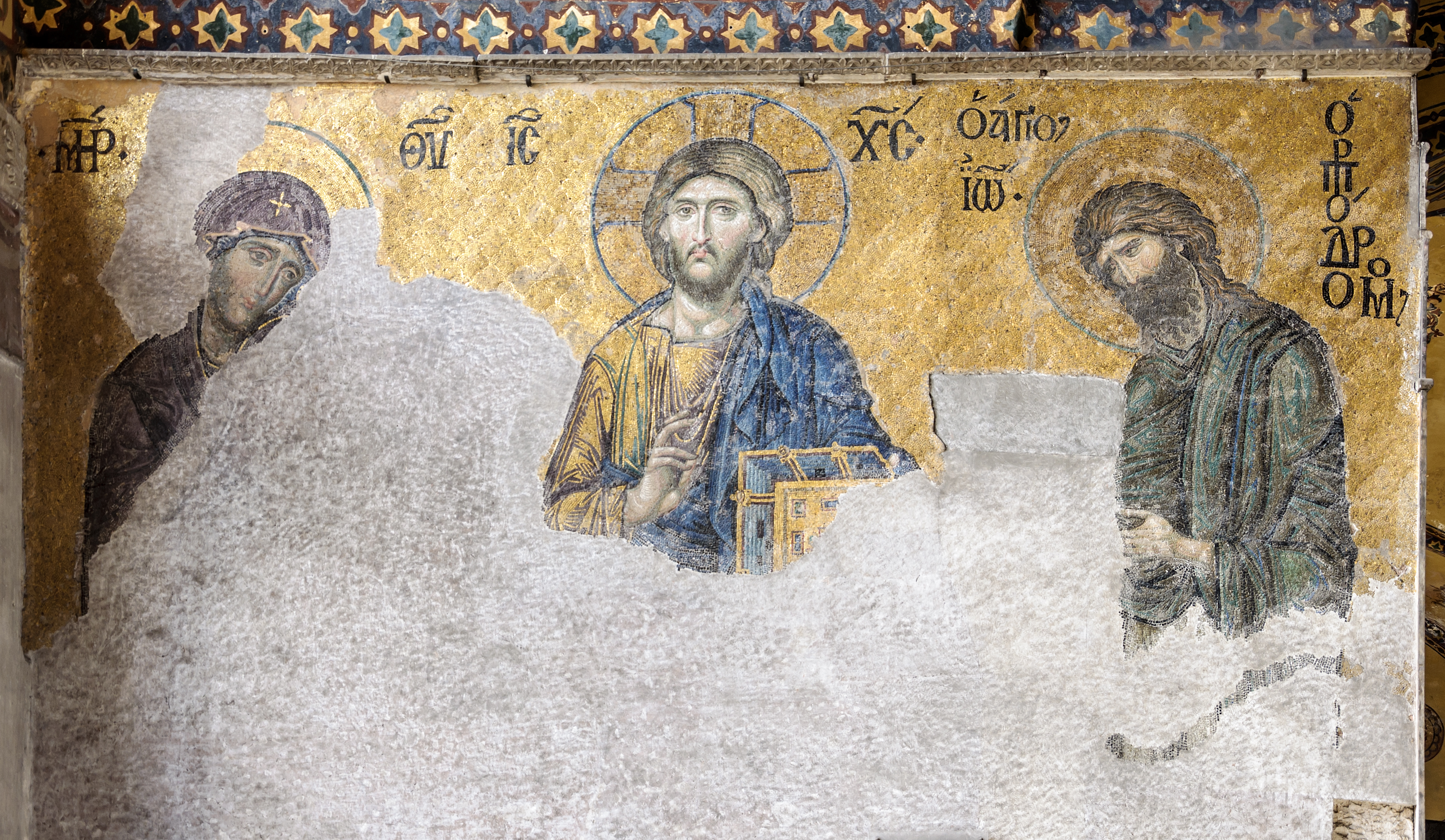
File:Deesis mosaic Hagia Sophia.jpg
Deësis (Gr. "Prayer" or "Supplication") mosaic, 13th century.  Hagia Sophia  (Holy Wisdom) Cathedral, Constantinople, Byzantine Empire; showing the Virgin Mary and John the Baptist on Christ's left and right (photo Wikimedia Commons)
 
 Now Jesus, going up to Jerusalem, took the twelve disciples aside on the road and said to them, "Behold, we are going up to Jerusalem, and the Son of Man will be betrayed to the chief priests and to the scribes; and they will condemn Him to death, and deliver Him to the Gentiles to mock and to scourge and to crucify.  And the third day He will rise again."

Then the mother of Zebedee's sons came to Him with her sons, kneeling down and asking something from Him.  And He said to her, "What do you wish?"  She said to Him, "Grant that these two sons of mine may sit, one of Your right hand and the other on the left, in Your kingdom."  But Jesus answered and said, "You do not know what you ask.  Are you able to drink the cup that I am about the drink, and to be baptized with the baptism that I am baptized with?"  They said to Him, "We are able."  So He said to them, "You will indeed drink My cup, and be baptized with the baptism that I am baptized with; but to sit on My right hand and on My left is not Mine to give, but it is for those for whom it is prepared by My Father."  And when the ten heard it, they were greatly displeased with the two brothers.  But Jesus called them to Himself and said, "You know  that the rulers of the Gentiles lord it over them, and those who are great exercise authority over them.  Yet it shall not be so among you; but whoever desires to become great among you, let him be your servant.  And whoever desires to be first among you, let him be your slave -- just as the Son of Man did not come to be served, but to serve, and to give His life a ransom for many."
 
- Matthew 20:17-28 
 
In yesterday's reading, Jesus gave the parable of the Workers in the Vineyard:  "For the kingdom of heaven is like a landowner who went out early in the morning to hire laborers for his vineyard.  Now when he had agreed with the laborers for a denarius a day, he sent then into his vineyard.  And he went out about the third hour and saw others standing idle in the marketplace, and said to them, 'You also go into the vineyard, and whatever is right I will give you.'  So they went.  Again he went out about the sixth and the ninth hour, and did likewise.  And about the eleventh hour he went out and found others standing idle, and said to them, 'Why have you been standing here idle all day?'  They said to him, 'Because no one hired us.'  He said to them, 'You also go into the vineyard, and whatever is right you will receive.'  So when evening had come, the owner of the vineyard said to his steward, 'Call the laborers and give them their wages, beginning with the last to the first.'  And when those came who were hired about the eleventh hour, they each received a denarius.  But when the first came, they supposed that they would receive more; and they likewise received each a denarius.  And when they had received it, they complained against the landowner, saying, 'These last men have worked only one hour, and you made them equal to us who have borne the burden and the heat of the day.'  But he answered one of them and said, 'Friend, I am doing you no wrong.  Did you not agree with me for a denarius?  Take what is yours and go your way.  I wish to give to this last man the same as to you.  Is it not lawful for me to do what I wish with my own things?  Or is your eye evil because I am good?'  So the last will be first, and the first last.  For many are called, but few chosen."
 
  Now Jesus, going up to Jerusalem, took the twelve disciples aside on the road and said to them, "Behold, we are going up to Jerusalem, and the Son of Man will be betrayed to the chief priests and to the scribes; and they will condemn Him to death, and deliver Him to the Gentiles to mock and to scourge and to crucify.  And the third day He will rise again."  My study Bible comments that Christ's repeated prediction of His Passion is meant to encourage and strengthen disciples for the terrifying events they will face.  According to Theophylact, it is as if Christ were saying, "Think on all these [words and miracles], so that when you see me hanging on the Cross, you will not imagine that I am suffering because I am powerless to do otherwise."

Then the mother of Zebedee's sons came to Him with her sons, kneeling down and asking something from Him.  And He said to her, "What do you wish?"  She said to Him, "Grant that these two sons of mine may sit, one of Your right hand and the other on the left, in Your kingdom."  But Jesus answered and said, "You do not know what you ask.  Are you able to drink the cup that I am about the drink, and to be baptized with the baptism that I am baptized with?"  They said to Him, "We are able."  So He said to them, "You will indeed drink My cup, and be baptized with the baptism that I am baptized with; but to sit on My right hand and on My left is not Mine to give, but it is for those for whom it is prepared by My Father."   We don't really know why at this juncture the mother of James and John Zebedee has come to Christ with this request.  It is a sort of repetition of the disciples previously asking, "Who then is greatest in the kingdom of heaven?"  But this time, it is the mother of Zebedee's sons who comes with this request on behalf of James and John.  When the question of "the greatest" was asked before, Jesus took pains with specific and extended teachings on humility and the need to serve, especially to take care of the "little ones" in the Church.  Perhaps Christ speaking of His coming Passion, and saying that on the third day He will rise again has prompted the disciples to assume that He will come into an eternal, earthly kingdom, as is widely expected of the Messiah.  But my study Bible comments that this quest for temporal power and glory is unfitting for a disciple and it shows an earthly misunderstanding of the Kingdom of God.  Here Matthew tells us that it was their mother who requested such an honor -- but John and James' own involved in revealed because Jesus addresses them in the plural "you" in the Greek both here and in Mark 10:36.   We must note that Christ calls His Crucifixion a cup and His death a baptism.  The Cross is a cup, my study Bible says, because He drank it willingly (Hebrews 12:2).  His death is baptism, as He was completely immersed in it, and yet it cleansed the world (Romans 6:3-6).  Christ's prophecy of John and James participating in the same cup and baptism shows the life of persecution and martyrdom these brothers would lead after Pentecost -- James would be the first apostle to be martyred (Acts 12:1-2), and John would go on to a long life of persecution and exile, producing one Gospel, three Epistles, and the Revelation.  My study Bible further notes on this passage that Christ declaring that the places of honor in the Kingdom are not His to give doesn't mean He lacks authority.  It means, instead, that they are not His to give arbitrarily.  He will give them to those for whom God has prepared them.  Note also, my study Bible says, that with regard to sitting as equals on the right and the left hand of Christ in Christ's Kingdom, St. John Chrysostom teaches that nobody could possibly occupy these positions.  Regarding the highest places of honor that can be given to human beings, the icons of the Orthodox Church universally depict the Virgin Mary (most blessed among women -- Luke 1:28) and John the Baptist (greatest born of women -- Matthew 11:11) holding these places.  See the icon above, the 13th century mosaic entitled Deësis, meaning "prayer" or "supplication" in Greek, from Hagia Sophia (Holy Wisdom) Cathedral in Constantinople, the capitol of the Byzantine Empire.
 
And when the ten heard it, they were greatly displeased with the two brothers.  But Jesus called them to Himself and said, "You know  that the rulers of the Gentiles lord it over them, and those who are great exercise authority over them.  Yet it shall not be so among you; but whoever desires to become great among you, let him be your servant.  And whoever desires to be first among you, let him be your slave -- just as the Son of Man did not come to be served, but to serve, and to give His life a ransom for many."  My study Bible notes that Jesus once again corrects the disciples, this time by first comparing them to the power-hungry Gentiles, whom they themselves considered an abomination, and contrasting them to Himself, who serves us although He is Lord of all.  My study Bible notes here that for many is an Aramaic expression which indicates "for all."

So, in the context of the Gospel, there is the common theme of sacrifice running as a thread throughout the past few readings.  There was first the story of the rich young man, whom Jesus loved, and whom He told that if he wanted to be perfect, he should sell his possessions and give to the poor, and follow Him.  This was followed by a discussion regarding the difficulties which wealth presents to those who would seek the kingdom of heaven, and the sacrifices which the disciples themselves have made.  In yesterday's reading (see above), Jesus gave the parable of the Workers in the Vineyard, expressing the principle that not all will labor equally, and yet all will receive the same reward.  Here we have the dynamic quality in the story line in which the mother of John and James Zebedee comes (seemingly on their behalf) asking Christ to make her two sons effectively greatest in His coming Kingdom, to sit at His right and left hand.  According to my study Bible, as we read above, these are positions no one could fill, and the positions there will be will go to those for whom they are prepared by God.  But again, all of this comes within the theme of sacrifice, for it all begins with Christ's second warning of His Passion and death to come, followed by Resurrection.  While the family of Zebedee has focused on what this might mean for a coming "earthly" type kingdom, Jesus' true meaning here is about His own sacrifice on behalf of all -- which will function as an image of service for everyone to remember after Pentecost and the mission of the Church has truly begun.  While Jesus has already answered the question, "Who then is the greatest in the kingdom of heaven?" with warnings about abuses of power, about humility, and service in the Church, this is yet a repetition with more emphasis, contrasting the use of power witnessed in the kingdoms of the Gentiles with the type of leadership Christ wants in His Church, to which He will entrust these apostles.  It's such an important lesson that sections of the Gospel are repeatedly devoted it, as Jesus begins His way toward Jerusalem with warnings to the disciples about what is to come.  Therefore it remains an essential lesson for the Church, and the world has seen plenty of excesses which enforce Christ's teachings all the more for all of us.  Let us endeavor to keep and live His faith, as He has taught, and follow the examples of those who have served throughout the centuries, both great and small, martyrs and saints, and the countless "little ones" who have served with their own lives and faith as well.