Showing posts with label Passion. Show all posts

Friday, June 12, 2026

For what profit is it to a man if he gains the whole world, and loses his own soul? Or what will a man give in exchange for his soul?

 
 From that time Jesus began to show to His disciples that He must go to Jerusalem, and suffer many things from the elders and chief priests and scribes, and be killed, and be raised the third day.  Then Peter took Him aside and began to rebuke Him, saying, "Far be it from You, Lord; this shall not happen to You!"  But He turned and said to Peter, "Get behind Me, Satan!  You are an offense to Me, for you are not mindful of the things of God, but the things of men."
 
Then Jesus said to His disciples, "If anyone desires to come after Me, let him deny himself, and take up his cross, and follow Me.  For whoever desires to save his life will lose it, but whoever loses his life for My sake will find it.  For what profit is it to a man if he gains the whole world, and loses his own soul?  Or what will a man give in exchange for his soul?  For the Son of Man will come in the glory of His Father with His angels, and then He will reward each according to his works.  Assuredly, I say to you, there are some standing here who shall not taste death till they see the Son of Man coming in His kingdom."
 
- Matthew 16:21-28 
 
Yesterday we read that when Jesus came into the region of Caesarea Philippi, He asked His disciples, saying, "Who do men say that I, the Son of Man, am?"  So they said, "Some say John the Baptist, some Elijah, and others Jeremiah or one of the prophets."  He said to them, "But who do you say that I am?"  Simon Peter answered and said, "You are the Christ, the Son of the living God."  Jesus answered and said to him, "Blessed are you, Simon Bar-Jonah, for flesh and blood has not revealed this to you, but My Father who is in heaven.  And I also say to you that you are Peter, and on this rock I will build My church, and the gates of Hades shall not prevail against it.  And I will give you the keys of the kingdom of heaven, and whatever you bind on earth will be bound in heaven, and whatever you loose on earth will be loosed in heaven."  Then He commanded His disciples that they should tell no one that He was Jesus the Christ.
 
  From that time Jesus began to show to His disciples that He must go to Jerusalem, and suffer many things from the elders and chief priests and scribes, and be killed, and be raised the third day.  Then Peter took Him aside and began to rebuke Him, saying, "Far be it from You, Lord; this shall not happen to You!"  But He turned and said to Peter, "Get behind Me, Satan!  You are an offense to Me, for you are not mindful of the things of God, but the things of men."  My study Bible informs us that, after St. Peter's confession (see yesterday's reading, above), Jesus reveals the true nature of His messiahship:  the mystery of His Passion.   It was expected that the Messiah would reign forever, so the idea that Christ would die was perplexing to St. Peter and remained scandalous to the Jews even after the Resurrection (1 Corinthians 1:23).  Here St. Peter unwittingly speaks for Satan, for the devil did not want Christ to fulfill His mission and save humankind through suffering and death.  
 
 Then Jesus said to His disciples, "If anyone desires to come after Me, let him deny himself, and take up his cross, and follow Me."  According to my study Bible, the cross, a dreaded instrument of Roman punishment, is also a symbol of suffering by Christians in imitation of Christ.  It says that we practice self-denial for the sake of the love of God and the gospel.  To accept this suffering is not a punishment, and neither is it an end in itself.  This is, in fact, a means by which to overcome the fallen world for the sake of the Kingdom and to crucify the flesh with its passions and desires (Galatians 5:24).  
 
"For whoever desires to save his life will lose it, but whoever loses his life for My sake will find it."  My study Bible calls this the central paradox of Christian living: in grasping for temporal things, we lose the eternal -- but in sacrificing everything in this world, we gain eternal riches that are unimaginable (1 Corinthians 2:9).
 
 "For what profit is it to a man if he gains the whole world, and loses his own soul?  Or what will a man give in exchange for his soul?  For the Son of Man will come in the glory of His Father with His angels, and then He will reward each according to his works."  Jesus asks, "What will a man give in exchange for his soul?"  My study Bible comments that this question emphasizes the utter foolishness of accumulating worldly wealth or power, as none of these things can redeem a fallen soul, nor will it benefit a person in the life to come.  
 
"Assuredly, I say to you, there are some standing here who shall not taste death till they see the Son of Man coming in His kingdom."  My study Bible tells us that this is a reference to something that occurs in the reading to follow; it refers to those who would witness the Transfiguration (Matthew 17:1-9), and also those in every generation who will experience the presence of God's Kingdom.
 
Jesus speaks in a powerful way about exchange.   Jesus says, "If anyone desires to come after Me, let him deny himself, and take up his cross, and follow Me."  If we look closely at today's reading, Jesus is addressing this problem of St. Peter insisting that Jesus should not die, should not go to His death on the Cross, His Passion, and therefore all that follows.  While each of us can understand St. Peter's perhaps horrified response to this news that Jesus will be put to death in this horrific and scandalous way, it is nonetheless that St. Peter is responding in the voice of Satan.  That is, there is a taught contradiction between how God will work in the world to bring all to the possibility of salvation and eternal life, and the purely human, secular perspective about what is good and what should not happen.  St. Peter wants to preserve the life of Jesus, his Lord, at all costs.  But Jesus is, in fact, Lord, and Christ teaches what will happen and must happen, as hard as it might be to bear, to hear, to accept.  And St. Peter, like all the rest of us, must be prepared to make that exchange between his personal human point of view, and the one that God, the Lord, is showing to him.  That is a leap of faith that would be tremendously difficult for any of us to make in the same circumstances, I would dare to say.  But nevertheless, we know who Christ is, and that He speaks with the voice of God and teaches the reality of God in the world.  ("He who has seen Me has seen the Father" - John 14:9.  So, in some sense to deny what Christ is teaching them about what must come is not simply speaking with the voice (or desire) of Satan, but also blasphemy against the Spirit.  And here, further, through St. Peter, as happens in so many instances (but most notably after his denial of Christ outside the home of the high priest in Matthew 26:69-75), we find that even a kind of blasphemy of the Spirit is forgivable through repentance, for we know that St. Peter repents of his words to Christ here.  And this is the remarkable thing about the Gospels and about St. Peter, for simply imagine enduring such a rebuke from Christ, in front of his fellow disciples, as to be called "Satan" by the Lord.  While St. Peter's impulsiveness and even enthusiasm seem to occasionally get him into trouble (such as his changeable response to Christ washing his feet at the Last Supper; see John 13:5-10), the one constant we do see is his devotion to Christ, and in particular, his capacity for humility -- in both enduring the rebuke in today's reading and continuing as apostle, and in his return to all of them and to Christ following his humiliating failure in his three-time denial of Christ while Jesus was on trial inside the home of the high priest.  It is St. Peter who teaches us so much about the continuing journey of our faith in Christ, to return in repentance and continue with Christ.  Eventually, we know that St. Peter accepts the unacceptable, even asking to be crucified himself upside down so as not to be considered equal to his Master.  St. Peter comes to embody the principle of Christ's teaching in today's reading.  He willingly, through his life and the living of his faith, finds his life by losing it for Christ's sake -- and this happens not only literally in St. Peter's death, but also figuratively in so many ways throughout his life.  In today's reading, Jesus says, "For what profit is it to a man if he gains the whole world, and loses his own soul?  Or what will a man give in exchange for his soul? "  St. Peter answers Christ's questions for us with a depth of affirmation that there is nothing more precious in the whole world than the value of the soul, and the life to be found in Christ.


Wednesday, November 19, 2025

Does your Teacher not pay the temple tax?

 
 Now while they were staying in Galilee, Jesus said to them, "The Son of Man is about to betrayed into the hands of men, and they will kill Him, and the third day He will be raised up."  And they were exceedingly sorrowful.  
 
When they had come to Capernaum, those who received the temple tax came to Peter and said, "Does your Teacher not pay the temple tax?"  He said, "Yes."  And when he had come into the house, Jesus  anticipated him, saying, "What do you think, Simon?  From whom do the kings of the earth take customs or taxes, from their sons or from strangers?"  Peter said to Him, "From strangers."  Jesus said to him, "Then the sons are free.  Nevertheless, lest we offend them, go to the sea, cast in a hook, and take the fish that comes up first.  And when you have opened its mouth, you will find a piece of money; take that and give it to them for Me and you."
 
- Matthew 17:22-27 
 
Yesterday we read that when Jesus, John, and Peter had returned from the mount of Transfiguration, they came to the multitude, and a man came to Christ, kneeling down to Him and saying, "Lord, have mercy on my son, for he is an epileptic and suffers severely; for he often falls into the fire and often into the water.  So I brought him to Your disciples, but they could not cure him."  Then Jesus answered and said, "O faithless and perverse generation, how long shall I be with you?  How long shall I bear with you?  Bring him here to Me."  And Jesus rebuked the demon, and it came out of him; and the child was cured from that very hour.  Then the disciples came to Jesus privately and said, "Why could we not cast it out?"  So Jesus said to them, "Because of your unbelief; for assuredly, I say to you, if you have faith as a mustard seed, you will say to this mountain, 'Move from here to there,' and it will move; and nothing will be impossible for you.  However, this kind does not go out except by prayer and fasting."
 
 Now while they were staying in Galilee, Jesus said to them, "The Son of Man is about to betrayed into the hands of men, and they will kill Him, and the third day He will be raised up."  And they were exceedingly sorrowful.   My study Bible comments here that Jesus predicts His death and Resurrection a second time (see the first here) in order to show that He is going to His Passion freely, and will not be taken against His will.  
 
 When they had come to Capernaum, those who received the temple tax came to Peter and said, "Does your Teacher not pay the temple tax?"  He said, "Yes."  And when he had come into the house, Jesus  anticipated him, saying, "What do you think, Simon?  From whom do the kings of the earth take customs or taxes, from their sons or from strangers?"  Peter said to Him, "From strangers."  Jesus said to him, "Then the sons are free.  Nevertheless, lest we offend them, go to the sea, cast in a hook, and take the fish that comes up first.  And when you have opened its mouth, you will find a piece of money; take that and give it to them for Me and you."  My study Bible explains that the temple tax was an annual head tax on all male Jews (except the priests) over twelve years of age.  This tax was for the maintenance of the temple (see Numbers 3:43-51).  Since Jesus is the Son of God, He is both High Priest and also "proprietor" of the temple, therefore He's exempt from the tax.  But nonetheless, Jesus pays it anyway, both to avoid unnecessary offense and to show that He has completely identified Himself with humankind.
 
 Jesus' solution to the payment of the temple tax is really quite ingenious if we think of it in a particular way.  As my study Bible says, He shows He truly is Son of God and Son of Man, human and divine, at the same time.  Just as He will in the future cleanse the temple to the dismay and indignation of the religious leadership (Matthew 21:12-13), so we understand that as "proprietor" of the temple (that is, as Messiah and Son of God) He is exempt from the tax.  He makes this point clear to St. Peter with His questions:  "What do you think, Simon?  From whom do the kings of the earth take customs or taxes, from their sons or from strangers?"  Peter said to Him, "From strangers."   In His divine identity, and as the Christ, Jesus is a kind of "king" in the temple of God.  But instead of standing on this point in order to "lord it over" others, so to speak, Jesus condescends to pay -- and not only for Himself but also for St. Peter. In this vein, we can see His compassion at work, as for St. Peter, this is a very important point among his community.  Peter has already said to those who questioned him that His Teacher does indeed pay the tax.  From other stories, we know how strongly the impact of shame within a community works upon St. Peter (see this story, for example, in which St. Paul takes him to task for it).  So, in some sense, just as Jesus publicly rebuked the crowds in yesterday's reading, but in private also spoke to the disciples of their lack of faith, here Jesus publicly avoids humiliating St. Peter.  But He does not order the money to be paid from the treasury of His ministry, neither does He produce money from any source of His own, so to speak.  But He does something miraculous, manifests another sign of His divinity in so doing, and instructs Peter (a fisherman by trade) to do what he knows to do:  to go catch a fish, and in the mouth of that fish is the temple tax for both Jesus and St. Peter.  In a type of protective show of humility as human being and the Teacher of St. Peter, Jesus instructs him:  "Nevertheless, lest we offend them, go to the sea, cast in a hook, and take the fish that comes up first.  And when you have opened its mouth, you will find a piece of money; take that and give it to them for Me and you."  This is shown in His explicit remark regarding avoiding giving offense to the temple authorities.  Of course, St. Peter is one of them to whom He remarked, "Follow Me, and I will make you fishers of men" (Matthew 4:19).  So there is another ray of meaning in today's reading besides the straightforward story of this miraculous sign.  As a kind of symbolic reference, we can see the work that the disciples like St. Peter will do, in being "fishers of men," as that which will build the true temple and feed our worship of God.  In that is the fuel that will feed and provide for our needs a faithful going forward into the future.  It is also an act of pure faith and obedience to Christ by His disciple, and in so doing, produces "wealth" for the Kingdom.  Notice how specific Christ's instructions are, including telling this fisherman to "cast in a hook" (similarly to the specific nature of His instructions for His Triumphal Entry and the Last Supper).  His instructions are definite and deliberate.  So perhaps we should think of all the works we do for God and in our faith in Christ as that which stokes, feeds, and upholds the true temple of God, the Church; that is, the community of the faithful.  When we are called to do something, as St. Peter has been called to be a fisher of men, and we obey, then we produce the things that sustain the Kingdom, we are fulfilling the need we have on earth to sustain the Church.  We should also consider that we are each temples of God, and so our own faith and obedience, and whatever work of faith we are called to do, also sustains and nurtures God's presence within us and close to us, closer than our own heartbeat.  It reminds us that in yesterday's reading (above), Jesus spoke of prayer and fasting as those things which increase, magnify, and make our faith more powerful.  So it is when we are called to do whatever works for God and fulfill them; we make "profit" for our faith, for our Church, for the whole of the communion of saints and the Kingdom which does indeed dwell within us.  Let us consider Christ's compassion, His humility, His condescension for us, His love for His disciples, and above all, the ways in which we are called also to find a way in this world to do the work of our faith, for Him who is also divine and loves us as our faithful Lord Jesus Christ, our Teacher.  For He shows us this wonderful, perfect balance of the Kingdom, fulfilling all that He is here to do -- and He will show us that life for us as well, if we follow Him in faith in the ways we're shown.


Tuesday, November 26, 2024

Son of David, have mercy on me!

 
 Then He took the twelve aside and said to them, "Behold, we are going up to Jerusalem, and all things that are written by the prophets concerning the Son of Man will be accomplished. For He will be delivered to the Gentiles and will be mocked and insulted and spit upon.  They will scourge Him and kill Him.  And the third day He will rise again."  But they understood none of these things; this saying was hidden from them, and they did not know the things which were spoken.  

Then it happened, as He was coming near Jericho, that a certain blind man sat by the road begging.  And hearing a multitude passing by, he asked what it meant.  So they told him that Jesus of Nazareth was passing by.  And he cried out, saying, "Jesus, Son of David, have mercy on me!"  Then those who went before warned him that he should be quiet; but he cried out all the more,"Son of David, have mercy on me!"  So Jesus stood still and commanded him to be brought to Him.  And when he had come near, He asked him, saying, "What do you want Me to do for you?"  He said, "Lord, that I may receive my sight.  Then Jesus said to him, "Receive your sight; your faith has made you well."  And immediately he received his sight, and followed Him, glorifying God.  And all the people, when they saw it, gave praise to God. 
 
- Luke 18:31-43 
 
Yesterday we read that people brought infants to Jesus that He might touch them; but when the disciples saw it, they rebuked them.  But Jesus called them to Him and said, "Let the little children come to Me, and do not forbid them; for of such is the kingdom of God.  Assuredly, I say to you, whoever does not receive the kingdom of God as a little child will by no means enter it."  Now a certain ruler asked Him, saying, "Good Teacher, what shall I do to inherit eternal life?"  So Jesus said to him, "Why do you call Me good?  No one is good but One, that is, God.  You know the commandments:  'Do not commit adultery,' 'Do not murder,' 'Do not steal,' 'Do not bear false witness,' 'Honor your father and your mother.'"  And he said, "All these things I have kept from my youth."  So when Jesus heard these things, He said to him, "You still lack one thing.  Sell all that you have and distribute to the poor, and you will have treasure in heaven; and come, follow Me."  But when he heard this, he became very sorrowful, for he was very rich.  And when Jesus saw that he became very sorrowful, He said, "How hard it is for those who have riches to enter the kingdom of God!  For it is easier for a camel to go through the eye of a needle than for a rich man to enter the kingdom of God."  And those who heard it said, "Who then can be saved?"  But He said, "The things which are impossible with men are possible with God."  Then Peter said, "See, we have left all and followed you."  So He said to them, "Assuredly, I say to you, there is no one who has left house or parents or brothers or wife or children, for the sake of the kingdom of God, who shall not receive many ties more in this present time, and in the age to come eternal life."  
 
Then He took the twelve aside and said to them, "Behold, we are going up to Jerusalem, and all things that are written by the prophets concerning the Son of Man will be accomplished. For He will be delivered to the Gentiles and will be mocked and insulted and spit upon.  They will scourge Him and kill Him.  And the third day He will rise again."  But they understood none of these things; this saying was hidden from them, and they did not know the things which were spoken.   My study Bible comments that the saying was hidden not by God, but because the disciples could not understand its meaning until the events of the Passion had taken place.  

Then it happened, as He was coming near Jericho, that a certain blind man sat by the road begging.  And hearing a multitude passing by, he asked what it meant.  So they told him that Jesus of Nazareth was passing by.  And he cried out, saying, "Jesus, Son of David, have mercy on me!"  Then those who went before warned him that he should be quiet; but he cried out all the more,"Son of David, have mercy on me!"  So Jesus stood still and commanded him to be brought to Him.  And when he had come near, He asked him, saying, "What do you want Me to do for you?"  He said, "Lord, that I may receive my sight.  Then Jesus said to him, "Receive your sight; your faith has made you well."  And immediately he received his sight, and followed Him, glorifying God.  And all the people, when they saw it, gave praise to God.  This blind man greets Jesus as Son of David, which is a title my study Bible refers to as one deeply associated with the Messiah.  Although He knows what we want before we ask, my study Bible says, Jesus calls us to ask freely so that we might learn of His mercy.   In the Gospel according to St. Matthew, there are two blind men in this story.  There's a spiritual interpretation to that miracle, in that future generations coming to Christ would do so only by hearing, without benefit of seeing Christ in person (see John 20:29).  Those trying to silence the men are the persecutors and tyrants who, in each generation, try to silence the Church.  But even under persecution, the Church all the more confesses Jesus Christ.  

There are some interesting ways that we could look at today's story of the blind man (in parallel with the two blind men found in Matthew's Gospel).  First of all, it's interesting that, as this man is deprived of his sight, he is nonetheless blessed with the resources and gifts of his voice and his hearing.  It's interesting that voice and hearing are linked through patristic interpretation with freedom; that is, the freedom of the Church to proclaim and confess Christ.  In a sense, the story is an illustration of St. Paul's experience, in which he prayed several times for God to take away a particular infirmity.  St. Paul writes, "And He said to me, 'My grace is sufficient for you, for My strength is made perfect in weakness.' Therefore most gladly I will rather boast in my infirmities, that the power of Christ may rest upon me" (see 2 Corinthians 12:7-10).  Like St. Paul's mysterious infirmity, which he called a "thorn in the flesh," the affliction of blindness nevertheless functions in some way to enable this man to find and use his hearing and his voice to call out to Jesus.  His title for Jesus, "Son of David," reveals that, even in the absence of sight (or perhaps because of it), he "sees" that Jesus is the Messiah.  Perhaps due to his blindness, Jesus is not diminished in his sight by viewing his human stature, but rather in hearing the multitude he is stirred to action.  There's another parallel to blindness in understanding the Scriptures and that is its association with sin and error; we are blind to that which we do not know and need to learn.  Jericho was a place traditionally associated with sin, with people, as the expression goes, who sat in darkness (Isaiah 9:2, as quoted in Matthew 4:16).  Despite the fact that he sits in darkness, this blind man can "see" who Jesus is better than the crowds can; he can use his hearing and his voice to make the connection of faith, to respond to Jesus' question with a specific prayer to receive his sight.  This perception on the part of the blind man is clear to Jesus, who is our ultimate guide to good vision, when He tells the blind man, "Receive your sight; your faith has made you well."  This formerly blind man can now be on his way to Jerusalem, following Christ.  And in that image of Jesus on His way to Jerusalem there is another tie with blindness in today's reading, and that is in the disciples.  Jesus gives very specific and almost graphic and detailed expression of what is going to happen to Him:  In Jerusalem, "all things that are written by the prophets concerning the Son of Man will be accomplished. For He will be delivered to the Gentiles and will be mocked and insulted and spit upon.  They will scourge Him and kill Him.  And the third day He will rise again." But the disciples sat in darkness, so to speak, in that they understood none of these things; this saying was hidden from them, and they did not know the things which were spoken.  This is another form of darkness, a blindness in their lack of understanding.  But they also will be illumined by faith.  Perhaps today's lesson from the reading is about times of our own blindness, when we can't see clearly ahead of us to understand which way life is pointing us forward, and need a light in the darkness; we pray, "Son of David, have mercy on me!"  Or better yet, the Jesus Prayer it inspired:  "Lord Jesus Christ, Son of God, have mercy on me."


Thursday, June 27, 2024

Are you able to drink the cup that I am about the drink, and to be baptized with the baptism that I am baptized with?


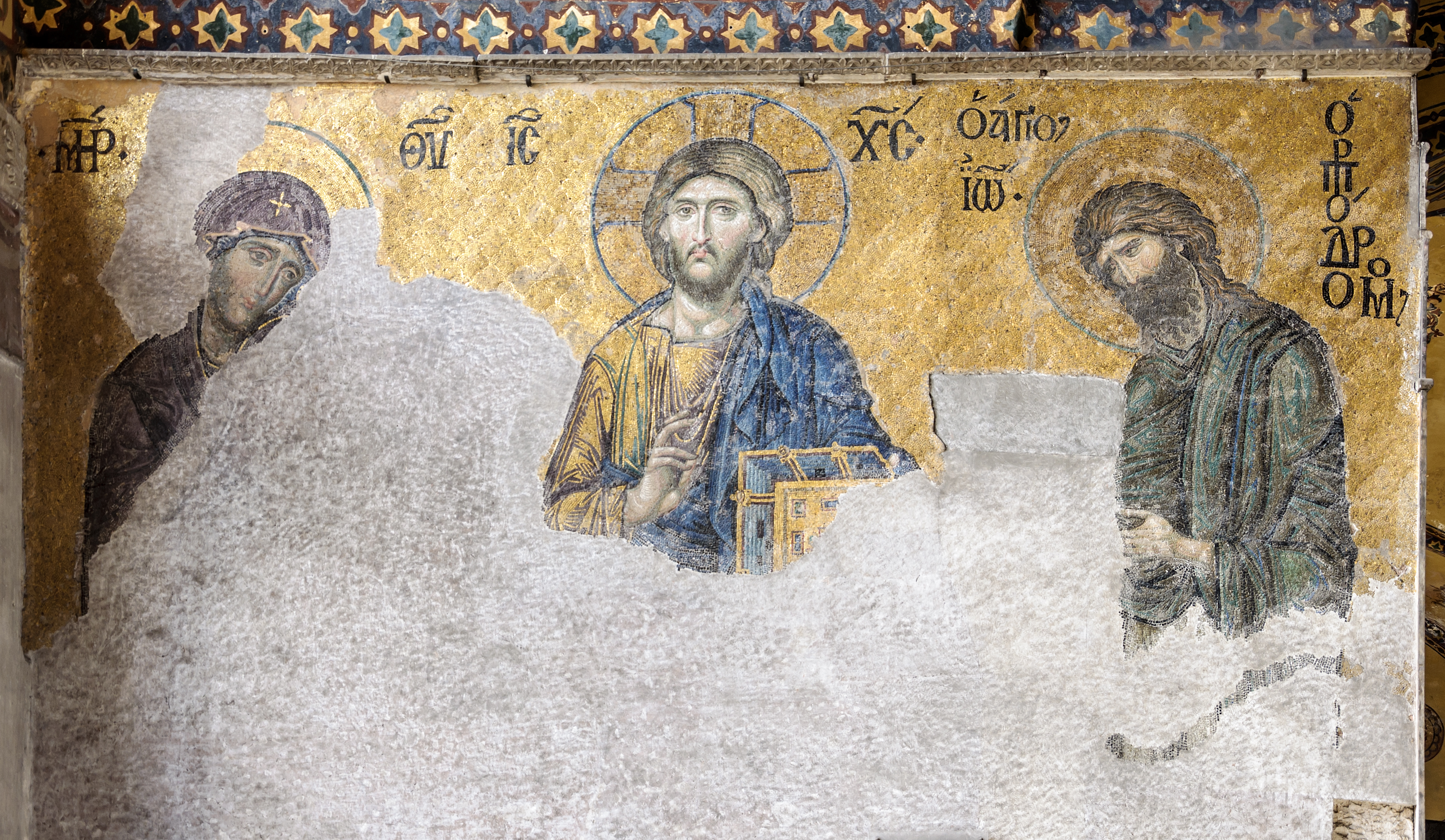
File:Deesis mosaic Hagia Sophia.jpg
Deësis (Gr. "Prayer" or "Supplication") mosaic, 13th century.  Hagia Sophia  (Holy Wisdom) Cathedral, Constantinople, Byzantine Empire; showing the Virgin Mary and John the Baptist on Christ's left and right (photo Wikimedia Commons)
 
 Now Jesus, going up to Jerusalem, took the twelve disciples aside on the road and said to them, "Behold, we are going up to Jerusalem, and the Son of Man will be betrayed to the chief priests and to the scribes; and they will condemn Him to death, and deliver Him to the Gentiles to mock and to scourge and to crucify.  And the third day He will rise again."

Then the mother of Zebedee's sons came to Him with her sons, kneeling down and asking something from Him.  And He said to her, "What do you wish?"  She said to Him, "Grant that these two sons of mine may sit, one of Your right hand and the other on the left, in Your kingdom."  But Jesus answered and said, "You do not know what you ask.  Are you able to drink the cup that I am about the drink, and to be baptized with the baptism that I am baptized with?"  They said to Him, "We are able."  So He said to them, "You will indeed drink My cup, and be baptized with the baptism that I am baptized with; but to sit on My right hand and on My left is not Mine to give, but it is for those for whom it is prepared by My Father."  And when the ten heard it, they were greatly displeased with the two brothers.  But Jesus called them to Himself and said, "You know  that the rulers of the Gentiles lord it over them, and those who are great exercise authority over them.  Yet it shall not be so among you; but whoever desires to become great among you, let him be your servant.  And whoever desires to be first among you, let him be your slave -- just as the Son of Man did not come to be served, but to serve, and to give His life a ransom for many."
 
- Matthew 20:17-28 
 
In yesterday's reading, Jesus gave the parable of the Workers in the Vineyard:  "For the kingdom of heaven is like a landowner who went out early in the morning to hire laborers for his vineyard.  Now when he had agreed with the laborers for a denarius a day, he sent then into his vineyard.  And he went out about the third hour and saw others standing idle in the marketplace, and said to them, 'You also go into the vineyard, and whatever is right I will give you.'  So they went.  Again he went out about the sixth and the ninth hour, and did likewise.  And about the eleventh hour he went out and found others standing idle, and said to them, 'Why have you been standing here idle all day?'  They said to him, 'Because no one hired us.'  He said to them, 'You also go into the vineyard, and whatever is right you will receive.'  So when evening had come, the owner of the vineyard said to his steward, 'Call the laborers and give them their wages, beginning with the last to the first.'  And when those came who were hired about the eleventh hour, they each received a denarius.  But when the first came, they supposed that they would receive more; and they likewise received each a denarius.  And when they had received it, they complained against the landowner, saying, 'These last men have worked only one hour, and you made them equal to us who have borne the burden and the heat of the day.'  But he answered one of them and said, 'Friend, I am doing you no wrong.  Did you not agree with me for a denarius?  Take what is yours and go your way.  I wish to give to this last man the same as to you.  Is it not lawful for me to do what I wish with my own things?  Or is your eye evil because I am good?'  So the last will be first, and the first last.  For many are called, but few chosen."
 
  Now Jesus, going up to Jerusalem, took the twelve disciples aside on the road and said to them, "Behold, we are going up to Jerusalem, and the Son of Man will be betrayed to the chief priests and to the scribes; and they will condemn Him to death, and deliver Him to the Gentiles to mock and to scourge and to crucify.  And the third day He will rise again."  My study Bible comments that Christ's repeated prediction of His Passion is meant to encourage and strengthen disciples for the terrifying events they will face.  According to Theophylact, it is as if Christ were saying, "Think on all these [words and miracles], so that when you see me hanging on the Cross, you will not imagine that I am suffering because I am powerless to do otherwise."

Then the mother of Zebedee's sons came to Him with her sons, kneeling down and asking something from Him.  And He said to her, "What do you wish?"  She said to Him, "Grant that these two sons of mine may sit, one of Your right hand and the other on the left, in Your kingdom."  But Jesus answered and said, "You do not know what you ask.  Are you able to drink the cup that I am about the drink, and to be baptized with the baptism that I am baptized with?"  They said to Him, "We are able."  So He said to them, "You will indeed drink My cup, and be baptized with the baptism that I am baptized with; but to sit on My right hand and on My left is not Mine to give, but it is for those for whom it is prepared by My Father."   We don't really know why at this juncture the mother of James and John Zebedee has come to Christ with this request.  It is a sort of repetition of the disciples previously asking, "Who then is greatest in the kingdom of heaven?"  But this time, it is the mother of Zebedee's sons who comes with this request on behalf of James and John.  When the question of "the greatest" was asked before, Jesus took pains with specific and extended teachings on humility and the need to serve, especially to take care of the "little ones" in the Church.  Perhaps Christ speaking of His coming Passion, and saying that on the third day He will rise again has prompted the disciples to assume that He will come into an eternal, earthly kingdom, as is widely expected of the Messiah.  But my study Bible comments that this quest for temporal power and glory is unfitting for a disciple and it shows an earthly misunderstanding of the Kingdom of God.  Here Matthew tells us that it was their mother who requested such an honor -- but John and James' own involved in revealed because Jesus addresses them in the plural "you" in the Greek both here and in Mark 10:36.   We must note that Christ calls His Crucifixion a cup and His death a baptism.  The Cross is a cup, my study Bible says, because He drank it willingly (Hebrews 12:2).  His death is baptism, as He was completely immersed in it, and yet it cleansed the world (Romans 6:3-6).  Christ's prophecy of John and James participating in the same cup and baptism shows the life of persecution and martyrdom these brothers would lead after Pentecost -- James would be the first apostle to be martyred (Acts 12:1-2), and John would go on to a long life of persecution and exile, producing one Gospel, three Epistles, and the Revelation.  My study Bible further notes on this passage that Christ declaring that the places of honor in the Kingdom are not His to give doesn't mean He lacks authority.  It means, instead, that they are not His to give arbitrarily.  He will give them to those for whom God has prepared them.  Note also, my study Bible says, that with regard to sitting as equals on the right and the left hand of Christ in Christ's Kingdom, St. John Chrysostom teaches that nobody could possibly occupy these positions.  Regarding the highest places of honor that can be given to human beings, the icons of the Orthodox Church universally depict the Virgin Mary (most blessed among women -- Luke 1:28) and John the Baptist (greatest born of women -- Matthew 11:11) holding these places.  See the icon above, the 13th century mosaic entitled Deësis, meaning "prayer" or "supplication" in Greek, from Hagia Sophia (Holy Wisdom) Cathedral in Constantinople, the capitol of the Byzantine Empire.
 
And when the ten heard it, they were greatly displeased with the two brothers.  But Jesus called them to Himself and said, "You know  that the rulers of the Gentiles lord it over them, and those who are great exercise authority over them.  Yet it shall not be so among you; but whoever desires to become great among you, let him be your servant.  And whoever desires to be first among you, let him be your slave -- just as the Son of Man did not come to be served, but to serve, and to give His life a ransom for many."  My study Bible notes that Jesus once again corrects the disciples, this time by first comparing them to the power-hungry Gentiles, whom they themselves considered an abomination, and contrasting them to Himself, who serves us although He is Lord of all.  My study Bible notes here that for many is an Aramaic expression which indicates "for all."

So, in the context of the Gospel, there is the common theme of sacrifice running as a thread throughout the past few readings.  There was first the story of the rich young man, whom Jesus loved, and whom He told that if he wanted to be perfect, he should sell his possessions and give to the poor, and follow Him.  This was followed by a discussion regarding the difficulties which wealth presents to those who would seek the kingdom of heaven, and the sacrifices which the disciples themselves have made.  In yesterday's reading (see above), Jesus gave the parable of the Workers in the Vineyard, expressing the principle that not all will labor equally, and yet all will receive the same reward.  Here we have the dynamic quality in the story line in which the mother of John and James Zebedee comes (seemingly on their behalf) asking Christ to make her two sons effectively greatest in His coming Kingdom, to sit at His right and left hand.  According to my study Bible, as we read above, these are positions no one could fill, and the positions there will be will go to those for whom they are prepared by God.  But again, all of this comes within the theme of sacrifice, for it all begins with Christ's second warning of His Passion and death to come, followed by Resurrection.  While the family of Zebedee has focused on what this might mean for a coming "earthly" type kingdom, Jesus' true meaning here is about His own sacrifice on behalf of all -- which will function as an image of service for everyone to remember after Pentecost and the mission of the Church has truly begun.  While Jesus has already answered the question, "Who then is the greatest in the kingdom of heaven?" with warnings about abuses of power, about humility, and service in the Church, this is yet a repetition with more emphasis, contrasting the use of power witnessed in the kingdoms of the Gentiles with the type of leadership Christ wants in His Church, to which He will entrust these apostles.  It's such an important lesson that sections of the Gospel are repeatedly devoted it, as Jesus begins His way toward Jerusalem with warnings to the disciples about what is to come.  Therefore it remains an essential lesson for the Church, and the world has seen plenty of excesses which enforce Christ's teachings all the more for all of us.  Let us endeavor to keep and live His faith, as He has taught, and follow the examples of those who have served throughout the centuries, both great and small, martyrs and saints, and the countless "little ones" who have served with their own lives and faith as well.  


Tuesday, June 18, 2024

And when you have opened its mouth, you will find a piece of money; take that and give it to them for Me and you

 
 Now while they were staying in Galilee, Jesus said to them, "The Son of Man is about to be betrayed into the hands of men, and they will kill Him, and the third day He will be raised up."  And they were exceedingly sorrowful.  

When they had come to Capernaum, those who received the temple tax came to Peter and said, "Does your Teacher not pay the temple tax?"  He said, "Yes."  And when he had come into the house, Jesus anticipated him, saying, "What do you think, Simon?  From whom do the kings of the earth take customs or taxes, from their sons or from strangers?"   Peter said to Him, "From strangers."  Jesus said to him, "Then the sons are free.  Nevertheless, lest we offend them, go to the sea, cast in a hook, and take the fish that comes up first.  And when you have opened its mouth, you will find a piece of money; take that and give it to them for Me and you."
 
- Matthew 17:22–27 
 
Yesterday we read that when Jesus, together with James, John, and Peter, had returned from the Mount of Transfiguration, they came to the multitude, and a man came to Him, kneeling down to Him and saying, "Lord, have mercy on my son, for he is an epileptic and suffers severely; for he often falls into the fire and often into the water.  So I brought him to Your disciples, but they could not cure him."  Then Jesus answered and said, "O faithless and perverse generation, how long shall I be with you?  How long shall I bear with you?  Bring him here to Me."  And Jesus rebuked the demon, and it came out of him; and the child was cured from that very hour.  Then the disciples came to Jesus privately and said, "Why could we not cast it out?"  So Jesus said to them, "Because of your unbelief; for assuredly, I say to you, if you have faith as a mustard seed, you will say to this mountain, 'Move from here to there,' and it will move; and nothing will be impossible for you.  However, this kind does not go out except by prayer and fasting."
 
  Now while they were staying in Galilee, Jesus said to them, "The Son of Man is about to be betrayed into the hands of men, and they will kill Him, and the third day He will be raised up."  And they were exceedingly sorrowful.  This is the second time that Jesus has predicted His death and Resurrection to the disciples.  (See this reading for the first, which immediately followed Peter's confession of faith that Jesus is Christ the Son.)  My study Bible says that Christ's repeated predictions of what is to come show that He is going to His Passion freely and is not being taken against His will.  
 
When they had come to Capernaum, those who received the temple tax came to Peter and said, "Does your Teacher not pay the temple tax?"  He said, "Yes."  And when he had come into the house, Jesus anticipated him, saying, "What do you think, Simon?  From whom do the kings of the earth take customs or taxes, from their sons or from strangers?"  Peter said to Him, "From strangers."  Jesus said to him, "Then the sons are free.  Nevertheless, lest we offend them, go to the sea, cast in a hook, and take the fish that comes up first.  And when you have opened its mouth, you will find a piece of money; take that and give it to them for Me and you."  My study Bible explains here that the temple tax was an annual head tax (meaning on individuals) for all male Jews over twelve years of age for the maintenance of the temple; only the priests were exempt from this tax.  See Numbers 3:43-51.  Since Jesus is the Son of God, it noes, He is both High Priest and "proprietor" of the temple, and is therefore exempt from the tax.  Nonetheless Jesus pays it anyway -- both to avoid unnecessary offense, and also to show that He has totally identified Himself with mankind.  

Several patristic commentaries on the passage regarding the temple tax comment on the coin as a symbol.  Roman coins bore the image of Caesar on them, together with an inscription naming Caesar as divine.  The tax itself is a kind of redemption, paid for individual salvation.  These commentaries note that Christ, having established to Peter that He is exempt from such a tax, does not take the coin from His own treasury of His ministry, nor from His own spending money.  Rather, we have this mysterious, seemingly "magical" story of the fish taken by the fisherman Peter.  In this miracle Christ tells Peter to go to the sea, cast in a hook, and take the fish that comes up first; in it he will find the money for the temple tax.  We look first at the specific direction here from Jesus; each detail makes us assured that this indeed is a powerful miracle which we must not overlook.  As Jesus has already shown that He is master over the sea (symbolic of the world) on two occasions when the disciples were struggling with storm and waves (see Matthew 8:23-27; 14:22-33), here He demonstrates the same again.  But in so doing, Peter takes from the sea an element of the world through the power of the Lord in order to "fulfill all righteousness" (Matthew 3:14-16).  We may also remember Christ's words to the fishermen Simon Peter and Andrew, "Follow Me, and I will make you fishers of men" (Matthew 4:18-20).  Christ will work through His apostles to redeem human beings who will exchange a worldly image for the image of Christ, a true identity as a "son" or adopted child and heir of God.  Christ is the first, but there will be many more to follow (see 1 Corinthians 15:20-28).  Out of this world, the Lord will redeem human beings made in the image and likeness of God, through those who will become the fishers of men.  We remember also that the fish would become a symbol for Christology.  The ancient Greek word, which is the one used in the Gospels to mean fish, is ιχθυς (ixthys).  Used as an acronym, taking each letter as the beginning of a word, this came to stand for Ιησους Χριστος, θεου Υιος, Σωτηρ (Iesous Christos, Theou Yios, Sotir) meaning "Jesus Christ, Son of God, Savior."  In His Incarnation, and through His Passion which He predicts for the second time in today's reading, He brings us salvation, the true manifestation of what it is to be "redeemed."  In His Passion, He pays the price for all of us, as He pays the temple tax today for Peter.  All of it through the power of the Lord, which turns the things which belong to our world into the things that work for God (Romans 8:28), allowing us all to become "sons of God."


Friday, March 22, 2024

You do not know what you ask

 
 Now they were on the road, going up to Jerusalem, and Jesus was going before them; and they were amazed.  And as they followed they were afraid.  Then He took the twelve aside again and began to tell them the things that would happen to Him:  "Behold, we are going up to Jerusalem, and the Son of Man will be betrayed to the chief priests and to the scribes; and they will condemn Him to death and deliver Him to the Gentiles; and they will mock Him, and scourge Him, and spit on Him, and kill Him.  And the third day He will rise again."

Then James and John, the sons of Zebedee, came to Him, saying, "Teacher, we want You to do for us whatever we ask."  And He said to them, "What do you want Me to do for you?"  They said to Him, "Grant us that we may sit, one on Your right hand and the other on Your left, in Your glory."  But Jesus said to them, "You do not know what you ask.  Are you able to drink the cup that I drink, and be baptized with the baptism that I am baptized with?"  They said to Him, "We are able."  So Jesus said to them, "You will indeed drink the cup that I drink, and with the baptism I am baptized with you will be baptized; but to sit on My right hand and on My left is not Mine to give, but it is for those for whom it is prepared."  And when the ten heard it, they began to be greatly displeased with James and John.  But Jesus called them to Himself and said to them, "You know that those who are considered rulers over the Gentiles lord it over them, and their great ones exercise authority over them.  Yet it shall not be so among you; but whoever desires to become great among you shall be your servant.  And whoever of you desires to be first shall be slave of all.  For even the Son of Man did not come to be served, but to serve, and to give His life a ransom for many."
 
- Mark 10:32–45 
 
Yesterday we read that as Jesus was going out on the road, one came running, knelt before Him, and asked Him, "Good Teacher, what shall I do that I may inherit eternal life?"  So Jesus said to him, "Why do you call Me good?  No one is good but One, that is, God.  You know the commandments:  'Do not commit adultery,' 'Do not murder,' 'Do not steal,' 'Do not bear false witness,' 'Do not defraud,' 'Honor your father and your mother.' "   And he answered and said to Him, "Teacher, all these things I have kept from my youth."  Then Jesus, looking at him, loved him, and said to him, "One thing you lack:  Go your way, sell whatever you have and give to the poor, and you will have treasure in heaven; and come, take up the cross, and follow Me."  But he was sad at this word, and went away sorrowful, for he had great possessions.  Then Jesus looked around and said to His disciples, "How hard it is for those who have riches to enter the kingdom of God!"  And the disciples were astonished at His words.  But Jesus answered again and said to them, "Children, how hard it is for those who trust in riches to enter the kingdom of God!  It is easier for a camel to go through the eye of a needle than for a rich man to enter the kingdom of God."  And they were greatly astonished, saying among themselves, "Who then can be saved?"  But Jesus looked at them and said, "With men it is impossible, but not with God; for with God all things are possible."  Then Peter began to say to Him, "See, we have left all and followed You."  So Jesus answered and said, "Assuredly, I say to you, there is no one who has left house or brothers or sisters or father or mother or wife or children or lands, for My sake and the gospel's, who shall not receive a hundredfold now in this time -- houses and brothers and sisters and mothers and children and lands, with persecutions -- and in the age to come, eternal life.  But many who are first will be last, and the last first."
 
  Now they were on the road, going up to Jerusalem, and Jesus was going before them; and they were amazed.  And as they followed they were afraid.  Then He took the twelve aside again and began to tell them the things that would happen to Him:  "Behold, we are going up to Jerusalem, and the Son of Man will be betrayed to the chief priests and to the scribes; and they will condemn Him to death and deliver Him to the Gentiles; and they will mock Him, and scourge Him, and spit on Him, and kill Him.  And the third day He will rise again."  My study Bible says that Christ's repeated predictions of His Passion were intended to encourage and to strengthen the disciples, as they will come to face terrifying events.  Let us make careful note of the fact that they are now on the road and going up to Jerusalem.  Additionally, my study Bible also comments that these warnings by Jesus confirm that He is going to His death in Jerusalem of His own will and choosing. 

Then James and John, the sons of Zebedee, came to Him, saying, "Teacher, we want You to do for us whatever we ask."  And He said to them, "What do you want Me to do for you?"  They said to Him, "Grant us that we may sit, one on Your right hand and the other on Your left, in Your glory."  But Jesus said to them, "You do not know what you ask.  Are you able to drink the cup that I drink, and be baptized with the baptism that I am baptized with?"  They said to Him, "We are able."  So Jesus said to them, "You will indeed drink the cup that I drink, and with the baptism I am baptized with you will be baptized; but to sit on My right hand and on My left is not Mine to give, but it is for those for whom it is prepared."  And when the ten heard it, they began to be greatly displeased with James and John.  But Jesus called them to Himself and said to them, "You know that those who are considered rulers over the Gentiles lord it over them, and their great ones exercise authority over them.  Yet it shall not be so among you; but whoever desires to become great among you shall be your servant.  And whoever of you desires to be first shall be slave of all."  In our readings from Monday, Tuesday, and Wednesday, Jesus has already been addressing the question of "greatness" among His disciples.  In yesterday's reading (above), Jesus addressed the question of great possessions and the obstacle that can be to entering the kingdom of God.  Here, my study Bible comments that this quest for temporal power and glory is unfitting for a disciple and shows an earthly misunderstanding of the kingdom of God.   In Matthew's Gospel it's reported that the mother of Zebedee's sons makes the request for this honor, but as is clear in the Greek text, Christ responds by addressing them in the plural ("What do you want Me to do for you?"; verse 36).  My study Bible notes also that Christ calls His Crucifixion a cup and His death a baptism.  It says that the Cross is a cup because He drinks it willingly (Hebrews 12:2); His death is baptism because He was completely immersed in it, yet it cleansed the world (Romans 6:3-6).  Here it is also noted that Christ's words to the Zebedee brothers are a prophecy.  That they will indeed participate in the same cup and baptism shows the life of persecution and martyrdom which both would lead after Pentecost.  Furthermore, that Christ says the places of honor in the Kingdom are not His to give doesn't mean that He lacks authority.  What it means is that these are not Christ's to give arbitrarily.  He will give them to those for whom God has prepared them.  With regard to sitting as equals on Christ's right and left hand in His Kingdom, St. John Chrysostom says that no one could possibly occupy a position like that.  In terms of the highest places of honor given to human beings, my study Bible notes that the icons of the Church universally show the Virgin Mary (the most blessed among women - Luke 1:28) and John the Baptist (the greatest born of women - Matthew 11:11) holding these places.  
 
 "For even the Son of Man did not come to be served, but to serve, and to give His life a ransom for many."  For many as used here is an Aramaic expression, which means "for all."

As pointed out above, in several readings this week Jesus has addressed the issue of greatness and what that is in His Church and His Kingdom.  Therefore, it is somewhat surprising at this stage that these apostles, John and James Zebedee, who together with St. Peter make up three "pillars of faith," should now come to Christ with this request.  They are the ones, together with Peter, whom Jesus has taken with Him in times that called for the greatest strength of faith:  in the healing of Jairus' daughter, and at the Transfiguration (and the healing that followed).  It seems quite possible that, at this stage when Jesus' intention is very clear that He is setting off on the road to Jerusalem, the brothers (and their mother, as indicated in St. Matthew's Gospel), believe that the purpose of going to Jerusalem is to inaugurate this Kingdom, which they assume will be an earthly one.  Perhaps it is, after all, because James and John have been so close to Jesus as part of His "inner circle" together with Peter that they seek these places of honor. But, as in the cases where Peter's behavior is disappointing (such as in his denials of Christ to come at Mark 14:29-31), or the times the disciples haven't measured up to the kind of faith Christ would ask of them (as in this reading), or have so lacked understanding it seemed to exasperate Jesus (in this reading), perhaps we are given these examples by the disciples to teach us something important.  For we learn primarily that discipleship is not a one-time quiz or test that we either pass or fail, but a lifelong journey.  Indeed the word for disciple in the Greek of the Gospels means "learner" (μαθητής/mathetes).  In modern Greek this word is used to mean "student."  Discipleship, in the context of the Gospels, is a lifelong road.  And we can see for ourselves, through the remarkably short three-year period of Christ's ministry, how the disciples grow and become the apostles they would eventually be.  As my study Bible pointed out, both John and James Zebedee (also named "Sons of Thunder" by Jesus as we read in Mark 3:17) would truly both drink Christ's cup and be baptized with His baptism.  James would be the first of the apostles to be martyred (in AD 44, beheaded by King Herod Agrippa I in Jerusalem; see Acts 12:2).  John would go on to a long life of persecution and exile, producing one Gospel, three Epistles, and the Revelation, as well as caring for Mary the Mother of God (John 19:26).  So what is it that will take these two men (and presumably their mother) from the ones who demand the two most important places in Christ's Kingdom, on His right and on His left, to the ones who would serve with the kind of greatness that Jesus has described over the course of the past several readings?  Christ's Passion itself, just ahead of them in Jerusalem, will without a doubt take them through its shattering realities and the tremendous story of Christ's sacrifice "for many," as Jesus prophesies in today's reading.  But the powerful spiritual realities to come, of Resurrection, and of the coming of the Holy Spirit at Pentecost, as well as the growth of the Church and its many servants to come, will no doubt have their effects upon all of them.  Let us take these examples to heart, and understand that for each of us, our journey forward into discipleship and deepening faith might very well take us through the deep changes of heart and mind as exemplified by these Sons of Thunder.  Let us be grateful for the grace we're given and the examples in the Gospels.  When these men make their request of Jesus, He tells them truthfully, "You do not know what you ask."  But they would learn in time, and through faith.  Let us remember that we, also, may have a lot to learn along the way.  Clearly, when we pray, we also may not know what we ask.  Let us keep our patience and keep learning as disciples throughout our lives, and pray for the grace to change and accept what we're meant to learn. 


Wednesday, November 22, 2023

Does your Teacher not pay the temple tax?

 
 Now while they were staying in Galilee, Jesus said to them, "The Son of Man is about to be betrayed into the hands of men, and they will kill Him, and the third day He will be raised up."  And they were exceedingly sorrowful.  

When they had come to Capernaum, those who received the temple tax came to Peter and said, "Does your Teacher not pay the temple tax?"  He said, "Yes."  And when he had come into the house, Jesus anticipated him, saying, "What do you think, Simon?  From whom do the kings of the earth take customs or taxes, from their sons or from strangers?"  Peter said to Him, "From strangers."  Jesus said to him, "Then the sons are free.  Nevertheless, lest we offend them, go to the sea, cast in a hook, and take the fish that comes up first.  And when you have opened its mouth, you will find a piece of money; take that and give it to them for Me and you."
 
- Matthew 17:22–27 
 
 Yesterday we read that, upon Jesus' return from the Mount of Transfiguration with Peter, James and John, when they had come to the multitude, a man came to Him, kneeling down to Him and saying, "Lord, have mercy on my son, for he is an epileptic and suffers severely; for he often falls into the fire and often into the water.  So I brought him to Your disciples, but they could not cure him."  Then Jesus answered and said, "O faithless and perverse generation, how long shall I be with you?  How long shall I bear with you?  Bring him here to Me."  And Jesus rebuked the demon, and it came out of him; and the child was cured from that very hour.  Then the disciples came to Jesus privately and said, "Why could we not cast it out?"  So Jesus said to them, "Because of your unbelief; for assuredly, I say to you, if you have faith as a mustard seed, you will say to this mountain, 'Move from here to there,' and it will move; and nothing will be impossible for you.  However, this kind does not go out except by prayer and fasting."   

Now while they were staying in Galilee, Jesus said to them, "The Son of Man is about to be betrayed into the hands of men, and they will kill Him, and the third day He will be raised up."  And they were exceedingly sorrowful.  This is the second warning to the disciples of Jesus' death and Resurrection (see also this earlier reading for the first).  My study Bible comments that Jesus makes these predictions in order to establish that He is going to His Passion freely and not being taken against His will.  

When they had come to Capernaum, those who received the temple tax came to Peter and said, "Does your Teacher not pay the temple tax?"  He said, "Yes."  And when he had come into the house, Jesus anticipated him, saying, "What do you think, Simon?  From whom do the kings of the earth take customs or taxes, from their sons or from strangers?"  Peter said to Him, "From strangers."  Jesus said to him, "Then the sons are free.  Nevertheless, lest we offend them, go to the sea, cast in a hook, and take the fish that comes up first.  And when you have opened its mouth, you will find a piece of money; take that and give it to them for Me and you."  My study Bible explains that the temple tax was an annual head tax which applied to all male Jews (except priests) over twelve years of age.  This was for the purpose of the maintenance of the temple (see Numbers 3:43-51).  Since Jesus is the Son of God, He is both High Priest and the "proprietor" of the temple -- therefore is exempt from the tax.  But nonetheless, He pays it anyway.  My study Bible explains this is both to avoid unnecessary offense and to show thta He has completely identified Himself with mankind.  
 
The story of the coin from the fish's mouth is one that is only found in St. Matthew's Gospel.  Most commentary emphasizes this structure in the story of the question of whether or not Jesus -- as Son of the living God -- is really required to pay this temple tax.  According to the framework of the Law, with this identity, He should not be.  This also would extend to His disciples as "sons" -- and Jesus concludes here that "then the sons are free."   So He first settles that question with Peter.  But we know from this and other stories that Peter struggles with public perception and pressure regarding His identity as a Jew and Jewish scrutiny upon him as a follower of Jesus.  He struggles mightily within himself even as the followers of Christ and the nascent Church would deal so much with this particular struggle of identity as well.  Indeed, we can read St. Paul's accusation against St. Peter regarding the question of Christian Jews and Christian Gentiles eating together in what is called the incident at Antioch (Galatians 2:11-14).  Perhaps we see St. Peter's susceptibility to intimidation of such a type in his denial of Christ three times in the courtyard of the High Priest (Matthew 26:69-75).   There, it seems, even a servant girl noticing his Galilean accent becomes something he wishes to deny in order to avoid identification as a follower of Christ -- which leads to his own bitter tears at his failure, and fulfillment of Christ's warning to him (Matthew 26:31-35).  So Christ's miraculous prophecy, with its wondrous quality of Peter the fisherman being told to cast in a hook, and find a coin in the mouth of the first fish he caught, becomes effectively a way both to uphold that "the sons are free" and also to allow Peter the firm certainty of place in the temple and in his community of Capernaum among those who asked if his Teacher paid the temple tax.  Jesus graciously avoids giving what is at this time unnecessary offense in this place of His ministry headquarters and St. Peter's home.   It is a kind of beautiful parable, one of those astonishing outcomes of Christ similar to the verbal outcomes of His jousts with the Pharisees in the temple during the final Passover week -- a sort of brilliant if miraculous logic at work.  But, as we reviewed in yesterday's reading and commentary, our recent readings seem to come to a focus again and again on the importance of faith and its indispensable need in our lives.  Faith connects us to everything Christ has to offer, to the healings in the Gospels, to His "mighty works" (and even the lack of them when faith is lacking), to casting out demons, to the seven "signs" in John's Gospel.  And the fish as a symbol of faith dates to the earliest periods of the Church.  The word for fish in the Greek of the first century,  ιχθύς/ixthys forms an acronym for the statement "Jesus Christ, Son of God, Savior" (Ἰησοῦς Χρῑστός Θεοῦ Υἱός Σωτήρ/Isous Christos Theou Yios Sotir).  Symbolically, then, we can view this miraculous coin as the product of Peter's faithful obedience to Christ and Christ's love and mercy expressed in response to that faith.  It also leads us to ask, indeed, who are the "sons?"   In that light, let us consider the day as we enter into the holiday of Thanksgiving in the United States, where many readers of this blog reside.  For our true treasure is symbolized in that gold coin of God's love and mercy, the product of our faith in Christ the Rock, upon whom we rely for "every good and perfect gift" (James 1:17).


Friday, February 10, 2023

To sit on My right hand and on My left is not Mine to give, but it is for those for whom it is prepared

 
 Now they were on the road, going up to Jerusalem, and Jesus was going before them; and they were amazed.  And as they followed they were afraid.  Then He took the twelve aside again and began to tell them the things that would happen to Him:  "Behold, we are going up to Jerusalem, and the Son of Man will be betrayed to the chief priests and to the scribes; and they will condemn Him to death and deliver Him to the Gentiles; and they will mock Him, and scourge Him, and spit on Him, and kill Him.  And the third day He will rise again."  

Then James and John, the sons of Zebedee, came to Him, saying, "Teacher, we want You to do for us whatever we ask."  And He said to them, "What do you want Me to do for you?"  They said to Him, "Grant us that we may sit, one on Your right hand and the other on Your left, in Your glory."  But Jesus said to them, "You do not know what you ask.  Are you able to drink the cup that I drink, and be baptized with the baptism that I am baptized with?"  They said to Him, "We are able."  So Jesus said to them, "You will indeed drink the cup that I drink, and with the baptism I am baptized with you will be baptized; but to sit on My right hand and on My left is not Mine to give, but it is for those for whom it is prepared."  And when the ten heard it, they began to be greatly displeased with James and John.  But Jesus called them to Himself and said to them, "You know that those who are considered rulers over the Gentiles lord it over them, and their great ones exercise authority over them.  Yet it shall not be so among you; but whoever desires to become great among you shall be your servant.  And whoever of you desires to be first shall be slave of all.  For even the Son of Man did not come to be served, but to serve, and to give His life a ransom for many."
 
- Mark 10:32–45 
 
Yesterday we read that as Jesus was going out on the road, one came running, knelt before Him, and asked Him, "Good teacher, what shall I do that I may inherit eternal life?"  So Jesus said to him, "Why do you call Me good?  No one is good but One, that is, God.  You know the commandments:  'Do not commit adultery,' 'Do not murder,' 'Do not steal,' 'Do not bear false witness,' 'Do not defraud,' 'Honor your father and your mother.'"   And he answered and said to Him, "Teacher, all these things I have kept from my youth."  Then Jesus, looking at him, loved him, and said to him, "One thing you lack:  Go your way, sell whatever you have and give to the poor, and you will have treasure in heaven; and come, take up the cross, and follow Me."  But he was sad at this word, and went away sorrowful, for he had great possessions.  Then Jesus looked around and said to His disciples, "How hard it is for those who have riches to enter the kingdom of God!"  And the disciples were astonished at His words.  But Jesus answered again and said to them, "Children, how hard it is for those who trust in riches to enter the kingdom of God!  It is easier for a camel to go through the eye of a needle than for a rich man to enter the kingdom of God."  And they were greatly astonished, saying among themselves, "Who then can be saved?"  But Jesus looked at them and said, "With men it is impossible, but not with God; for with God all things are possible."  Then Peter began to say to Him, "See, we have left all and followed You."  So Jesus answered and said, "Assuredly, I say to you, there is no one who has left house or brothers or sisters or father or mother or wife or children or lands, for My sake and the gospel's, who shall not receive a hundredfold now in this time  -- houses and brothers and sisters and mothers and children and lands, with persecutions -- and in the age to come, eternal life.  But many who are first will be last, and the last first."
 
 Now they were on the road, going up to Jerusalem, and Jesus was going before them; and they were amazed.  And as they followed they were afraid.  Then He took the twelve aside again and began to tell them the things that would happen to Him:  "Behold, we are going up to Jerusalem, and the Son of Man will be betrayed to the chief priests and to the scribes; and they will condemn Him to death and deliver Him to the Gentiles; and they will mock Him, and scourge Him, and spit on Him, and kill Him.  And the third day He will rise again."   This is the third time that Jesus teaches the disciples in advance about what is to happen to Him in Jerusalem.  My study Bible notes that Christ's repeated predictions of His Passion were intended to encourage and strengthen them for the terrifying events they would face.  They also confirm that Christ was going to His death of His own will and choosing.  At this stage, the disciples are both amazed and afraid because He is going up to Jerusalem before them, knowing the animosity of the religious leadership that awaits there.
 
 Then James and John, the sons of Zebedee, came to Him, saying, "Teacher, we want You to do for us whatever we ask."  And He said to them, "What do you want Me to do for you?"  They said to Him, "Grant us that we may sit, one on Your right hand and the other on Your left, in Your glory."  But Jesus said to them, "You do not know what you ask.  Are you able to drink the cup that I drink, and be baptized with the baptism that I am baptized with?"  They said to Him, "We are able."  So Jesus said to them, "You will indeed drink the cup that I drink, and with the baptism I am baptized with you will be baptized; but to sit on My right hand and on My left is not Mine to give, but it is for those for whom it is prepared."  And when the ten heard it, they began to be greatly displeased with James and John.  But Jesus called them to Himself and said to them, "You know that those who are considered rulers over the Gentiles lord it over them, and their great ones exercise authority over them.  Yet it shall not be so among you; but whoever desires to become great among you shall be your servant.  And whoever of you desires to be first shall be slave of all."  My study Bible comments that this quest by James and John, the sons of Zebedee, for temporal power and glory is unfitting for a disciple and it shows an earthly misunderstanding of the Kingdom of God.  In Matthew's Gospel, it is the mother of Zebedee's sons that makes this request, but even there, Jesus addresses them all in the plural, as well as here (see Matthew 20:20).  Christ calls His Crucifixion a cup and His death a baptism.  My study Bible explains that the Cross is a cup because He drank it willingly (Hebrews 12:2).  His death is baptism, as He was completely immersed in it, yet it cleansed the world (Romans 6:3-6).  Jesus' prophecy of John and James participating in the same cup and baptism teaches the life of persecution and martyrdom they would lead after Pentecost:  James was the first disciple to be martyred  (Acts 12:2), and John would go on to a life in which he endured the persecutions of the Church and of exile on the island of Patmos (Revelation 1:9).  My study Bible adds that Christ declaring that the places of honor in the Kingdom are not His to give does not mean that He lacks authority.  Instead, it indicates that they are not His to give arbitrarily.  In effect, He will give them to those for whom God has prepared them.  Let us note also that with regard to sitting as equals on the right and left hand of Christ in His Kingdom, according to St. John Chrysostom no one could possibly occupy such a position.  Regarding the highest places of honor that can be given to human beings, in the icons of the Orthodox Church these places are universally depicted as belonging to the Virgin Mary (most blessed among women - Luke 1:28) and John the Baptist (greatest born of women - Matthew 11:11).  

"For even the Son of Man did not come to be served, but to serve, and to give His life a ransom for many."  The phrase for many, my study Bible notes, is an Aramaic expression which means "for all." 

Today's reading gives us a chance to brood on another quite modern topic, and that is a sense of entitlement.  This is a word one hears often in a modern society, which denotes, for the most part, a certain sense of what one believes one has a right to expect without qualification.  In terms of its most negative sense of social commentary, entitlement is defined as "the belief that one is inherently deserving of privileges or special treatment" (according to Oxford Languages).  Generally speaking, entitlement speaks of having a right to something, or perhaps the "amount" to which a person has a right (again, according to Oxford Languages).  But be that as it may, for our present purpose, we will stick to the very general use of this term as modern social commentary on those who feel they have a "right" to something, especially in terms of identity alone rather than any sort of merit.  The purpose of this blog is not to dispute such modern concepts, especially as they apply to political or broad social issues; there is a wide variety of thought on these terms which are not in the perspective of this blog whatsoever.  But it is important to understand the reading itself which we can put into a relative framework.  James and John Zebedee are extremely close to Jesus and form a part of His closest circle (of Peter, James, and John).  He takes these three with Him to enact His most difficult healings that require strength in the face of ridicule (such as that of Jairus' daughter, for example).  These are the three who were taken to witness the Transfiguration (which included a manifestation of the Trinity as well).  James and John, along with Peter and his brother Andrew, are the earliest disciples of Christ (Mark 1:16-20).   They had all earlier been the disciples of John the Baptist.  John Zebedee is presumed to be the unnamed disciple of the two in John 1:35-42, as well as the one "whom Jesus loved" in John 13:23, 19:26, 20:2, 21:7, 20.  We might make note that it was John to whom Jesus entrusted the care of His mother at the Cross (John 19:26).  So, given this history that preceded this request, and which would come afterward, one might presume that John and James had a sense of themselves as close followers of Jesus so that they would presume to ask for such positions.  But there is a sense of entitlement here that is nonetheless unwarranted.  It speaks to our deep need for humility, especially where the things of God are concerned.  There is first of all the commentary of St. John Chrysostom that to sit on Christ's right and left is a position of honor in terms of the majesty of God that no one can really fill those places nor imagine what authority they would entail. But there is something more important which Christ names here, and that is the sense in which the "entitlements" that come from God are for those for whom God has prepared such places.  In terms of discipleship and authority, a long life of struggle with faith and in following Christ as best we can is a life of preparation for something, and not of entitlements.  We might think of the Eucharist as something we are entitled to if we are baptized Christians, but this is not the case.  For we cannot think of such a gift as an entitlement, and must always understand the nature of a gift.  If we can put it in modern terms, a spoiled child may feel they are entitled to anything they ask for, but this is a form of blight and a lack of maturity and understanding.  It is, in effect, a way of looking at relationships with others purely in terms of materiality, of transaction and commerce.  It negates love and is blind to the heart, and there is where, so often, a sense of entitlement comes into play.  It lacks the discernment of personhood, and the maturity to respect the boundaries that are the true entitlements of what it means to be a person made in the image of God.  In today's reading, John and James are looking at Christ and the Kingdom in very material terms, as if they are opting for government service in the cabinet of a man they've supported for political office, as if Christ is one worldly power vying against another for a worldly kingdom.  But this is not the case, and there are much deeper things to understand in terms of our spirituality, and maturity regarding a relationship to God.  There are no real "entitlements" here in this material sense, but there is participation, and there is deep love so great that it is inexpressible on our own terms and too far beyond our grasp to fully comprehend it.  There is, especially, a guidance and a preparation for a fullness of ourselves which we don't already know, but God knows of us -- and the promise of a fullness of that image in which we were created.  This is where John and James Zebedee, and so many of the rest of us, make a mistake with regard to the theme of today's reading.  We don't know what God has prepared for us or for others, so we cannot tell the fullness of perfection to which we're being guided.  We don't know God's plans for us.  But humility and trust are the beginning steps to knowing God's love and God's providence, and the beginning of maturity as a spiritual person with a soul ennobled through faith.  Let us perceive the message of God's strength and love in this dialogue.  


Thursday, February 2, 2023

For whoever desires to save his life will lose it, but whoever loses his life for My sake and the gospel's will save it

 
 Now Jesus and His disciples went out to the towns of Caesarea Philippi; and on the road He asked His disciples, saying to them, "Who do men say that I am?"  So they answered, "John the Baptist; but some say, Elijah; and others, one of the prophets."  He said to them, "But who do you say that I am?"  Peter answered and said to Him, "You are the Christ."  Then He strictly warned them that they should tell no one about Him.  

And He began to teach them that the Son of Man must suffer many things, and be rejected by the elders and chief priests and scribes, and be killed, and after three days rise again.  He spoke this word openly.  Then Peter took Him aside and began to rebuke Him.  But when He had turned around and looked at His disciples, He rebuked Peter, saying, "Get behind Me, Satan!  For you are not mindful of the things of God, but the things of men."

When He had called the people to Himself, with His disciples also, He said to them, "Whoever desires to come after Me, let him deny himself, and take up his cross, and follow Me.  For whoever desires to save his life will lose it, but whoever loses his life for My sake and the gospel's will save it.  For what will it profit a man if he gains the whole world, and loses his own soul?  Or what will a man give in exchange for his soul?  For whoever is ashamed of Me and My words in this adulterous and sinful generation, of him the Son of Man also will be ashamed when He come sin the glory of His Father with the holy angels."  And He said to them, "Assuredly, I say to you that there are some standing here who will not taste death till they see the kingdom of God present with power."
 
- Mark 8:27-9:1 
 
Yesterday we read that the Pharisees came out and began to dispute with Him, seeking from Him a sign from heaven, testing Him.  But He sighed deeply in His spirit, and said, "Why does this generation seek a sign?  Assuredly, I say to you, no sign shall be given to this generation."  And He left them, and getting into the boat again, departed to the other side.  Now the disciples had forgotten to take bread, and they did not have more than one loaf with them in the boat.  Then He charged them, saying, "Take heed, beware of the leaven of the Pharisees and the leaven of Herod."  And they reasoned among themselves, saying, "It is because we have no bread."  But Jesus, being aware of it, said to them, "Why do you reason because you have no bread?  Do you not yet perceive nor understand?  Is your heart still hardened?  Having eyes, do you not see?  And having ears, do you not hear?  And do you not remember?  When I broke the five loaves for the five thousand, how many baskets full of fragments did you take up?"  They said to Him, "Twelve."  Also, when I broke the seven for the four thousand, how many large baskets full of fragments did you take up?"  And they said, "Seven."  So He said to them, "How is it you do not understand?"  Then He came to Bethsaida; and they brought a blind man to Him, and begged Him to touch him.  So He took the blind man by the hand and led him out of the town.  And when He had spit on his eyes and put His hands on him, He asked Him if he saw anything.  And he looked up and said, "I see men like trees, walking."  Then He put His hands on his eyes again and made him look up.  And he was restored and saw everyone clearly.  Then He sent him away to his house, saying, "Neither go into the town, nor tell anyone in the town."
 
 Now Jesus and His disciples went out to the towns of Caesarea Philippi; and on the road He asked His disciples, saying to them, "Who do men say that I am?"  So they answered, "John the Baptist; but some say, Elijah; and others, one of the prophets."  He said to them, "But who do you say that I am?"  Peter answered and said to Him, "You are the Christ."  Then He strictly warned them that they should tell no one about Him.  My study Bible says that, "Who do you say that I am?" is the greatest question that any person can ever face.  This is because it is the question that defines Christianity.  Peter answers correctly, and this answer prevents the Christian faith from being seen as simply another philosophical system or path of spirituality.  In Matthew's Gospel, Peter answers fully, "You are the Christ, the Son of the living God."  Such a position, as unique Son of  God, excludes all compromise with other religious systems.  This recognition of Christ, my study Bible says, cannot be achieved by human reason, but only by divine revelation through faith (1 Corinthians 12:3).  Christ means "Anointed One," and is equivalent to the Hebrew title, "Messiah."  Additionally, it is noted that Christ first draws out the erroneous opinions that men say about Him.  This is done in order to identify incorrect ideas, as one is better prepared to avoid false teachings when they are clearly identified.  

And He began to teach them that the Son of Man must suffer many things, and be rejected by the elders and chief priests and scribes, and be killed, and after three days rise again.  He spoke this word openly.  Then Peter took Him aside and began to rebuke Him.  But when He had turned around and looked at His disciples, He rebuked Peter, saying, "Get behind Me, Satan!  For you are not mindful of the things of God, but the things of men."  After Peter's confession that Jesus is the Christ, Jesus now reveals the true nature of His messiahship.  This is the mystery of His Passion.  My study Bible explains that it was expected that the Messiah would reign forever.  Therefore the notion that Christ would die was perplexing to Peter and remained scandalous to the Jews even after the Resurrection (1 Corinthians 1:23).  Unwittingly, Peter has spoken for Satan, as the devil did not want Christ to fulfill His mission and save humankind through suffering and death.  

When He had called the people to Himself, with His disciples also, He said to them, "Whoever desires to come after Me, let him deny himself, and take up his cross, and follow Me."  This central teaching of Christianity is a reflection of the Passion and Resurrection, and our participation in these realities.  My study Bible notes that the cross, a dreaded instrument of Roman punishment, is also a symbol of suffering by Christians in imitation of Christ.  It says that we practice self-denial for the sake of the love of God and the gospel.  To accept this suffering is not a punishment, nor it is an end in itself, but a means to overcome the fallen world for the sake of the Kingdom and to crucify the flesh with its passions and desire (Galatians 5:24). 

"For whoever desires to save his life will lose it, but whoever loses his life for My sake and the gospel's will save it."  My study Bible comments that the central paradox of Christian living is that in grasping for temporal things, we lose the eternal; but in sacrificing everything in this world, we gain eternal riches that are unimaginable (1 Corinthians 2:9).  

"For what will it profit a man if he gains the whole world, and loses his own soul?  Or what will a man give in exchange for his soul?  For whoever is ashamed of Me and My words in this adulterous and sinful generation, of him the Son of Man also will be ashamed when He come sin the glory of His Father with the holy angels."  Christ's questions emphasize the foolishness of sacrificing one's salvation for the accumulation of wealth or power, for these cannot redeem a fallen soul, nor benefit a person in the life to come.  

And He said to them, "Assuredly, I say to you that there are some standing here who will not taste death till they see the kingdom of God present with power."  My study Bible says that this is a reference to those who would witness the Transfiguration (Mark 9:2-10; in our next reading), as well as those in every generation who will experience the presence of God's Kingdom.
 
In today's reading, Jesus makes this powerful central statement, reflecting on our need for Christ and our salvation:  "For what will it profit a man if he gains the whole world, and loses his own soul?  Or what will a man give in exchange for his soul? For whoever is ashamed of Me and My words in this adulterous and sinful generation, of him the Son of Man also will be ashamed when He comes in the glory of His Father with the holy angels."   But what is our soul, and why is it of such significance?  My study Bible defines soul as follows:  "A living substance, simple, bodiless, and invisible by nature, activating the body to which it brings life, growth, sensation and reproduction. The mind is not distinct from the soul but serves as a window to the soul. The soul is free, endowed with will, and the power to act. Along with the body, the soul is created by God in His image. The soul of man will never die  (Genesis 1:26; 2:7; Matthew 10:28).  In Genesis 2:7 we read that "the Lord God formed man of the dust of the ground, and breathed into his nostrils the breath of life; and man became a living being."   "Living being" is also translated as "living soul."  What we understand, then, is that the soul is inseparable from life itself, that which constitutes and gives us life.  The eternal soul, therefore, is not simply something we should preserve, protect, and cherish for the sake of a life which we understand continues after our physical death in this world, but the condition of the soul also defines how we will experience life as a human being, fully in this world.  Therefore, the priceless nature of this soul, as defined by Christ, applies to every single day of our lives, and the choices that we make in life.  We should therefore not relegate this statement to something that applies only to an afterlife, or to the final judgment at Christ's return.  For we are surrounded by those holy angels mentioned in Jesus' statement, and the power of the Cross inspires us even in the ways in which we live our daily lives, just as Jesus indicates when He says, "Whoever desires to come after Me, let him deny himself, and take up his cross, and follow Me."  Whatever we desire in our lives, whatever plans we make and follow for the shape and direction of life, the soul is present and with us, activating us, giving us life, and the true care and nurturing of the soul thus becomes the condition within which we experience and frame our lives.  When we set our lives on the path that Christ lays out, when we choose to shape our lives by living "for My sake and the gospel's" we choose a path that gives us purpose and meaning.  Every choice and direction becomes a way to set a pattern, to consider what values we add to ourselves and our lives -- and what values we communicate to others.  We live for a higher purpose, and we can take on qualities that we see in Christ.  It is His example that has inspired countless people to the qualities of leadership Jesus embodies, in particular the willingness to sacrifice what is temporary and fleeting to what becomes a part of us, what we can pass on that makes the world good, giving a quality of life that materiality alone cannot give.  It takes courage, foresight, and a deep appreciation of what is truly good -- in short, what makes life truly "civilized" -- to make such choices.  But when we bear the gospel into the world, and Christ with it, we have a higher good to fulfill, a greater power and strength and depth of meaning, and a purpose and image to manifest that helps to create life "more abundantly"  The easy way is not the best way.  But with Christ we are promised that we should first seek the Kingdom, and all else is added unto that.