Showing posts with label second warning. Show all posts

Wednesday, November 19, 2025

Does your Teacher not pay the temple tax?

 
 Now while they were staying in Galilee, Jesus said to them, "The Son of Man is about to betrayed into the hands of men, and they will kill Him, and the third day He will be raised up."  And they were exceedingly sorrowful.  
 
When they had come to Capernaum, those who received the temple tax came to Peter and said, "Does your Teacher not pay the temple tax?"  He said, "Yes."  And when he had come into the house, Jesus  anticipated him, saying, "What do you think, Simon?  From whom do the kings of the earth take customs or taxes, from their sons or from strangers?"  Peter said to Him, "From strangers."  Jesus said to him, "Then the sons are free.  Nevertheless, lest we offend them, go to the sea, cast in a hook, and take the fish that comes up first.  And when you have opened its mouth, you will find a piece of money; take that and give it to them for Me and you."
 
- Matthew 17:22-27 
 
Yesterday we read that when Jesus, John, and Peter had returned from the mount of Transfiguration, they came to the multitude, and a man came to Christ, kneeling down to Him and saying, "Lord, have mercy on my son, for he is an epileptic and suffers severely; for he often falls into the fire and often into the water.  So I brought him to Your disciples, but they could not cure him."  Then Jesus answered and said, "O faithless and perverse generation, how long shall I be with you?  How long shall I bear with you?  Bring him here to Me."  And Jesus rebuked the demon, and it came out of him; and the child was cured from that very hour.  Then the disciples came to Jesus privately and said, "Why could we not cast it out?"  So Jesus said to them, "Because of your unbelief; for assuredly, I say to you, if you have faith as a mustard seed, you will say to this mountain, 'Move from here to there,' and it will move; and nothing will be impossible for you.  However, this kind does not go out except by prayer and fasting."
 
 Now while they were staying in Galilee, Jesus said to them, "The Son of Man is about to betrayed into the hands of men, and they will kill Him, and the third day He will be raised up."  And they were exceedingly sorrowful.   My study Bible comments here that Jesus predicts His death and Resurrection a second time (see the first here) in order to show that He is going to His Passion freely, and will not be taken against His will.  
 
 When they had come to Capernaum, those who received the temple tax came to Peter and said, "Does your Teacher not pay the temple tax?"  He said, "Yes."  And when he had come into the house, Jesus  anticipated him, saying, "What do you think, Simon?  From whom do the kings of the earth take customs or taxes, from their sons or from strangers?"  Peter said to Him, "From strangers."  Jesus said to him, "Then the sons are free.  Nevertheless, lest we offend them, go to the sea, cast in a hook, and take the fish that comes up first.  And when you have opened its mouth, you will find a piece of money; take that and give it to them for Me and you."  My study Bible explains that the temple tax was an annual head tax on all male Jews (except the priests) over twelve years of age.  This tax was for the maintenance of the temple (see Numbers 3:43-51).  Since Jesus is the Son of God, He is both High Priest and also "proprietor" of the temple, therefore He's exempt from the tax.  But nonetheless, Jesus pays it anyway, both to avoid unnecessary offense and to show that He has completely identified Himself with humankind.
 
 Jesus' solution to the payment of the temple tax is really quite ingenious if we think of it in a particular way.  As my study Bible says, He shows He truly is Son of God and Son of Man, human and divine, at the same time.  Just as He will in the future cleanse the temple to the dismay and indignation of the religious leadership (Matthew 21:12-13), so we understand that as "proprietor" of the temple (that is, as Messiah and Son of God) He is exempt from the tax.  He makes this point clear to St. Peter with His questions:  "What do you think, Simon?  From whom do the kings of the earth take customs or taxes, from their sons or from strangers?"  Peter said to Him, "From strangers."   In His divine identity, and as the Christ, Jesus is a kind of "king" in the temple of God.  But instead of standing on this point in order to "lord it over" others, so to speak, Jesus condescends to pay -- and not only for Himself but also for St. Peter. In this vein, we can see His compassion at work, as for St. Peter, this is a very important point among his community.  Peter has already said to those who questioned him that His Teacher does indeed pay the tax.  From other stories, we know how strongly the impact of shame within a community works upon St. Peter (see this story, for example, in which St. Paul takes him to task for it).  So, in some sense, just as Jesus publicly rebuked the crowds in yesterday's reading, but in private also spoke to the disciples of their lack of faith, here Jesus publicly avoids humiliating St. Peter.  But He does not order the money to be paid from the treasury of His ministry, neither does He produce money from any source of His own, so to speak.  But He does something miraculous, manifests another sign of His divinity in so doing, and instructs Peter (a fisherman by trade) to do what he knows to do:  to go catch a fish, and in the mouth of that fish is the temple tax for both Jesus and St. Peter.  In a type of protective show of humility as human being and the Teacher of St. Peter, Jesus instructs him:  "Nevertheless, lest we offend them, go to the sea, cast in a hook, and take the fish that comes up first.  And when you have opened its mouth, you will find a piece of money; take that and give it to them for Me and you."  This is shown in His explicit remark regarding avoiding giving offense to the temple authorities.  Of course, St. Peter is one of them to whom He remarked, "Follow Me, and I will make you fishers of men" (Matthew 4:19).  So there is another ray of meaning in today's reading besides the straightforward story of this miraculous sign.  As a kind of symbolic reference, we can see the work that the disciples like St. Peter will do, in being "fishers of men," as that which will build the true temple and feed our worship of God.  In that is the fuel that will feed and provide for our needs a faithful going forward into the future.  It is also an act of pure faith and obedience to Christ by His disciple, and in so doing, produces "wealth" for the Kingdom.  Notice how specific Christ's instructions are, including telling this fisherman to "cast in a hook" (similarly to the specific nature of His instructions for His Triumphal Entry and the Last Supper).  His instructions are definite and deliberate.  So perhaps we should think of all the works we do for God and in our faith in Christ as that which stokes, feeds, and upholds the true temple of God, the Church; that is, the community of the faithful.  When we are called to do something, as St. Peter has been called to be a fisher of men, and we obey, then we produce the things that sustain the Kingdom, we are fulfilling the need we have on earth to sustain the Church.  We should also consider that we are each temples of God, and so our own faith and obedience, and whatever work of faith we are called to do, also sustains and nurtures God's presence within us and close to us, closer than our own heartbeat.  It reminds us that in yesterday's reading (above), Jesus spoke of prayer and fasting as those things which increase, magnify, and make our faith more powerful.  So it is when we are called to do whatever works for God and fulfill them; we make "profit" for our faith, for our Church, for the whole of the communion of saints and the Kingdom which does indeed dwell within us.  Let us consider Christ's compassion, His humility, His condescension for us, His love for His disciples, and above all, the ways in which we are called also to find a way in this world to do the work of our faith, for Him who is also divine and loves us as our faithful Lord Jesus Christ, our Teacher.  For He shows us this wonderful, perfect balance of the Kingdom, fulfilling all that He is here to do -- and He will show us that life for us as well, if we follow Him in faith in the ways we're shown.


Saturday, August 9, 2025

Whoever receives one of these little children in My name receives Me; and whoever receives Me, receives not Me but Him who sent Me

 
 Then they departed from there and passed through Galilee, and He did not want anyone to know it.  For He taught His disciples and said to them, "The Son of Man is being betrayed into the hands of men, and they will kill Him.  And after He is killed, He will rise the third day."  But they did not understand this saying, and were afraid to ask Him. 
 
Then He came to Capernaum.  And when He was in the house He asked them, "What was it you disputed among yourselves on the road?"  But they kept silent, for on the road they had disputed among themselves who would be the greatest.   And He sat down, called the twelve, and said to them, "If anyone desires to be first, he shall be last of all and servant of all."  Then He took a little child and set him in the midst of them.  And when He had taken him in His arms, He said to them, "Whoever receives one of these little children in My name receives Me; and whoever receives Me, receives not Me but Him who sent Me."  
 
Now John answered Him, saying, "Teacher, we saw someone who does not follow us casting out demons in Your name, and we forbade him because he does not follow us."   But Jesus said, "Do not forbid him, for no one who works a miracle in My name can soon afterward speak evil of Me.  For he who is not against us is on our side.  For whoever gives you a cup of water to drink in My name, because you belong to Christ, assuredly, I say to you, he will by no means lose his reward."
 
- Mark 9:30–41 
 
 And when He came to the disciples, He saw a great multitude around them, and scribes disputing with them.  Immediately, when they saw Him, all the people were greatly amazed, and running to Him, greeted Him.  And He asked the scribes, "What are you discussing with them?"  Then one of the crowd answered and said, "Teacher, I brought You my son, who has a mute spirit.  And wherever it seizes him, it throws him down; he foams at the mouth, gnashes his teeth, and becomes rigid.  So I spoke to Your disciples, that they should cast it out, but they could not."  He answered him and said, "O faithless generation, how long shall I be with you?  How long shall I bear with you?  Bring him to Me."  Then they brought him to Him.  And when he saw Him, immediately the spirit convulsed him, and he fell on the ground and wallowed, foaming at the mouth.  So He asked his father, "How long has this been happening to him?"  And he said, "From childhood.  And often he has thrown him both into the fire and into the water to destroy him.  But if You can do anything, have compassion on us and help us."  Jesus said to him, "If you can believe, all things are possible to him who believes."  Immediately the father of the child cried out and said with tears, "Lord, I believe; help my unbelief!"  When Jesus saw that the people came running together, He rebuked the unclean spirit, saying to it:  "Deaf and dumb spirit, I command you, come out of him and enter him no more!"  Then the spirit cried out, convulsed him greatly, and came out of him.  And he became as one dead, so that many said, "He is dead."  But Jesus took him by the hand and lifted him up, and he arose.  And when He had come into the house, His disciples asked Him privately, "Why could we not cast it out?"  So He said to them, "This kind can come out by nothing but prayer and fasting."
 
  Then they departed from there and passed through Galilee, and He did not want anyone to know it.  For He taught His disciples and said to them, "The Son of Man is being betrayed into the hands of men, and they will kill Him.  And after He is killed, He will rise the third day."  But they did not understand this saying, and were afraid to ask Him.   Here Jesus predicts His death and Resurrection a second time to the disciples (see also this reading).  My study Bible says that He does so in order to show that He is going to His Passion freely, and not being taken against His will.  Let us note that the disciples still did not understand what He was telling them, and they were afraid to ask Him about it as well.  
 
 Then He came to Capernaum.  And when He was in the house He asked them, "What was it you disputed among yourselves on the road?"  But they kept silent, for on the road they had disputed among themselves who would be the greatest.   And He sat down, called the twelve, and said to them, "If anyone desires to be first, he shall be last of all and servant of all."  Then He took a little child and set him in the midst of them.  And when He had taken him in His arms, He said to them, "Whoever receives one of these little children in My name receives Me; and whoever receives Me, receives not Me but Him who sent Me."   It's likely that Christ's talk of rising again on the third day has the disciples convinced that He is speaking about a worldly kingdom that will manifest, with Jesus the Messiah at its head.  My study Bible comments that the dispute among the disciples as to who would be the greatest in the kingdom they envisioned indicates a selfish interest in worldly power.  Jesus powerfully asserts the norms of service, and of humility as those which must operate regarding greatness in His kingdom (and His Church).   To receive even a little child in Christ's name is to receive Christ; and to receive Christ is to receive God the Father who sent Him.  
 
 Now John answered Him, saying, "Teacher, we saw someone who does not follow us casting out demons in Your name, and we forbade him because he does not follow us."   But Jesus said, "Do not forbid him, for no one who works a miracle in My name can soon afterward speak evil of Me.  For he who is not against us is on our side.  For whoever gives you a cup of water to drink in My name, because you belong to Christ, assuredly, I say to you, he will by no means lose his reward."  My study Bible notes that Theophylact sees John's comment voiced as a regret, his conscience having been pricked by what Christ said about the least and the great.  But St. Ambrose, on the other hand, sees John as expecting full obedience to accompany these blessings of the Kingdom.  In either interpretation, my study Bible says, Christ's response shows those acting in good faith are not excluded, even if they are not currently numbered among the disciples.  Theophylact writes, "See how divine grace is at work even in those who are not His disciples."  See also Numbers 11:24-30.  On those who use Christ's name without good faith, see Luke 11:23; Acts 19:13-16.  
 
 There are interesting "directions" (or perhaps we should call them "redirections") in today's reading.  By that one intends to note how Jesus asks us to redirect our perception of persons to Himself.  In the first case, we're told that then He took a little child and set him in the midst of them.  And when He had taken him in His arms, He said to them, "Whoever receives one of these little children in My name receives Me; and whoever receives Me, receives not Me but Him who sent Me."  Jesus asks us to redirect our gaze upon those whom we receive in His name, and to look beyond them to see Himself.  In this case, we're to redirect our gaze yet again -- in order to see God the Father received wherever He is.  Note that He sets down the specific condition under which this happens:  when they are received "in My name."   That is, when the disciples are acting on Christ's behalf, as we all might do when we are acting as His disciples, serving in His Church, living our faith.  In the second instance, to act in Christ's name is something He asks us to observe also in other people, whom we perhaps do not even know.  And for those people as well, we are supposed to perceive Christ in the midst of their action.  Jesus says,   "Do not forbid him, for no one who works a miracle in My name can soon afterward speak evil of Me.  For he who is not against us is on our side.  For whoever gives you a cup of water to drink in My name, because you belong to Christ, assuredly, I say to you, he will by no means lose his reward."   From this latter statement, we can presume that one who acts (gives you a cup of water to drink) in His name, and also because the receiver is somehow "in His name" (because you belong to Christ), will by no means lose his reward.   From these statements we can conclude that the power of Christ's Person, and particularly of His "energies" or spiritual activity in the world, is always going to be at work accompanying those who act in His name, and those who live lives of faithfulness to Him.  When we maintain this kind of faithful living for ourselves, and when we receive even those of seeming least importance in His name, then we are to see Him in that person (as well as the Father by implication), and we are those who carry His blessings as well.  We're given a hint in these statements about the power and blessings that accompany the presence of Christ.  Perhaps we should rather say that Christ's words affirm His presence in all that we do, if we act "in His name."  That is, when we are living faithful lives, and acting as His disciples, seeking to live His will for us.  This principle is true when we are the principle actors, or are the recipients of faithful action, as one who belongs to Him.  Moreover, we're to carry this action of Christ's presence over to our own awareness, our consciousness of receiving Him even in "the least of these," and -- even more powerfully -- this magnifies moreover into the presence of God the Father who sent Him on His saving mission in the world.  Like a powerful worldly emperor or king, all that is "in His name" belongs to Him and represents the presence of His Person, even of the One who sent Him.  When St. Paul writes about a great "cloud of witnesses," he is referring by extension to all those who played a role in the salvation history of the world, the creation and unfolding of the faith that we receive.  But such a cloud could not exist without what it means to act and be faithful "in His name" -- for, as St. Paul also writes, "He is the author and finisher of our faith" (see Hebrews 12:1-3).   In these senses in which Christ is present with us in our faithfulness, through people we receive in His name, and also through us when those who receive us do us kindness, that faithfulness "in His name" makes possible a kind of icon.  That is, in all of these encounters, and in living this life of faithfulness, icons of Christ Himself -- images which point to and reflect Him -- become possible in all encounters.  This chain of meetings and images and meanings works to turn Christ's creation into His icon, when we live and practice faith in His name.  Let us be ready and willing for these encounters and the life He asks of us.  


Saturday, October 19, 2024

O faithless and perverse generation, how long shall I be with you and bear with you?

 
 Now it happened on the next day, when they had come down from the mountain, that a great multitude met Him.  Suddenly a man from the multitude cried out, saying, "Teacher, I implore You, look on my son, for he is my only child.  And behold, a spirit seizes him, and he suddenly cries out; it convulses him so that he foams at the mouth; and it departs from him with great difficulty, bruising him.  So I implored Your disciples to cast it out, but they could not."  Then Jesus answered and said, "O faithless and perverse generation, how long shall I be with you and bear with you?  Bring your son here."  And as he was still coming, the demon threw him down and convulsed him.  Then Jesus rebuked the unclean spirit, healed the child, and gave him back to his father. 

And they were all amazed at the majesty of God.  But while everyone marveled at all the things which Jesus did, He said to His disciples, "Let these words sink down into your ears, for the Son of Man is about to be betrayed into the hands of men."  But they did not understand this saying, and it was hidden from them so that they did not perceive it; and they were afraid to ask Him about this saying. 

Then a dispute arose among them as to which of them would be greatest.  And Jesus, perceiving the thought of their heart, took a little child and set him by Him, and said to them, "Whoever receives this little child in My name receives Me; and whoever receives Me receives Him who sent Me.  For he who is least among you all will be great.   Now John answered and said, "Master, we saw someone casting out demons in Your name, and we forbade him because he does not follow with us."  But Jesus said to him, "Do not forbid him, for he who is not against us is on our side."
 
- Luke 9:37–50 
 
 Yesterday we read that it came to pass, about eight days after Peter's confession that Jesus is the Christ, and Jesus' prophesy about His Crucifixion and the way of the Cross, that He took Peter, John, and James and went up on the mountain to pray.  As He prayed, the appearance of His face was altered, and His robe became white and glistening.  And behold, two men talked with Him, who were Moses and Elijah, who appeared in glory and spoke of His decease which He was about to accomplish at Jerusalem.  But Peter and those with him were heavy with sleep; and when they were fully awake, they saw His glory and the two men who stood with Him.  Then it happened, as they were parting from Him, that Peter said to Jesus, "Master, it is good for us to be here; and let us make three tabernacles:  one for You, one for Moses, and one for Elijah" -- not knowing what he said.  While he was saying this, a cloud came and overshadowed them; and they were fearful as they entered the cloud.  And a voice came out of the cloud, saying, "This is My beloved Son.  Hear Him!"  When the voice had ceased, Jesus was found alone.  But they kept quiet, and told no one in those days any of the things they had seen.   
 
Now it happened on the next day, when they had come down from the mountain, that a great multitude met Him.  Suddenly a man from the multitude cried out, saying, "Teacher, I implore You, look on my son, for he is my only child.  And behold, a spirit seizes him, and he suddenly cries out; it convulses him so that he foams at the mouth; and it departs from him with great difficulty, bruising him.  So I implored Your disciples to cast it out, but they could not."  Then Jesus answered and said, "O faithless and perverse generation, how long shall I be with you and bear with you?  Bring your son here."  And as he was still coming, the demon threw him down and convulsed him.  Then Jesus rebuked the unclean spirit, healed the child, and gave him back to his father.   My study Bible comments on this passage that while the disciples' faith was incomplete (Matthew 17:19-20), Christ's rebuke ("O faithless and perverse generation, how long shall I be with you and bear with you?")  is also to the crowds, whose faith was weaker still.  (See Mark 9:22-24, in which the father of the child pleads, "Lord, I believe; help my unbelief!")
 
 And they were all amazed at the majesty of God.  But while everyone marveled at all the things which Jesus did, He said to His disciples, "Let these words sink down into your ears, for the Son of Man is about to be betrayed into the hands of men."  But they did not understand this saying, and it was hidden from them so that they did not perceive it; and they were afraid to ask Him about this saying.   My study Bible says that Christ's repeated prediction of His Passion was meant to encourage and strengthen the disciples for the terrifying events that they would face -- and also to assure them that Christ was not powerless, but went to the Cross willingly. 

Then a dispute arose among them as to which of them would be greatest.  And Jesus, perceiving the thought of their heart, took a little child and set him by Him, and said to them, "Whoever receives this little child in My name receives Me; and whoever receives Me receives Him who sent Me.  For he who is least among you all will be great.   Now John answered and said, "Master, we saw someone casting out demons in Your name, and we forbade him because he does not follow with us."  But Jesus said to him, "Do not forbid him, for he who is not against us is on our side."   Here Jesus begins to instruct the disciples on how He desires "greatness" among them in His Church to come.  The key to this teaching is grace and humility, even in receiving a little child in Christ's name.  In so doing, we receive Christ, and we receive the Father who sent Him.  Regarding John's comment, my study Bible cites Theophylact, who sees John's comment as regret, his conscience being pricked by what Christ has said about the least and the great.  On the other hand, it notes, St. Ambrose sees John as expecting full obedience to accompany these blessings.  In either interpretation, Christ's response indicates that all acting in good faith are not excluded, even if not currently numbered among the disciples.  Theophylact writes, "See how divine grace is at work even in those who are not His disciples" (see also Numbers 11:24-30).  On those who use Christ's name without good faith, see Luke 11:23; Acts 19:13-16.  

Faith plays a great role in today's reading, as we begin with a story of healing in which the crowd's faith is challenged directly by Jesus.  He says, "O faithless and perverse generation, how long shall I be with you and bear with you?"  Jesus has come down from the Mount of Transfiguration (together with the disciples Peter, James, and John) to find this crowd and a dispute:  the other disciples were asked to heal a child, and they could not.  So, the father of the child brings his case before Jesus, and Christ's words addressed to the crowd and their lack of faith are the result.  It's almost like a signal about the change happening in Christ's ministry at this point, and it coincides with His now second warning to the disciples that follows, that they need to "Let these words sink down into your ears, for the Son of Man is about to be betrayed into the hands of men."  Notice that Jesus insists that they hear this, even as the crowd marvels at the healing that is finally done for the man and his son, and they were all amazed at the majesty of God.   The disciples fail to take in Christ's words:  But they did not understand this saying, and it was hidden from them so that they did not perceive it; and they were afraid to ask Him about this saying.   But even though they can't consciously perceive nor process, perhaps, what is happening, there is a subtle shift nonetheless.  Amidst the great revelation of the Transfiguration in yesterday's reading, and the stunning healing of the boy by Jesus (and casting out of the demon) before the crowd, there is something distinctly turning toward a different end than perhaps they -- or anyone else except Jesus -- would expect.  And then in that change that has begun happening, faith perhaps paradoxically begins to take on even more importance than has been given even in Christ's teaching until now.  Here is the place where the disciples will need to grow their faith more than ever, for Jesus will not be with them for all time -- not in the worldly sense, anyway, and not in the sense in which He can come and effect a  healing which they failed to perform.  For now with His second warning of what is to come in His earthly life at the Crucifixion, the disciples will need to be prepared to carry on this work they've begun in their first apostolic mission (Luke 9:1-6), in their roles as disciples, and in taking up the mantle of authority in His Church which is to come.  Faith will need to play an even greater role, as it must for us today, when Christ is no longer with them as the human Jesus, their Lord and Teacher.   As the disciples begin to understand that something great will happen at Jerusalem, they begin to dispute who will be the greatest.  Perhaps the immediacy of the presence of the Kingdom is something that's been communicated to them about the experience of Peter, James, and John on the mountain at the Transfiguration.  Perhaps Christ's words that He will be betrayed sparks expectations of a sort of confrontation in which they cannot imagine Christ would not be victorious in an earthly sense of power or authority.   But couple these expectations and lack of understanding with Jesus' startling teaching on humility as the sign of greatness, that it is the least among them all who would be great, presents yet a greater demand for faith.  It is a teaching impossible to carry out and to serve without it.   Finally, there is Christ's teaching on the others who cast out demons in Christ's name, but who are not among those who follow together with the disciples.  Even they, it seems, are not subject to the disciples' correction and authority to forbid, " for he who is not against us is on our side."   This again is yet a new, perhaps subtle demand on the faith of the disciples that somehow this mission and aim of Christ's ministry will be fulfilled, even if there are others who do not follow together with them, even if they were mistaken in forbidding the others.  As Jesus is preparing the disciples for what is to come, they are being asked not to give up their mission, but to take even greater responsibilities for faith, for functioning in ways they perhaps have not expected, for meeting even greater demands upon that faith, for humility toward others, for tolerance, for the receiving of even a little child in His name and its ultimate meaning of receiving Christ and even the Father.  These things are asked of us today, and what they ask us for is faith.  For even though Christ's healing of the young boy takes the crowd into amazement at the majesty of God, we who are faithful have a mission for faith that persists and grows in our own lives today.  This is a faith that must be shaped and defined by the Cross and the Resurrection, the hope of things to come but also the love of God we know.  We rely upon the Spirit which is present and filling all things, Who teaches us to pray and brings to mind and gives meaning to the words of Christ which are spirit and life.  All of this asks us for faith, and one that grows and endures.  In this we are prepared by Christ as are the disciples, and we can look at our lives, and the things we cherish that are good in the world,  and know what it is to build upon this rock that is faith. 


Thursday, June 27, 2024

Are you able to drink the cup that I am about the drink, and to be baptized with the baptism that I am baptized with?


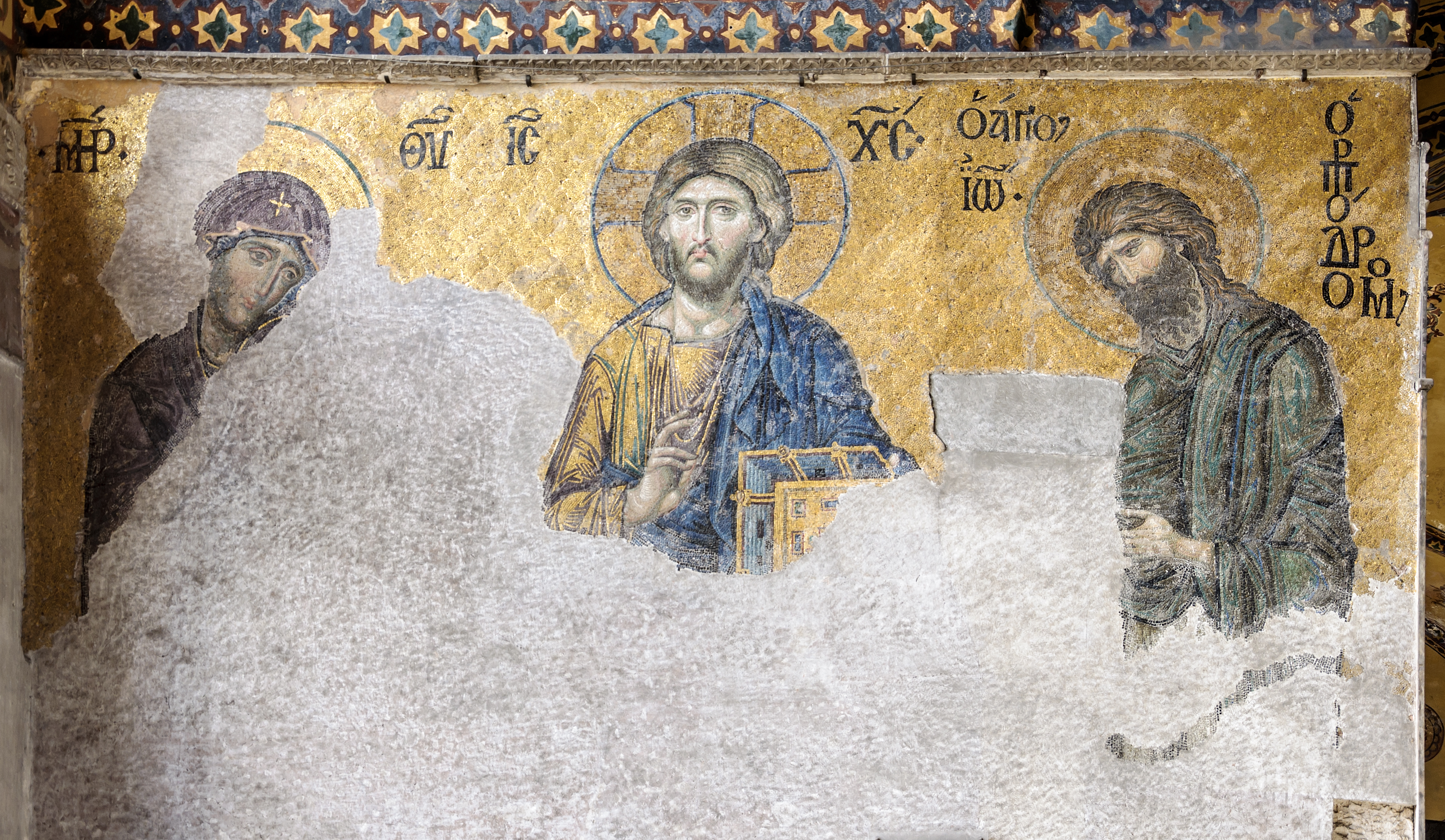
File:Deesis mosaic Hagia Sophia.jpg
Deësis (Gr. "Prayer" or "Supplication") mosaic, 13th century.  Hagia Sophia  (Holy Wisdom) Cathedral, Constantinople, Byzantine Empire; showing the Virgin Mary and John the Baptist on Christ's left and right (photo Wikimedia Commons)
 
 Now Jesus, going up to Jerusalem, took the twelve disciples aside on the road and said to them, "Behold, we are going up to Jerusalem, and the Son of Man will be betrayed to the chief priests and to the scribes; and they will condemn Him to death, and deliver Him to the Gentiles to mock and to scourge and to crucify.  And the third day He will rise again."

Then the mother of Zebedee's sons came to Him with her sons, kneeling down and asking something from Him.  And He said to her, "What do you wish?"  She said to Him, "Grant that these two sons of mine may sit, one of Your right hand and the other on the left, in Your kingdom."  But Jesus answered and said, "You do not know what you ask.  Are you able to drink the cup that I am about the drink, and to be baptized with the baptism that I am baptized with?"  They said to Him, "We are able."  So He said to them, "You will indeed drink My cup, and be baptized with the baptism that I am baptized with; but to sit on My right hand and on My left is not Mine to give, but it is for those for whom it is prepared by My Father."  And when the ten heard it, they were greatly displeased with the two brothers.  But Jesus called them to Himself and said, "You know  that the rulers of the Gentiles lord it over them, and those who are great exercise authority over them.  Yet it shall not be so among you; but whoever desires to become great among you, let him be your servant.  And whoever desires to be first among you, let him be your slave -- just as the Son of Man did not come to be served, but to serve, and to give His life a ransom for many."
 
- Matthew 20:17-28 
 
In yesterday's reading, Jesus gave the parable of the Workers in the Vineyard:  "For the kingdom of heaven is like a landowner who went out early in the morning to hire laborers for his vineyard.  Now when he had agreed with the laborers for a denarius a day, he sent then into his vineyard.  And he went out about the third hour and saw others standing idle in the marketplace, and said to them, 'You also go into the vineyard, and whatever is right I will give you.'  So they went.  Again he went out about the sixth and the ninth hour, and did likewise.  And about the eleventh hour he went out and found others standing idle, and said to them, 'Why have you been standing here idle all day?'  They said to him, 'Because no one hired us.'  He said to them, 'You also go into the vineyard, and whatever is right you will receive.'  So when evening had come, the owner of the vineyard said to his steward, 'Call the laborers and give them their wages, beginning with the last to the first.'  And when those came who were hired about the eleventh hour, they each received a denarius.  But when the first came, they supposed that they would receive more; and they likewise received each a denarius.  And when they had received it, they complained against the landowner, saying, 'These last men have worked only one hour, and you made them equal to us who have borne the burden and the heat of the day.'  But he answered one of them and said, 'Friend, I am doing you no wrong.  Did you not agree with me for a denarius?  Take what is yours and go your way.  I wish to give to this last man the same as to you.  Is it not lawful for me to do what I wish with my own things?  Or is your eye evil because I am good?'  So the last will be first, and the first last.  For many are called, but few chosen."
 
  Now Jesus, going up to Jerusalem, took the twelve disciples aside on the road and said to them, "Behold, we are going up to Jerusalem, and the Son of Man will be betrayed to the chief priests and to the scribes; and they will condemn Him to death, and deliver Him to the Gentiles to mock and to scourge and to crucify.  And the third day He will rise again."  My study Bible comments that Christ's repeated prediction of His Passion is meant to encourage and strengthen disciples for the terrifying events they will face.  According to Theophylact, it is as if Christ were saying, "Think on all these [words and miracles], so that when you see me hanging on the Cross, you will not imagine that I am suffering because I am powerless to do otherwise."

Then the mother of Zebedee's sons came to Him with her sons, kneeling down and asking something from Him.  And He said to her, "What do you wish?"  She said to Him, "Grant that these two sons of mine may sit, one of Your right hand and the other on the left, in Your kingdom."  But Jesus answered and said, "You do not know what you ask.  Are you able to drink the cup that I am about the drink, and to be baptized with the baptism that I am baptized with?"  They said to Him, "We are able."  So He said to them, "You will indeed drink My cup, and be baptized with the baptism that I am baptized with; but to sit on My right hand and on My left is not Mine to give, but it is for those for whom it is prepared by My Father."   We don't really know why at this juncture the mother of James and John Zebedee has come to Christ with this request.  It is a sort of repetition of the disciples previously asking, "Who then is greatest in the kingdom of heaven?"  But this time, it is the mother of Zebedee's sons who comes with this request on behalf of James and John.  When the question of "the greatest" was asked before, Jesus took pains with specific and extended teachings on humility and the need to serve, especially to take care of the "little ones" in the Church.  Perhaps Christ speaking of His coming Passion, and saying that on the third day He will rise again has prompted the disciples to assume that He will come into an eternal, earthly kingdom, as is widely expected of the Messiah.  But my study Bible comments that this quest for temporal power and glory is unfitting for a disciple and it shows an earthly misunderstanding of the Kingdom of God.  Here Matthew tells us that it was their mother who requested such an honor -- but John and James' own involved in revealed because Jesus addresses them in the plural "you" in the Greek both here and in Mark 10:36.   We must note that Christ calls His Crucifixion a cup and His death a baptism.  The Cross is a cup, my study Bible says, because He drank it willingly (Hebrews 12:2).  His death is baptism, as He was completely immersed in it, and yet it cleansed the world (Romans 6:3-6).  Christ's prophecy of John and James participating in the same cup and baptism shows the life of persecution and martyrdom these brothers would lead after Pentecost -- James would be the first apostle to be martyred (Acts 12:1-2), and John would go on to a long life of persecution and exile, producing one Gospel, three Epistles, and the Revelation.  My study Bible further notes on this passage that Christ declaring that the places of honor in the Kingdom are not His to give doesn't mean He lacks authority.  It means, instead, that they are not His to give arbitrarily.  He will give them to those for whom God has prepared them.  Note also, my study Bible says, that with regard to sitting as equals on the right and the left hand of Christ in Christ's Kingdom, St. John Chrysostom teaches that nobody could possibly occupy these positions.  Regarding the highest places of honor that can be given to human beings, the icons of the Orthodox Church universally depict the Virgin Mary (most blessed among women -- Luke 1:28) and John the Baptist (greatest born of women -- Matthew 11:11) holding these places.  See the icon above, the 13th century mosaic entitled Deësis, meaning "prayer" or "supplication" in Greek, from Hagia Sophia (Holy Wisdom) Cathedral in Constantinople, the capitol of the Byzantine Empire.
 
And when the ten heard it, they were greatly displeased with the two brothers.  But Jesus called them to Himself and said, "You know  that the rulers of the Gentiles lord it over them, and those who are great exercise authority over them.  Yet it shall not be so among you; but whoever desires to become great among you, let him be your servant.  And whoever desires to be first among you, let him be your slave -- just as the Son of Man did not come to be served, but to serve, and to give His life a ransom for many."  My study Bible notes that Jesus once again corrects the disciples, this time by first comparing them to the power-hungry Gentiles, whom they themselves considered an abomination, and contrasting them to Himself, who serves us although He is Lord of all.  My study Bible notes here that for many is an Aramaic expression which indicates "for all."

So, in the context of the Gospel, there is the common theme of sacrifice running as a thread throughout the past few readings.  There was first the story of the rich young man, whom Jesus loved, and whom He told that if he wanted to be perfect, he should sell his possessions and give to the poor, and follow Him.  This was followed by a discussion regarding the difficulties which wealth presents to those who would seek the kingdom of heaven, and the sacrifices which the disciples themselves have made.  In yesterday's reading (see above), Jesus gave the parable of the Workers in the Vineyard, expressing the principle that not all will labor equally, and yet all will receive the same reward.  Here we have the dynamic quality in the story line in which the mother of John and James Zebedee comes (seemingly on their behalf) asking Christ to make her two sons effectively greatest in His coming Kingdom, to sit at His right and left hand.  According to my study Bible, as we read above, these are positions no one could fill, and the positions there will be will go to those for whom they are prepared by God.  But again, all of this comes within the theme of sacrifice, for it all begins with Christ's second warning of His Passion and death to come, followed by Resurrection.  While the family of Zebedee has focused on what this might mean for a coming "earthly" type kingdom, Jesus' true meaning here is about His own sacrifice on behalf of all -- which will function as an image of service for everyone to remember after Pentecost and the mission of the Church has truly begun.  While Jesus has already answered the question, "Who then is the greatest in the kingdom of heaven?" with warnings about abuses of power, about humility, and service in the Church, this is yet a repetition with more emphasis, contrasting the use of power witnessed in the kingdoms of the Gentiles with the type of leadership Christ wants in His Church, to which He will entrust these apostles.  It's such an important lesson that sections of the Gospel are repeatedly devoted it, as Jesus begins His way toward Jerusalem with warnings to the disciples about what is to come.  Therefore it remains an essential lesson for the Church, and the world has seen plenty of excesses which enforce Christ's teachings all the more for all of us.  Let us endeavor to keep and live His faith, as He has taught, and follow the examples of those who have served throughout the centuries, both great and small, martyrs and saints, and the countless "little ones" who have served with their own lives and faith as well.  


Monday, March 18, 2024

If anyone desires to be first, he shall be last of all and servant of all

 
Then they departed from there and passed through Galilee, and He did not want anyone to know it.  For He taught His disciples and said to them, "The Son of Man is being betrayed into the hands of men, and they will kill Him.  And after He is killed, He will rise the third day."  But they did not understand this saying, and were afraid to ask Him.  

Then He came to Capernaum.  And when He was in the house He asked them, "What was it you disputed among yourselves on the road?"  But they kept silent, for on the road they had disputed among themselves who would be the greatest.  And He sat down, called the twelve, and said to them, "If anyone desires to be first, he shall be last of all and servant of all."  Then He took a little child and set him in the midst of them.  And when He had taken him in His arms, He said to them, "Whoever receives one of these little children in My name receives Me; and whoever receives Me, receives not Me but Him who sent Me."  

Now John answered Him, saying, "Teacher, we saw someone who does not follow us casting out demons in Your name, and we forbade him because he does not follow us."  But Jesus said, "Do not forbid him, for no one who works a miracle in My name can soon afterward speak evil of Me.  For he who is not against us is on our side.  For whoever gives you a cup of water to drink in My name, because you belong to Christ, assuredly, I say to you, he will by no means lose his reward."
 
- Mark 9:30–41 
 
Yesterday we read that, returning from the mountain of the Transfiguration, when He came to the disciples, Jesus saw a great multitude around them, and scribes disputing with them.  Immediately, when they saw Him, all the people were greatly amazed, and running to Him, greeted Him.  And He asked the scribes, "What are you discussing with them?"  Then one of the crowd answered and said, "Teacher, I brought You my son, who has a mute spirit.  And wherever it seizes him, it throws him down; he foams at the mouth, gnashes his teeth, and becomes rigid.  So I spoke to Your disciples, that they should cast it out, but they could not."  He answered him and said, "O faithless generation, how long shall I be with you?  How long shall I bear with you?  Bring him to Me."  Then they brought him to Him.  And when he saw Him, immediately the spirit convulsed him, and he fell on the ground and wallowed, foaming at the mouth.  So He asked his father, "How long has this been happening to him?"  And he said, "From childhood.  And often he has thrown him both into the fire and into the water to destroy him.  But if You can do anything, have compassion on us and help us."  Jesus said to him, "If you can believe, all things are possible to him who believes."  Immediately the father of the child cried out and said with tears, "Lord, I believe; help my unbelief!"  When Jesus saw that the people came running together, He rebuked the unclean spirit, saying to it:  "Deaf and dumb spirit, I command you, come out of him and enter him no more!"  Then the spirit cried out, convulsed him greatly, and came out of him.  And he became as one dead, so that many said, "He is dead."  But Jesus took him by the hand and lifted him up, and he arose.  And when He had come into the house, His disciples asked Him privately, "Why could we not cast it out?"  So He said to them, "This kind can come out by nothing but prayer and fasting."  
 
 Then they departed from there and passed through Galilee, and He did not want anyone to know it.  For He taught His disciples and said to them, "The Son of Man is being betrayed into the hands of men, and they will kill Him.  And after He is killed, He will rise the third day."  But they did not understand this saying, and were afraid to ask Him.  This is the second time Jesus predicts His death and Resurrection (see the first time here).  My study Bible says that He does so in order to show that He is going to His Passion freely, and that He will not be taken against His will.  Note that it is still not the time for this to happen, as Jesus seeks to avoid open conflict -- He did not want anyone to know He was passing through Galilee.
 
 Then He came to Capernaum.  And when He was in the house He asked them, "What was it you disputed among yourselves on the road?"  But they kept silent, for on the road they had disputed among themselves who would be the greatest.  And He sat down, called the twelve, and said to them, "If anyone desires to be first, he shall be last of all and servant of all."  Then He took a little child and set him in the midst of them.  And when He had taken him in His arms, He said to them, "Whoever receives one of these little children in My name receives Me; and whoever receives Me, receives not Me but Him who sent Me."   This question of who would be the greatest likely arises because the disciples have misunderstood about Jesus rising on the third day.  Perhaps they consider that Jesus will then come into a worldly kingdom, and so they dispute among themselves about who would have the greatest place in such a kingdom.  My study Bible comments that the nature of this dispute indicates a selfish interest in worldly power.  Rather than emphasizing the ideal of greatness in a world dominated by Caesar and powerful kings, Jesus teaches them that even when receiving a little child in His name means receiving Him -- and moreover, to receive Christ means instead to receive God the Father who sent Him. 
 
 Now John answered Him, saying, "Teacher, we saw someone who does not follow us casting out demons in Your name, and we forbade him because he does not follow us."  But Jesus said, "Do not forbid him, for no one who works a miracle in My name can soon afterward speak evil of Me.  For he who is not against us is on our side.  For whoever gives you a cup of water to drink in My name, because you belong to Christ, assuredly, I say to you, he will by no means lose his reward."  My study Bible cites the commentary of both Theophylact and St. Ambrose of Milan on this passage, for us to consider.  Theophylact sees regret in John's comment, and his conscience pricked by what Christ has just said about being the last of all and servant of all.  But St. Ambrose comments, in contrast, that John expects full obedience to accompany such blessings.  But, my study Bible says, in either understanding, Christ's response shows that those who act in good faith are not excluded, even if they are not currently numbered among the disciples.  Theophylact writes, "See how divine grace is at work even in those who are not His disciples" (see also Numbers 11:24-30).  On those who use Christ's name without good faith, see Luke 11:23; Acts 19:13-16
 
Once again, it's something remarkable to observe Jesus' careful attempts to conceal His presence, His efforts not to draw attention to Himself.  Here He is back in His home territory of the region of Galilee, and on His way to what some consider His ministry headquarters, the city of Capernaum.  But He did not want anyone to know it.  As we have previously observed, there are times when Jesus wants to withdraw from all forms of conflict, from the scrutiny of the religious leaders. No doubt they would be expecting Him in Galilee, and would have heard of the healing and exorcism He effected, after His disciples could not do so and were disputing with some scribes about it (in Saturday's reading, above).  It shows us how aware He is of the ambitions of the religious leadership to rid themselves of His presence, which they now consider a threat to their authority.  So, on His way back to Capernaum and Peter's home which served as a ministry headquarters, He does not want anyone to be aware of His presence.  For the second time, He also warns the disciples about His Passion to come.  But they misunderstand what is going to happen, notably likely about what it means that He will rise the third day.  While Jesus takes great care to reveal to the disciples what is coming, we observe that He does not rush to His fate, and neither does He seek to make it happen.  Quite the opposite is going on here, in fact.  Everything depends upon the Father's time, and that is the proper time.  He is by no means anxious to spark an open confrontation and manipulate circumstances to force the hand of the authorities.  He is not in a rush to "force" His hour of glory (John 12:16).  And in keeping with this humility and obedience of Jesus, He teaches these men so eager for "greatness" what it is to be truly great, and that their own mission depends upon their capacity for humility and service.  Jesus is teaching them to, in fact, reject common notions of greatness in order to be truly great in His kingdom, and to serve His Church as they must do.  While, thanks no doubt to the influence of Christ's teachings, we have historical cultural values that uplift gracious behavior and humility as the foundation of public good manners, Christ's call to us still asks us to defy common notions of greatness.  We elevate celebrity to high achievement, and in an age of social media, personal publicity is a common pattern with which we might be all too familiar.  Children are measuring themselves by what they see as achievement in social media, none of which may be true or reasonable in the least.  Humility is not seeking publicity for good works or even charitable donations, although that may come of its own merit.  Being kind and compassionate is not simply useful for social value.   Even the Caesars uplifted their public works and called themselves benefactors, as Jesus taught (Luke 22:25).  While it seems not at all obvious to these men what greatness they will find in service and humility, they will in fact build the Church through such virtues, and the central empowerment to such efforts is faith.  Their personal sacrifices in building the Church will result, for example, in the creation of public hospitals.  The first dedicated public hospital in the world was built by St. Basil the Great in the 4th century (369 AD), after Christianity ceased to be persecuted and was established as a dominant religion.  Within a short period, not only were hospitals to become ubiquitous in the Byzantine Empire, but even the science and ethics of medicine would expand as a result.  In our modern perspective of popular media and culture, we are offered so much in the way of both spectacle and also consumer goods that it is hard to imagine the beauty of humility and service in giving through faith in Christ as a way of life.  But nonetheless, we are still asked to build our own integrity upon the values Jesus teaches in today's reading.  Especially in a world with greater than ever material power at its command, it's essential that we understand how we can build better lives and better communities through the intangibles of Christ's values, and especially through this simple practice of coming to see ourselves receiving not only Christ, but God the Father, in those "little ones" in our communities, perhaps particularly in our churches.  Let us consider the greatness that Christ desires, and what might be shaped, especially in a world such as ours today, by His image for us.  His teaching of greatness may seem paradoxical, but it is a paradox that has elevated goodness in the world, and it constitutes the rock upon which we may build our lives, our hopes, and our faith.  


Tuesday, June 14, 2022

Does your Teacher not pay the temple tax?

 
 Now while they were staying in Galilee, Jesus said to them, "The Son of Man is about to be betrayed into the hands of men, and they will kill Him, and the third day He will be raised up."  And they were exceedingly sorrowful.

When they had come to Capernaum, those who received the temple tax came to Peter and said, "Does your Teacher not pay the temple tax?"  He said, "Yes."  And when he had come into the house, Jesus anticipated him, saying, "What do you think, Simon?  From whom do the kings of the earth take customs or taxes, from their sons or from strangers?"  Peter said to Him, "From strangers."  Jesus said to him, "Then the sons are free.  Nevertheless, lest we offend them, go to the sea, take the fish that comes up first.  And when you have opened its mouth, you will find a piece of money; take that and give it to them for Me and you."
 
- Matthew 17:22-27 
 
Yesterday we read that when Jesus (together with Peter, James, and John) had returned from the Mount of Transfiguration and come to the multitude, a man came to Him, kneeling down to Him and saying, "Lord, have mercy on my son, for he is an epileptic and suffers severely; for he often falls into the fire and often into the water.  So I brought him to Your disciples, but they could not cure him."  Then Jesus answered and said, "O faithless and perverse generation, how long shall I be with you?  How long shall I bear with you?  Bring him here to Me."  And Jesus rebuked the demon, and it came out of him; and the child was cured from that very hour.  Then the disciples came to Jesus privately and said, "Why could we not cast it out?"  So Jesus said to them, "Because of your unbelief; for assuredly, I say to you, if you have faith as a mustard seed, you will say to this mountain, 'Move from here to there,' and it will move; and nothing will be impossible for you.  However, this kind does not go out except by prayer and fasting."
 
 Now while they were staying in Galilee, Jesus said to them, "The Son of Man is about to be betrayed into the hands of men, and they will kill Him, and the third day He will be raised up."  And they were exceedingly sorrowful.  This is the second time that Jesus predicts His death and Resurrection to the disciples (see the previous time at Matthew 16:21).  In repeatedly warning the disciples, He shows to them that He is going to His Passion freely, and He is not being taken against His will.  

When they had come to Capernaum, those who received the temple tax came to Peter and said, "Does your Teacher not pay the temple tax?"  He said, "Yes."  And when he had come into the house, Jesus anticipated him, saying, "What do you think, Simon?  From whom do the kings of the earth take customs or taxes, from their sons or from strangers?"  Peter said to Him, "From strangers."  Jesus said to him, "Then the sons are free.  Nevertheless, lest we offend them, go to the sea, take the fish that comes up first.  And when you have opened its mouth, you will find a piece of money; take that and give it to them for Me and you."  My study Bible explains that the temple tax was an annual head tax on all male Jews (except the priests) over twelve years of age, and was for the maintenance of the temple (see Numbers 3:43-51).   It says that since Jesus is the Son of God, He is both High Priest and "proprietor" of the temple.  Thus, He is exempt from the tax.  But nonetheless, He pays it anyway -- both in order to avoid unnecessary offense and also to show that He has totally identified Himself with mankind.  

Jesus instructs Peter, a former fisherman, now made by Christ a "fisher of men" (Matthew 4:19), to go to the sea, and in the fish that comes up first will find a piece of money in order to pay the temple tax.  The temple tax was a half shekel, required by all males regardless or wealth or status (except priests).  So the shekel in the mouth of the fish is enough for both Peter and for Christ.  But Jesus makes it clear that in His identity as Christ, the Son of the living God in accordance with Peter's confession (Matthew 16:16), His nature is of One who should be exempt in praying the tax.  He is Son of God, and also the son of King David by lineage.  But Jesus' miracle of the fish establishes several things at once.  First of all, He addresses an attack made upon Himself by those who have done so through the embarrassment of His disciple, Peter.  Jesus, in some sense, fulfills all righteousness (Matthew 3:15), by paying the tax as the human Jesus whom others do not know nor realize is both a son of David and also Son of God.  He also pays for Peter, covering Peter's embarrassment before others within his own community of Capernaum.  Not only is a miracle the way by which Christ chooses to do so, making it perfectly clear what His own nature is for Peter and the disciples (and we who read the Gospel), but the coin that comes out of the mouth of the fish bears in the image of Caesar.  Various Church Fathers, including, for example, Apollinaris, have suggested that this coin is in some sense representing Christ's crucifixion, the offer of His Body to us as sacrifice for our salvation.  What is given up is that which was demanded by Caesar, so to speak, whose image is on the coin.  But the true image of Christ, the Person of Christ, can never be sacrificed nor given up -- and it is His image that He in turn will place in us.  As with His own sacrifice on the Cross, He will give up His human life in order to "cover" each of us, all of our spiritual debts in some sense; He pays a "tax" to the "prince of this world" but in so doing, He redeems all of us, and His sacrifice continues to have this power through the transforming power of God to defeat death and sin.  It is His act of self-chosen sacrifice which in effect redeems, liberates all of us from the evil one.  So when we think of this scene, and Jesus' instructions to Peter the fisherman whose very livelihood has been transformed to God's purposes and mission and service, let us consider how Christ can do the same in our lives.  For His sacrifice is for all of us, and His Cross will show each of the ways to transfigure our lives, and ways in which our own sacrifices can be rendered for the service of God.  The "miraculous coin" in our own lives gives us the meanings meant for each, given in turn by the divine image of Christ within each of us through faith.  For we also are the fish drawn out of the sea by the fishers of men commissioned by Christ.


Wednesday, November 17, 2021

Nevertheless, lest we offend them, go to the sea, cast in a hook, and take the fish that comes up first. And when you have opened its mouth, you will find a piece of money; take that and give it to them for Me and you

 
 Now while they were staying in Galilee, Jesus said to them, "The Son of Man is about to be betrayed into the hands of men, and they will kill Him, and the third day He will be raised up."  And they were exceedingly sorrowful.

When they had come to Capernaum, those who received the temple tax came to Peter and said, "Does your Teacher not pay the temple tax?"  He said, "Yes."  And when he had come into the house, Jesus anticipated him, saying, "What do you think, Simon?  From whom do the kings of the earth take customs or taxes, from their sons or from strangers?"  Peter said to Him, "From strangers."  Jesus said to him, "Then the sons are free.  Nevertheless, lest we offend them, go to the sea, cast in a hook, and take the fish that comes up first.  And when you have opened its mouth, you will find a piece of money; take that and give it to them for Me and you."
 
- Matthew 17:22-27 
 
Yesterday we read that when Jesus and the three disciples, James, John, and Peter had come down from the Mount of the Transfiguration to the multitude, a man came to Him, kneeling down to Him and saying, "Lord, have mercy on my son, for he is an epileptic and suffers severely; for he often falls into the fire and often into the water.  So I brought him to Your disciples, but they could not cure him."  Then Jesus answered and said, "O faithless and perverse generation, how long shall I be with you?  How long shall I bear with you?  Bring him here to Me."  And Jesus rebuked the demon, and it came out of him, and the child was cured from that very hour.  Then the disciples came to Jesus privately and said, "Why could we not cast it out?"  So Jesus said to them, "Because of your unbelief; for assuredly, I say to you, if you have faith as a mustard seed, you will say to this mountain, 'Move from here to there,' and it will move; and nothing will be impossible for you.  However, this kind does not go out except by prayer and fasting."
 
  Now while they were staying in Galilee, Jesus said to them, "The Son of Man is about to be betrayed into the hands of men, and they will kill Him, and the third day He will be raised up."  And they were exceedingly sorrowful.  This is the second time that Jesus predicts His death and Resurrection (see also this reading for the first, which immediately followed Peter's confession that Jesus is the Christ, the Son of the living God).   My study Bible comments that this is done to show the disciples that He is going to His Passion freely, and not being taken against His will. 

When they had come to Capernaum, those who received the temple tax came to Peter and said, "Does your Teacher not pay the temple tax?"  He said, "Yes."  And when he had come into the house, Jesus anticipated him, saying, "What do you think, Simon?  From whom do the kings of the earth take customs or taxes, from their sons or from strangers?"  Peter said to Him, "From strangers."  Jesus said to him, "Then the sons are free.  Nevertheless, lest we offend them, go to the sea, cast in a hook, and take the fish that comes up first.  And when you have opened its mouth, you will find a piece of money; take that and give it to them for Me and you."  My study Bible explains that the temple tax was an annual head tax on all male Jews (with the exception of priests) over twelve years old, for the maintenance of the temple (see Numbers 3:43-51).  As Jesus is the Son of God, it says, He is both High Priest and also "proprietor" of the temple, and therefore is exempt from the temple tax.  But He pays it anyway, both to avoid unnecessary offense, and also to show that He has totally identified Himself with mankind.

I'm quite intrigued about the story of the temple tax.  Yes, there is a seemingly "magical" element to it, if that is even an appropriate term.  Let us call it mystical, and an aspect of Christ's dominion over all things that there is a coin in the mouth of the first fish Peter the fisherman can catch, and Christ means it to be paid for the temple tax.  Let us go to the question, instead, of the approach of those whose job it is to collect the tax.  It seems to me that the question, "Does your Teacher not pay the temple tax?" is designed to embarrass Peter, and to cause him shame over Jesus.  Let us bear in mind that this is his community, and so shame becomes a particularly important element of the story.  Of course, shame and scandal will become a key component of the Passion.  We often forget when discussing Christ's Crucifixion that this singular event affects all of us, everybody.  It is not Christ alone who is involved, but all who witness, then and now -- both for those who reject Jesus and the Gospel, and for those who are the followers of Christ.  Let us imagine the impact of the Passion on His immediate followers, such as Peter and the rest of the disciples.  Of course, we know Peter's denial of Christ on the night Jesus was arrested, and his subsequent return to Christ and to the other disciples.  So this particular stumbling block of shame, with observation, does become something of an important thread in the story of Peter as a disciple to Christ.  Here, Jesus makes it perfectly clear that "the sons are free."  But nevertheless, Jesus divinely gifts Peter with the money for the temple tax from the coin in the mouth of the fish, "lest we offend them."  This seems at once to be a concession to avoid an unnecessary conflict, and also an act of compassion for Peter within his community.  There will be time soon enough when Peter's own concern for what might be scandalous will test him (see Matthew 26:33-35, 69-75).  It seems this same sort of test among community will be referred to again when St. Paul raises the issue in Galatians 2 and 3 regarding Peter's conduct within the early Christian community of both Gentiles and Jews.  There, St. Paul also raises this question to Peter in light of Christ's crucifixion, saying to him, "I have been crucified with Christ; it is no longer I who live, but Christ lives in me; and the life which I now live in the flesh I live by faith in the Son of God, who loved me and gave Himself for me. I do not set aside the grace of God; for if righteousness comes through the law, then Christ died in vain" (Galatians 2:20-21).  For if we are truly crucified with Christ, if we also participate in His Passion, then there will be questions that arise in our lives also where we might "bear a little shame" (to use the words of Fr. Stephen Freeman, who frequently writes about this topic on his blog, Glory to God for All Things), for the sake of the place to which Christ calls us, even in the face of our own communities.  Are we called to befriend the stranger whom others shun?  Can we really befriend the person singled out as scapegoat or for bullying?  These questions will come up again and again in whatever nominal "group" we're a part of, from the intimacy of family to large groups of Church and wider community of all kinds.  Here, Christ seems to wish to avoid a conflict for Peter and within a community in which His ministry has a kind of headquarters, and one which is not a part of the necessary clash to come with the religious leaders in Jerusalem.  But He takes care to teach Peter in private, and make His point clear nonetheless, affirming His divinity in the process.  As Fr. Freeman points out about this passage, Christ seems to "cover" Peter's shame with the miraculous coin.  After all, Peter has already answered the men from the temple in the affirmative, having taken upon himself to speak for Christ as one of His followers when he answers "Yes" to their question.  In so many ways, Christ seems to teach us both discernment and compassion, when it is time to bear shame or scandal for His sake, and when it is not.  In today's reading, it is He who graciously condescends to us, as one of us, for Peter and for the community.  In all ways, it is His personal love and compassion from which we truly learn, and let us again bear this in mind as we approach the season of His Nativity.


Saturday, May 15, 2021

Whoever receives this little child in My name receives Me; and whoever receives Me receives Him who sent Me. For he who is least among you all will be great


St. Ignatius of Antioch being devoured by lions in the Colosseum at Rome.  Menologion of Byzantine Emperor Basil II (r. 976–1025), illustrated manuscript, ca. 1000.  Vatican Library (Ms. Vat. gr. 1613)

 Now it happened on the next day, when they had come down from the mountain, that a great multitude met Him.  Suddenly a man from the multitude cried out, saying, "Teacher, I implore You, look on my son, for he is my only child.  And behold, a spirit seizes him, and he suddenly cries out; it convulses him so that he foams at the mouth; and it departs from him with great difficulty, bruising him.  So I implored Your disciples to cast it out, but they could not."  Then Jesus answered and said, "O faithless and perverse generation, how long shall I be with you and bear with you?  Bring your son here."  And as he was still coming, the demon threw him down and convulsed him.  Then Jesus rebuked the unclean spirit, healed the child, and gave him back to his father.

And they were all amazed at the majesty of God.  But while everyone marveled at all the things which Jesus did, He said to His disciples, "Let these words sink down into your ears, for the Son of Man is about to be betrayed into the hands of men."  But they did not understand this saying, and it was hidden from them so that they did not perceive it; and they were afraid to ask Him about this saying.  

Then a dispute arose among them as to which of them would be greatest.  And Jesus, perceiving the thought of their heart, took a little child and set him by Him, and said to them, "Whoever receives this little child in My name receives Me; and whoever receives Me receives Him who sent Me.  For he who is least among you all will be great."  Now John answered and said, "Master, we saw someone casting out demons in Your name, and we forbade him because he does not follow with us."  But Jesus said to him, "Do not forbid him, for he who is not against us is on our side."
 
- Luke 9:37–50 
 
Yesterday we read that, about eight days after Jesus first warned the disciples about the events and struggles to come (see Monday's reading), that He took Peter, John, and James and went up on the mountain to pray.  As He prayed, the appearance of His face was altered, and His robe became white and glistening.  And behold, two men talked with Him, who were Moses and Elijah, who appeared in glory and spoke of His decease which He was about to accomplish at Jerusalem.  But Peter and those with him were heavy with sleep; and when they were fully awake, they saw His glory and the two men who stood with Him.  Then it happened, as they were parting from Him, that Peter said to Jesus, "Master, it is good for us to be here; and let us make three tabernacles:  one for You, one for Moses, and one for Elijah" -- not knowing what he said.  While he was saying this, a cloud came and overshadowed them; and they were fearful as they entered the cloud.  And a voice came out of the cloud, saying, "This is My beloved Son.  Hear Him!"  When the voice had ceased, Jesus was found alone.  But they kept quiet, and told no one in those days any of the things they had seen.
 
  Now it happened on the next day, when they had come down from the mountain, that a great multitude met Him.  Suddenly a man from the multitude cried out, saying, "Teacher, I implore You, look on my son, for he is my only child.  And behold, a spirit seizes him, and he suddenly cries out; it convulses him so that he foams at the mouth; and it departs from him with great difficulty, bruising him.  So I implored Your disciples to cast it out, but they could not."  Then Jesus answered and said, "O faithless and perverse generation, how long shall I be with you and bear with you?  Bring your son here."  And as he was still coming, the demon threw him down and convulsed him.  Then Jesus rebuked the unclean spirit, healed the child, and gave him back to his father.  My study bible comments on this passage that while the disciples' faith was incomplete (see Matthew 17:19-20), Christ's rebuke (O faithless and perverse generation, how long shall I be with you and bear with you?) is directed also to the crowds, whose faith was weaker still (see Mark 9:22-24). 
 
And they were all amazed at the majesty of God.  But while everyone marveled at all the things which Jesus did, He said to His disciples, "Let these words sink down into your ears, for the Son of Man is about to be betrayed into the hands of men."  But they did not understand this saying, and it was hidden from them so that they did not perceive it; and they were afraid to ask Him about this saying. This is the second warning that Jesus gives to the disciples about the betrayal and His suffering to come.  My study bible tells us that Christ's repeated prediction of His Passion was meant to encourage and strengthen His disciples for the terrifying events that they would face, and also to assure them that Christ was not powerless but went to the Cross willingly.

 Then a dispute arose among them as to which of them would be greatest.  And Jesus, perceiving the thought of their heart, took a little child and set him by Him, and said to them, "Whoever receives this little child in My name receives Me; and whoever receives Me receives Him who sent Me.  For he who is least among you all will be great."  Now John answered and said, "Master, we saw someone casting out demons in Your name, and we forbade him because he does not follow with us."  But Jesus said to him, "Do not forbid him, for he who is not against us is on our side."   Addressing the dispute as to which of them would be greatest, Jesus uses a little child to teach them about power, hierarchy, and humility.  The little child has the least stature, and yet if they receive one little child in His name, they will be receiving not only Christ, but also the Father who sent Him.   In Orthodox iconography, St. Ignatius of Antioch is depicted as this child.  In certain legends of saints, he is the boy who gave the loaves and fishes (John 6:9).  Regarding the dispute with the other who was casting out demons in Christ's name, Theophylact observes John's comment as regret:  his conscience was pricked by what Christ said about the least and the great.   But, on the other hand, St. Ambrose of Milan sees John as expecting full obedience to accompany such blessings.  My study bible comments that in either interpretation, Christ's response shows that those who act in good faith are not excluded, even if they are not currently numbered among the disciples.  Theophylact writes, "See how divine grace is at work even in those who are not His disciples."  See also Numbers 11:24-30.  On those who use Christ's name without good faith, see Luke 11:23, Acts 19:13-16.

Ignatius of Antioch was a first century bishop, who became a martyr.  There is dispute about the letters we have from him, but generally it is considered that the texts we have are at least based upon authentic communications of the saint, if possibly expanded from originals.  St. Ignatius called himself Theophoros, meaning one who bore God within himself.  (We contrast the title Theophoros with Theotokos, which refers to Mary the Mother of God, the one who literally bore or gave birth to Christ.)  A hallmark of his letters is a profound humility to the point of bearing all the ills and afflictions the world would impose for the sake of the love of Christ.  He uses the term "God's athlete" to describe himself, and as an image for other faithful, meaning one who might bear all kinds of pains and struggles for the sake of the great prize of ultimate faith in Christ, and the crown of martyrdom.  Indeed, the story of St. Ignatius is that he ultimately died in the Colosseum at Rome, being given to wild beasts for the entertainment of the crowds.  In the story of St. Ignatius we can read the ultimate outcome of the little boy who served as a model for Christ's teaching of humility among the twelve apostles.  His great desire was to give his life for Christ, to be -- as perhaps the adult who was that little boy -- one who truly became an example of the faith for all, who bore in himself and followed to the end the life of the One whom he called his bishop, Jesus Christ.  Indeed, he saw this as his mission, as he repeated in the letters that we have.  It is a kind of fullness of Christ's teaching regarding the least and the greatest that Ignatius grew to be the martyr that we know, the one who gave his life as an athlete or soldier for Christ, because it is an expression of the deep love which Christ first expressed to him as the little child in today's reading.   It seems to me quite possible, even likely, that St. Ignatius gave himself the name Theophoros ("God-Bearer") precisely in response to this statement of Jesus directing the apostles to see in the child Christ Himself and also the Father who sent Him.  There are all kinds of ways to be great in this world.  We commonly focus ourselves on our homes, our families, our jobs, our wealth, what we look like, and all these things by which success most often seems to be measured.  But let us consider today an entirely different mindset in the extraordinary humility of the St. Igantius, who sought to bear God in the world following the word of Christ whom he called his bishop.  St. Ignatius teaches us to be athletes and soldiers for Christ, entering an arena, and dedicating our whole lives with such passion to the One who loved us first, and taught us what it meant to be truly great.  His greatest honor was the crown -- the laurel wreath -- of martyrdom, giving his all in loyalty to Christ whom he served above all. 


Saturday, August 12, 2017

Whoever gives you a cup of water to drink in My name, because you belong to Christ, assuredly, I say to you, he will by no means lose his reward


 Then they departed from there and passed through Galilee, and He did not want anyone to know it.  For He taught His disciples and said to them, "The Son of Man is being betrayed into the hands of men, and they will kill Him.  And after He is killed, He will rise the third day."  But they did not understand this saying, and were afraid to ask Him.

Then He came to Capernaum.  And when He was in the house He asked them, "What was it you disputed among yourselves on the road?"  But they kept silent, for on the road they had disputed among themselves who would be the greatest.  And He sat down, called the twelve, and said to them, "If anyone desires to be first, he shall be last of all and servant of all."  Then He took a little child and set him in the midst of them.  And when He had taken him in His arms, He said to them, "Whoever receives one of these little children in My name receives Me; and whoever receives Me, receives not Me but Him who sent Me."  Now John answered Him, saying, "Teacher, we saw someone who does not follow us casting out demons in Your name, and we forbade him because he does not follow us."  But Jesus said, "Do not forbid him, for no one who works  a miracle in My name can soon afterward speak evil of Me.  For he who is not against us is on our side.  For whoever gives you a cup of water to drink in My name, because you belong to Christ, assuredly, I say to you, he will by no means lose his reward."

- Mark 9:30-41

Yesterday we read that when Jesus came to the disciples (returning with Peter, James, and John from the mount of Transfiguration), He saw a great multitude around them, and scribes disputing with them.  Immediately, when they saw Him, all the people were greatly amazed, and running to Him, greeted Him.  And He asked the scribes, "What are you discussing with them?"  Then one of the crowd answered and said, "Teacher, I brought You my son, who has a mute spirit.  And wherever it seizes him, it throws him down; he foams at the mouth, gnashes his teeth, and becomes rigid.  So I spoke to Your disciples, that they should cast it out, but they could not."  He answered him and said, "O faithless generation, how long shall I be with you?   How long shall I bear with you?  Bring him to Me."  Then they brought him to Him.  And when he saw Him, immediately the spirit convulsed him, and he fell on the ground and wallowed, foaming at the mouth.  So He asked his father, "How long has this been happening to him?"  And he said, "From childhood.  And often he has thrown him both into the fire and into the water to destroy him.  But if You can do anything, have compassion on us and help us."   Jesus said to him, "If you can believe, all things are possible to him who believes."  Immediately the father of the child cried out and said with tears, "Lord, I believe; help my unbelief!"  When Jesus saw that the people came running together, He rebuked the unclean spirit, saying to it, "Deaf and dumb spirit, I command you, come out of him and enter him no more!"  Then the spirit cried out, convulsed him greatly, and came out of him.  And he became as one dead, so that many said, "He is dead."  But Jesus took him by the hand and lifted him up, and he arose.  And when He had come into the house, His disciples asked Him privately, "Why could we not cast it out?"  So He said to them, "This kind can come out by nothing but prayer and fasting." 

 Then they departed from there and passed through Galilee, and He did not want anyone to know it.  For He taught His disciples and said to them, "The Son of Man is being betrayed into the hands of men, and they will kill Him.  And after He is killed, He will rise the third day."  But they did not understand this saying, and were afraid to ask Him.   This is the second time in Mark's Gospel that Jesus predicts His death and Resurrection to the disciples.  My study bible says that through doing so, He shows He is going to His passion freely, and not being taken against His will.  We once again note the hidden quality of this "secret" of the Messiah, that He will suffer and be killed, and rise the third day; He does not want anyone to know He is passing through Galilee.  It is necessary to teach without fanfare the truth about the nature of this saving mission and how it will unfold -- that which will later be called a stumbling block to the Jews and foolishness to the Greeks.  And once again, we note the measures Jesus takes to protect and nurture faith, beginning with His disciples.

Then He came to Capernaum.  And when He was in the house He asked them, "What was it you disputed among yourselves on the road?"  But they kept silent, for on the road they had disputed among themselves who would be the greatest.  It may seem to us that this dispute as to who would be the greatest of the disciples comes out of nowhere.  But the disciples all have strong cultural and historical expectations of the Messiah and the kingdom that will be ushered in with the advent of the Messiah.  They most likely expect that after rising on the third day, the Messianic kingdom will be established -- and they dispute among themselves who is going to get the greatest position in that royal kingdom. Considering that Jesus has just told them about the suffering and death He will experience, it is altogether a rather petty dispute.  But it teaches us something really extraordinary, that when we are faced with a crisis or some kind of earth-shattering news, we may well need to learn new lessons about how we live in response to it.  As followers of Christ, our learning (the meaning of the word disciple in Greek is "learner") never stops with each new challenge.  Our known reactions may be entirely inadequate for the new place we've come to. 

And He sat down, called the twelve, and said to them, "If anyone desires to be first, he shall be last of all and servant of all."  Then He took a little child and set him in the midst of them.  And when He had taken him in His arms, He said to them, "Whoever receives one of these little children in My name receives Me; and whoever receives Me, receives not Me but Him who sent Me."   Jesus addresses a selfish interest in worldly power, the understanding of authority and position.   To be last of all and servant of all is a quality of humility, the greatest and first ranking virtue of discipleship.  And in terms of position and rank -- they are to receive even each little child as if they are receiving Christ.

Now John answered Him, saying, "Teacher, we saw someone who does not follow us casting out demons in Your name, and we forbade him because he does not follow us."  But Jesus said, "Do not forbid him, for no one who works  a miracle in My name can soon afterward speak evil of Me.  For he who is not against us is on our side.  For whoever gives you a cup of water to drink in My name, because you belong to Christ, assuredly, I say to you, he will by no means lose his reward."  Christ Himself is the great dividing line of power in the world.   All acting in good faith are not excluded, even if not currently numbered among the disciples.  Theophylact comments on the similar passage in Luke, "See how divine grace is at work even in those who are not His disciples."  This grace extends even to those who give so much as a cup of water to drink in His name to those who belong to Him.

Christ is the dividing line, the measure of all things, the plumb line, the lode star.  It is the Person of Christ by whom all things are judged.  This truth runs through all things and people in a mysterious depth we can't quite touch nor always fully grasp.  But in today's reading, we're told that one who so much as gives a cup of water in His name to another that belongs to Him shall by no means lose his or her reward.  What we find is a kind of spiritual dividing line that acts in concert with His power, the mysterious power of the energies of grace at work in the world.  Sometimes this plumb line may not have an obvious name or affiliation, but rather it works as a guidepost to someone who may never have heard His name, but is reaching within themselves for the truth which they deeply desire to find.  Sometimes the depth of this plumb line is understood as love.  I believe there are times in life where one may follow an instinct without even knowing that the One who calls at the other end is Christ Himself.  But nevertheless, He is the knower-of-hearts, even when we don't even understand ourselves.  What we do to shore up faith in ourselves must serve this depth, this ultimate goal of whoever it is we are in His image, in His name.  That is the basic choice that is left to us.  It is the depth of discernment, the root of how our lives will go.  Whatever god or principle or goal or popular idea we put before that is always a diversion from what's truly best for us, from His guiding light.  Sometimes even what seems like a diversion from our course, or something negative, like an illness, a seeming setback, a delay, or a crisis of some sort, can be God's hand giving us time to pause and rethink and reset our goals and values.  There is no time like the present to invest in the power of prayer to ask that He keep us in His name and on the course He sets for us to be with Him, or to pray for others for the same.  The depth of love that runs beneath all things is more reaching than any other value or belief -- but only we can let our own pettiness stand in the way.  Let us note also that it is He who brings the reward -- and not the world we're dependent upon -- when we but offer so little as a cup of water.