Showing posts with label serve. Show all posts

Wednesday, February 25, 2026

So He came and took her by the hand and lifted her up, and immediately the fever left her. And she served them

 
 Now as soon as they had come out of the synagogue, they entered the house of Simon and Andrew, with James and John.  But Simon's wife's mother lay sick with a fever, and they told Him about her at once.  So He came and took her by the hand and lifted her up, and immediately the fever left her.  And she served them.  
 
At evening, when the sun had set, they brought to Him all who were sick and those who were demon-possessed.  And the whole city was gathered together at the door.   Then He healed many who were sick with various diseases, and cast out many demons; and He did not allow the demons to speak, because they knew Him. 
 
Now in the morning, having risen a long while before daylight, He went out and departed to a solitary place; and there He prayed.  And Simon and those who were with Him searched for Him.  When they found Him, they said to Him, "Everyone is looking for You."  But He said to them, "Let us go into the next towns, that I may preach there also, because for this purpose I have come forth."  And He was preaching in their synagogues throughout all Galilee, and casting out demons. 
 
Now a leper came to Him, imploring Him, kneeling down to Him and saying to Him, "If You are willing, You can make me clean."  Then Jesus, moved with compassion, stretched out His hand and touched him, and said to him, "I am willing; be cleansed."  As soon as he had spoken, immediately the leprosy left him, and he was cleansed.  And He strictly warned him and sent him away at once,  and said to him, "See that you say nothing to anyone; but go your way, show yourself to the priest, and offer for your cleansing those things which Moses commanded, as a testimony to them."  However, he went out and began to proclaim it freely, and to spread the matter, so that Jesus could no longer openly enter the city, but was outside in deserted places; and they came to Him from every direction.
 
- Mark 1:29-45 
 
 Now after John was put in prison, Jesus came to Galilee, preaching the gospel of the kingdom of God, and saying, "The time is fulfilled, and the kingdom of God is at hand.  Repent, and believe in the gospel." And as He walked by the Sea of Galilee, He saw Simon and Andrew his brother casting a net into the sea; for they were fishermen.  Then Jesus said to them, "Follow Me, and I will make you become fishers of men."  They immediately left their nets and followed Him.  When He had gone a little farther from there, He saw James the son of Zebedee, and John his brother who also were in the boat mending their nets.  And immediately He called them, and they left their father Zebedee in the boat with the hired servants, and went after Him.  Then they went into Capernaum, and immediately on the Sabbath He entered the synagogue and taught.  And they were astonished at His  teaching, for He taught them as one having authority, and not as the scribes.  Now there was a man in their synagogue with an unclean spirit.  And he cried out, saying, "Let us alone!  What have we to do with You, Jesus of Nazareth?  Did You come to destroy us?  I know who You are -- the Holy One of God!"  But Jesus rebuked him, saying, "Be quiet, and come out of him!"  And when the unclean spirit had convulsed him and cried out with a loud voice, he came out of him.  Then they were all amazed, so that the questioned among themselves, saying, "What is this?  What new doctrine is this?  For with authority He commands even the unclean spirits, and they obey Him."  And immediately His fame spread throughout all the region around Galilee. 
 
  Now as soon as they had come out of the synagogue, they entered the house of Simon and Andrew, with James and John.  But Simon's wife's mother lay sick with a fever, and they told Him about her at once.  So He came and took her by the hand and lifted her up, and immediately the fever left her.  And she served them.  Passages such as this in the Gospels (see also Matthew 8:14-15, Luke 4:38-39) and 1 Corinthians 9:5 (in which Peter is called Cephas) show us that St. Peter was married.  My study Bible comments that the Lord's healing miracles are diverse.  Here, He heals by touch.  Elsewhere, such as in rebuking the unclean spirit in yesterday's reading (see above), He heals with a word.  This healing of St. Peter's mother-in-law  is immediate and complete; others are gradual (Mark 8:22-25) or they require the cooperation of the person healed or of his loved ones (Luke 8:54-55).  All of Christ's miracles or signs (the word used in St. John's Gospel) manifest His redemption of ailing humanity.  In the case of St. Peter's mother-in-law we must recognize that her serving this early ministry of Christ is a restoration of her place in the household, as one who serves Christ.  In modern language and culture, we might fail to recognize that this is an honored place.  The word translated as "served" is διακονέω/diakoneo, from which we derive the English word "deacon."  In effect she takes her place one who ministers to Christ.
 
 At evening, when the sun had set, they brought to Him all who were sick and those who were demon-possessed.  And the whole city was gathered together at the door.   Then He healed many who were sick with various diseases, and cast out many demons; and He did not allow the demons to speak, because they knew Him.  Once again, the Gospel emphasizes that Jesus' messianic identity is to be kept a secret; therefore He did not allow the demons to speak, because they knew Him.  See also yesterday's reading and commentary.  
 
 Now in the morning, having risen a long while before daylight, He went out and departed to a solitary place; and there He prayed.  And Simon and those who were with Him searched for Him.  When they found Him, they said to Him, "Everyone is looking for You."  But He said to them, "Let us go into the next towns, that I may preach there also, because for this purpose I have come forth."  And He was preaching in their synagogues throughout all Galilee, and casting out demons.  My study Bible comments that here Jesus sets forth for us an example of spiritual life.  Although He was God incarnate, he prayed continually, and often found a solitary place to be freed from distraction -- despite everyone's need of Him.  My study Bible notes that the Lord's ministry comes forth from His communion with the Father and the Holy Spirit and flows to people in their needs.  His praying in the morning teaches that we must put as first priority our commitment to God, and only then we will be equipped to properly serve others.
 
 Now a leper came to Him, imploring Him, kneeling down to Him and saying to Him, "If You are willing, You can make me clean."  Then Jesus, moved with compassion, stretched out His hand and touched him, and said to him, "I am willing; be cleansed."  As soon as he had spoken, immediately the leprosy left him, and he was cleansed.  And He strictly warned him and sent him away at once,  and said to him, "See that you say nothing to anyone; but go your way, show yourself to the priest, and offer for your cleansing those things which Moses commanded, as a testimony to them."  However, he went out and began to proclaim it freely, and to spread the matter, so that Jesus could no longer openly enter the city, but was outside in deserted places; and they came to Him from every direction.  The biblical law concerning leprosy is found in Leviticus 13; 14.  In Deuteronomy 24:8 we may find the requirement for purification of lepers and leprous houses, a duty which was entrusted to the priests.  My study Bible explains that leprosy was considered a direct punishment for sins, and as lepers were unclean, they weren't permitted to live in community or to worship in synagogues or the temple.  To touch the unclean was forbidden (Leviticus 7:21), but Jesus touched the leper, expressing His compassion, and showing that Christ is not subject to the Law but is over it.  To the clean, my study Bible notes, nothing is unclean (see Romans 14:14; Titus 1:15).  
 
 What do we make of St. Peter's mother-in-law, who, upon her immediate healing by Jesus, being lifted up by Him, served Jesus and His disciples in their family home?  This word used for her act of serving, as noted above, is the basis for our word in the Church for those who serve, deacon.  Essentially we can read that she is ministering to Christ's ministry, to Him and to His first called disciples in her home which would become the ministry headquarters for Jesus.  It tells us a kind of story of the traditional roles of women in the Church, as it was women who ministered to the ministry, so to speak, by supporting it out of their own resources.  In Luke 8, we read these women:  "Now it came to pass, afterward, that He went through every city and village, preaching and bringing the glad tidings of the kingdom of God. And the twelve were with Him, and certain women who had been healed of evil spirits and infirmities—Mary called Magdalene, out of whom had come seven demons, and Joanna the wife of Chuza, Herod’s steward, and Susanna, and many others who provided for Him from their substance" (Luke 8:1-3).  At the Cross, St. Matthew tells us quite literally:  "And many women who followed Jesus from Galilee, ministering [my italics] to Him, were there looking on from afar, among whom were Mary Magdalene, Mary the mother of James and Joses, and the mother of Zebedee’s sons" (Matthew 27:55-56).  So, just as these women (especially Mary Magdalene) would also become known as apostles to the apostles after they are the first to see the risen Christ and so spread the news to the apostles of Christ's Resurrection, during His earthly ministry, they are "ministers to the ministers," if you will.  In a modern context, we are tempted to equate serving with a diminished status, but for these women this is not so.  Their roles are indispensable.  Without them, Christ's ministry could not have been supported and carried on as it was; they are an integral part not only of His ministry, but of the entire story of salvation.  Without them, events would not have unfolded as they did, for these women went even to His tomb to anoint and care for His body, even when the apostles were in hiding.  Thus, just as they literally supported His ministry, they were the first to hear, believe, and proclaim the Resurrection -- see Luke 24:1-10.  Theirs are not simply secondary roles available to women in a society in which women had diminished status.  These are roles given through the spiritual reality of Christ's ministry, which these women filled with strength, resourcefulness, resilience, and a kind of courage that at time surpassed that of the apostles.  Let us not make the common present assumption that because they served, their roles are not as honorific as were the men's.  One would consider that a misreading and misunderstanding of what is being communicated to us in the Gospels, and what a tremendous honor they had to serve God in this integral and essential way.  Moreover, this would be a neglectful understanding of the impact which Christ's ministry and specifically His treatment of women would have on the whole of society and in every place in which Christianity became practiced; those effects are undeniable.  A woman's soul is essential to the salvation plan of Christ as any man's, and this is made clear through His ministry.  The many early martyrs in the Church who were young women who chose not to marry as their families demanded, but to claim their soul's redemption even if it meant death is, in fact, testimony to this.  Today, of course, because of the effects of Christianity on culture and history, our societies differ from Christ's immediate contemporaries, and so new questions arise for the role of women in the Kingdom and in ministry.  But let us not project upon the past and diminish these women's roles and their powerful sanctification as embraced by Christ and enshrined in the Church as God's work in the world.  Let us not apply a worldly standard to the truth of the truly counter-cultural reality of Christ, for whom His followers participated in a Kingdom which rendered them in the world but not of it.  


Friday, June 6, 2025

Mary has chosen that good part, which will not be taken away from her

 
 Now it happened as they went that He entered a certain village; and a certain woman named Martha welcomed Him into her house.  And she had a sister called Mary, who also sat at Jesus' feet and heard His word.  But Martha was distracted with much serving, and she approached Him and said, "Lord, do You not care that my sister has left me to serve alone?  Therefore tell her to help me."   And Jesus answered and said to her, "Martha, Martha, you are worried and troubled about many things.  But one thing is needed, and Mary has chosen that good part, which will not be taken away from her."
 
- Luke 10:38–42 
 
Yesterday we read that a certain lawyer stood up and tested Jesus, saying, "Teacher, what shall I do to inherit eternal life?"  He said to him, "What is written in the law?  What is your reading of it?"  So he answered and said, "'You shall love the LORD your God with all your heart, with all your heart, with all your soul, with all your strength, and with all your mind,' and 'your neighbor as yourself.'"  And He said to him, "You have answered rightly; do this and you will live."  But he, wanting to justify himself, said to Jesus, "And who is my neighbor?"  Then Jesus answered and said:  "A certain man went down from Jerusalem to Jericho, and fell among thieves, who stripped him of his clothing, wounded him, and departed, leaving him half dead.  Now by chance a certain priest came down that road.  And when he saw him, he passed by on the other side.  Likewise a Levite, when he arrived at the place, came and looked, and passed by on the other side.  But a certain Samaritan, as he journeyed, came where he was.  And when he saw him, he had compassion.  So he went to him and bandaged his wounds, pouring on oil and wine; and he set him on his own animal, brought him to an inn, and took care of him.  On the next day, when he departed, he took out two denarii, gave them to the innkeeper, and said to him, 'Take care of him; and whatever more you spend, when I come again, I will repay you.'   So which of these three do you think was neighbor to him who fell among the thieves?"  And he said, "He who showed mercy on him."  Then Jesus said to him, "Go and do likewise."  
 
  Now it happened as they went that He entered a certain village; and a certain woman named Martha welcomed Him into her house.  And she had a sister called Mary, who also sat at Jesus' feet and heard His word.  But Martha was distracted with much serving, and she approached Him and said, "Lord, do You not care that my sister has left me to serve alone?  Therefore tell her to help me."   And Jesus answered and said to her, "Martha, Martha, you are worried and troubled about many things.  But one thing is needed, and Mary has chosen that good part, which will not be taken away from her."   Mary and Martha are the sisters of Lazarus, the one whom Jesus raised from the dead (see John 11:1-44).  My study Bible comments here that Martha is not rebuked for serving, but for complaining and for being distracted, worried, and troubled.  In following Christ, it says, we serve in order to facilitate the spread of the gospel (see Acts 6:1-4).  
 
Martha and Mary have much to offer us in their story.  First of all, there is the commentary of my study Bible, that the object of service is Christ and the spread of His gospel in following His command.  But no character study would be remiss for looking at these two sisters, and their different personas and the ways in which they address the world.  Consistent throughout the Gospels (especially within the story of the raising of Lazarus in John 11), Mary is the one inclined to more contemplative behavior, while Martha is a model of hospitality.  Although here Jesus tells Martha that Mary has chosen that good part,  we should not be dismissive of Martha's hospitality.  In the story of Lazarus and Christ's seventh and final sign in John's Gospel, the raising of Lazarus from the dead, the same character traits are on display in Martha and Mary.  When Jesus comes to Bethany, their hometown, Martha goes out to meet Him on the road to their house, true to her character of hospitality, while Mary remains seated in the home with others who mourn, the proper attitude of mourning in her time and place.  Martha is the more outgoing, while Mary is the one who is observant, we could say.  Hospitality, in Christian tradition, is one of the most important virtues of what it means to practice our faith, for hospitality is one form of active love.  Of course, as my study Bible comments, this is done not to be ostentatious, to impress, or simply to follow custom; but ultimately we seek to serve Christ in all that we do.  Here, according to that commentary in my study Bible, Mary has chosen the better part because she sits at the feet of Christ, listening to His word, while Martha is worried and troubled about many things.  The passage in St. John's Gospel that tells us of the raising of Lazarus also teaches us how much Jesus loved both of these sisters and their brother (John 11:5).  In some sense, we could also look at Martha as the one fulfilling her social role, and doing what is expected of her, while Mary sits at Christ's feet -- perhaps with the other, male disciples.  But again, as our Lord indicates most clearly, it is she who has chosen that good part, and even those who choose "outside the box" in following Christ are the ones He praises in this context.  Perhaps one of the most important things we can take from this understanding of these two quite different sisters is the compatible and complementary way that these women fit into Christ's supporters, and those who surround Him in His ministry.  It tells us that there is room for all to fulfill their places as followers of Christ, for to serve Him and to serve the spread of His gospel does not require that we each all be "the same," for there is no such thing as a cookie-cutter saint, so to speak.  That is, saints are called to serve each in their own way, just as we each have our own unique cross to bear in terms of how we serve and the ways in which our lives are transfigured by faith in Christ.  Mary has chosen that good part, setting us an example, but Martha also serves, and supports, and is loved by Christ.  Today, let us note that it is her distracted, worried, and troubled countenance that Christ takes an issue with, but Mary has chosen to hear His word.  Let us follow what this teaches us, and choose to put the good part first in whatever we do.  


Saturday, November 16, 2024

He who is faithful in what is least is faithful also in much; and he who is unjust in what is least is unjust also in much

 
 "He who is faithful in what is least is faithful also in much; and he who is unjust in what is least is unjust also in much.  Therefore if you have not been faithful in the unrighteous mammon, who will commit to your trust the true riches?  And if you have not been faithful in what is another man's, who will give you what is your own?  No servant can serve two masters; for either he will hate the one and love the other, or else he will be loyal to the one and despise the other.  You cannot serve God and mammon."

Now the Pharisees, who were lovers of money, also heard all these things, and they derided Him.  And He said to them, "You are those who justify yourselves before men, but God knows your hearts.  For what is highly esteemed among men is an abomination in the sight of God.  
 
"The law and the prophets were until John.  Since that time the kingdom of God has been preached, and everyone is pressing into it.  And it is easier for heaven and earth to pass away than for one tittle of the law to fail.  
 
"Whoever divorces his wife and marries another commits adultery; and whoever marries her who is divorced from her husband commits adultery."
 
- Luke 16:10–17 (18) 
 
Yesterday we read that, after preaching three parables to the Pharisees and scribes about God's desire to save the lost (see the readings from Wednesday and Thursday), He also said to His disciples:  "There was a certain rich man who had a steward, and an accusation was brought to him that this man was wasting his goods.  So he called him and said to him, 'What is this I hear about you?  Give an account of your stewardship, for you can no longer be steward.'  Then the steward said within himself, 'What shall I do?  For my master is taking the stewardship away from me.  I cannot dig; I am ashamed to beg.  I have resolved what to do, that when I am put out of the stewardship, they may receive me into their houses.'  So he called every one of his master's debtors to him, and said to the first, 'How much do you owe my master?'  And he said, 'A hundred measures of oil.'  So he said to him, 'Take your bill, and sit down quickly and write fifty.'  Then he said to another, 'And how much do you owe?'  So he said, 'A hundred measures of wheat.'  And he said to him, 'Take your bill, and write eighty.'  So the master commended the unjust steward because he had dealt shrewdly.  For the sons of this world are more shrewd in their generation than the sons of light.  And I say to you, make friends for yourselves by unrighteous mammon, that when you fail, they may receive you into an everlasting home."
 
"He who is faithful in what is least is faithful also in much; and he who is unjust in what is least is unjust also in much.  Therefore if you have not been faithful in the unrighteous mammon, who will commit to your trust the true riches?  And if you have not been faithful in what is another man's, who will give you what is your own?  No servant can serve two masters; for either he will hate the one and love the other, or else he will be loyal to the one and despise the other.  You cannot serve God and mammon."  My study Bible comments that the test as to whether God will bestow heavenly blessings (true riches) on a person is directly related to how one spends one's money.  The money which we consider to be our own, my study Bible notes, is actually another man's.  That is, it belongs to God, or at least to the poor.  In patristic texts, there is a universal view that a person's failure to give money to God's work is stealing.  Theophylact calls it "nothing less than embezzlement of money belonging to someone else."

Now the Pharisees, who were lovers of money, also heard all these things, and they derided Him.  And He said to them, "You are those who justify yourselves before men, but God knows your hearts.  For what is highly esteemed among men is an abomination in the sight of God."  My study Bible notes that the things which are highly esteemed among men include money, power, position, and praise. 
 
 "The law and the prophets were until John.  Since that time the kingdom of God has been preached, and everyone is pressing into it.  And it is easier for heaven and earth to pass away than for one tittle of the law to fail."   A tittle is the smallest stroke in certain Hebrew letters.  So, what Christ teaches here is that the whole of the Law is affirmed as the foundation of His new teaching, the gospel of the kingdom of God.   

"Whoever divorces his wife and marries another commits adultery; and whoever marries her who is divorced from her husband commits adultery."  Here is a teaching on divorce, which was a highly debated topic in Christ's time, particularly among the Pharisees.  My study Bible comments that in contrast to the easy access to divorce under the Mosaic Law, and because of the misuse of divorce in that time (a topic also important to the Pharisees), Jesus repeatedly condemns divorce in the Gospels (see for example, Matthew 5:31-32; 19:8-9), and He emphasizes the eternal nature of marriage.  The disputes over divorce often centered on the misuse of dowry money and remarriage for that purpose. 

It's important to understand Jesus' mentioning of the teaching regarding divorce in what seems to be an out-of-context mentioning of a different subject.  But, first of all, as noted above, divorce was also a matter of the misuse of marriage for purposes of financial gain, due to concerns about the way dowries could be manipulated through remarriage.  This was an important concern for the Pharisees also, and it distinguished them from the Sadducees.  So Jesus quite knew to whom He was preaching.  But, as is so often true in the Gospels, there is a kind of poetic "rhyming" [if you will] of subjects on a more abstract level.  Jesus is speaking of fidelity to God, to God's purposes, to God's will.  In that context, we can also consider the subject of marriage and divorce as touching upon the meaning of fidelity, of being true to something, upholding something.  This topic can also be extended to Christ's words on the Law:  that "it is easier for heaven and earth to pass away than for one tittle of the law to fail."  As with the subject of divorce, the Pharisees were the ones who endlessly debated the fine points of the Law and believed they zealously upheld its commandments.  So here Jesus preaches about His gospel of the Kingdom, that it is founded upon the Law, in which a violation of one part of the Law meant a violation of all of it.  Fidelity to the commandments of God was the whole foundation of the Pharisees' belief in their traditions that they had built up; but Christ's preaching is always to emphasize that this fidelity must be true to God's purposes in the Law, otherwise it is a failure of fidelity to God.  In other words, the emphasis is on faithfulness.  So, in these perhaps abstract senses, Jesus' preaching here on divorce reminds them all that our loyalty is above all to God and to God's purposes, not to our interpretation of traditions that may hinder the practice of mercy, which is prized above all.  As part of today's daily lectionary readings, we're also given a passage in the Epistle of James (James 2:1-13).  In that passage, James also speaks of fidelity to the Law, but he speaks also of what he calls the "royal law" :  "If you really fulfill the royal law according to the Scripture, 'You shall love your neighbor as yourself,' you do well" (James 2:8), and the chapter finishes with the following:  "So speak and so do as those who will be judged by the law of liberty. For judgment is without mercy to the one who has shown no mercy. Mercy triumphs over judgment" (James 2:12-13).   In His conversation here in Luke, addressing both the Pharisees and scribes who complain that He receives and eats with tax collectors and sinners, and in Christ's address of yesterday's parable of the Unjust Steward to His disciples, Jesus has embraced on the whole this topic of mercy and justice.  In His preaching against divorce, He has also brought mercy into the equation.  In Matthew 19, Jesus prefaces the same words He teaches here against divorce with this sentence:  "Moses, because of the hardness of your hearts, permitted you to divorce your wives, but from the beginning it was not so" (see Matthew 19:8-9).  So in the teachings in this chapter on the use of money, on forgiveness and sin, even on good stewardship in its broad sense, all echo themes of love, mercy, and the practice of God's justice:  fidelity and faithfulness to God's purpose in all things. 


Thursday, June 27, 2024

Are you able to drink the cup that I am about the drink, and to be baptized with the baptism that I am baptized with?


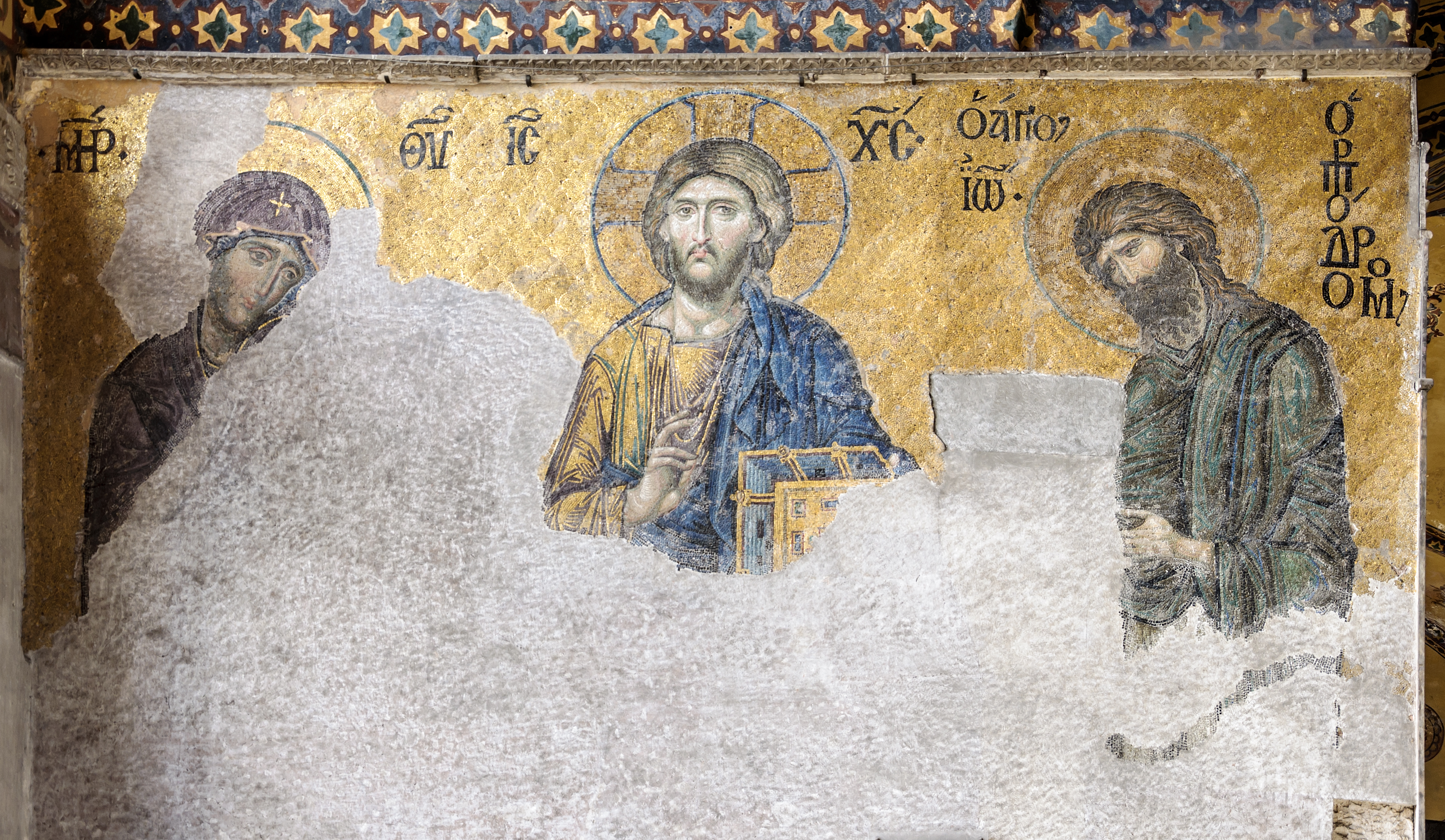
File:Deesis mosaic Hagia Sophia.jpg
Deësis (Gr. "Prayer" or "Supplication") mosaic, 13th century.  Hagia Sophia  (Holy Wisdom) Cathedral, Constantinople, Byzantine Empire; showing the Virgin Mary and John the Baptist on Christ's left and right (photo Wikimedia Commons)
 
 Now Jesus, going up to Jerusalem, took the twelve disciples aside on the road and said to them, "Behold, we are going up to Jerusalem, and the Son of Man will be betrayed to the chief priests and to the scribes; and they will condemn Him to death, and deliver Him to the Gentiles to mock and to scourge and to crucify.  And the third day He will rise again."

Then the mother of Zebedee's sons came to Him with her sons, kneeling down and asking something from Him.  And He said to her, "What do you wish?"  She said to Him, "Grant that these two sons of mine may sit, one of Your right hand and the other on the left, in Your kingdom."  But Jesus answered and said, "You do not know what you ask.  Are you able to drink the cup that I am about the drink, and to be baptized with the baptism that I am baptized with?"  They said to Him, "We are able."  So He said to them, "You will indeed drink My cup, and be baptized with the baptism that I am baptized with; but to sit on My right hand and on My left is not Mine to give, but it is for those for whom it is prepared by My Father."  And when the ten heard it, they were greatly displeased with the two brothers.  But Jesus called them to Himself and said, "You know  that the rulers of the Gentiles lord it over them, and those who are great exercise authority over them.  Yet it shall not be so among you; but whoever desires to become great among you, let him be your servant.  And whoever desires to be first among you, let him be your slave -- just as the Son of Man did not come to be served, but to serve, and to give His life a ransom for many."
 
- Matthew 20:17-28 
 
In yesterday's reading, Jesus gave the parable of the Workers in the Vineyard:  "For the kingdom of heaven is like a landowner who went out early in the morning to hire laborers for his vineyard.  Now when he had agreed with the laborers for a denarius a day, he sent then into his vineyard.  And he went out about the third hour and saw others standing idle in the marketplace, and said to them, 'You also go into the vineyard, and whatever is right I will give you.'  So they went.  Again he went out about the sixth and the ninth hour, and did likewise.  And about the eleventh hour he went out and found others standing idle, and said to them, 'Why have you been standing here idle all day?'  They said to him, 'Because no one hired us.'  He said to them, 'You also go into the vineyard, and whatever is right you will receive.'  So when evening had come, the owner of the vineyard said to his steward, 'Call the laborers and give them their wages, beginning with the last to the first.'  And when those came who were hired about the eleventh hour, they each received a denarius.  But when the first came, they supposed that they would receive more; and they likewise received each a denarius.  And when they had received it, they complained against the landowner, saying, 'These last men have worked only one hour, and you made them equal to us who have borne the burden and the heat of the day.'  But he answered one of them and said, 'Friend, I am doing you no wrong.  Did you not agree with me for a denarius?  Take what is yours and go your way.  I wish to give to this last man the same as to you.  Is it not lawful for me to do what I wish with my own things?  Or is your eye evil because I am good?'  So the last will be first, and the first last.  For many are called, but few chosen."
 
  Now Jesus, going up to Jerusalem, took the twelve disciples aside on the road and said to them, "Behold, we are going up to Jerusalem, and the Son of Man will be betrayed to the chief priests and to the scribes; and they will condemn Him to death, and deliver Him to the Gentiles to mock and to scourge and to crucify.  And the third day He will rise again."  My study Bible comments that Christ's repeated prediction of His Passion is meant to encourage and strengthen disciples for the terrifying events they will face.  According to Theophylact, it is as if Christ were saying, "Think on all these [words and miracles], so that when you see me hanging on the Cross, you will not imagine that I am suffering because I am powerless to do otherwise."

Then the mother of Zebedee's sons came to Him with her sons, kneeling down and asking something from Him.  And He said to her, "What do you wish?"  She said to Him, "Grant that these two sons of mine may sit, one of Your right hand and the other on the left, in Your kingdom."  But Jesus answered and said, "You do not know what you ask.  Are you able to drink the cup that I am about the drink, and to be baptized with the baptism that I am baptized with?"  They said to Him, "We are able."  So He said to them, "You will indeed drink My cup, and be baptized with the baptism that I am baptized with; but to sit on My right hand and on My left is not Mine to give, but it is for those for whom it is prepared by My Father."   We don't really know why at this juncture the mother of James and John Zebedee has come to Christ with this request.  It is a sort of repetition of the disciples previously asking, "Who then is greatest in the kingdom of heaven?"  But this time, it is the mother of Zebedee's sons who comes with this request on behalf of James and John.  When the question of "the greatest" was asked before, Jesus took pains with specific and extended teachings on humility and the need to serve, especially to take care of the "little ones" in the Church.  Perhaps Christ speaking of His coming Passion, and saying that on the third day He will rise again has prompted the disciples to assume that He will come into an eternal, earthly kingdom, as is widely expected of the Messiah.  But my study Bible comments that this quest for temporal power and glory is unfitting for a disciple and it shows an earthly misunderstanding of the Kingdom of God.  Here Matthew tells us that it was their mother who requested such an honor -- but John and James' own involved in revealed because Jesus addresses them in the plural "you" in the Greek both here and in Mark 10:36.   We must note that Christ calls His Crucifixion a cup and His death a baptism.  The Cross is a cup, my study Bible says, because He drank it willingly (Hebrews 12:2).  His death is baptism, as He was completely immersed in it, and yet it cleansed the world (Romans 6:3-6).  Christ's prophecy of John and James participating in the same cup and baptism shows the life of persecution and martyrdom these brothers would lead after Pentecost -- James would be the first apostle to be martyred (Acts 12:1-2), and John would go on to a long life of persecution and exile, producing one Gospel, three Epistles, and the Revelation.  My study Bible further notes on this passage that Christ declaring that the places of honor in the Kingdom are not His to give doesn't mean He lacks authority.  It means, instead, that they are not His to give arbitrarily.  He will give them to those for whom God has prepared them.  Note also, my study Bible says, that with regard to sitting as equals on the right and the left hand of Christ in Christ's Kingdom, St. John Chrysostom teaches that nobody could possibly occupy these positions.  Regarding the highest places of honor that can be given to human beings, the icons of the Orthodox Church universally depict the Virgin Mary (most blessed among women -- Luke 1:28) and John the Baptist (greatest born of women -- Matthew 11:11) holding these places.  See the icon above, the 13th century mosaic entitled Deësis, meaning "prayer" or "supplication" in Greek, from Hagia Sophia (Holy Wisdom) Cathedral in Constantinople, the capitol of the Byzantine Empire.
 
And when the ten heard it, they were greatly displeased with the two brothers.  But Jesus called them to Himself and said, "You know  that the rulers of the Gentiles lord it over them, and those who are great exercise authority over them.  Yet it shall not be so among you; but whoever desires to become great among you, let him be your servant.  And whoever desires to be first among you, let him be your slave -- just as the Son of Man did not come to be served, but to serve, and to give His life a ransom for many."  My study Bible notes that Jesus once again corrects the disciples, this time by first comparing them to the power-hungry Gentiles, whom they themselves considered an abomination, and contrasting them to Himself, who serves us although He is Lord of all.  My study Bible notes here that for many is an Aramaic expression which indicates "for all."

So, in the context of the Gospel, there is the common theme of sacrifice running as a thread throughout the past few readings.  There was first the story of the rich young man, whom Jesus loved, and whom He told that if he wanted to be perfect, he should sell his possessions and give to the poor, and follow Him.  This was followed by a discussion regarding the difficulties which wealth presents to those who would seek the kingdom of heaven, and the sacrifices which the disciples themselves have made.  In yesterday's reading (see above), Jesus gave the parable of the Workers in the Vineyard, expressing the principle that not all will labor equally, and yet all will receive the same reward.  Here we have the dynamic quality in the story line in which the mother of John and James Zebedee comes (seemingly on their behalf) asking Christ to make her two sons effectively greatest in His coming Kingdom, to sit at His right and left hand.  According to my study Bible, as we read above, these are positions no one could fill, and the positions there will be will go to those for whom they are prepared by God.  But again, all of this comes within the theme of sacrifice, for it all begins with Christ's second warning of His Passion and death to come, followed by Resurrection.  While the family of Zebedee has focused on what this might mean for a coming "earthly" type kingdom, Jesus' true meaning here is about His own sacrifice on behalf of all -- which will function as an image of service for everyone to remember after Pentecost and the mission of the Church has truly begun.  While Jesus has already answered the question, "Who then is the greatest in the kingdom of heaven?" with warnings about abuses of power, about humility, and service in the Church, this is yet a repetition with more emphasis, contrasting the use of power witnessed in the kingdoms of the Gentiles with the type of leadership Christ wants in His Church, to which He will entrust these apostles.  It's such an important lesson that sections of the Gospel are repeatedly devoted it, as Jesus begins His way toward Jerusalem with warnings to the disciples about what is to come.  Therefore it remains an essential lesson for the Church, and the world has seen plenty of excesses which enforce Christ's teachings all the more for all of us.  Let us endeavor to keep and live His faith, as He has taught, and follow the examples of those who have served throughout the centuries, both great and small, martyrs and saints, and the countless "little ones" who have served with their own lives and faith as well.  


Wednesday, May 1, 2024

For where your treasure is, there your heart will be also

 
 "Do not lay up for yourselves treasures on earth, where moth and rust destroy and where thieves break in and steal; but lay up for yourselves treasures in heaven, where neither moth nor rust destroys and where thieves do not break in and steal.  For where your treasure is, there your heart will be also.  

"The lamp of the body is the eye.  If therefore your eye is good, your whole body will be full of light.  But if your eye is bad, your whole body will be full of darkness.  If therefore the light that is in you is darkness, how great is that darkness!

"No one can serve two masters; for either he will hate the one and love the other, or else he will be loyal to the one and despise the other.  You cannot serve God and mammon."
 
- Matthew 6:19-24 
 
We are currently reading through the Sermon on the Mount.  In yesterday's reading, Jesus gave us the prayer we call the Lord's Prayer, or the Our Father:  "And when you pray, do not use vain repetitions as the heathen do.  For they think that they will be heard for their many words.  Therefore do not like them.  For your Father knows the things you have need of before you ask Him.  In this manner, therefore, pray:  'Our Father in heaven, hallowed be Your name.  Your kingdom come.  Your will be done on earth as it is in heaven.  Give us this day our daily bread.  And forgive us our debts, as we forgive our debtors.  And do not lead us into temptation, but deliver us from the evil one.  For Yours is the kingdom and the power and the glory forever. Amen.'  For if you forgive men their trespasses, your heavenly Father will also forgive you.  But if you do not forgive men their trespasses, neither will your Father forgive your trespasses." 
 
 "Do not lay up for yourselves treasures on earth, where moth and rust destroy and where thieves break in and steal; but lay up for yourselves treasures in heaven, where neither moth nor rust destroys and where thieves do not break in and steal.  For where your treasure is, there your heart will be also."  By attaching themselves to treasures on earth, my study Bible says, people cut themselves off from heavenly treasures. This attachment makes people become slaves to earthly things, rather than free in Christ.  My study Bible tells us that the heart of discipleship lies in first disentangling ourselves from the chains of earthly things, and then attaching ourselves to God, who is our true treasure.  
 
 "The lamp of the body is the eye.  If therefore your eye is good, your whole body will be full of light.  But if your eye is bad, your whole body will be full of darkness.  If therefore the light that is in you is darkness, how great is that darkness!"  My study Bible says that the mind (in Greek, nous/νοῦς) is the spiritual eye of the soul. It illuminates the inner person, and governs the will.  So, to keep one's mind wholesome and pure is fundamental to the Christian life.  

"No one can serve two masters; for either he will hate the one and love the other, or else he will be loyal to the one and despise the other.  You cannot serve God and mammon."  As slaves who serve two masters, my study Bible comments, people attempt to maintain an attachment to both earthly and heavenly things.  But this is not possible, because both demand full allegiance.  Here, Jesus calls mammon ("riches") a master not because wealth is evil by nature, but because of the control it has over people.  

If we look up the definition for this word mammon used by Jesus (μαμωνᾶς/mamonas as transliterated in the Greek), we find it is Aramaic, a Semitic term.  According to HELPS Word-Studies it means "the treasure one trusts in."   As such we may easily view what Christ is saying as a kind of competition for our trust, or where we choose to place that trust.  In the Greek of the New Testament, the word that is often translated as "believe" has as its root "to trust."   This is the word, for example, in John 6:29, in which Jesus teaches, "This is the work of God, that you believe in Him whom He sent."  So Christ asks us to trust in Him -- and if we link this to the teachings and meanings surrounding mammon, then we see a side-by-side choice:  we can put our trust, the full weight of our faith, in riches -- or we have the choice to put that trust in God and rely upon God.  Jesus puts it starkly, in clear terms:  "No one can serve two masters; for either he will hate the one and love the other, or else he will be loyal to the one and despise the other.  You cannot serve God and mammon."   This is all about how we think, what we put our faith into, where the weight of value rests for us.  Jesus begins, in today's reading, by speaking about the things we treasure, where our treasure is:  "Do not lay up for yourselves treasures on earth . . .but lay up for yourselves treasures in heaven . . . For where your treasure is, there your heart will be also."  What is the heart?  It is the center of who we are; it tells us what we trust, what we love, where we place our values and what we give the most substance.  In the Orthodox tradition, the mind and the heart are closely related, and a true balance when we pray is "with the mind in the heart."  Here Jesus is teaching us to place our values correctly, so that our understanding is based on light, because the way we "see" will determine everything about who we are.  There is a negative corollary to an eye full of light, and that is what is also called in Scripture an "evil eye" (Matthew 20:15).  Actually the word in today's text which is translated as "bad" (in "if your eye is bad") literally means "evil" in Greek (πονηρὸς/poneros).  Most often the evil eye is connected with envy, and we can see how that is linked to where we place our treasure, and what we trust in.  To be full of light in this spiritual sense is to be illuminated with the light of Christ, to see things as He asks us to see them, and to understand as He asks us to understand.  But to do this requires placing our values first on the rock of faith, putting our trust in Him as the One we count on for the ultimate good, the fullest truth -- and perhaps most importantly, our deepest sense of who we are called to be.  Let us serve God in all things, this being the measure of how we live, and what we bring into being.  Our foundation begins with our trust, our treasure, and what and whom we serve.   Let us set our hearts on what is of the greatest value.  Material goods can be gained, worked for, manufactured.  But the treasures in heaven are priceless.


Saturday, February 26, 2022

Most assuredly, I say to you, unless a grain of wheat falls into the round and dies, it remains alone; but if it dies, it produces much grain

 
 Now there were certain Greeks among those who came up to worship at the feast.  Then they came to Philip, who was from Bethsaida of Galilee, and asked him, saying, "Sir, we wish to see Jesus."  Philip came and told Andrew, and in turn Andrew and Philip told Jesus.  But Jesus answered them, saying, "The hour has come that the Son of Man should be glorified.  Most assuredly, I say to you, unless a grain of wheat falls into the round and dies, it remains alone; but if it dies, it produces much grain.  He who loves His life will lose it, and he who hates his life in this world will keep it for eternal life.  If anyone serves Me, let him follow Me; and where I am, there My servant will be also.  If anyone serves Me, him My Father will honor."
 
- John 12:20-26 
 
Yesterday we read that a great many in Jerusalem knew that Jesus was there for the Passover; and they came, not for Jesus' sake only, but that they might also see Lazarus, whom He had raised from the dead.  But the chief priests plotted to put Lazarus to death also, because on account of him many of the Jews went away and believed in Jesus.   The next day a great multitude that had come to the feast, when they heard that Jesus was coming to Jerusalem, took branches of palm trees and went out to meet Him, and cried out:  "Hosanna!  'Blessed is He who comes in the name of the LORD!'  The King of Israel!"  Then Jesus, when He had found a young donkey, sat on it; as it is written:  "Fear not, daughter of Zion; Behold, your King is coming, sitting on a donkey's colt."  His disciples did not understand these things at first; but when Jesus was glorified, then they remembered that these things were written about Him and that they had done these things to Him.   Therefore the people, who were with Him when He called Lazarus out of his tomb and raised him from the dead, bore witness.  For this reason the people also met Him, because they heard that He had done this sign.  The Pharisees therefore said among themselves, "You see that you are accomplishing nothing.  Look, the world has gone after Him!"
 
Now there were certain Greeks among those who came up to worship at the feast.  Then they came to Philip, who was from Bethsaida of Galilee, and asked him, saying, "Sir, we wish to see Jesus."  Philip came and told Andrew, and in turn Andrew and Philip told Jesus.  But Jesus answered them, saying, "The hour has come that the Son of Man should be glorified."  My study Bible explains that these Greeks were Gentiles who believed in the God of Abraham, and that they have come to Jerusalem to participate in the Passover feast.  That they are still called "Greeks" shows that they were not yet full converts to Judaism.   It notes that since Jesus had taught His disciples not to go to the Gentiles (Matthew 10:5, 15:24), the disciples approach Jesus first before bringing these new inquirers to Him.  Glorified is a reference to Christ's death on the Cross.  Moreover, my study Bible adds, Christ's obscure response indicates two things:  first, the answer these Greeks seek won't be found in words, but in the Cross; and second, the Cross will be the event that opens all manner of grace to the Gentiles.  Let us note also that this is the first sign in the Gospel that inquirers from the wider, Greek-speaking world are coming to hear of Christ; perhaps it also serves as a sign for Jesus.  Greek was the "international language" for communication of this time; and, of course, the New Testament will be written in Greek for this reason.  It is the language in which the gospel of the Kingdom will travel through the highways of the world.

"Most assuredly, I say to you, unless a grain of wheat falls into the round and dies, it remains alone; but if it dies, it produces much grain,  He who loves His life will lose it, and he who hates his life in this world will keep it for eternal life.  If anyone serves Me, let him follow Me; and where I am, there My servant will be also.  If anyone serves Me, him My Father will honor."   Jesus gives the image of the grain of wheat dying in order to bear fruit -- my study Bible comments that this signifies His death will give life to the world (John 6:51).  It is a tradition in many Orthodox churches to serve boiled wheat, sweetened and spiced, at memorial services for the departed faithful, a gesture which affirms God's promise that those who have died in Christ will rise again to life.  This passage is read in the Armenian Apostolic Church as part of every requiem.
 
Jesus speaks in vivid language, saying, "He who loves His life will lose it, and he who hates his life in this world will keep it for eternal life.  If anyone serves Me, let him follow Me; and where I am, there My servant will be also.  If anyone serves Me, him My Father will honor."    Elsewhere He uses similar bold language, such as when He says, "If anyone comes to Me and does not hate his father and mother, wife and children, brothers and sisters, yes, and his own life also, he cannot be My disciple" (Luke 14:26).  He follows with a statement similar to the pattern He establishes in today's reading, "And whoever does not bear his cross and come after Me cannot be My disciple."   In each case, He contrasts the extremes of loving or hating one's life in this world (including family members) with loving and following Him.  These are difficult things to reconcile, possibly unimaginable to most of us.  But for the times that come down to spiritual choice, these statements might not be so extreme.  This vivid and colorful language used by Christ is quite possibly meant to shock, in order to make a point:  that loyalty to God ultimately takes precedence over the rest of our priorities in life.  St. Paul writes, "For the word of God is living and powerful, and sharper than any two-edged sword, piercing even to the division of soul and spirit, and of joints and marrow, and is a discerner of the thoughts and intents of the heart" (Hebrews 4:12).  There are times when our prayers will lead us to make choices for which we may need to break with rules or habits learned at home in our natal families, or to disagree with a loved one over a particular path or opinion.  It is in this sense that choice is offered to us in our spiritual lives, a truth we must choose to love even when others whom we love do not approve or do not like our choices.  There comes such a time when a love of God, and the truth we must accept, trumps all else we care for.  Jesus goes to the Cross Himself certainly understanding this and making such a hard choice.  We know of His love for His mother, and for all of His disciples, and yet He will go to the Cross in obedience to the Father, seemingly abandoning those who love Him and for whom the prospect of His death is unmitigated tragedy (see St. Peter's response to Christ's prophecy of His Crucifixion, "Far be it from You, Lord; this shall not happen to You!" - Matthew 16:22-24).  Jesus goes the Cross in order to give us an abundant life, one that we may claim even if we die a human death.  Many people separate a life in the world from this life after death, but that is a false conclusion, as Jesus indicates here.  In a recent reading, Jesus said to Martha, "I am the resurrection and the life. He who believes in Me, though he may die, he shall live."  This offer is not about an afterlife, but about the quality of life we choose in the here and now, and this is what Jesus is trying to clarify by His deeply powerful and stark statements.  He offers us to participate in His power of immortality, but participation in that life is a choice that is always with us now, and we come face to face it in our lives when our deepest loyalties and truths are tested.  In today's reading, Jesus speaks of offering Himself and giving His life as a sacrifice, in order to produce abundant life.  Even His own deepest human impulses do not take priority over the choice to offer us this life in abundance through His willing sacrifice in following the Father's will.  May our own sacrifices to follow a prayerful life of faith also produce much grain.


Friday, November 26, 2021

And whoever desires to be first among you, let him be your slave -- just as the Son of Man did not come to be served, but to serve, and to give His life a ransom for many

 
 Now Jesus, going up to Jerusalem, took the twelve disciples aside on the road and said to them, "Behold, we are going up to Jerusalem, and the Son of Man will be betrayed to the chief priests and to the scribes; and they will condemn Him to death, and deliver Him to the Gentiles to mock and to scourge and to crucify.  And the third day He will rise again."  

Then the mother of Zebedee's sons came to Him with her sons, kneeling down and asking something from Him.  And He said to her, "What do you wish?"  She said to Him, "Grant that these two sons of mine may sit, one on Your right hand and the other on the left, in Your kingdom."  But Jesus answered and said, "You do not know what you ask.  Are you able to drink the cup that I am about to drink, and be baptized with the baptism that I am baptized with?"  They said to Him, "We are able."  So He said to them, "You will indeed drink My cup, and be baptized with the baptism that I am baptized with; but to sit on My right hand and on My left is not Mine to give, but it is for those for whom it is prepared by My Father."  And when the ten heard it, they were greatly displeased with the two brothers.  But Jesus called them to Himself and said, "You know that the rulers of the Gentiles lord it over them, and those who are great exercise authority over them.  Yet it shall not be so among you; but whoever desires to become great among you, let him be your servant.  And whoever desires to be first among you, let him be your slave -- just as the Son of Man did not come to be served, but to serve, and to give His life a ransom for many."
 
- Matthew 20:17-28 
 
 In yesterday's reading, Jesus taught a parable, in response to a question from Peter regarding the reward for discipleship:  "For the kingdom of heaven is like a landowner who went out early in the morning to hire laborers for his vineyard.  Now when he had agreed with the laborers for a denarius a day, he sent them into his vineyard.  And he went out about the third hour and saw others standing idle in the marketplace, and said to them, 'You also go into the vineyard, and whatever is right I will give you.'  So they went.  Again he went out about the sixth and the ninth hour, and did likewise.  And about the eleventh hour he went out and found others standing idle, and said to them, 'Why have you been standing here idle all day?'  They said to him, 'Because no one hired us.'  He said to them, 'You also to into the vineyard, and whatever is right you will receive.'  So when evening had come, the owner of the vineyard said to his steward, 'Call the laborers and give them their wages, beginning with the last to the first.'  And when those came who were hired about the eleventh hour, they each received a denarius.  But when the first came, they supposed that they would receive more; and they likewise received a denarius.  And when they had received it, they complained against the landowner, saying, 'These last men have worked only one hour, and you made them equal to us who have borne the burden and the heat of the day.'  But he answered one of them and said, 'Friend, I am doing you no wrong.  Did you not agree with me for a denarius?  Take what is yours and go your way.  I wish to give to this last man the same as to you.  Is it not lawful for me to do what I wish with my own things?  Or is your eye evil because I am good?'  So the last will be first, and the first last.  For many are called, but few chosen."
 
  Now Jesus, going up to Jerusalem, took the twelve disciples aside on the road and said to them, "Behold, we are going up to Jerusalem, and the Son of Man will be betrayed to the chief priests and to the scribes; and they will condemn Him to death, and deliver Him to the Gentiles to mock and to scourge and to crucify.  And the third day He will rise again."   My study Bible comments that Christ's repeated prediction of His Passion was meant to encourage and strengthen the disciples for the terrifying events that they would face.  Theophan comments that it is as if Christ were saying, "Think on all these [words and miracles], so that when you see me hanging on the Cross, you will not imagine that I am suffering because I am powerless to do otherwise."  This is the third time He has taught the disciples that He will suffer, die, and rise again on the third day.  This is also the first time He has declared openly that "we are going up to Jerusalem."

Then the mother of Zebedee's sons came to Him with her sons, kneeling down and asking something from Him.  And He said to her, "What do you wish?"  She said to Him, "Grant that these two sons of mine may sit, one on Your right hand and the other on the left, in Your kingdom."  But Jesus answered and said, "You do not know what you ask.  Are you able to drink the cup that I am about to drink, and be baptized with the baptism that I am baptized with?"  They said to Him, "We are able."  So He said to them, "You will indeed drink My cup, and be baptized with the baptism that I am baptized with; but to sit on My right hand and on My left is not Mine to give, but it is for those for whom it is prepared by My Father." This is yet again another request from among the disciples regarding being one of the great ones in Christ's Kingdom.  In last Thursday's reading, the disciples asked Him, "Who then is the greatest in the kingdom of heaven?"  In Wednesday's reading this week, Peter asked, "See, we have left all and followed You.  Therefore what shall we have?"   Directly following Christ's third prophecy that He will suffer, die, and rise again, there is this request from James and John Zebedee.  Matthew reports that it is their mother who makes the request, but Christ answers with a plural you in the Greek text (in "You do not know what you ask.  Are you able to drink the cup that I am about to drink, and be baptized with the baptism that I am baptized with?"), which reveals the brothers' involvement, as in Mark 10:35.   It is as if in hearing Christ's repeated warnings about what is to come, all the disciples seem to grasp is that He will come into His kingdom, and they want to know their places in that kingdom.  My study Bible says that this quest for temporal power and glory is unfitting for a disciple, and that it shows an earthly misunderstanding of the Kingdom of God.  It also notes that Christ calls His Crucifixion a cup and His death a baptism.  The Cross is a cup because He drank it willingly (Hebrews 12:2).  His death is baptism, for He was completely immersed in it, yet it cleansed the world (Romans 6:3-6).  Christ's prophecy of James and John participating in this same cup and baptism is a prediction of the life of persecution and martyrdom they both would lead after Pentecost.  James would be the first apostle to be martyred (Acts 12:2), and John endured a long life of persecution, giving the Church one Gospel, three Epistles, and the Revelation.  My study Bible also says that Christ declaring that the places of honor in the Kingdom are not His to give doesn't mean that He lacks authority.  Instead, it means that these are not His to give arbitrarily.  They will be given by Him to those for whom God has prepared them.  In regard to those sitting as equals on the right and left hand of Christ in the Kingdom, St. John Chrysostom teaches that no one could possibly occupy such a position.  As to the highest places of honor that can be given to human beings, the icons of the Church universally depict the Virgin Mary (most blessed among women -- Luke 1:28) and John the Baptist (greatest born of women -- Matthew 11:11) holding those places.  As Jesus has just declared His intent to go to Jerusalem, it is easy to imagine the expectation of the disciples that there He will claim what they think will be a worldly kingdom.  The text in this way makes clear to us that at this stage, they simply cannot fathom the reality of what is to come.

And when the ten heard it, they were greatly displeased with the two brothers.  But Jesus called them to Himself and said, "You know that the rulers of the Gentiles lord it over them, and those who are great exercise authority over them.  Yet it shall not be so among you; but whoever desires to become great among you, let him be your servant.  And whoever desires to be first among you, let him be your slave -- just as the Son of Man did not come to be served, but to serve, and to give His life a ransom for many."    Jesus makes it clear that His Kingdom will not be like the kingdoms of the world; and that to think only of places of greatness is out of place for His disciples -- especially in the context of the mysteries of His Passion, Crucifixion, and Resurrection that He's just revealed.  My study Bible points out that He corrects their thinking by comparing them to the power-hungry Gentiles, whom they themselves considered an abomination, and then contrasting them to Himself, who serves us even though He is Lord of all.  For many is an Aramaic expression which means "for all."

Jesus teaches us here about what it means to be great, what greatness is and does.  He makes Himself the example, that the Son of Man did not come to be served, but to serve, and to give His life as a ransom for many.  It is an important lesson which builds on the things He has already taught them regarding how to use power within His Kingdom, and in His Church.   They must be humble and serve the littlest ones; acts of abuse of power, habits which lead to offenses against those in their charge must be decisively dealt with and cut away from their lives (see this reading).   The pursuit of and love of wealth for its own sake can be prohibitive to anyone desiring to be a part of His Kingdom (see this reading).  And the ultimate lesson is here, regarding service to all.  Everything leads back to the ultimate good, the ultimate truth, and the ultimate beauty and value -- and that is a life lived in service to God and God's kingdom lived through our own lives in this world.  Jesus will go to the Cross for our salvation, but it is ultimately up to us to accept and value the gift of His Kingdom, and to choose also to participate in His life as He has offered it to us.  This is not a question of sacrifice or even service for its own sake or as some sort of pious virtue we can hold up in front of others.  Jesus will have His own choice words for the hypocrites who supposedly served God and were the custodians for the people and their spiritual heritage of His time -- which serves as another warning to we who call ourselves His followers about how we live our faith and how nominal custodians and guardians of that faith conduct themselves and use that power to do so.  Jesus' service is not sentimentality nor pity; but it is a gift to the world that conquers death and evil through its sacrifice, that plants the seeds of love, and ultimately seeks to secure God's will "on earth as it is in heaven."  That is, to bring the real values of goodness, truth, and beauty into this world and to secure them as posterity for all by living them in our lives, and to teach others to do so.  This is the only real way to serve the "little ones," and it requires humility to do so, for no matter how much we know, regardless of what wisdom we might possess or authority we might merit in our lives, there will always be the One to whom we humble ourselves, more to learn, and more to examine in our own hearts in Christ's light.  There is always more to real love than what we think we know and understand, for God is always beyond us and Christ always calls us forward.  This requires self-emptying, the willingness to learn more, to change, to be corrected, and in so doing to serve all.  Christ's teaching here is for us to escape the confines of the prison of a type of self-centeredness that has us focus on our image in the eyes of others and instead to focus on the image that God gives us of ourselves.  Ultimately, to love God with all our heart and soul and mind and strength, and neighbor as ourselves, becomes a focus on living the fullness of such a relationship, securing God's kingdom in this world through that living relationship that teaches us what love is, where our real boundaries must be, and not to look away from what is evil but to seek God's will for how to deal with it.  This is how we serve all, and Christ will give the fullest example we have, His once-and-for-all sacrifice for all, in which we may participate in our own lives.  Let us consider the truth of Christ's teaching, the power of removing the mask the world might seek for our image of "greatness," and serving by instead asking God to bring us to the fullness of what our "greatness "might really look like.  For this is what He did, even to the point of His death on the Cross, so that He might point the way to what is truly worth serving.


Thursday, June 25, 2020

Are you able to drink the cup that I am about to drink, and be baptized with the baptism that I am baptized with?


Deesis mosaic, 13th century.  Haghia Sophia cathedral, Constantinple

Now Jesus, going up to Jerusalem, took the twelve disciples aside on the road and said to them, "Behold, we are going up to Jerusalem, and the Son of Man will be betrayed to the chief priests and to the scribes; and they will condemn Him to death, and deliver Him to the Gentiles to mock and to scourge and to crucify.  And the third day He will rise again."

Then the mother of Zebedee's sons came to Him with her sons, kneeling down and asking something from Him.  And He said to her, "What do you wish?"  She said to Him, "Grant that these two sons of mine may sit, one on Your right hand and the other on the left, in Your kingdom."  But Jesus answered and said, "You do not know what you ask.  Are you able to drink the cup that I am about to drink, and be baptized with the baptism that I am baptized with?"  They said to Him, "We are able."  So He said to them, "You will indeed drink My cup, and be baptized with the baptism that I am baptized with; but to sit on My right hand and on My left is not Mine to give, but it is for those for whom it is prepared by My Father."  And when the ten heard it, they were greatly displeased with the two brothers.  But Jesus called them to Himself and said, "You know that the rulers of the Gentiles lord it over them, and those who are great exercise authority over them.  Yet it shall not be so among you; but whoever desires to become great among you, let him be your servant.  And whoever desires to be first among you, let him be your slave -- just as the Son of Man did not come to be served, but to serve, and to give His life a ransom for many."

- Matthew 20:17-28

Yesterday we read that Jesus taught:  "For the kingdom of heaven is like a landowner who went out early in the morning to hire laborers for his vineyard.  Now when he had agreed with the laborers for a denarius a day, he sent them into his vineyard.  And he went out about the third hour and saw others standing idle in the marketplace, and said to them, 'You also go into the vineyard, and whatever is right I will give you.'  So they went.  Again he went out about the sixth and the ninth hour, and did likewise.  And about the eleventh hour he went out and found others standing idle, and said to them, 'Why have you been standing idle here all day?'  They said to him, 'Because no one hired us.'  He said to them, 'You also go into the vineyard, and whatever is right you will receive.'  So when evening had come, the owner of the vineyard said to his steward, 'Call the laborers and give them their wages, beginning with the last to the first.'  And when those came who were hired about the eleventh hour, they each received a denarius. But when the first came, they supposed that they would receive more; and they likewise received each a denarius.  And when they had received it, they complained against the landowner, saying, 'These last men have worked only one hour, and you made them equal to us who have borne the burden and the heat of the day.'  But he answered one of them and said, 'Friend, I am doing you no wrong.  Did you not agree with me for a denarius?  Take what is yours and go your way.  I wish to give to this last man the same as to you.  Is it not lawful for me to do what I wish with my own things?  Or is your eye evil because I am good?'  So the last will be first, and the first last.  For many are called, but few chosen."

Now Jesus, going up to Jerusalem, took the twelve disciples aside on the road and said to them, "Behold, we are going up to Jerusalem, and the Son of Man will be betrayed to the chief priests and to the scribes; and they will condemn Him to death, and deliver Him to the Gentiles to mock and to scourge and to crucify.  And the third day He will rise again."  My study bible comments here that Christ's repeated prediction of His Passion is meant to encourage and strengthen the disciples:  after Jesus is in Jerusalem they will face the terrifying events to come.  According to Theophan, it is as if Jesus is saying:  "Think on all these [words and miracles], so that when you see me hanging on the Cross, you will not imagine that I am suffering because I am powerless to do otherwise."

Then the mother of Zebedee's sons came to Him with her sons, kneeling down and asking something from Him.  And He said to her, "What do you wish?"  She said to Him, "Grant that these two sons of mine may sit, one on Your right hand and the other on the left, in Your kingdom."  But Jesus answered and said, "You do not know what you ask."   My study bible calls this question for temporal power and glory unfitting for a disciple, and says that it shows an earthly misunderstanding of the Kingdom of God.  Here, Matthew tells us that it was the mother of Zebedee's sons who made this request.  But Jesus' responses is in the plural you (in the Greek text), when He says, "You do not know what you ask . . ..Mark 10:35 clearly indicates the involvement of John and James as well.

"Are you able to drink the cup that I am about to drink, and be baptized with the baptism that I am baptized with?"  They said to Him, "We are able."  So He said to them, "You will indeed drink My cup, and be baptized with the baptism that I am baptized with; but to sit on My right hand and on My left is not Mine to give, but it is for those for whom it is prepared by My Father."   Jesus refers to His Crucifixion as a cup and His death as a baptism.  My study bible says that the Cross is a cup because Jesus drank it willingly (Hebrews 12:2).  His death is baptism, as He was completely immersed in it, yet it cleansed the world (Romans 6:3-6).  Jesus' prophecy of John and James participating in the same cup and baptism shows the life of persecution and martyrdom they would lead after Pentecost.   That these places of honor requested by the mother of Zebedee's sons (and John and James themselves) is not Christ's to give doesn't mean that He is lacking in authority.  Rather, my study bible points out, it means that they are not Christ's to give arbitrarily.  Instead, these places will be given by Christ to those for whom God has prepared them.  St. John Chrysostom, additionally, teaches that to sit as equals on the right and left hand of Christ in His Kingdom belongs to no one -- for there is none who could occupy such a position.  Regarding the highest places of honor given to human beings, in the icons of the Orthodox Church it is universally depicted that the Virgin Mary (most blessed among women, Luke 1:28) and John the Baptist (greatest born of women, 11:11) hold these places.

And when the ten heard it, they were greatly displeased with the two brothers.  But Jesus called them to Himself and said, "You know that the rulers of the Gentiles lord it over them, and those who are great exercise authority over them.  Yet it shall not be so among you; but whoever desires to become great among you, let him be your servant.  And whoever desires to be first among you, let him be your slave -- just as the Son of Man did not come to be served, but to serve, and to give His life a ransom for many."  For many, my study bible says, is an Aramaic expression which means "for all."

What does it mean to accept a place of honor?  We have to think about this in terms of Christ's answer to Zebedee's wife Salome, the mother of the apostles James and John.  Jesus makes it clear that the places of honor in His Kingdom are not about favoritism.  They are not about doing political favors.  Neither are they even about how close Jesus might be to one disciple or another in a worldly sense (for these men are surely His friends, and one of them -- John -- will be the one to whom He entrusts the care of His mother at the Cross; see John 19:26).  Jesus makes it very clear that the positions of honor which may come in is Kingdom are those for whom God has prepared such places.  This authority does not rest only in Jesus, but rather in the will of the Father and -- perhaps even more importantly -- within the grand scheme of salvation for an entire cosmos.  This "event" therefore, of honor in the Kingdom, involves much more than a temporal sense of Jesus' ministry.  It involves all who are to come, and all that is to become in the salvation plan of God.  Moreover, it involves spiritual judgment, even the ultimate judgment in the hands of Christ.  Therefore, when you or I speak about honor, about whom we should honor in our hearts and in our lives, about how we ourselves might find honor in our lives, let us consider first of all to Whom it is that Jesus turns when He's asked about places of honor.  He makes it clear that all things rest in the hands of God, and it is to God that all must turn in honor in order to realize honor.  That is, there is an entirety to the plan of salvation not only for this world and all of the people in the world, but in terms of the entirety of a cosmos,  a created order of things, the full range of time and space and all that is within it.  Honor, in short, comes only from the One who has such a perspective, and we don't know what roles we may play in such a purview.  Consider, for instance, the long-range effects of one person's choice and another's.  We don't really know where such things will lead.  We don't know the depth of commitment in their hearts to God, nor their actual level of participation in the life of God.  Who can know these things?  Only God can know such things.  But there is one thing of which we can be certain:  that is that Jesus turns the attention from the places of honor to what it takes to fulfill that honor and to live that honor.  That is, He focuses their attention upon the cup of His Crucifixion, and the baptism of His death.  These are the things that are asked of Jesus in the fullness of the story of salvation and in His role in it.  Can they be prepared to drink that cup and accept that baptism for themselves?  Will they participate in the same honor in which He will play that role?  The answer is surely yes, as James Zebedee will be the first of the apostles to be martyred (Acts 12:1-2), and his brother John will go on to a life of exile and persecution, to care for Christ's mother, and to have attributed to him one Gospel, three Epistles, and the Revelation.  Each one will fulfill the cup and baptism asked of them as well.  But the answer of Christ, and this question posed to these disciples, "Are you able to drink the cup that I am about to drink, and be baptized with the baptism that I am baptized with?" is really a question that applies to each of us.  It is, moreover, a question to be asked throughout time of all who would follow Jesus.  This is because, to one extent and another, we must all be prepared to follow in Christ's footsteps -- but even more importantly, to participate in His life.  We do this through the sacraments, through the Eucharist and the commemoration of His life and Incarnation, through our understanding of His Ascension, and even as we await His return.  We participate in the same sense in which the rich man was asked to give up His possessions to receive eternal life (in this reading).  It is not that we each must follow some pre-ordered prescription of what we must do.  It is, rather, that as we move forward in faith in Christ, and grow in that discipleship, there will be cups and baptisms that are asked of us, and that this is the way of the Cross, to which each of us is called.  We are called to become what we must be in Christ's image of who we are, and that image is shaped, formed, and transfigured in the life He offers.  What that means for each one of us is specific to each, as St. Chrysostom has commented on the story of the rich young man.  But it is indeed the way of the Cross.  It is, indeed, the call for humility and especially for us to honor the very place -- or rather, the Person -- from whom all honor comes.  Jesus goes on to set the record straight with the rest of the disciples when He contrasts the "Lordship" of the Gentiles (and worldly power) with the kind of Lordship He exercises.  His power is in the reality of the love that is the substance of God, and all power and authority extends from God who is love (1 John 4:7-8).  In that understanding, it is the One who will lay down His life for His friends in an expression of the greatest love to whom we turn to define "honor" (John 15:13).  In the icon above, a mosaic made in the 13th century on the wall of the Hagia Sophia Church in Constantinople, we see a scene which is called in Greek "Deesis" (which means prayer or supplication).  It shows the risen Christ, the Almighty.  Closes to Him are Mary ("blessed among women") and John the Baptist ("among those born of women no one greater").  Both bow to Christ in the position of prayer.  Let us consider those whom we join when we do the same, and enter into the honor of those who honor God with their lives.


Wednesday, May 13, 2020

No one can serve two masters; for either he will hate the one and love the other, or else he will be loyal to the one and despise the other. You cannot serve God and mammon


 "Do not lay up for yourselves treasures on earth, where moth and rust destroy and where thieves break in and steal; but lay up for yourselves treasures in heaven, where neither moth nor rust destroys and where thieves do not break in and steal.  For where your treasure is, there your heart will be also.

"The lamp of the body is the eye.  If therefore your eye is good, your whole body will be full of light.  But if your eye is bad, your whole body will be full of darkness.  If therefore the light that is in you is darkness, how great is that darkness!

"No one can serve two masters; for either he will hate the one and love the other, or else he will be loyal to the one and despise the other.  You cannot serve God and mammon."

- Matthew 6:19-24

Yesterday we read that Jesus taught (in the Sermon on the Mount):  "And when you pray, do not use vain repetitions as the heathen do.  For they think that they will be heard by their many words.  Therefore do not be like them.  For your Father knows the things you have need of before you ask Him.  In this manner, therefore, pray:  "Our Father in heaven, hallowed be Your name. Your kingdom come.  Your will be done on earth as it is in heaven.  Give us this day our daily bread.  And forgive us our debts, as we forgive our debtors.  And do not lead us into temptation, but deliver us from the evil one.  For Yours is the kingdom and the power and the glory forever.  Amen.  For if you forgive men their trespasses, your heavenly Father will also forgive you.  But if you do not forgive men their trespasses, neither will your Father forgive your trespasses."

 "Do not lay up for yourselves treasures on earth, where moth and rust destroy and where thieves break in and steal; but lay up for yourselves treasures in heaven, where neither moth nor rust destroys and where thieves do not break in and steal.  For where your treasure is, there your heart will be also."   My study bible comments that by attaching themselves to treasures on earth, people cut themselves off from heavenly treasures.  People becomes slaves, in effect, to earthly things, rather than free in Christ.  The heart of discipleship, a note reads, is to disentangle ourselves from the chains of earthly things and to attach ourselves to God, the true treasure.

"The lamp of the body is the eye.  If therefore your eye is good, your whole body will be full of light.  But if your eye is bad, your whole body will be full of darkness.  If therefore the light that is in you is darkness, how great is that darkness!"   My study bible calls the mind (in Greek, nous/νοῦς) the spiritual eye of the soul.   This capacity for understanding illuminates the inner person and governs the will.  To keep the mind wholesome and pure, it says, is fundamental to the Christian life.

"No one can serve two masters; for either he will hate the one and love the other, or else he will be loyal to the one and despise the other.  You cannot serve God and mammon."  As slaves who serve two masters, my study bible notes, people will attempt to maintain attachments both to earthly and heavenly things.  But this is, in fact, impossible -- both demand full allegiance.  Jesus calls mammon ("riches") a master not as wealth is evil by its nature, but rather because of the control that it has over people.

I find it interesting to read Jesus speaking about treasures to which we cling in the light of our reading from yesterday.  Yesterday, we read the prayer Jesus gives us, called the Lord's Prayer, or the Our Father, in which we're taught to pray:  "Forgive us our debts, as we forgive our debtors."  These debts in the prayer are spiritual, or even debts of the soul.  But Jesus also implies this forgiveness -- or literally "letting go" -- in today's reading regarding material treasure as well.  Taken as a whole it conveys an attitude toward life which Christ calls us to cultivate and maintain.  In today's reading, we're taught to "let go" of our clinging to material treasure as our main goal or central reliance, and turn instead to treasures in heaven.  That is, those things which we acquire when we practice discipleship, especially in the practices of prayer, almsgiving, and fasting which Jesus has just addressed in the Sermon on the Mount (see reading from Monday and yesterday's reading, above).  In the parable Christ gives of Judgment (25:31-46), Jesus emphasizes practices of compassion as those which lend us "credit" in heaven.  Taken all together, our readings give us an emphasis in letting go of our immediate concerns, be they hurts or temptations or passions of any kind -- but doing so in order to give them to God for proper balance and prioritization in life.  Jesus immediately speaks of the eye as the lamp of the body, and therefore emphasizes how we see.  That is how we look at life around us and our immediate concerns and desires.  He encourages us to have a healthy state of perception so that the whole of ourselves may be led in the right direction for life, and so that we live a healthy life in all ways:  spiritually, mentally, emotionally, physically.  Once again, it is an emphasis on a healthy integration and balance of body, soul, and spirit.  It reminds us of His earlier words, "If your right eye causes you to sin, pluck it out and cast it from you; for it is more profitable for you that one of your members perish, than for your whole body to be cast into hell" (5:29).  It is again a warning that "little things" if left uncared for and properly maintained can lead the whole of us into darkness, where we don't want to go.  It will darken our entire worldview.  So, just as in today's reading, Jesus tells us that we can be unwitting slaves to mammon and so must choose what we will serve, so forgiveness of spiritual debts (as in the Lord's Prayer) keeps us from being slaves to old hurts and harmful experience.  So stark is this choice, apparently, that Jesus speaks in terms of slavery and service, and that each master demands full obedience.  This applies on so many levels.  If we are slaves to a worldly perspective, we may spend a lifetime nurturing a grudge and with an inner slavish demand for vengeance or getting our own back.  If our number one priority in life is accumulating possessions above all other considerations in life -- that is, not a healthy understanding of saving and choosing wisely how to use our goods, but rather a love of money (emphasis mine) -- then we are slaves to mammon.  We will not be capable of truly serving God.  I have quite literally experienced this to be true, with the "bottom line" outweighing all considerations of love and even family ties.  In each sense of the material or spiritual, it is Jesus' truth that can set us free of slavishness to something that will not love us back nor guide us in the proper direction for full health and well-being.  As Psalm states, it is far better to be "a doorkeeper in the house of my God than dwell in the tents of wickedness" (Psalm 84:10).  For in the house of our Father we are loved and cared for, nurtured and given the best medicine and teachings for growth.  Jesus presents us with stark choices, which we perhaps only in rare moments see with such clarity in our normal waking lives.  Let us take His word seriously, for we know of His love for us.  And who wants to be a slave to that which cannot love?